Perennial Combinations That Look Good Together
Pets & Toxicity
Recorded toxicity for plants linked in this guide. An unknown status is not a safety assessment.
Toxic to pets: Festiva maxima peony, bearded iris, Stella de Oro daylily and 4 moreDetailsHide
Paeonia lactiflora 'Festiva Maxima' — Toxicity Warning
Toxic to petsView Paeonia lactiflora 'Festiva Maxima' plant profileHemerocallis × 'Stella de Oro' — Toxicity Warning
Toxic to petsView Hemerocallis × 'Stella de Oro' plant profileIris sibirica 'Caesar's Brother' — Toxicity Warning
Toxic to pets and humansView Iris sibirica 'Caesar's Brother' plant profileLavandula angustifolia 'Munstead' — Toxicity
Non-toxicView Lavandula angustifolia 'Munstead' plant profileHelleborus orientalis — Toxicity Warning
Toxic to pets and humansView Helleborus orientalis plant profile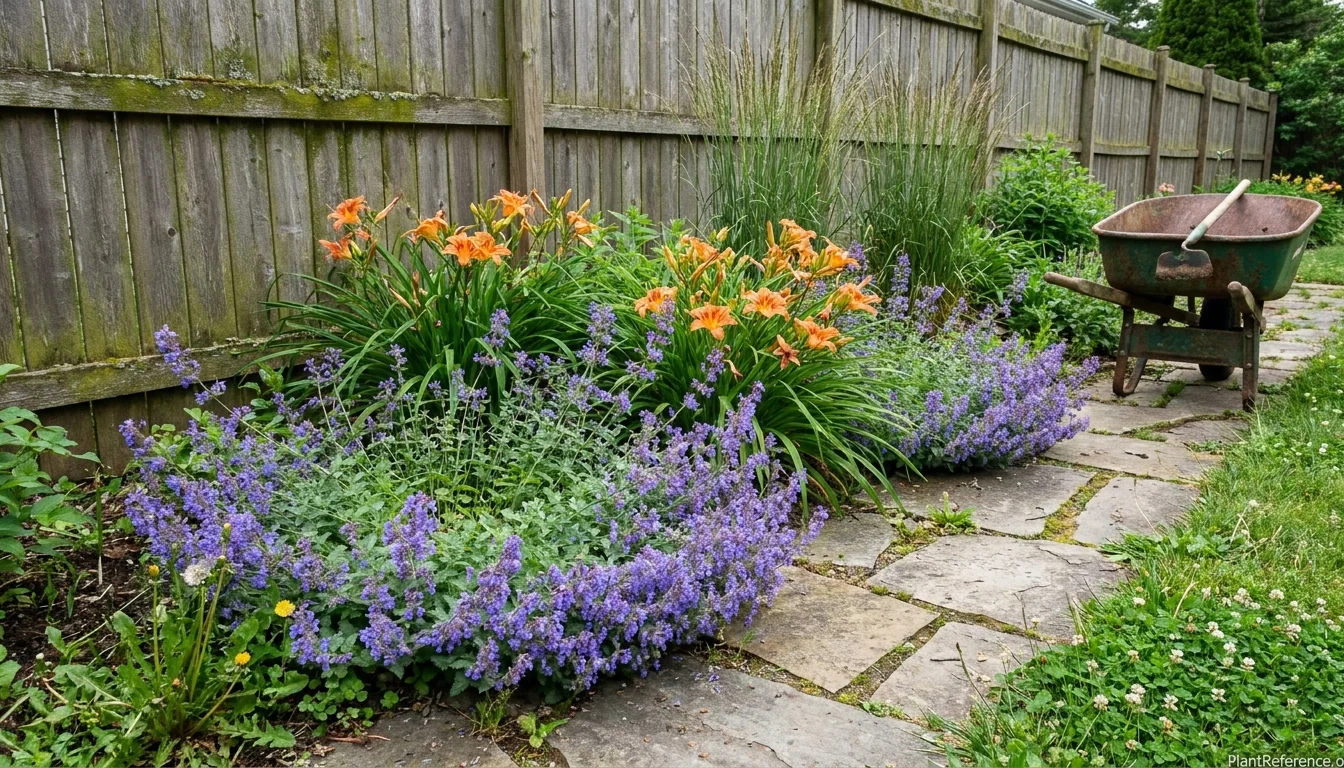
— Image © PlantReference.org 2026
The best perennial companion planting combinations are decided underground, not on a colour wheel. I have pulled out more good-looking plant pairings than I can count because one half of the pair was drowning while the other was fine — and no amount of design sense fixes a plant sitting in the wrong soil. Get the growing conditions matched, and the visual work becomes surprisingly easy.
Why Most Perennial Combinations Fail
Walk past a struggling border in August and you can usually diagnose it from the sidewalk. Half the plants look right and half look tired. That is almost never a design failure — it is a moisture or light mismatch that took two seasons to show itself.
🌿Lavandula angustifolia (lav-AN-dew-la an-gus-tih-FOH-lee-a) wants sharp drainage and full sun. Astilbe chinensis wants consistent moisture and afternoon shade. Put them 18 inches apart because the flower colours worked in a catalogue photo, and one of them is going to lose. Usually the lavender, and usually to root rot — the pattern described in Why Your Lavender Died and How to Prevent It Next Time.
Mismatched water needs — the single most common cause of a failed pairing
Mismatched light, especially when a young tree matures over five years
Aggressive spreaders swamping slower clump-formers within two seasons
Everything peaking in June, leaving August and September blank
Uniform leaf texture, which makes a bed read flat even in full bloom
Match Conditions First, Colour Second
Before pairing anything, sort your beds into cultural groups. Dry and sunny. Average and sunny. Moist and shaded. Most gardens have all three, sometimes within twenty feet.
Then apply three design rules in order. Height layering — tallest at the back or centre, mid-height through the middle, low edgers at the front. Foliage contrast — bold against fine, blue-green against chartreuse. Bloom succession — no two neighbours peaking in the same fortnight if you can help it.
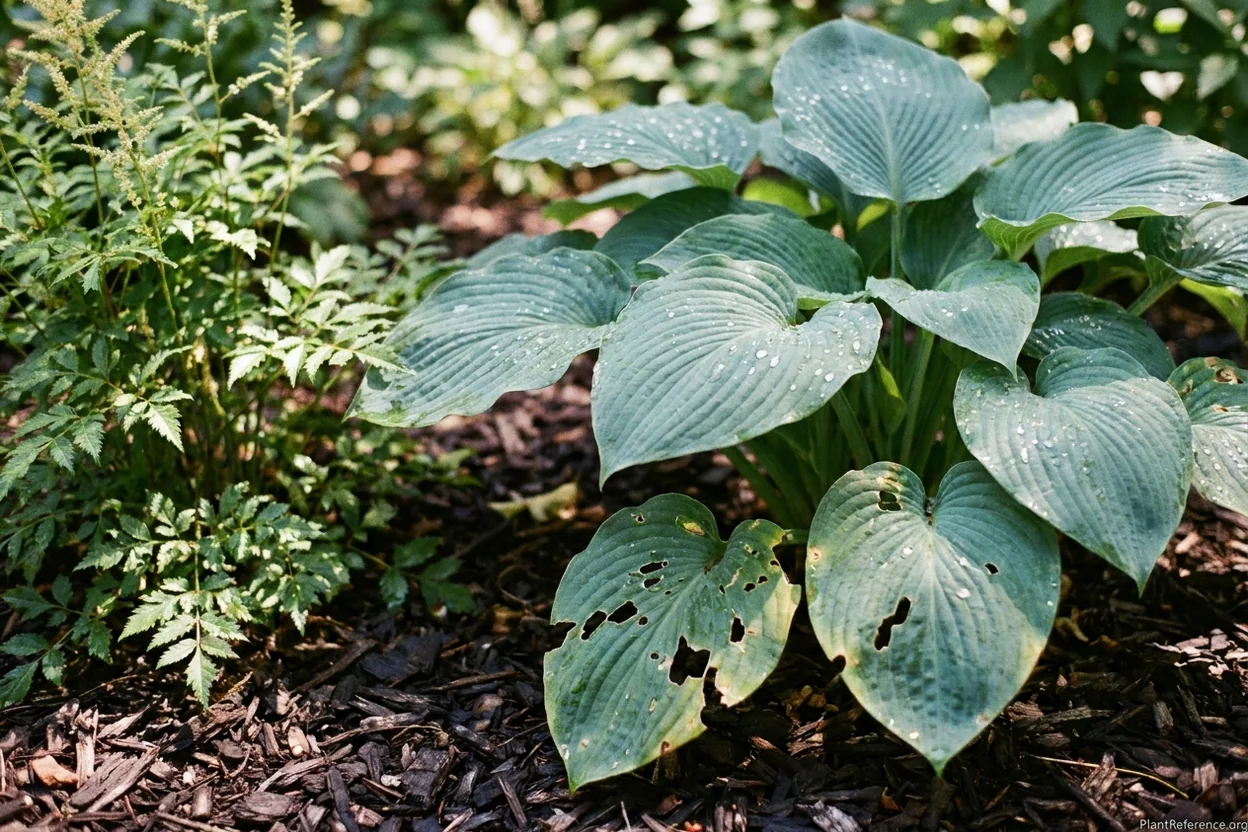
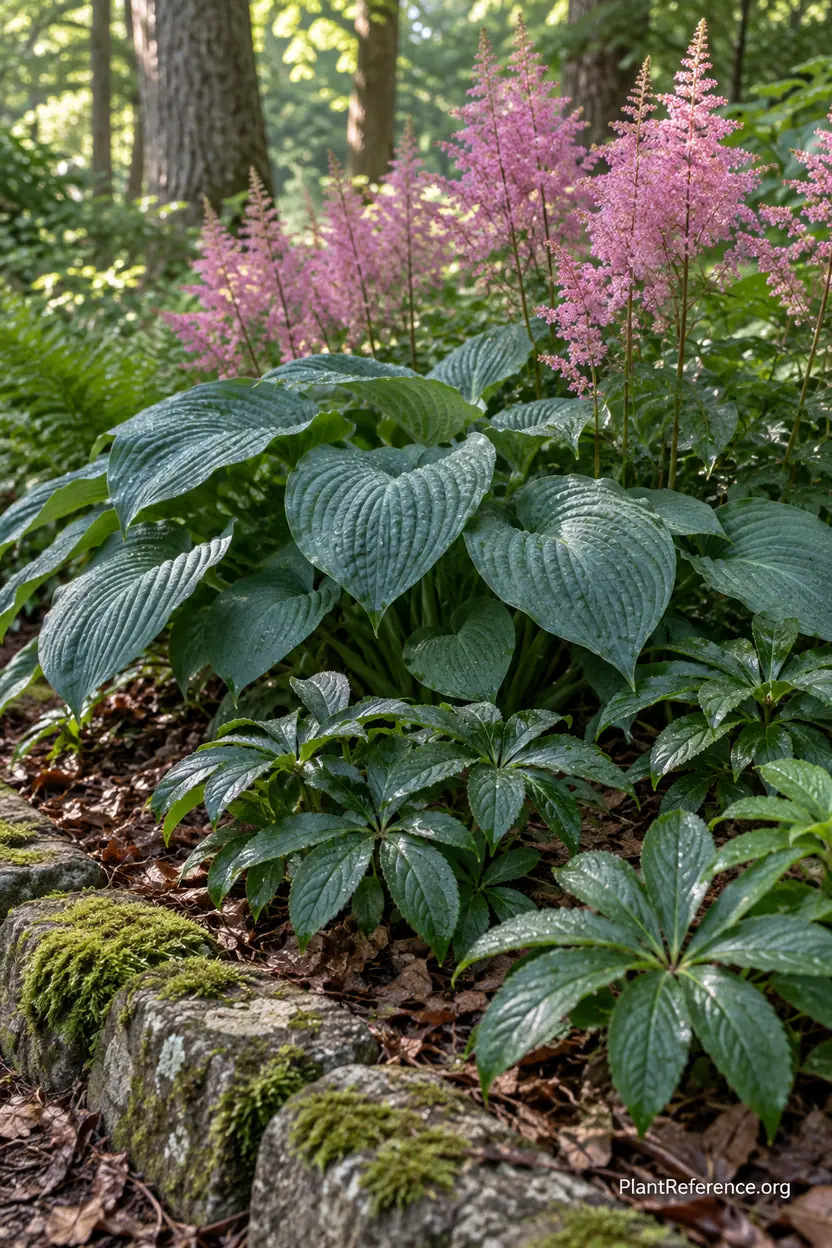
Foliage matters more than most people expect. A border spends maybe eight weeks in serious bloom and the rest of the season being looked at anyway. The pairing of a corrugated hosta leaf against a lacy fern frond works in July when neither is flowering, which is exactly the point.
Spring Combinations
Spring is the easiest season to combine because so little is competing for attention. The trick is planning for what the bed looks like in late June when the spring bulbs have collapsed.
For sun: 🌿Paeonia lactiflora 'Festiva Maxima' with 🌿Iris germanica and 🌿Alchemilla mollis. The peony carries the weight, bearded iris adds vertical structure a fortnight earlier, and lady's mantle spills over the front edge hiding the base of both. All three want the same thing — full sun, decent drainage, no standing water.
For the bulb problem: 🌿Hemerocallis 'Stella de Oro' planted through 🌿Narcissus spp. drifts. Daylily foliage rises exactly as daffodil leaves start yellowing, and hides them completely while they finish feeding the bulb. Hostas do the same job in shade. It is the most useful trick in perennial gardening and costs nothing.
For early colour: 🌿Phlox subulata and 🌿Iberis sempervirens along a wall edge, with Allium 'Purple Sensation' rising through them. Creeping phlox and candytuft both want lean, well-drained soil and full sun, so they are genuinely compatible rather than just simultaneous.
If your peonies are in the mix and refusing to cooperate, Why Your Peonies Won't Bloom: The 5 Most Common Causes covers the usual culprits. Iris in a mixed planting will need lifting every three or four years — see How to Divide Irises Without Killing Them.
Early Summer Combinations
This is where borders either hold together or fall apart, because the June flush ends abruptly.
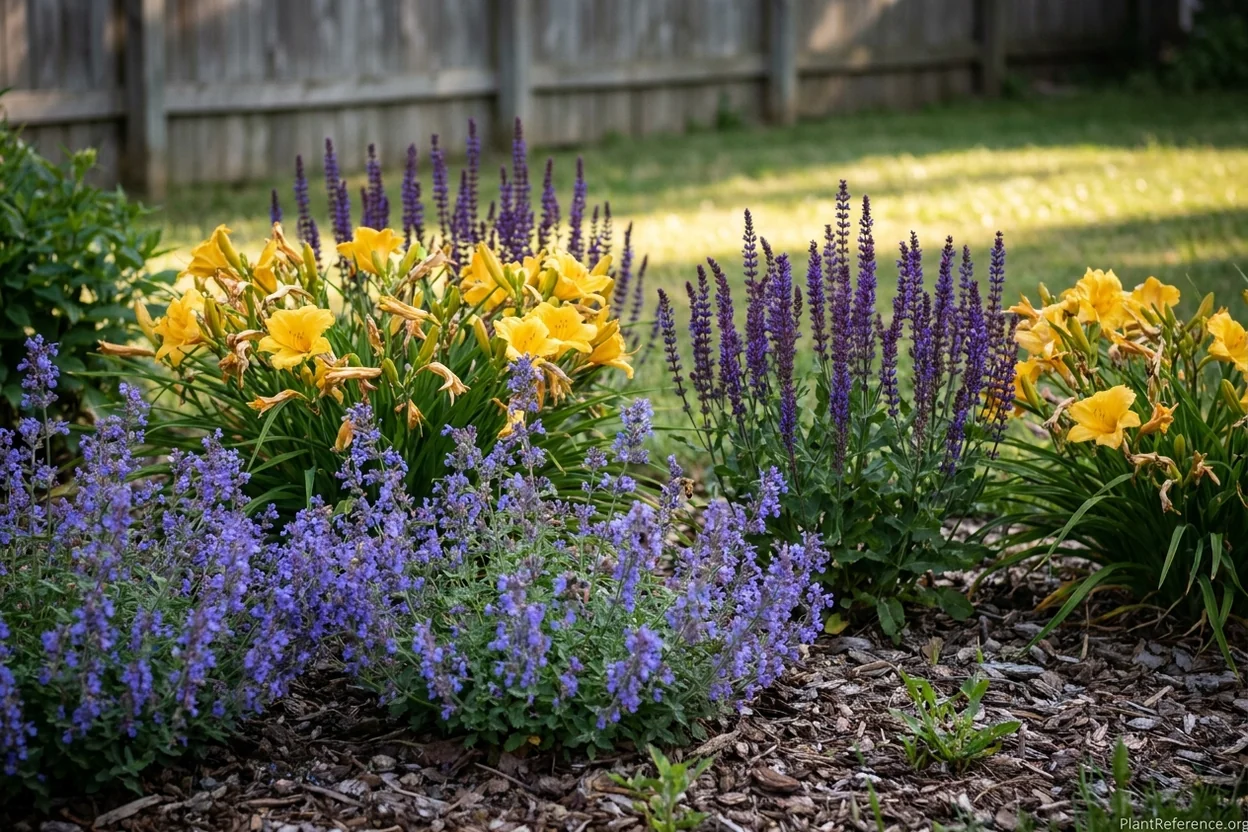
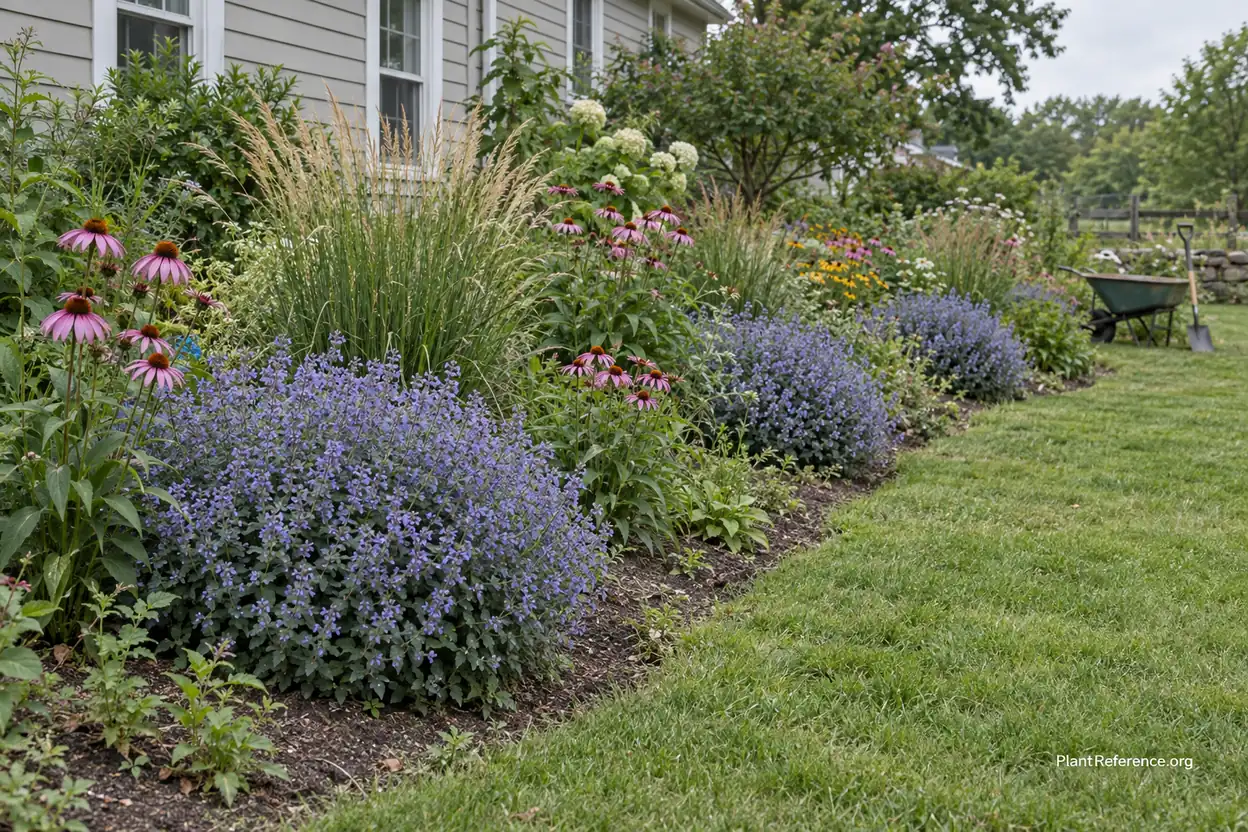
The reliable one: Nepeta 'Walker's Low' with 🌿Hemerocallis 'Stella de Oro' and 🌿Salvia nemorosa 'May Night'. Catmint blooms first and keeps going after a shear, salvia gives you dark violet spikes against the daylily's gold, and all three tolerate dry spells once established. This combination is close to bulletproof in Zone 5-7 and it is deer-resistant into the bargain.
For a damp spot: 🌿Iris sibirica 'Caesar's Brother' with 🌿Astilbe chinensis 'Visions' and 🌿Alchemilla mollis. Siberian iris handles moisture that would rot a bearded iris, and its grassy foliage stays presentable long after bloom — which is more than bearded iris manages.
For a hot, dry bank: 🌿Lavandula angustifolia 'Munstead' with 🌿Achillea millefolium and 🌿Perovskia atriplicifolia. Everything here wants poor soil and sharp drainage. Do not improve the bed. Do not mulch heavily against the crowns.
Season | Combination | Conditions | Why It Works |
|---|---|---|---|
Spring | 🌿Paeonia lactiflora 'Festiva Maxima' + 🌿Iris germanica + 🌿Alchemilla mollis | Full sun, sharp drainage | Vertical, mounded and spilling forms in one shared bed |
Early summer | Nepeta 'Walker's Low' + 🌿Hemerocallis 'Stella de Oro' + 🌿Salvia nemorosa 'May Night' | Full sun, average to dry | Long overlapping bloom, all deer-resistant |
Early summer | 🌿Iris sibirica 'Caesar's Brother' + 🌿Astilbe chinensis 'Visions' | Part sun, consistent moisture | Grassy and feathery textures hold after bloom |
Late summer | 🌿Echinacea purpurea 'Magnus' + 🌿Rudbeckia fulgida 'Goldsturm' + 🌿Panicum virgatum 'Shenandoah' | Full sun, average soil | Prairie group; seed heads carry into winter |
Fall | Sedum 'Autumn Joy' + 🌿Symphyotrichum novae-angliae + Anemone x hybrida 'Honorine Jobert' | Full to part sun | Extends the border six weeks past the summer peak |
Shade | Hosta 'Halcyon' + 🌿Astilbe chinensis 'Visions' + 🌿Helleborus orientalis | Shade, moist and rich | Three distinct leaf shapes; interest without much flower |
Late Summer Combinations
August is where amateur borders go quiet and good ones do not. The answer is the North American prairie palette, which evolved to peak exactly now.
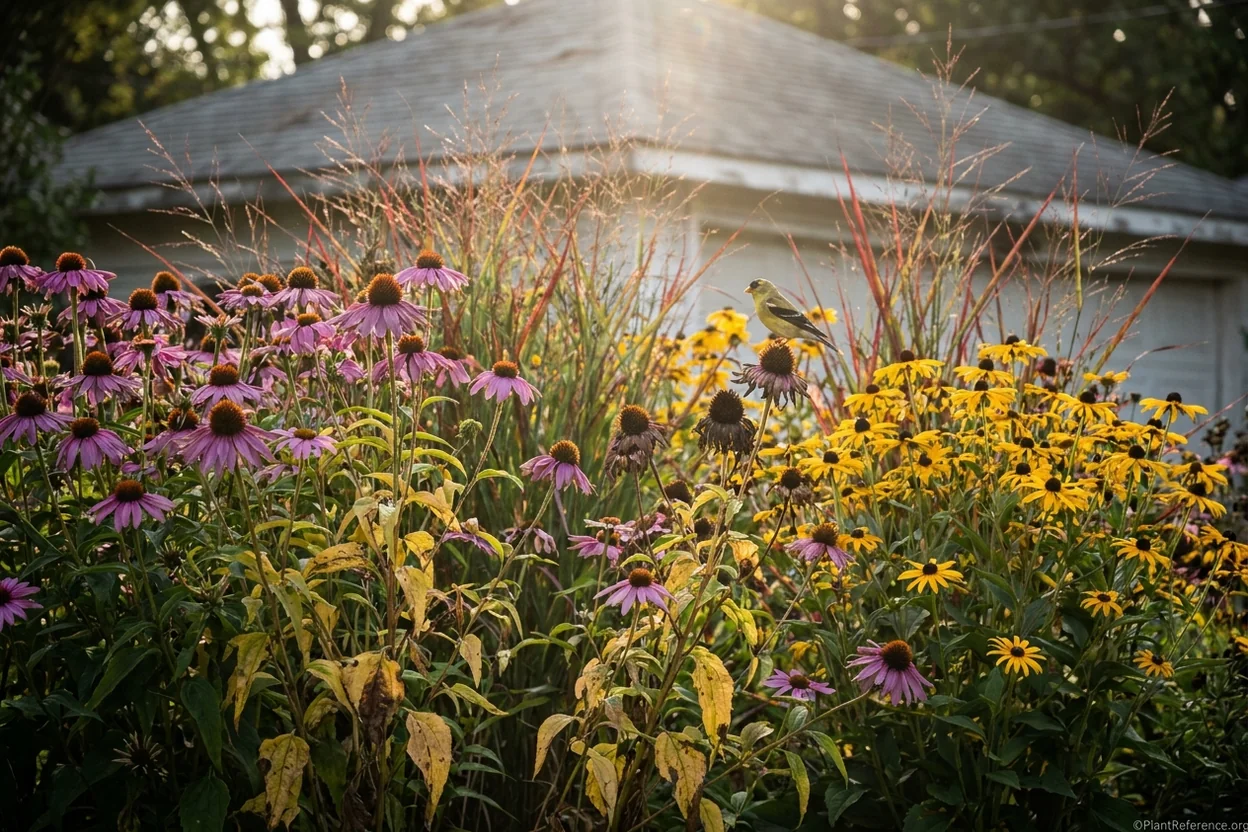
The workhorse group: 🌿Echinacea purpurea 'Magnus' with 🌿Rudbeckia fulgida 'Goldsturm' and 🌿Panicum virgatum 'Shenandoah'. Purple, gold, and the red-tipped upright grass behind them. All three want full sun and average soil, all three resent being fussed over, and all three leave seed heads worth keeping through winter.
For pollinators: add 🌿Monarda didyma 'Jacob Cline' to that group, or substitute it for the rudbeckia. Bee balm plus coneflower is the pairing that brings hummingbirds and butterflies to the same square metre. Give 🌿Monarda didyma 'Jacob Cline' air movement — crowded bee balm gets powdery mildew every time.
For structure: 🌿Perovskia atriplicifolia behind Sedum 'Autumn Joy'. Russian sage goes hazy blue-grey while the sedum heads are still green, then the sedum turns pink as the perovskia fades. Two plants, six weeks of continuous change, no deadheading.
Daylilies flowering poorly in a crowded late-summer bed are usually overdue for division rather than short of anything — Why Your Daylilies Stopped Blooming (And How to Fix It) explains the timing.
Fall Combinations
New England gives you six good weeks after Labor Day and most gardens waste them.
The classic: Sedum 'Autumn Joy' with 🌿Symphyotrichum novae-angliae and ornamental grasses. New England aster brings violet at a point in the season when almost nothing else does, and it is genuinely native — the pollinator traffic in late September is worth the space on its own.
For shade edges: Anemone x hybrida 'Honorine Jobert' with Hosta 'Halcyon'. Japanese anemone throws white flowers on wiry three-foot stems above hosta foliage that is still holding, right through to first frost.
Pinch New England aster back by half in early June or it will reach four feet and flop. That single cut is the difference between a self-supporting plant and a staking job.
When the season ends, resist the urge to level everything. Most of these plants are worth leaving standing — the sorting is in When to Cut Back Perennials in Fall (And What to Leave), and Deer-Resistant Perennials: A Zone-by-Zone Planting Guide covers which of them browsing deer will leave alone over winter.
Shade Combinations That Hold Up
Shade planting is a foliage problem with occasional flowers, and once you accept that it gets much easier.
The standard trio: Hosta 'Halcyon' with 🌿Astilbe chinensis 'Visions' and 🌿Helleborus orientalis. Broad blue leaves, fine feathery plumes, and leathery evergreen hellebore foliage that carries the group through winter. All three want moisture-retentive soil with real organic matter in it.
For dry shade — under mature maples, where most things fail — Epimedium x rubrum with 🌿Dryopteris erythrosora and 🌿Brunnera macrophylla. Nothing here will look lush, but all three survive root competition that kills hostas outright.
The catch with any hosta-based combination is slugs. Damp shade is exactly what they want, and a chewed hosta ruins the texture contrast the whole planting depends on — How to Get Rid of Slugs on Hostas: What Works is the practical version, and How to Grow Hostas: Varieties, Care & Pest Solutions covers cultivar choice, since thicker-substance blue hostas take noticeably less damage.
Making the Sequence Work Across a Whole Season
A combination is not the same as a border. Once you have pairings that work, you have to distribute them so the flowering moves through the bed rather than lighting up one corner in June and going dark.
Repeat one plant every 3 to 4 metres (10-13 feet) to tie the border together visually
Plant in odd-numbered groups of three or five, not single specimens
Keep at least one late-season group in every sightline you actually use
Leave 18 to 24 inches (45-60 cm) between mature clumps — crowding causes mildew
Interplant spring bulbs under summer-emerging perennials, never beside them
Plant in autumn where you can. Roots establish while soil is still warm, and combinations settle in together rather than one plant getting a year's head start on its neighbour. The whole-border approach is laid out in Plan a Perennial Garden That Blooms Spring to Fall, and when clumps outgrow their spacing in three or four years, How to Divide Perennials: A Species-by-Species Guide and How to Grow Daylilies: The Complete Guide to Division cover the resets.
One last note. Give a new combination two full seasons before you judge it. Perennials spend year one on roots, and a pairing that looks thin and awkward in its first July is usually the same pairing that looks inevitable by its third.
Frequently Asked Questions
Reading about plants and recognising them are different skills. These three build the second.
- Daily PlantIdentify the day’s mystery plant from a close-up photograph.
- Keyed OutWork a dichotomous key, lead by lead, to name a hidden specimen.
- Name That PlantName a specimen from botanical clues dealt hardest first.
Free to play, no account needed
Tagged with
Kevin is a landscape contractor in the Boston area who specializes in cold-climate perennial gardens and hardscaping. He studied landscape design and worked at a prominent nursery on the North Shore before starting his own design-build firm. Kevin's gardens are built to handle New England weather—freeze-thaw cycles, nor'easters, late springs, and heavy snow loads. He's particularly interested in native perennials and shrubs that provide four-season interest without constant maintenance. Kevin writes about cold-hardy plant selection, winter garden structure, and building landscapes that look good even in February.