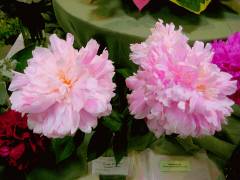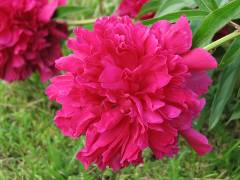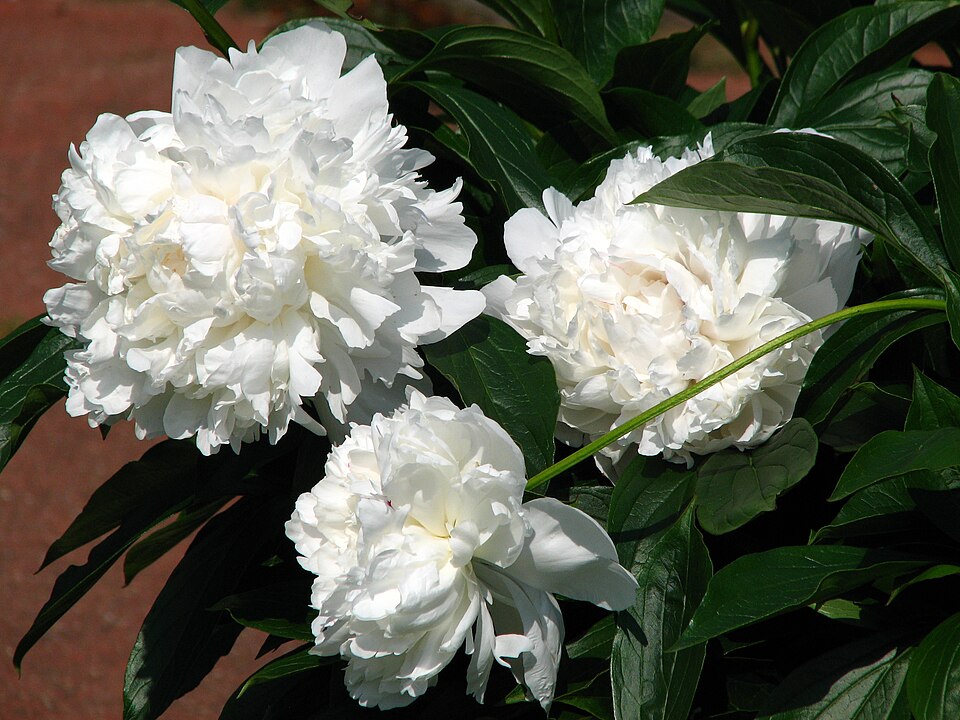
Paeonia, Genus, lactiflora, Species, 'Festiva Maxima', Cultivar,
- Genus & species
- Cultivar
Festiva maxima peony
Overview
Paeonia lactiflora 'Festiva Maxima' is a herbaceous perennial reaching 30-36 inches (75-90 cm) tall with a spread of 30-36 inches (75-90 cm). Stems are sturdy but may require support when flowers are fully open and rain-soaked. Leaves are compound, biternate, with glossy dark green leaflets 3-5 inches (8-13 cm) long that emerge with a reddish tinge in early spring. Flowers are fully double, 5-7 inches (13-18 cm) across, white with irregular crimson flecks concentrated at the base of the inner petals. The fragrance is strong and sweet-rose scented. Each stem produces one terminal flower and occasionally 1-2 lateral buds. Bloom occurs over a 2-3 week period in late May to early June in zones 5-7. Foliage remains green through summer, turning bronze to yellow-brown in October before dying back. Growth is slow to moderate; plants reach mature size in 3-4 years from a bare-root division with 3-5 eyes. The root system consists of thick, fleshy tuberous roots extending 12-18 inches (30-45 cm) deep. Plants are long-lived, persisting for 50 years or more in undisturbed sites. Botrytis blight (Botrytis paeoniae) causes bud blast and stem dieback in wet, cool springs, particularly in crowded plantings with limited air circulation. This cultivar was introduced in 1851 by Auguste Miellez in Lille, France.
Native Range
Paeonia lactiflora is native to central and eastern Asia, occurring across northern China, Mongolia, eastern Siberia, and the Korean Peninsula. The species grows in meadows, open scrubland, and forest margins at elevations of 1,500-7,500 feet (460-2,300 m) on well-drained, humus-rich soils.Suggested Uses
Commonly planted in perennial borders and cutting gardens at 30-36 inch (75-90 cm) spacing to allow air circulation. Performs as a hedge-like mass planting when spaced at 24 inches (60 cm), though closer spacing increases botrytis risk. Root competition from nearby trees and shrubs reduces flowering; a minimum clearance of 36 inches (90 cm) from woody root zones is typical.How to Identify
Appearance
Size & Dimensions
Height2'6" - 3'
Width/Spread2'6" - 3'
Bloom Information
Bloom occurs in late May to early June in zones 5-7. In zones 3-4, bloom shifts to mid-June. In zone 8, bloom begins in early May but flowers persist for a shorter period due to heat. Individual flowers last 7-10 days; total bloom period per plant is 2-3 weeks. Cut flowers last 5-7 days in water.
Detailed Descriptions
Flower Description
White with crimson flecksFoliage Description
Glossy dark green, emerging with reddish tingeGrowing Conditions
Sun Requirements
Requires 6-10 hours of direct sunlight daily
• Full Sun: 6+ hours of direct sunlight
• Partial Shade: 3-6 hours of direct sunlight
• Full Shade: Less than 3 hours of direct sunlight
Care & Maintenance
Care Guide
Tuberous roots are positioned with eyes 1-2 inches (2.5-5 cm) below the soil surface at planting; deeper placement reduces flowering. Water deeply once per week during active growth from spring through bloom; reduce watering after bloom as foliage matures. Botrytis blight develops on buds and stems during wet, cool springs; spores overwinter on debris left at the base of plants. Ants crawling on flower buds feed on nectar secreted by the buds and do not damage the plant. Annual application of 1-2 inches (2.5-5 cm) of compost in late fall around the drip line replenishes soil organic matter. Peony ring supports installed in early spring prevent stems from splaying when flowers are rain-soaked.Pruning
Cut all stems to ground level in late fall after frost has killed the foliage, and remove all debris from the base of the plant to reduce overwintering disease spores. Disbudding lateral buds in spring, leaving only the terminal bud per stem, increases terminal flower size by approximately 20-30%. Spent flowers are removed promptly after petals drop to prevent seed formation.Pruning Schedule
Prune: October–November
fall
Container Growing
Suitable for container growing
Minimum container size: 10 gallons