Image 1 of 12
1 / 12
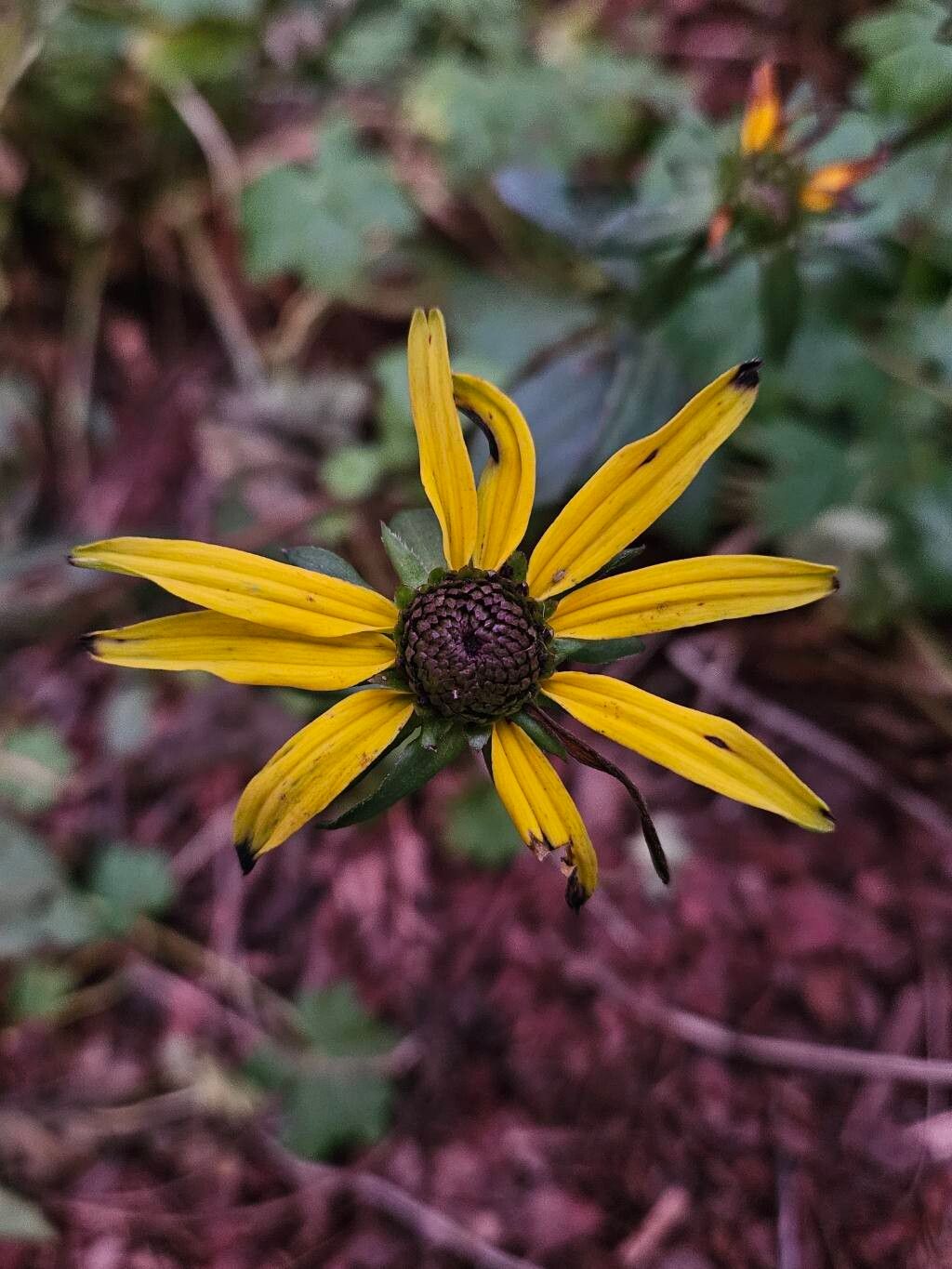
Species photo — your cultivar may vary
© CawVus, some rights reserved (CC-BY-SA) · GBIF
Rudbeckia, Genus, fulgida, Species, 'Goldsturm', Cultivar,
- Genus & species
- Cultivar
Goldsturm Black-Eyed Susan
Overview
Rudbeckia fulgida 'Goldsturm' is a clump-forming herbaceous perennial reaching 24-30 inches (60-75 cm) tall and 18-24 inches (45-60 cm) wide. Stems are stiff, branched in the upper third, with rough-hairy texture. Basal leaves are 4-6 inches (10-15 cm) long, ovate to lance-shaped, with serrated margins and rough surfaces. Stem leaves are smaller, 2-4 inches (5-10 cm), and clasp the stem. Daisy-form flowers are 3-4 inches (7.5-10 cm) across, with golden-yellow ray petals surrounding a dark brown to black domed disk. Flowers form on terminal stems and branches, opening in succession over 6-8 weeks from late July through September in zones 4-7, and from June into October in zones 8-9. Stems are sturdy and resist flopping in unstaked plantings. Spreads by short rhizomes 2-4 inches (5-10 cm) per year and by self-seeding when seedheads are left intact. Seedheads of black domes persist on stiff stems through winter, then break down in late winter rains. Septoria leaf spot causes black blotches and lower-leaf yellowing in humid summers, particularly when overhead irrigation is used. Selected in Germany in the 1930s, this cultivar is more uniform in habit and flower size than seed-grown R. fulgida.
Native Range
The species Rudbeckia fulgida is native to eastern and central North America from southern Ontario west to Iowa, south to Florida and Texas, growing in moist meadows, woodland edges, and prairie margins from sea level to 3,000 feet (900 m) elevation. The cultivar 'Goldsturm' is a selection made by Karl Foerster from material grown at the Czech botanical garden in the 1930s.Suggested Uses
Used in perennial borders, prairie-style plantings, mass plantings, and pollinator gardens spaced 18-24 inches (45-60 cm) apart. Self-seeding habit suits informal and meadow plantings but produces volunteer seedlings in formal gardens. Grows in containers of at least 5 gallons (19 L) with adequate drainage; container plants tend to be shorter-lived than ground specimens.How to Identify
Appearance
Size & Dimensions
Height2' - 2'6"
Width/Spread1'6" - 2'
Bloom Information
Late July through September in zones 4-7; June through October in zones 8-9. Individual flowers last 10-14 days; total bloom period extends 6-8 weeks. Deadheading extends bloom by 2-3 weeks; seedheads left intact persist through winter and self-seed.
Detailed Descriptions
Flower Description
Golden-yellow with dark brown to black centerFoliage Description
Dark greenGrowing Conditions
Sun Requirements
Requires 6-10 hours of direct sunlight daily
• Full Sun: 6+ hours of direct sunlight
• Partial Shade: 3-6 hours of direct sunlight
• Full Shade: Less than 3 hours of direct sunlight
Care & Maintenance
Care Guide
Water weekly during the first growing season, with 5-8 gallons (19-30 L) per session in the absence of rain. Established plants tolerate 2-3 weeks without rain but flower production decreases during prolonged drought, especially in zones 7-9 with reflected heat. Septoria leaf spot causes black blotches and yellowing on lower leaves in humid summers; reducing overhead irrigation and improving air circulation reduces severity. Divide every 3-4 years in spring as the clump expands and the center thins; smaller divisions of 3-5 stems each replant readily. Self-seeding produces 10-30 volunteer seedlings per plant annually if seedheads are left intact through winter. Mulch 2-3 inches (5-7.5 cm) deep retains soil moisture; mulch pulled back from the crown in spring reduces crown rot in heavy soils.Pruning
Cut stems to 2-3 inches (5-7.5 cm) above ground level in late winter or early spring before new growth emerges; stems left through winter provide stiff support for snow and seedheads for birds. Deadhead spent flowers to extend bloom by 2-3 weeks and reduce self-seeding. Yellowing lower leaves caused by Septoria leaf spot can be removed mid-season; removal does not affect plant health. Divide in spring every 3-4 years when bloom decreases.Pruning Schedule
Prune: February–March
winterearly spring
Container Growing
Suitable for container growing
Minimum container size: 5 gallons
Toxicity
Non-toxicRelated Rudbeckia species
 Large black-eyed susanRudbeckia hirta
 Black-eyed susanRudbeckia fulgida var. sullivantii 'Goldsturm'
 Deams black-eyed susanRudbeckia fulgida var. deamii
 Little suzy black-eyed susanRudbeckia fulgida var. speciosa 'Viette's Little Suzy'
 Indian summer black-eyed susanRudbeckia hirta 'Indian Summer'
 Brown-eyed susanRudbeckia triloba