Rudbeckia, Genus, fulgida, Species, var., Variety, sullivantii, Variety, 'Goldsturm', Cultivar,
- Genus & species
- Variety
- Cultivar
black-eyed susan
Eastern and central United States (Ohio, West Virginia, Kentucky and adjacent states); cultivar selected in Germany before 1937
Overview
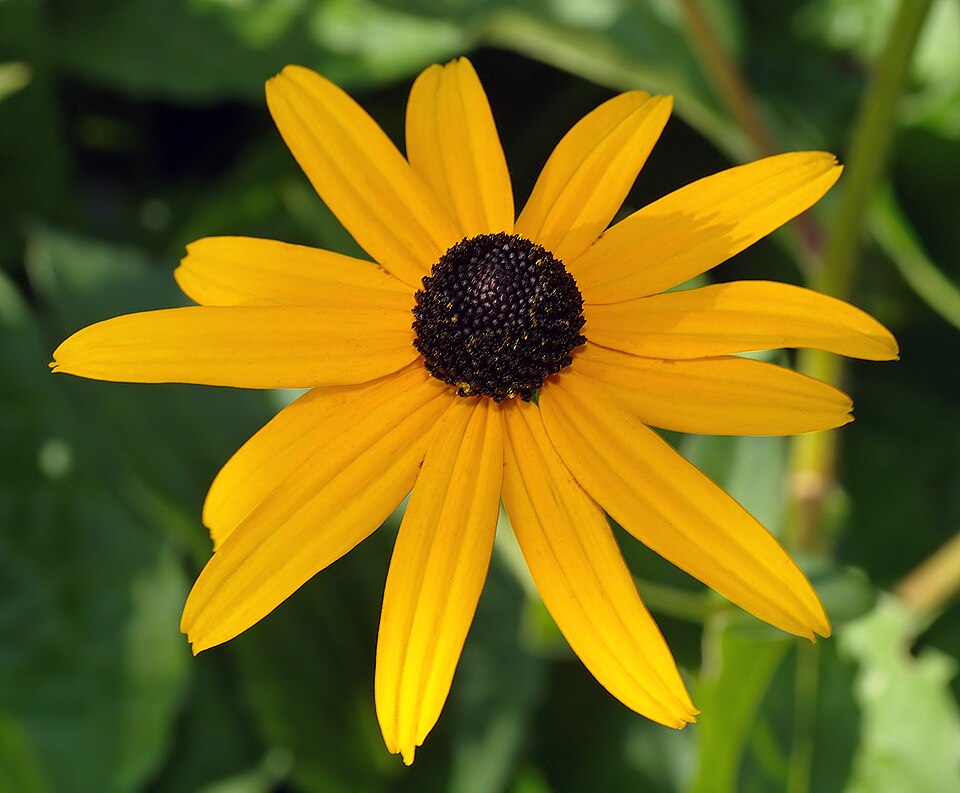
Rudbeckia fulgida var. sullivantii 'Goldsturm' is a compact clump-forming herbaceous perennial in the family Asteraceae, reaching 18–24 inches (45–60 cm) tall and 18–24 inches (45–60 cm) wide. The cultivar was selected in Germany before 1937 and named by K. Kayser — 'Goldsturm' translates as 'gold storm' — and received the Perennial Plant Association's Perennial Plant of the Year award in 1999, a designation given to one cultivar per year for consistent garden performance across a wide range of North American climates. The parent taxon R. fulgida var. sullivantii is native to moist meadows and open woodlands of the eastern and central United States. Plants form neat well-branched mounds of rough-textured lance-shaped to ovate basal leaves 3–5 inches (8–13 cm) long in dark green. From late July through September or October, the plant is covered in daisy-like flower heads 2.5–3.5 inches (6–9 cm) across: 12–18 bright golden-yellow ray florets surround a prominent dome-shaped brown-to-black disc 0.5–0.75 inch (13–19 mm) across. Flower production is heavier than the parent species and the habit is more compact and uniform — the principal reasons for the cultivar's horticultural persistence. Persistent seed heads on old flowering stems remain on the plant through autumn and winter and are fed on by goldfinches, chickadees, and other seed-eating songbirds. Not known to be toxic to pets or humans.
Native Range
Rudbeckia fulgida var. sullivantii is native to the moist meadows, open woodlands, and stream banks of the eastern and central United States — including Ohio, West Virginia, Kentucky, and adjacent states. 'Goldsturm' was selected from this wild variety in Germany before 1937 by K. Kayser.Suggested Uses
Used in mixed perennial borders, naturalized meadow plantings, native plant gardens, and cutting gardens at 18–24 inch (45–60 cm) spacing. The 10–12 week late-summer bloom window makes the cultivar a reliable color anchor in the late-summer palette where most perennials have finished their main bloom. Pairing with ornamental grasses such as Panicum virgatum 'Shenandoah' or Calamagrostis × acutiflora 'Karl Foerster', with purple asters such as Symphyotrichum novae-angliae 'Purple Dome', or with Echinacea purpurea in the late-summer composition carries the well-established North American meadow-garden palette through September and October. Cut flower stems hold 7–10 days in water. The cultivar does not grow well in heavy deep shade, waterlogged soils, or exposed high-wind sites where rainfall is unreliable.How to Identify
Appearance
Size & Dimensions
Height1'6" - 2'
Width/Spread1'6" - 2'
Bloom Information
Daisy-like flower heads 2.5–3.5 inches (6–9 cm) across with 12–18 bright golden-yellow ray florets surrounding a prominent dome-shaped brown-to-black disc 0.5–0.75 inch (13–19 mm) across appear from late July through September or October in USDA zones 3–9 over a 10–12 week bloom window. In the Pacific Northwest, bloom runs reliably from late July until mid-October, contributing golden color to the late-summer and early-fall perennial border alongside ornamental grasses and asters. Deadheading is optional: removing spent heads extends the bloom by 1–2 weeks; leaving them produces persistent seed heads that feed goldfinches and chickadees through autumn and winter.
Detailed Descriptions
Flower Description
Bright golden-yellow ray florets (12-18 per head) surrounding prominent dome-shaped brown-to-black disc 0.5-0.75 inch across; daisy-like flower heads 2.5-3.5 inches across; late July through September or OctoberFoliage Description
Dark green; simple, alternate, lance-shaped to ovate, 3-5 inches long, rough-texturedGrowing Conditions
Sun Requirements
Requires 4-8 hours of direct sunlight daily
• Full Sun: 6+ hours of direct sunlight
• Partial Shade: 3-6 hours of direct sunlight
• Full Shade: Less than 3 hours of direct sunlight
Care & Maintenance
Care Guide
Grow in full sun to partial shade with 4 or more hours of direct light in average well-drained to moist loam, clay, or sandy loam at pH 5.5–7.0. The cultivar tolerates clay soils and temporary drought once established in its second growing season, though plants run more vigorously and flower more heavily with moderate consistent moisture than with extended drought. Brief drought stress produces premature wilting but plants recover quickly once watered. Division every 3–4 years in early spring is the principal maintenance operation — the clump center begins to die out around year 4 and dividing preserves plant vigor. Staking is not required; stems are sturdy enough to stand at full height without support. Pest and disease pressure runs very low across most growing conditions, which contributes to the cultivar's long-term garden persistence.Pruning
Leave seed heads intact through fall and winter to feed goldfinches and chickadees and to provide structural interest in the dormant-season border. Cut all stems to 3–4 inches (8–10 cm) above ground in late winter (February–March) before new growth begins. Divide every 3–4 growing seasons in early spring: lift the clump, discard the woody center, and replant vigorous outer sections at 18–24 inch (45–60 cm) spacing to reestablish the colony.Pruning Schedule
Prune: February–March
early spring
Toxicity
Non-toxicRelated Rudbeckia species
 Large black-eyed susanRudbeckia hirta
 Deams black-eyed susanRudbeckia fulgida var. deamii
 Little suzy black-eyed susanRudbeckia fulgida var. speciosa 'Viette's Little Suzy'
 Indian summer black-eyed susanRudbeckia hirta 'Indian Summer'
 Brown-eyed susanRudbeckia triloba
 American gold rush black-eyed susanRudbeckia × 'American Gold Rush'