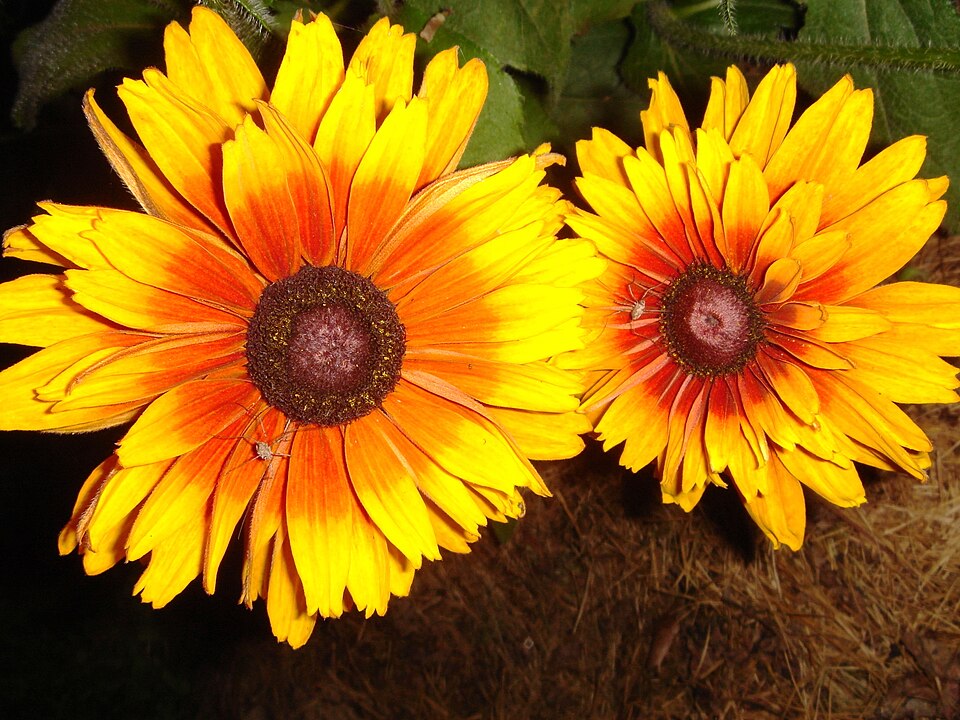
Rudbeckia, Genus, hirta, Species, 'Prairie Sun', Cultivar,
- Genus & species
- Cultivar
prairie sun rudbeckia
Central and eastern North America (species range)
Overview
Rudbeckia hirta 'Prairie Sun' is a short-lived perennial or biennial gloriosa daisy reaching 30-36 inches (76-91 cm) tall and 18-24 inches (45-60 cm) wide. Stems are stiff, erect, and branched in the upper third, covered in coarse white hairs. Lance-shaped basal leaves are 4-6 inches (10-15 cm) long, hairy, and mid-green; stem leaves reduce in size up the stem. Flowers are 4-5 inches (10-13 cm) across, with golden-orange petal tips fading to lemon-yellow at the base of each ray, surrounding a domed, light green center disk; this disk does not turn dark brown as in many R. hirta cultivars. Bloom occurs late June through first frost; deadheading prolongs flowering. Plants behave as annuals in zones 3-4 and as short-lived perennials (2-3 years) in zones 5-9. Self-seeding is moderate; volunteer seedlings often revert to species-type form with brown disks. Powdery mildew develops on lower leaves in late summer and may cause early leaf drop. Slugs feed on emerging spring growth in damp gardens; aphids may colonize flower buds.
Native Range
Rudbeckia hirta is native to central and eastern North America, ranging from the Great Plains east to the Atlantic coast and from southern Canada south to northern Mexico. It grows in prairies, open woodlands, fields, and roadsides on a range of soils. 'Prairie Sun' is a 2003 All-America Selections winner derived from R. hirta breeding.Suggested Uses
Used in mid-border perennial plantings, cutting gardens, and naturalistic prairie plantings at 18-24 inch (45-60 cm) spacing. Long stems make it suitable for cut-flower production; vase life averages 7-10 days when stems are cut early in the morning. Container culture is feasible in 3-gallon (11 L) or larger pots; plants typically reseed themselves but seedlings may revert to species coloration.How to Identify
Appearance
Size & Dimensions
Height2'6" - 3'
Width/Spread1'6" - 2'
Bloom Information
Late June through first frost in zones 5-7, mid June through October in zones 8-9, and early July through first frost in zones 3-4. Individual flowers last 2-3 weeks; deadheading triggers continuous bud production through the growing season. Plants started indoors in late winter flower the same year as a 12-week summer annual; outdoor sowings flower in their second year.
Detailed Descriptions
Flower Description
golden-orange petal tips fading to lemon-yellow with a light green domed center diskFoliage Description
mid-green; hairyGrowing Conditions
Sun Requirements
Requires 6-10 hours of direct sunlight daily
• Full Sun: 6+ hours of direct sunlight
• Partial Shade: 3-6 hours of direct sunlight
• Full Shade: Less than 3 hours of direct sunlight
Care & Maintenance
Care Guide
Seeds are surface-sown indoors 6-8 weeks before last frost or direct-sown in late spring after soil reaches 70°F (21°C); germination takes 7-14 days at 70-75°F (21-24°C). Plants are spaced 18-24 inches (45-60 cm) apart in full sun. Established plants tolerate 2-3 weeks of dry soil but flower size decreases under drought. A balanced 10-10-10 fertilizer is applied at half strength once at planting; supplemental feeding is unnecessary on average garden soils. Powdery mildew appears on lower leaves in late summer; affected leaves are removed and overhead watering is reduced. Aphids may colonize flower buds in spring and are dislodged with a forceful water spray. Plants are typically replaced every 2-3 years as flowering declines.Pruning
Spent flowers are cut just below the bloom every 7-10 days to maintain continuous flowering and to reduce self-seeding. Stems are cut to ground level after the first hard frost in autumn or in early spring before new growth emerges. No structural pruning is required.Pruning Schedule
Prune: November
fall
Container Growing
Suitable for container growing
Minimum container size: 3 gallons
Toxicity
Non-toxicRelated Rudbeckia species
 Large black-eyed susanRudbeckia hirta
 Black-eyed susanRudbeckia fulgida var. sullivantii 'Goldsturm'
 Deams black-eyed susanRudbeckia fulgida var. deamii
 Little suzy black-eyed susanRudbeckia fulgida var. speciosa 'Viette's Little Suzy'
 Indian summer black-eyed susanRudbeckia hirta 'Indian Summer'
 Brown-eyed susanRudbeckia triloba