Rudbeckia, Genus, fulgida, Species, var., Variety, deamii, Variety,
- Genus & species
- Variety
Deams black-eyed susan
Central United States — primarily Indiana, Illinois, Ohio, and surrounding states; tallgrass prairie remnants, prairie-edge meadows, and forest-margin habitats.
Overview
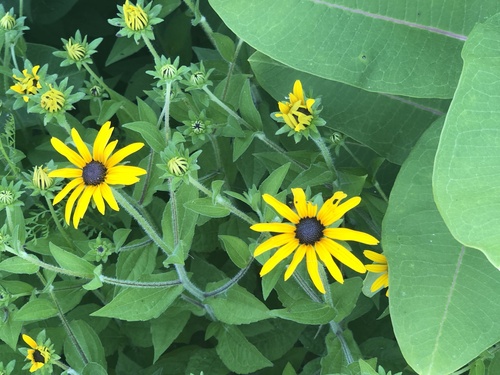
Rudbeckia fulgida var. deamii is a clumping black-eyed Susan in the daisy family (Asteraceae) named after Charles Christopher Deam (1865-1953), the Indiana state botanist who collected and described many central-United-States native plants in the early 20th century. Plants grow 24-36 inches (60-90 cm) tall and 18-24 inches (45-60 cm) wide as a clumping (non-stoloniferous) clump that expands slowly across multiple seasons rather than spreading aggressively by underground runners. Golden-yellow ray florets surround a dark brown-black central cone of disc florets in the typical Asteraceae composite flower head architecture, with the entire flower head measuring 3-4 inches (8-10 cm) across and the dark central cone giving the black-eyed Susan common-name reference. The flowers open from July through October across a 10-week active flowering window — the long bloom is one of the variety's principal garden features and produces a continuous golden-yellow display from mid-summer through the first hard frost. The principal distinction between var. deamii and the more commonly planted var. sullivantii Goldsturm (which is also a Rudbeckia fulgida cultivar) is the growth habit: var. deamii forms well-behaved clumps that expand slowly by basal-crown enlargement, while Goldsturm spreads aggressively by stolons (short underground runners that emerge from the parent plant and root at the tip to form new daughter plants) and can colonize large areas within 3-5 years of planting. The clumping habit makes var. deamii the better choice for cultivated borders where containment matters, while Goldsturm suits naturalized meadow plantings and large-scale ground-cover positions where the aggressive spread is desirable. The flowers are slightly larger and the plant is slightly taller than Goldsturm, giving var. deamii a different scale presence in the planting design. Dark green ovate rough-textured hairy leaves form a basal rosette and continue along the upright flowering stems, with the rough hairy texture deterring deer browsing because deer prefer the smoother foliage of unrelated perennials. The dark seed cones persist on standing stems through winter and supply a primary winter food source for goldfinches and other granivorous birds; cutting the stems back in fall removes this winter wildlife value, so the standard fall management leaves the stems standing through January-February for the bird-forage benefit. The cultivar tolerates clay, drought, and summer heat — the combination of tolerances that makes it useful for difficult planting positions where other perennials struggle.
Native Range
Rudbeckia fulgida var. deamii is native to the central United States, with a range concentrated in Indiana, Illinois, Ohio, and surrounding midwestern states. The variety occurs in tallgrass prairie remnants, prairie-edge meadows, oak savannas, and forest-margin habitats across the central-states native range, where the deep humus-rich tallgrass prairie soil and the moderate summer rainfall create the cultivation conditions that the variety evolved with. The variety was named after Charles Christopher Deam (1865-1953), the Indiana state botanist whose comprehensive Indiana flora documentation in the early 20th century catalogued many central-states native plants including this regional Rudbeckia variant.Suggested Uses
Used in perennial borders, prairie restoration plantings, naturalized meadow plantings, pollinator gardens, and native-plant garden plantings, with the clumping habit suiting the variety to cultivated borders where the aggressive stoloniferous spread of var. sullivantii Goldsturm would overtake neighboring perennials. The 10-week bloom window from July through October gives golden-yellow color through the late-summer-into-fall transition when many other perennials have completed their flowering; the long bloom is the variety's principal selling point relative to shorter-bloom alternatives. The persistent winter seed cones supply goldfinch food and add winter wildlife value to plantings that maintain the standing stems through January and February. The variety pairs with summer-blooming companion perennials including Echinacea purpurea, Liatris spicata, Monarda fistulosa, and warm-season ornamental grasses (Panicum virgatum, Schizachyrium scoparium) that share the prairie-and-meadow plant-community origin and the late-summer-bloom timing.How to Identify
Appearance
Size & Dimensions
Height2' - 3'
Width/Spread1'6" - 2'
Colors
Bloom Information
Golden-yellow ray florets around dark brown-black central cones open in the typical Asteraceae composite flower heads from July through October across a 10-week active flowering window. The 10-week bloom is one of the variety's principal garden features and produces a continuous golden-yellow display from mid-summer through the first hard frost. Pollination is by bees and butterflies that work the open daisy-form flower heads, with the flat composite landing platform giving multiple pollinators simultaneous access to the disc florets in the central cone. The persistent seed cones develop after the ray florets drop and supply winter food for goldfinches and other granivorous birds across the dormant season.
Detailed Descriptions
Flower Description
Golden-yellow ray florets surrounding a dark brown-black central cone of disc florets, in the typical Asteraceae composite flower head architecture; the flower heads are 3-4 inches (8-10 cm) across — slightly larger than the related variety sullivantii Goldsturm — and the dark central cone gives the black-eyed Susan common-name referenceFoliage Description
Dark green; ovate rough-textured hairy leaves arranged in a basal rosette and along the upright flowering stems, with the rough hairy texture giving the foliage its tactile and visual character distinct from the smoother foliage of related Rudbeckia speciesGrowing Conditions
Sun Requirements
Requires 5-10 hours of direct sunlight daily
• Full Sun: 6+ hours of direct sunlight
• Partial Shade: 3-6 hours of direct sunlight
• Full Shade: Less than 3 hours of direct sunlight
Care & Maintenance
Care Guide
Plant in full sun to partial shade with 5-10 hours of direct light. Average to moist well-drained soil at pH 5.5-7.5 supports the variety; clay soil and seasonally wet positions are tolerated, which makes the variety useful for difficult planting positions where many other perennials struggle. Fertilization is omitted because the variety is adapted to lean prairie soils and produces leggy growth in high-fertility conditions. Watering is during establishment and through extended summer drought; the variety is drought-tolerant once the basal-crown root system develops. Standing stems are left through fall and winter for goldfinch and bird seed food and for winter structural interest, with the cutback timed to late February through March before new spring growth emerges. Division every 3-4 years in spring renews the clump when the center thins and flowering declines. The variety is one of the more low-maintenance native perennials available for the central and eastern United States native-plant garden category.Pruning
All stems are cut to ground level in late February through March before new spring growth emerges. Standing stems are left through fall and winter for the seed-cone wildlife value (goldfinches and other granivorous birds) and for winter structural interest. Division every 3-4 years in spring renews the clump when the center becomes less vigorous.Pruning Schedule
Prune: March
early spring
Container Growing
Suitable for container growing
Minimum container size: 5 gallons
Toxicity
Non-toxicRelated Rudbeckia species
 Large black-eyed susanRudbeckia hirta
 Black-eyed susanRudbeckia fulgida var. sullivantii 'Goldsturm'
 Little suzy black-eyed susanRudbeckia fulgida var. speciosa 'Viette's Little Suzy'
 Indian summer black-eyed susanRudbeckia hirta 'Indian Summer'
 Brown-eyed susanRudbeckia triloba
 American gold rush black-eyed susanRudbeckia × 'American Gold Rush'