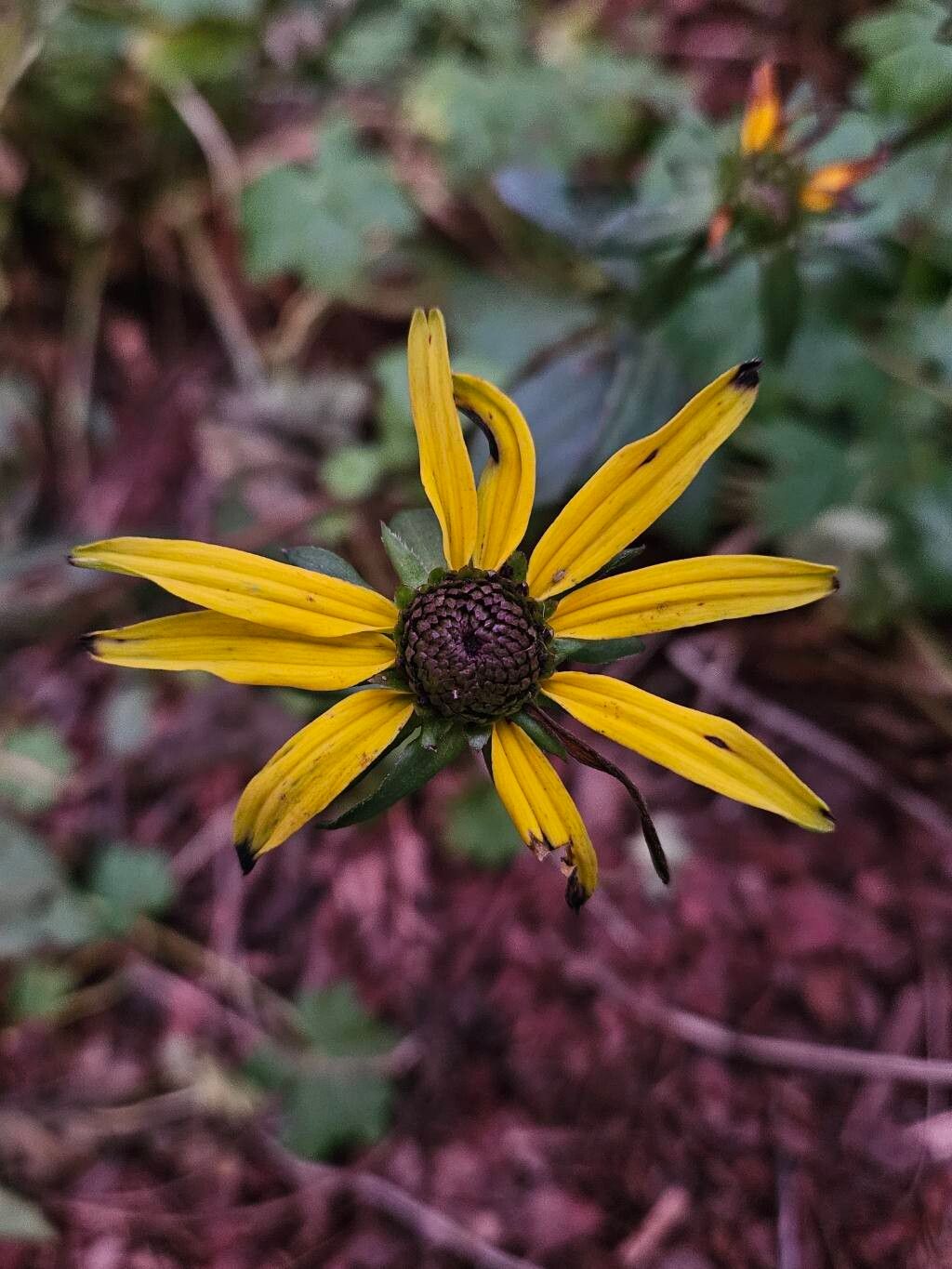
Rudbeckia, Genus, spp., Multiple species,
- Genus
- Multiple species
black-eyed susans and coneflowers
Overview
Rudbeckia is a genus of about 25 species of annual, biennial, and perennial herbs in the daisy family, Asteraceae, native to North America. Plants form upright clumps of coarse, often bristly leaves and bear daisy-like flower heads on stems 1–7 ft (30–210 cm) tall. Each flower head has a ring of yellow to orange ray florets around a raised central cone of dark brown to black disc florets, a pattern that gives the group the name black-eyed Susan. The cone becomes more prominent as the head matures and persists after the rays drop. Common black-eyed Susan R. hirta is a short-lived species often grown as an annual or biennial, while R. fulgida and R. laciniata are longer-lived perennials that spread by rhizomes. The fruit is a small, dry, four-angled achene eaten by finches and other birds. Some species self-seed freely and can spread through borders and meadows. The flower heads stand above the foliage for much of summer and into autumn. The genus grows in prairies, open woodland, meadows, and roadside ground across much of the continent.
Native Range
Rudbeckia is native to North America, ranging across the United States, southern Canada, and northern Mexico in prairies, meadows, and open woods. Black-eyed Susan R. hirta occurs across most of the continent. Several species and selections, such as R. fulgida Goldsturm, are grown well beyond their original ranges.Suggested Uses
Rudbeckia species are grown in borders, prairie and meadow plantings, and mass displays, and the long-stemmed species are cut for arrangements. Seed heads left through winter feed finches and other birds. The flowers attract bees, butterflies, and other pollinating insects.How to Identify
Appearance
Size & Dimensions
Height1' - 7'
Width/Spread1' - 3'
Bloom Information
Most Rudbeckia species flower from midsummer into autumn, roughly June to October, with each plant blooming over many weeks. Removing spent heads prolongs flowering, while leaving them supplies seed for birds and winter structure. Black-eyed Susan R. hirta flowers in its first year from an early sowing. Flower color centers on yellow and gold, with orange and mahogany tones in some forms.
Detailed Descriptions
Flower Description
yellow to orange rays with a dark brown to black central coneFoliage Description
greenGrowing Conditions
Sun Requirements
Requires 6-10 hours of direct sunlight daily
• Full Sun: 6+ hours of direct sunlight
• Partial Shade: 3-6 hours of direct sunlight
• Full Shade: Less than 3 hours of direct sunlight
Care & Maintenance
Care Guide
Rudbeckia species grow in full sun to light shade in average, moist, well-drained soil with a pH around 6.0 to 7.5. Established plants tolerate heat, humidity, and short dry spells, though they flower and grow most freely with steady moisture. They need little feeding, and rich soil can produce floppy, overlong stems. Perennial species spread by rhizomes and self-seeding and are divided every few years to control spread and maintain vigor. Powdery mildew and leaf spot can affect plants in crowded, humid conditions. Plants are hardy in USDA zones 3 to 9 depending on the species.Pruning
Spent Rudbeckia flower heads are deadheaded to extend bloom, or left standing to feed birds and provide winter interest. Stems are cut to the ground in late winter before new growth begins. Crowded perennial clumps are lifted and divided every 3 to 4 years.Container Growing
Suitable for container growing
Minimum container size: 2 gallons
Toxicity
Non-toxicRelated Rudbeckia species
 Large black-eyed susanRudbeckia hirta
 Black-eyed susanRudbeckia fulgida var. sullivantii 'Goldsturm'
 Deams black-eyed susanRudbeckia fulgida var. deamii
 Little suzy black-eyed susanRudbeckia fulgida var. speciosa 'Viette's Little Suzy'
 Indian summer black-eyed susanRudbeckia hirta 'Indian Summer'
 Brown-eyed susanRudbeckia triloba