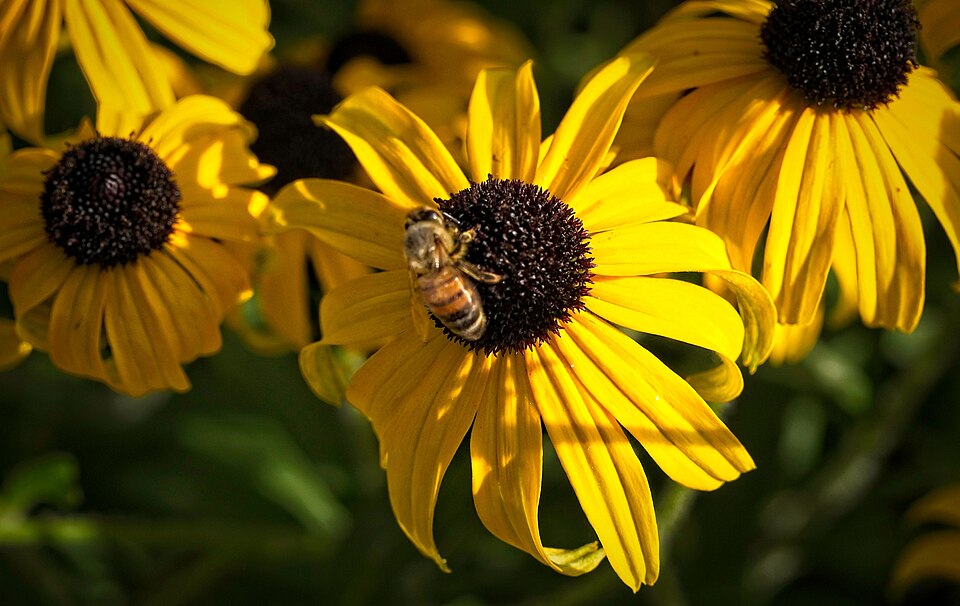
Rudbeckia, Genus, ×, Hybrid, 'American Gold Rush', Cultivar,
- Genus
- Hybrid
- Cultivar
American gold rush black-eyed susan
Garden hybrid; Perennial Plant of the Year 2023
Overview
Rudbeckia × 'American Gold Rush' is a hybrid black-eyed Susan named the 2023 Perennial Plant of the Year, growing 22–26 inches (55–65 cm) tall and wide. Golden-yellow daisy flowers 2–3 inches (5–8 cm) across with dark brown-black central cones appear from July through October. The cultivar was bred specifically to resist Septoria leaf spot — the fungal disease that disfigures the lower foliage of 'Goldsturm' and other R. fulgida selections by midsummer, causing brown-spotted, defoliated lower stems. 'American Gold Rush' maintains clean foliage through the entire growing season, addressing the single biggest complaint about traditional black-eyed Susans. The foliage has a different shape from typical rudbeckias: narrow, willow-like, dark green hairy leaves rather than the broad ovate leaves of R. fulgida. This narrow leaf shape is inherited from R. missouriensis in its parentage and contributes to the disease resistance — the narrower leaves dry faster and resist fungal infection. The clumping habit is well-behaved — moderate spread without aggressive stolons. The compact stature and clean foliage make this a practical black-eyed Susan for residential landscapes. Deer avoid the foliage.
Native Range
Rudbeckia × 'American Gold Rush' is a garden hybrid bred by Dr. Jim Ault at the Chicago Botanic Garden. Perennial Plant of the Year 2023.Suggested Uses
Used in perennial borders, mass plantings, and residential landscapes where clean foliage is valued. A strong alternative for gardeners tired of Septoria-spotted 'Goldsturm'. Perennial Plant of the Year 2023. The narrow foliage adds a different texture to the garden.How to Identify
Appearance
Size & Dimensions
Height1'10" - 2'2"
Width/Spread1'10" - 2'2"
Colors
Bloom Information
Detailed Descriptions
Flower Description
Golden-yellow ray florets with a dark brown-black central coneFoliage Description
Dark green, narrow, willow-like, hairy — a different shape from typical broad rudbeckia foliageGrowing Conditions
Sun Requirements
Requires 5-10 hours of direct sunlight daily
• Full Sun: 6+ hours of direct sunlight
• Partial Shade: 3-6 hours of direct sunlight
• Full Shade: Less than 3 hours of direct sunlight
Care & Maintenance
Care Guide
Sow or set in full sun to partial shade. Average to moist soil; tolerates clay. No fertilization is needed. The disease resistance means no fungicide spraying or lower-leaf cleanup is needed. Stems can be left standing through winter. Cut to ground in early spring. Divide every 3–4 years.Pruning
Cut all stems to ground in late February–March. No midsummer foliage cleanup needed — the disease-resistant leaves stay clean.Pruning Schedule
Prune: March
early spring
Container Growing
Suitable for container growing
Minimum container size: 5 gallons
Toxicity
Non-toxicRelated Rudbeckia species
 Large black-eyed susanRudbeckia hirta
 Black-eyed susanRudbeckia fulgida var. sullivantii 'Goldsturm'
 Deams black-eyed susanRudbeckia fulgida var. deamii
 Little suzy black-eyed susanRudbeckia fulgida var. speciosa 'Viette's Little Suzy'
 Indian summer black-eyed susanRudbeckia hirta 'Indian Summer'
 Brown-eyed susanRudbeckia triloba