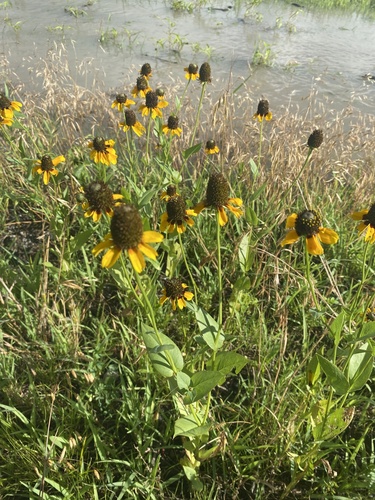
Rudbeckia, Genus, amplexicaulis, Species,
- Genus & species
clasping coneflower
SunFull Sun – Part Shade
WaterHigh
Overview
Rudbeckia amplexicaulis, also placed in the genus Dracopis, is an annual wildflower in the aster family, growing 1-2.5 ft (30-75 cm) tall on smooth, branching stems. The blue-green leaves are oblong and clasp the stem with rounded, ear-like bases, a feature that gives the plant its common name. From April to July the stems carry daisy-like heads 1-2 in (2.5-5 cm) across, with drooping yellow rays that are often marked reddish-brown to maroon toward the base, surrounding a raised, columnar dark cone. As the head ages the central cone elongates. The flowers draw bees and butterflies, and the seeds feed small birds. The plant grows in moist prairies, ditches, floodplains, and roadside swales across the south-central United States, favoring damp, open ground. As an annual it completes its cycle in one season and relies on prolific self-seeding to return. It tolerates seasonal flooding and clay soils but flowers poorly in deep shade or dry sites. It can be confused with true Rudbeckia coneflowers, which are often perennial and have rough, non-clasping leaves.
Native Range
Rudbeckia amplexicaulis is native to the south-central United States, centered on Texas, Oklahoma, Louisiana, and neighboring states, with naturalized stands farther east. It grows in moist prairies, ditches, floodplains, and low roadsides.Suggested Uses
Rudbeckia amplexicaulis is used in wildflower meadows, rain gardens, pond edges, and moist native plantings for late-spring color. It supports bees, butterflies, and seed-eating birds. It suits damp, sunny areas where many drought-loving wildflowers would fail.How to Identify
Appearance
Size & Dimensions
Height1' - 2'6"
Width/Spread9" - 1'6"
Bloom Information
Detailed Descriptions
Flower Description
yellow with maroon baseFoliage Description
blue-greenGrowing Conditions
Sun Requirements
Requires 6-12 hours of direct sunlight daily
• Full Sun: 6+ hours of direct sunlight
• Partial Shade: 3-6 hours of direct sunlight
• Full Shade: Less than 3 hours of direct sunlight
Water & Climate
Water Needs
Care & Maintenance
Care Guide
Rudbeckia amplexicaulis grows in full sun to part shade on moist to wet soils and tolerates clay and seasonal flooding better than most coneflowers. As an annual it is sown from seed in autumn or early spring and completes its cycle in one growing season. It needs steady moisture during growth and flowering and falters on dry sites. No winter care applies once the plant has set seed and died. It self-sows freely where soil stays open and damp, returning year after year. Removing some spent heads limits spread while leaving others feeds birds and reseeds the stand.Pruning
Pruning is not needed for this annual. Deadheading spent flowers extends bloom and controls self-seeding, while leaving late heads yields seed for birds. Plants are cleared after they die back at season's end.Toxicity
Non-toxicPlanting Guide
Planting Methods & Timing
Planting Method
direct sow
Direct Sow Timing
Fall or early spring
Days to Maturity
70–100 days
Plant Spacing
12 inches
Companion Planting
Good Companions
Related Rudbeckia species
 Large black-eyed susanRudbeckia hirta
 Black-eyed susanRudbeckia fulgida var. sullivantii 'Goldsturm'
 Deams black-eyed susanRudbeckia fulgida var. deamii
 Little suzy black-eyed susanRudbeckia fulgida var. speciosa 'Viette's Little Suzy'
 Indian summer black-eyed susanRudbeckia hirta 'Indian Summer'
 Brown-eyed susanRudbeckia triloba