Hydrangea Types Explained: Pruning, Color & Care Guide
Pets & Toxicity
Recorded toxicity for plants linked in this guide. An unknown status is not a safety assessment.
Toxic to pets: bigleaf hydrangea, Panicle hydrangea, oak-leaf hydrangea and 11 more (16 linked plants checked)DetailsHide
Hydrangea macrophylla — Toxicity Warning
Toxic to pets and humansView Hydrangea macrophylla plant profileHydrangea paniculata — Toxicity Warning
Toxic to pets and humansView Hydrangea paniculata plant profileHydrangea quercifolia — Toxicity Warning
Toxic to pets and humansView Hydrangea quercifolia plant profileHydrangea anomala ssp. petiolaris — Toxicity Warning
Toxic to pets and humansView Hydrangea anomala ssp. petiolaris plant profileHydrangea macrophylla 'Endless Summer' — Toxicity Warning
Toxic to pets and humansView Hydrangea macrophylla 'Endless Summer' plant profileHydrangea macrophylla 'BloomStruck' — Toxicity Warning
Toxic to pets and humansView Hydrangea macrophylla 'BloomStruck' plant profileHydrangea macrophylla 'Penny Mac' — Toxicity Warning
Toxic to pets and humansView Hydrangea macrophylla 'Penny Mac' plant profileHydrangea paniculata 'Quick Fire' — Toxicity Warning
Toxic to pets and humansView Hydrangea paniculata 'Quick Fire' plant profileHydrangea paniculata 'Fire Light' — Toxicity Warning
Toxic to pets and humansView Hydrangea paniculata 'Fire Light' plant profileHydrangea paniculata 'Grandiflora' — Toxicity Warning
Toxic to pets and humansView Hydrangea paniculata 'Grandiflora' plant profileHydrangea arborescens 'Incrediball' — Toxicity Warning
Toxic to petsView Hydrangea arborescens 'Incrediball' plant profileHydrangea quercifolia 'Pee Wee' — Toxicity
Non-toxicView Hydrangea quercifolia 'Pee Wee' plant profileHydrangea quercifolia 'Snow Queen' — Toxicity
Non-toxicView Hydrangea quercifolia 'Snow Queen' plant profileHydrangea quercifolia 'Alice' — Toxicity Warning
Toxic to pets and humansView Hydrangea quercifolia 'Alice' plant profileHydrangea serrata 'Blue Billow' — Toxicity Warning
Toxic to pets and humansView Hydrangea serrata 'Blue Billow' plant profile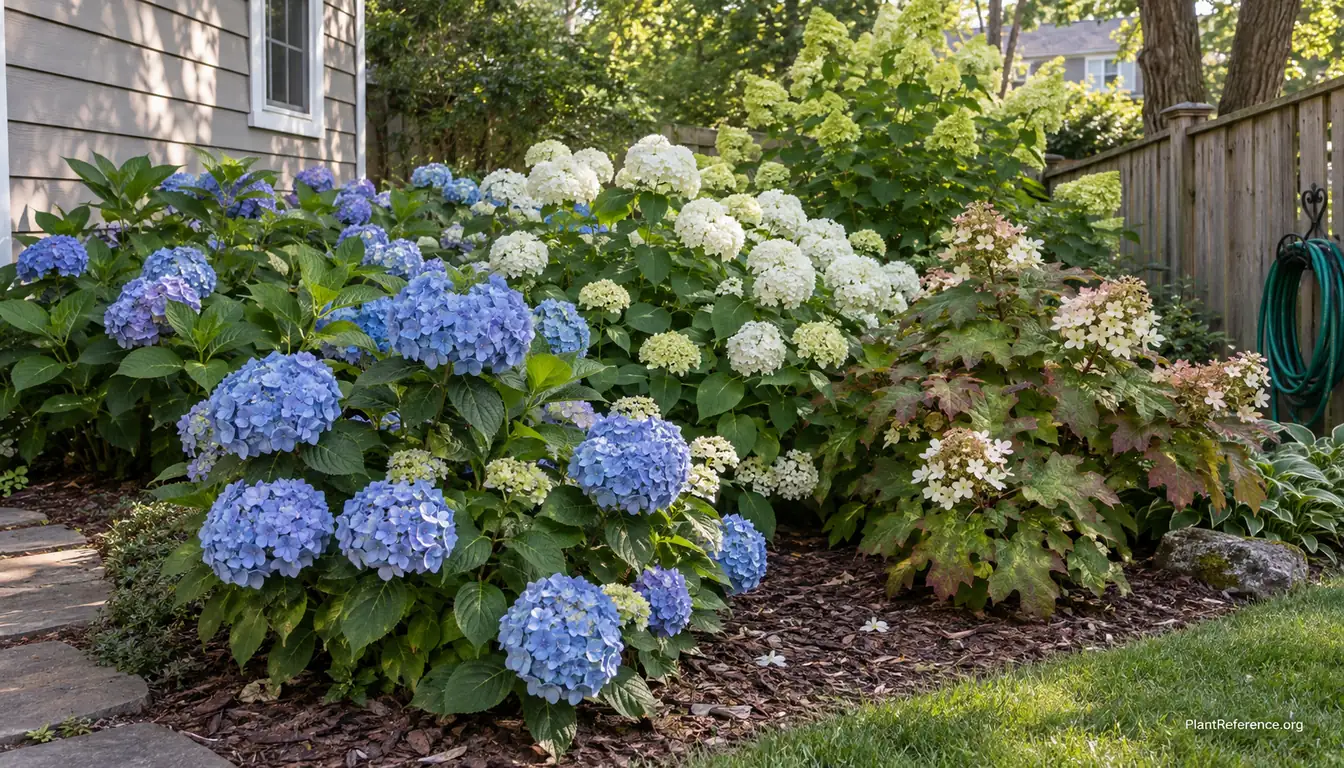
— Image © PlantReference.org 2026
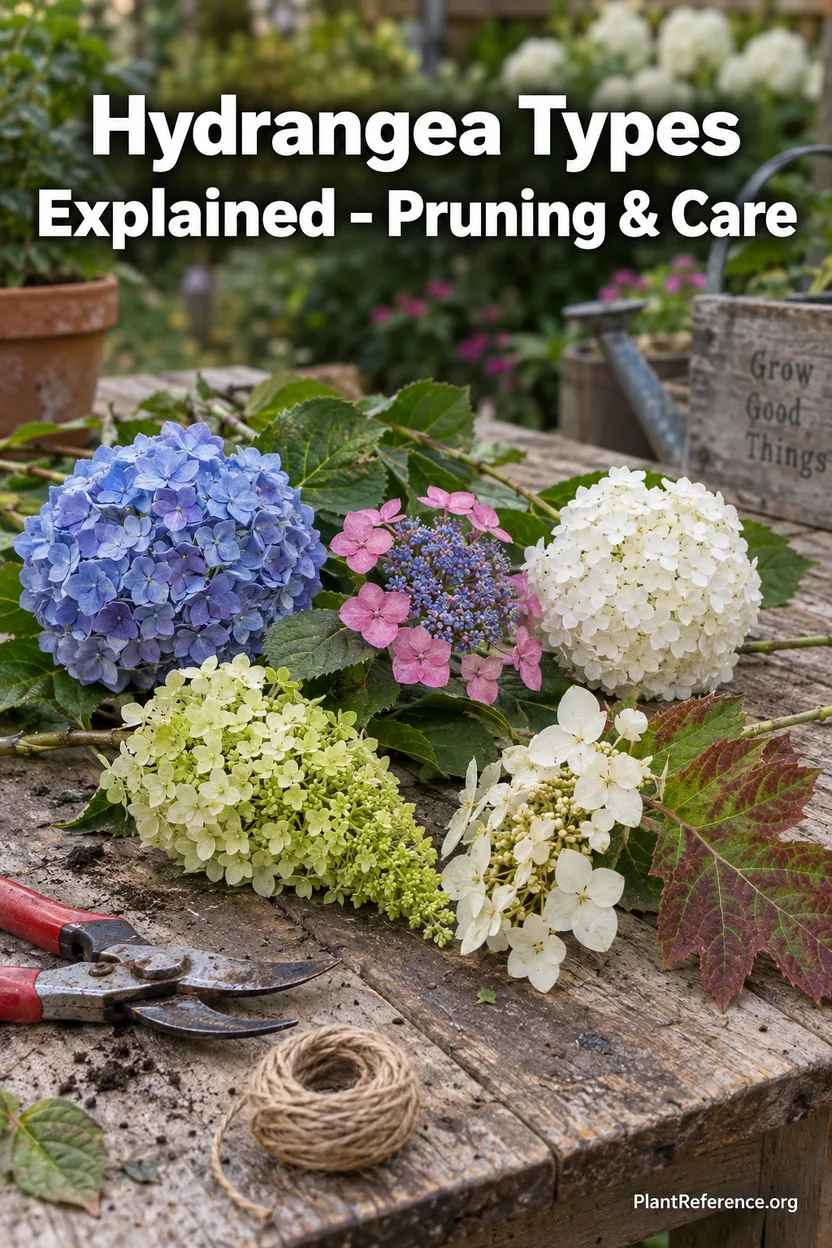
Most hydrangea frustration comes from one misunderstanding: gardeners treat "hydrangea" as a single plant when it is really six different species with different biology. Understanding hydrangea types is the key to knowing when to prune, whether your flowers can change color, and why your neighbor's shrub blooms every year while yours produces nothing but leaves. This guide walks through each species, how to identify it, and exactly how to care for it.
The One Question That Decides Everything: Old Wood or New Wood?
Before we meet the individual species, you need one concept from plant physiology. Every hydrangea forms its flower buds at a specific point in its growth cycle, and that timing determines nearly every care decision you will make.
Old-wood bloomers set next year's flower buds in late summer and early fall, on stems that already grew this season. Those buds sit through winter, then open the following summer. If you cut those stems in fall, winter, or spring, you cut off the flowers. If a hard winter or late spring freeze kills the buds, you get foliage but no bloom.
New-wood bloomers form flower buds on stems that grow in the current spring. The buds develop and open within the same season. You can prune these plants hard in late winter, a severe winter can kill stems back, and a late frost can nip early shoots, yet the plant will still grow new stems and flower on schedule.
This single distinction explains the most common hydrangea complaint in North America. Improper pruning is the leading controllable reason hydrangeas fail to bloom, and nearly all of those failures involve cutting an old-wood species at the wrong time. The same logic appears in other shrubs; if you have read How to Prune Roses: When and How to Prune Every Type of Rose, you will recognize the pattern of matching cuts to bloom timing.
Species | Common Name | Bloom Wood | Hardiness Zones | When to Prune | Changes Color? |
|---|---|---|---|---|---|
Bigleaf, mophead, lacecap | Old wood (rebloomers: old + new) | 5-9 (buds reliable 6-9) | Right after flowering, or dead wood only | Yes | |
Panicle, PeeGee | New wood | 3-8 | Late winter to early spring | No | |
Hydrangea arborescens | Smooth, Annabelle | New wood | 3-9 | Late winter to early spring | No |
Oakleaf | Old wood | 5-9 | Right after flowering | No | |
Mountain | Old wood | 5-9 | Right after flowering | Yes | |
Climbing | Old wood | 4-8 | Right after flowering | No |
Bigleaf Hydrangea (Hydrangea macrophylla)
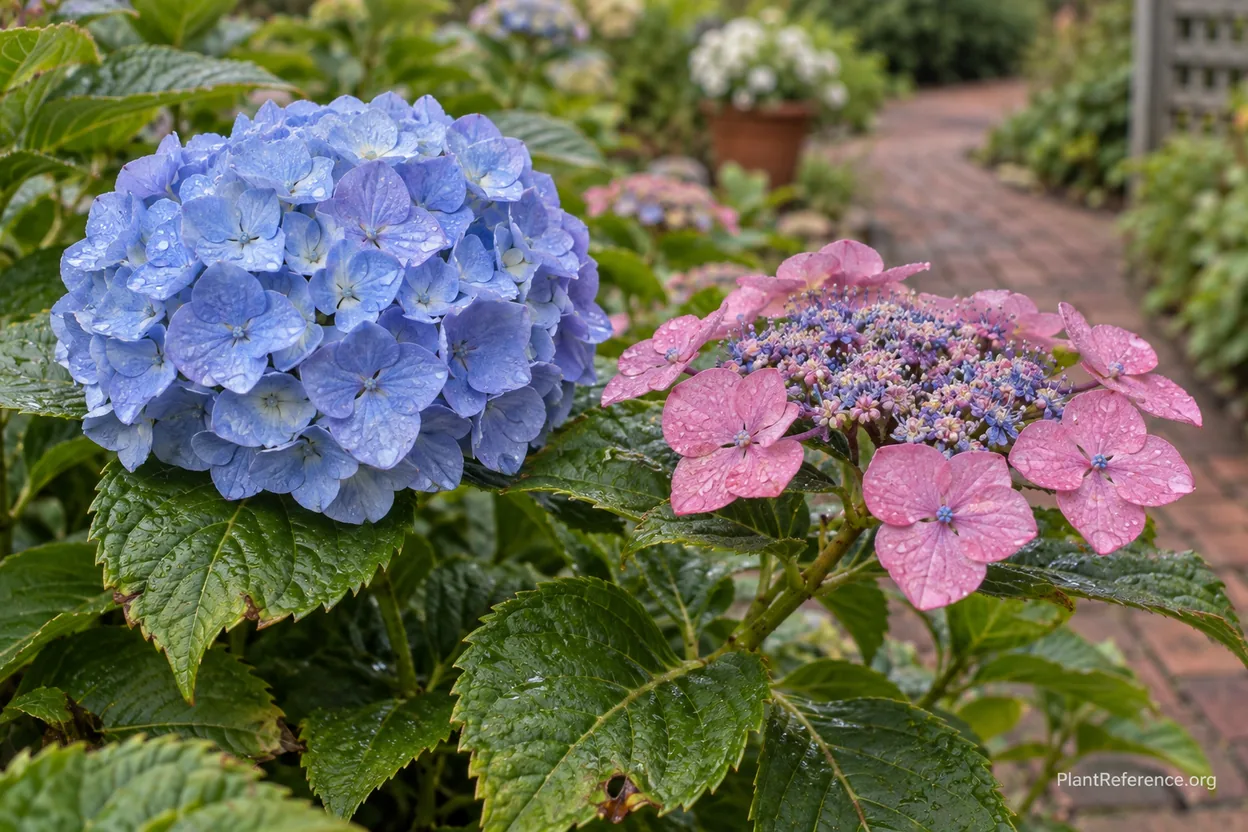
🌿Hydrangea macrophylla (hy-DRAN-jee-uh mak-roh-FIL-uh) is the hydrangea most people picture: large, glossy, coarsely toothed leaves and big blue or pink flower heads. It goes by many names, including mophead, lacecap, French hydrangea, florist's hydrangea, and hortensia. Plants reach 3-6 feet (0.9-1.8 m) tall and wide and bloom from June into September.
Mopheads vs. Lacecaps
Bigleaf hydrangeas come in two flower forms. Mopheads produce rounded, ball-shaped clusters made almost entirely of large sterile florets. Lacecaps produce flat clusters with a center of tiny fertile florets ringed by showier sterile ones. Pollinators visit lacecaps far more often because those fertile florets offer pollen.
Why Bigleaf Hydrangeas Fail to Bloom
The species is native to coastal Japan and thrives in mild, maritime climates in Zones 7-9. The plant itself survives to Zone 5, but its overwintering flower buds do not. Sustained temperatures below 0°F (-18°C) during dormancy kill the buds, and any freeze after the buds begin to swell in spring does the same. The result is a healthy green shrub with no flowers, which is the basis of the most-searched hydrangea problem in the country.
Reblooming cultivars were bred to address this. 🌿Hydrangea macrophylla 'Endless Summer' was the first widely available rebloomer, producing flowers on both old and new wood. Improved successors include 🌿Hydrangea macrophylla 'BloomStruck' with stronger stems and deeper color, and Hydrangea macrophylla 'Twist-n-Shout', a lacecap with more cold-tolerant buds. The Let's Dance series from Proven Winners offers similar rebloom.
Temper your expectations in cold climates, though. In Zones 4-5, new-wood bloom on these cultivars is often a handful of smaller flowers in late summer rather than a full June show. UMass Extension notes that even a properly sited bigleaf hydrangea will skip some years because of unfavorable winter or spring conditions.
Other Reliable Bigleaf Cultivars
🌿Hydrangea macrophylla 'Nikko Blue' is the classic mophead, turning vivid blue in acidic soil and performing well in Zones 6-9. 🌿Hydrangea macrophylla 'Penny Mac' is often cited as one of the hardiest bigleaf cultivars for gardeners at the cold edge of the range.
Pruning Bigleaf Hydrangeas
For traditional cultivars, prune only immediately after flowering, and finish before August. Any pruning later than that removes next year's buds. For rebloomers, the best practice is simpler still: do not prune except to remove dead wood in spring, once you can clearly see which stems are leafing out.
Panicle Hydrangea (Hydrangea paniculata)
🌿Hydrangea paniculata (hy-DRAN-jee-uh pan-ik-yoo-LAY-tuh) is the workhorse of cold-climate hydrangea gardening. It is the most cold-hardy species, reliable in Zones 3-8, and the most sun-tolerant. Because it blooms entirely on new wood, no amount of winter severity, late frost, deer browse, or aggressive pruning prevents flowering.
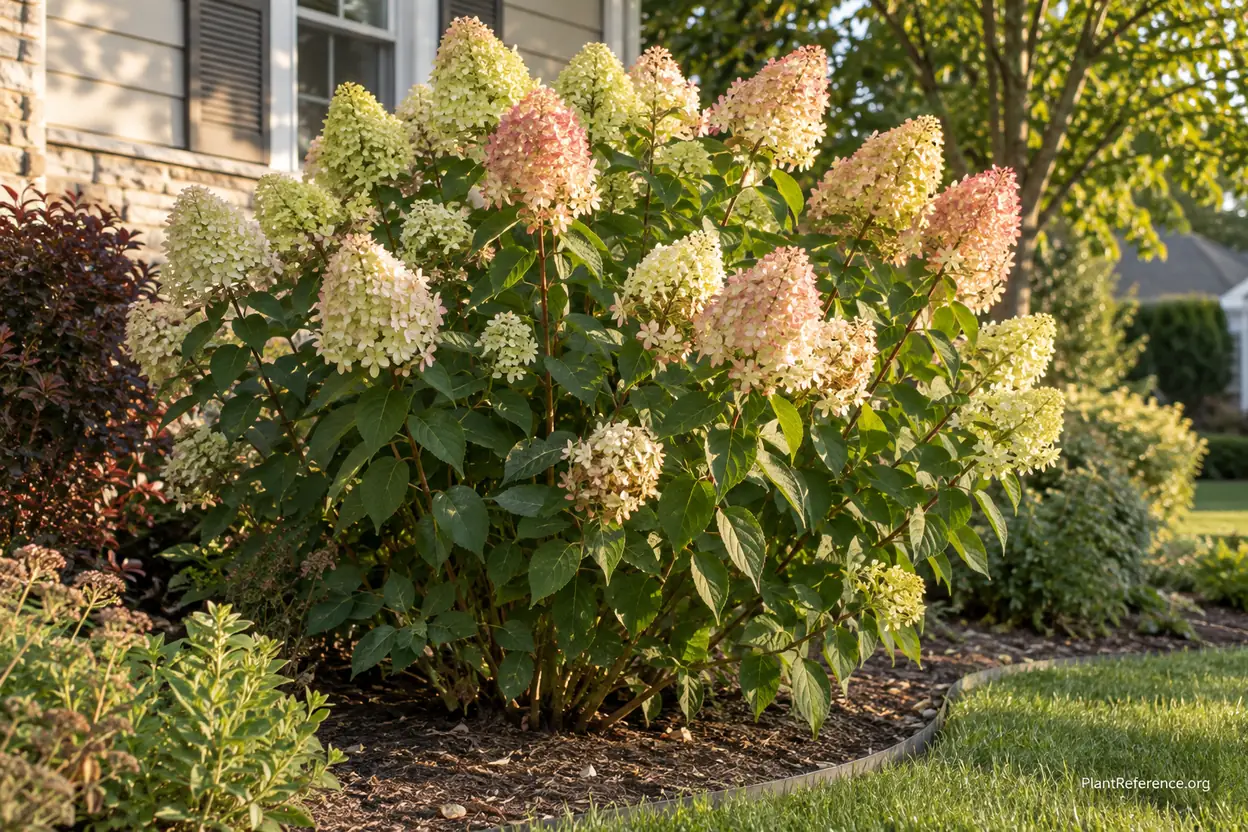
You can recognize a panicle hydrangea by its cone-shaped flower heads, which start white or lime-green in midsummer and age through pink, rose, and burgundy as nights cool in fall. The leaves are smaller, oval, and more matte than bigleaf foliage, and the stems are woody and upright. Sizes range from 3 feet (0.9 m) for dwarf cultivars to 15 feet (4.6 m) or more for the heritage types.
Top Panicle Cultivars
🌿Hydrangea paniculata 'Limelight' is the benchmark. Its lime-green flowers age to cream and then blush pink on a 6-8 foot (1.8-2.4 m) shrub, and it consistently ranks near the top of independent trials. Hydrangea paniculata 'Little Lime' offers the same color progression at 3-5 feet (0.9-1.5 m), and Hydrangea paniculata 'Bobo' stays at a compact 2-3 feet (60-90 cm) with white flowers aging to pink.
For earlier or redder color, 🌿Hydrangea paniculata 'Quick Fire' starts blooming in June and ages to deep red, while 🌿Hydrangea paniculata 'Fire Light' carries large panicles on very strong stems that turn pomegranate red. Hydrangea paniculata 'Pinky Winky' creates a bicolor effect, with fresh white florets opening at the tip as lower florets turn pink. The heritage 🌿Hydrangea paniculata 'Grandiflora', the original PeeGee, can reach 10-25 feet (3-7.6 m).
Pruning Panicle Hydrangeas
Prune in late winter or early spring before growth begins. You can cut stems back by one-third for a natural shape or as low as 12-24 inches (30-60 cm) for a compact plant; either way, it will flower that same summer. Panicle hydrangea is also the only species that can be reliably trained into a single-trunk tree form, and it makes an excellent flowering hedge.
Smooth Hydrangea (Hydrangea arborescens)
Hydrangea arborescens (hy-DRAN-jee-uh ar-bor-ESS-enz) is native to eastern North America, which helps explain why it is so tough. It is hardy in Zones 3-9, tolerates more shade than most species, and needs very little attention. Plants grow 3-5 feet (0.9-1.5 m) tall and wide and bloom from June through September.
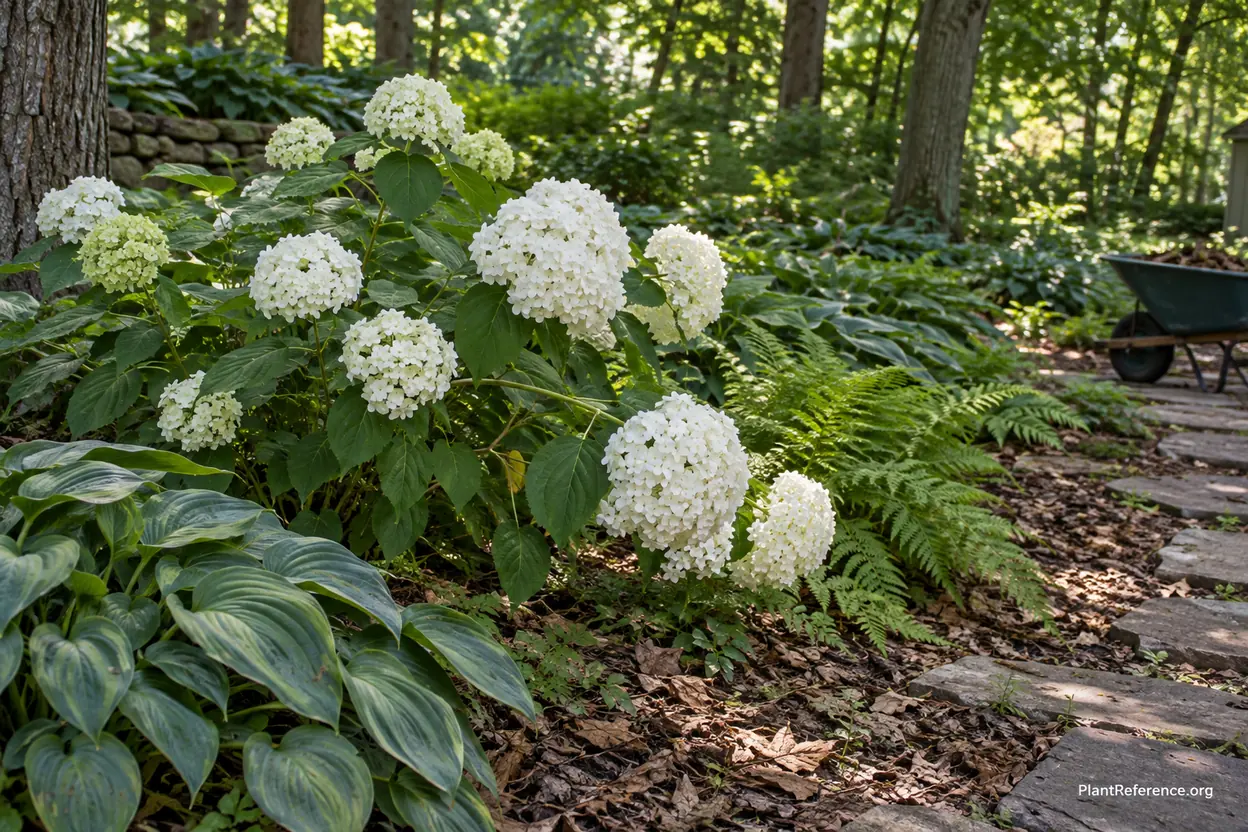
Smooth hydrangeas produce large, rounded flower heads, often called snowballs, that can reach 12 inches (30 cm) across on improved cultivars. The leaves are thin, heart-shaped to oval, and softer than bigleaf foliage. Stems are thinner and more herbaceous-feeling, and many die back to near the ground in cold winters, which does not matter because the species blooms on new wood.
Top Smooth Cultivars
🌿Hydrangea arborescens 'Annabelle' is the classic, with huge white heads and one well-known flaw: its stems flop after heavy rain soaks the flowers. 🌿Hydrangea arborescens 'Incrediball' solves that problem with sturdier stems and even larger heads. The Invincibelle series adds color and size options, including Hydrangea arborescens 'Invincibelle Spirit II' in warm rose-pink, Hydrangea arborescens 'Invincibelle Ruby' with burgundy buds and dark foliage, and the dwarf Hydrangea arborescens 'Invincibelle Limetta' at 30-36 inches (76-91 cm).
Pruning Smooth Hydrangeas
In late winter, cut all stems back to 12-24 inches (30-60 cm), or even to the ground. The plant regrows and blooms the same summer. Leaving 18-24 inches (45-60 cm) of old stem gives new growth extra support and reduces flopping on older cultivars. Smooth hydrangeas pair well with the species in Best Perennials for Shade: 12 Species That Thrive for a low-maintenance woodland edge.
Oakleaf Hydrangea (Hydrangea quercifolia)
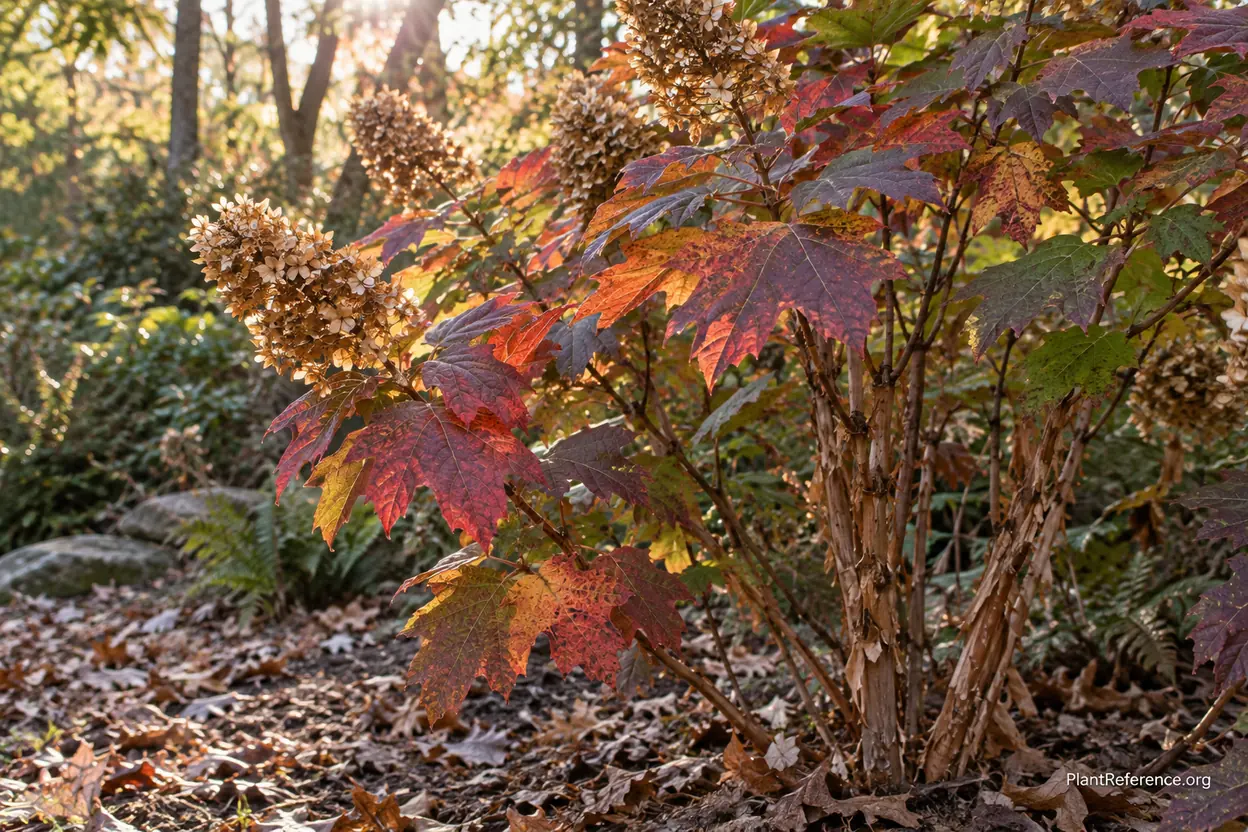
🌿Hydrangea quercifolia (hy-DRAN-jee-uh kwer-sih-FOH-lee-uh) is native to the southeastern United States and is the easiest species to identify. Its deeply lobed leaves look like oversized oak leaves and turn orange, red, and mahogany in fall, giving it the best autumn color of any hydrangea. In winter, cinnamon-colored exfoliating bark adds a fourth season of interest.
Upright, cone-shaped white flower heads appear in June and July and age to pinkish-tan. Plants grow 4-8 feet (1.2-2.4 m) tall and wide, are hardy in Zones 5-9, and handle more drought than other species once established. They do not tolerate consistently wet soil, so avoid low spots.
Oakleaf hydrangea blooms on old wood. Its buds are hardier than bigleaf buds, but gardeners in Zone 5 can still lose flowers in harsh winters. Prune only right after flowering, and only when you need to control size.
Recommended cultivars include compact Hydrangea quercifolia 'Ruby Slippers' at 3-4 feet (0.9-1.2 m) with flowers aging to deep rose; 🌿Hydrangea quercifolia 'Pee Wee', similarly compact with proportionally smaller flowers; 🌿Hydrangea quercifolia 'Snow Queen' with upright heads and excellent fall color at 5-6 feet (1.5-1.8 m); Hydrangea quercifolia 'Gatsby Moon' with double flowers; and the giant 🌿Hydrangea quercifolia 'Alice', which reaches 8-12 feet (2.4-3.7 m).
Mountain Hydrangea (Hydrangea serrata)
🌿Hydrangea serrata (hy-DRAN-jee-uh ser-AY-tuh) is so closely related to bigleaf hydrangea that some botanists treat it as a subspecies. It is smaller and more compact at 2-4 feet (60-120 cm), with narrower, finer-toothed leaves and mostly lacecap flowers. It prefers part shade and blooms June through August.
The important difference is bud hardiness. Mountain hydrangea buds survive winter better than bigleaf buds, which makes this species a smart alternative for gardeners in Zones 5-6 who want blue or pink flowers without constant bud kill. 🌿Hydrangea serrata 'Blue Billow' and the Tuff Stuff series from Proven Winners have shown exceptional winter bud hardiness, and some newer selections rebloom. Like bigleaf hydrangea, mountain hydrangea changes color with soil pH and is pruned only after flowering.
Climbing Hydrangea (Hydrangea anomala subsp. petiolaris)
🌿Hydrangea anomala ssp. petiolaris (hy-DRAN-jee-uh uh-NOM-uh-luh pet-ee-oh-LAIR-iss) is a woody vine rather than a shrub. It climbs by aerial rootlets and can eventually reach 30-50 feet (9-15 m) on a wall or large tree. White lacecap flowers appear from May into July, and heart-shaped glossy leaves cover the stems.
This is one of very few flowering plants that performs in part to full shade, which makes it valuable for north-facing walls. It is hardy in Zones 4-8 and does not damage sound masonry. Patience is required: expect 3-5 years before significant bloom, because the vine spends its early years building roots and a framework. It blooms on old wood, so trim only after flowering and only to keep it in bounds.
How to Identify Your Hydrangea Type
If you inherited a hydrangea or lost the tag, you can usually identify it in a few minutes. Start with the leaves, then confirm with the flowers. For a broader primer on reading plant features, see How to Identify Any Plant: A Beginner's Guide to Leaves, Flowers, and Stems.
Use these field marks:
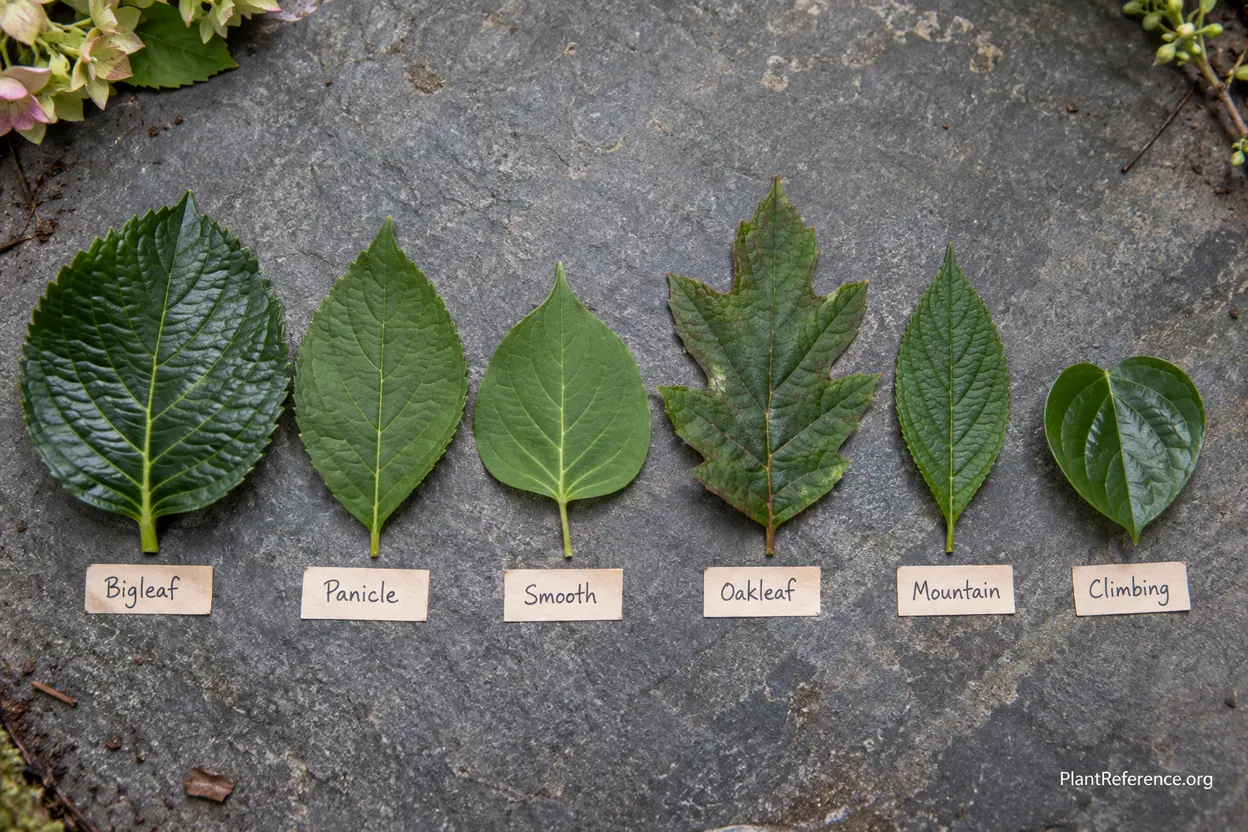
Lobed, oak-like leaves: oakleaf hydrangea, with no other lookalike
Large, thick, glossy leaves with coarse teeth and ball or flat flowers in blue, pink, or purple: bigleaf hydrangea
Smaller, narrow, finely toothed leaves on a compact shrub with lacecap flowers: mountain hydrangea
Cone-shaped flowers on stiff, woody, upright stems in full sun: panicle hydrangea
Thin, soft, heart-shaped leaves and white or pink snowball flowers on thin stems: smooth hydrangea
A vine clinging to a wall or tree trunk with aerial roots: climbing hydrangea
Flower shape alone can mislead you, because both oakleaf and panicle hydrangeas produce cone-shaped heads. Leaves settle the question every time. Flower color can also mislead: a blue or pink flower almost always means bigleaf or mountain hydrangea, but a white flower could belong to any species. The Flower Identification Guide: Petals, Shape & Color Explained covers the terminology if you want to go further.
Why Only Some Hydrangea Types Change Color
Blue and pink hydrangea color is chemistry, not genetics alone. In bigleaf and mountain hydrangeas, the sepals contain an anthocyanin pigment called delphinidin-3-glucoside. When aluminum ions reach the flower, they bind with that pigment and produce blue. Without aluminum, the same pigment shows pink or magenta.
Soil pH controls whether aluminum is available. In acidic soil at pH 4.5-5.5, aluminum dissolves and roots absorb it, producing blue. From pH 5.5-6.2, you get purple or mauve transitional shades. At pH 6.5-7.5, aluminum precipitates out of solution and flowers turn pink. Phosphorus also matters, because it binds aluminum into insoluble aluminum phosphate, so high-phosphorus fertilizers push flowers toward pink.
Several practical rules follow from this:
Only bigleaf and mountain hydrangeas change color; panicle pinks and smooth pinks are genetic and do not respond to pH
White cultivars of any species stay white regardless of soil
Change takes weeks to months and is easier from pink to blue than from blue to pink
Pennies and nails buried in soil do not change color, despite the persistent myth
Start with a soil test before adding sulfur or lime. The process described in Raised Bed Soil pH Problems: Testing, Adjusting, and Maintaining Balance applies equally to shrub borders. Gardeners in the Pacific Northwest often get blue flowers without trying, a result explained in Why Pacific Northwest Soil Is Acidic + How to Fix It.
Choosing the Right Hydrangea Type for Your Zone
Your hardiness zone is the second filter after bloom wood. Here is how the species sort out across the country:
Zone | Most Reliable Types | Use With Caution | Key Challenge |
|---|---|---|---|
3-4 | 🌿Hydrangea paniculata, Hydrangea arborescens | Rebloomers of 🌿Hydrangea macrophylla | Bigleaf bud kill almost every winter |
5-6 | Panicle, smooth, oakleaf (Zone 6), mountain | Bigleaf (marginal) | Late spring freezes on swelling buds |
7-8 | All six species | None | Humidity-driven leaf diseases |
9-10 | Bigleaf, oakleaf, smooth | Panicle (heat), climbing | Extreme heat and irregular chill hours |
In Zones 3-4, choose panicle and smooth hydrangeas and treat bigleaf types as foliage plants that may occasionally surprise you. In Zones 5-6, panicle and smooth types remain the reliable backbone, oakleaf is generally dependable in Zone 6, and mountain hydrangea is your best bet for blue flowers.
Zones 7-8 are the sweet spot, where every species performs and the main variable is disease pressure from humidity. In Zones 9-10, near year-round bloom is possible, but insufficient winter chill can make flowering irregular, and every species needs afternoon shade. Humid regions such as the Gulf Coast face disease pressure throughout the year.
Deer are the other regional variable. They browse hydrangea buds readily, which is devastating for old-wood types; if deer are a problem in your area, see Deer-Resistant Perennials: A Zone-by-Zone Planting Guide for companion plants and strategy.
Care Basics That Apply to Every Hydrangea Type
Once you know your species, the rest of hydrangea care is refreshingly consistent. The name "hydrangea" comes from the Greek for water vessel, and that is a useful reminder.
Soil and Water
All hydrangeas want moist, well-drained soil rich in organic matter. None tolerate standing water, and oakleaf types are especially sensitive to wet feet. Provide 1-2 inches (2.5-5 cm) of water per week, more in heat. Hydrangeas have relatively shallow roots, so they are often the first shrubs in a garden to wilt during drought. Afternoon wilting that recovers by morning is normal heat stress; wilting that persists into the next morning signals a genuine water or root problem.
Mulch and Fertilizer
Spread 2-3 inches (5-7.5 cm) of mulch over the root zone, keeping it a few inches away from stems. Apply a balanced fertilizer once in early spring. Excess nitrogen produces lush leaves at the expense of flowers, so resist the urge to feed repeatedly.
Light
Match light to species. Panicle hydrangeas handle full sun; smooth hydrangeas tolerate the most shade; bigleaf and mountain hydrangeas want morning sun and afternoon shade, which becomes essential in Zones 7 and warmer. Too much shade reduces flowering for every type.
Planting and Transplanting
Plant or transplant in early spring or fall, never in the heat of summer. Dig a hole two to three times wider than the root ball and no deeper. Expect 2-4 weeks of transplant shock, with some wilting, before the plant settles.
Winter Preparation
For old-wood types at the cold edge of their range, protecting flower buds is worth the effort. A burlap cage filled with dry leaves shields buds from the coldest temperatures. New-wood types need no protection at all. Timing for fall cleanup follows the same principles covered in When to Cut Back Perennials in Fall (And What to Leave): leave hydrangea stems standing through winter, since dried flower heads add structure and the old wood of some species holds next year's blooms.
Design Uses
Hydrangeas work as foundation plantings, shade-garden anchors, flowering hedges (especially panicle types), and sources of cut and dried flowers. Panicle and smooth hydrangeas dry exceptionally well once their flowers turn papery. For ideas on pairing them with herbaceous plants, Perennial Combinations That Look Good Together offers useful principles for layering by height, texture, and bloom time.
Frequently Asked Questions
Reading about plants and recognising them are different skills. These three build the second.
- Daily PlantIdentify the day’s mystery plant from a close-up photograph.
- Keyed OutWork a dichotomous key, lead by lead, to name a hidden specimen.
- Name That PlantName a specimen from botanical clues dealt hardest first.
Free to play, no account needed
Tagged with
Sarah earned her doctorate in plant biology and spent time working in botanical garden education before transitioning to freelance writing and consulting. Now based in Portland, Oregon, she teaches plant identification workshops at local community centers and maintains a modest collection of over 60 houseplants in her small apartment. Sarah specializes in helping beginners understand plant science without the jargon—her approach focuses on practical observation over theory. She's killed her fair share of fiddle leaf figs and finally cracked the code on keeping them alive.