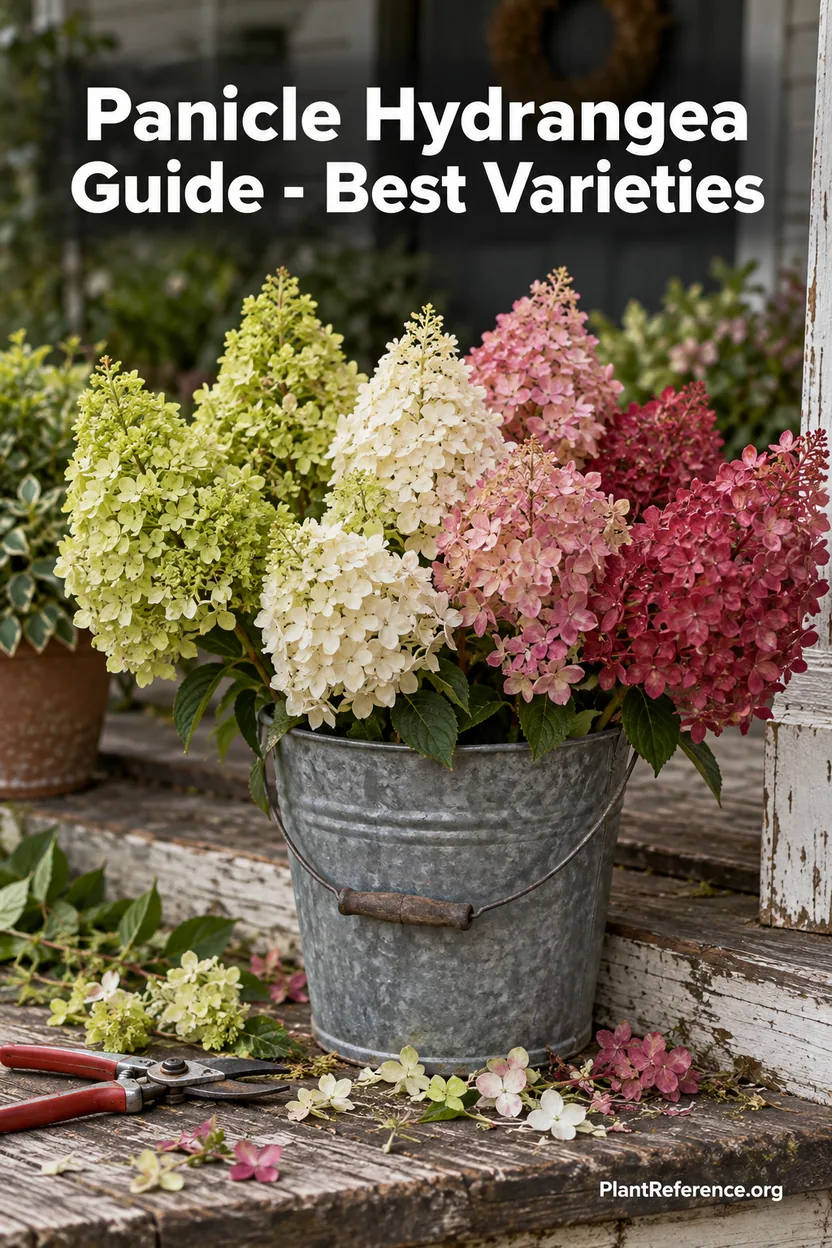
Panicle Hydrangea Guide: Limelight, Little Lime & More
Pets & Toxicity
Recorded toxicity for plants linked in this guide. An unknown status is not a safety assessment.
Toxic to pets: Limelight PeeGee hydrangea, Panicle hydrangea, Tardiva hydrangea and 3 moreDetailsHide
Hydrangea paniculata 'Limelight' — Toxicity Warning
Toxic to petsView Hydrangea paniculata 'Limelight' plant profileHydrangea paniculata — Toxicity Warning
Toxic to pets and humansView Hydrangea paniculata plant profileHydrangea paniculata 'Tardiva' — Toxicity Warning
Toxic to pets and humansView Hydrangea paniculata 'Tardiva' plant profileHydrangea paniculata 'Quick Fire' — Toxicity Warning
Toxic to pets and humansView Hydrangea paniculata 'Quick Fire' plant profileHydrangea paniculata 'Fire Light' — Toxicity Warning
Toxic to pets and humansView Hydrangea paniculata 'Fire Light' plant profileHydrangea paniculata 'Grandiflora' — Toxicity Warning
Toxic to pets and humansView Hydrangea paniculata 'Grandiflora' plant profile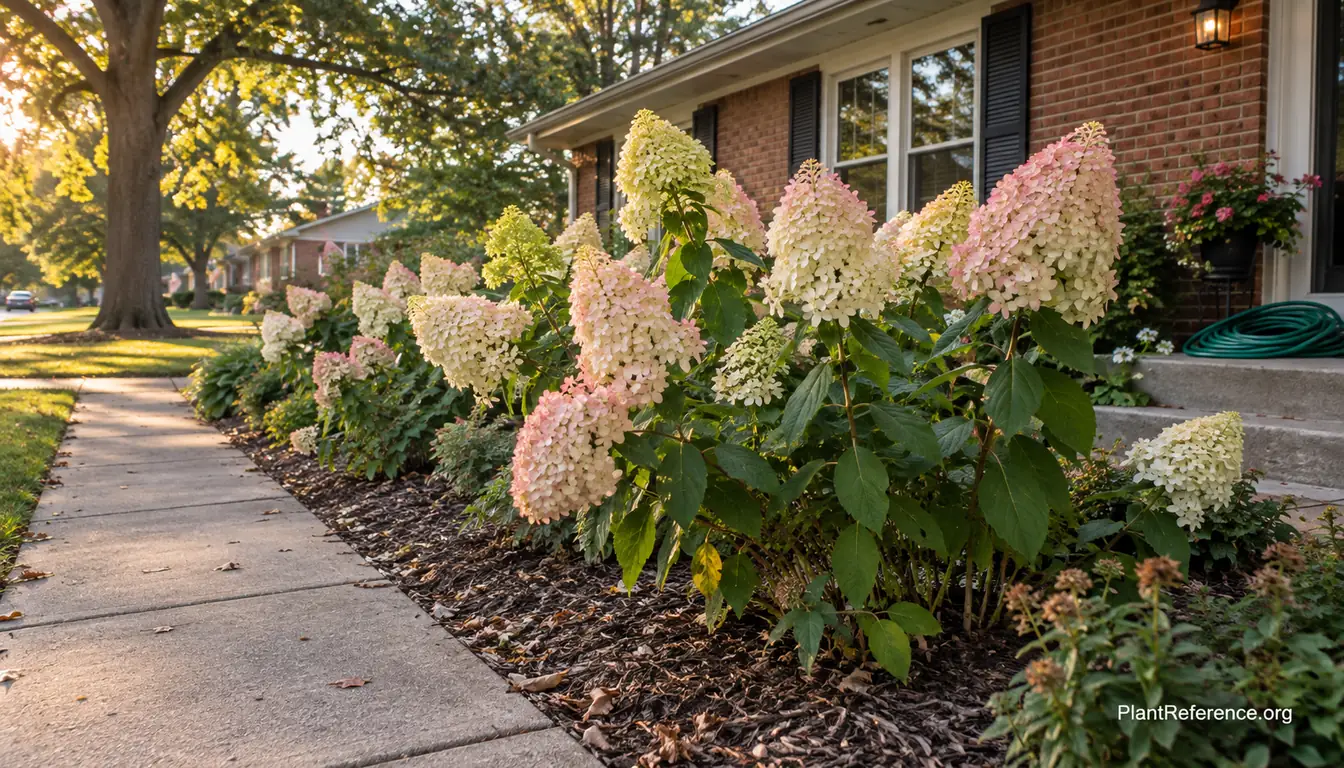
— Image © PlantReference.org 2026
If a customer walks into the nursery wanting a hydrangea that will bloom every single year, I steer them to the panicle hydrangea. It shrugs off Zone 3 winters, handles full sun, and flowers on new wood, so a hard freeze, a late frost, or an overeager pruner can't take away the summer show. This guide covers the best varieties, from pocket-size Hydrangea paniculata 'Bobo' to the classic 🌿Hydrangea paniculata 'Limelight', and exactly how to grow them.
Why Panicle Hydrangeas Are the Most Reliable Hydrangea
I've spent a long career answering the same question at the register: "Why didn't my hydrangea bloom?" Nine times out of ten, the customer bought a bigleaf hydrangea, and a cold winter or a spring pruning took out the flower buds. I almost never hear that complaint about a panicle hydrangea.
The reason is biology. The panicle hydrangea 🌿Hydrangea paniculata (hy-DRAN-juh pan-ik-yoo-LAY-tuh) forms its flower buds on stems that grow in spring and early summer. Nothing that happens in winter matters to the flowers, because the flowers don't exist yet. You can prune it hard in March, lose every stem tip to a January cold snap, or have deer nibble it in April, and you'll still get full-size blooms by midsummer.
Here's what makes this species the workhorse of the hydrangea family:
Cold hardy in Zones 3-8, the widest cold tolerance of any common hydrangea
The most sun-tolerant hydrangea, thriving in full sun across the northern half of the country
Blooms on new wood, so pruning mistakes and winter damage don't cost you flowers
Flower color changes with the season, not soil pH, so no amendments are needed
Can be grown as a shrub, a hedge, a container plant, or a small tree
That's why paniculata is the first recommendation for cold-climate gardeners in Minnesota, Wisconsin, and the northern Plains. It also earns a spot farther south, as long as you give it some afternoon shade where summers run hot.
How to Identify a Panicle Hydrangea
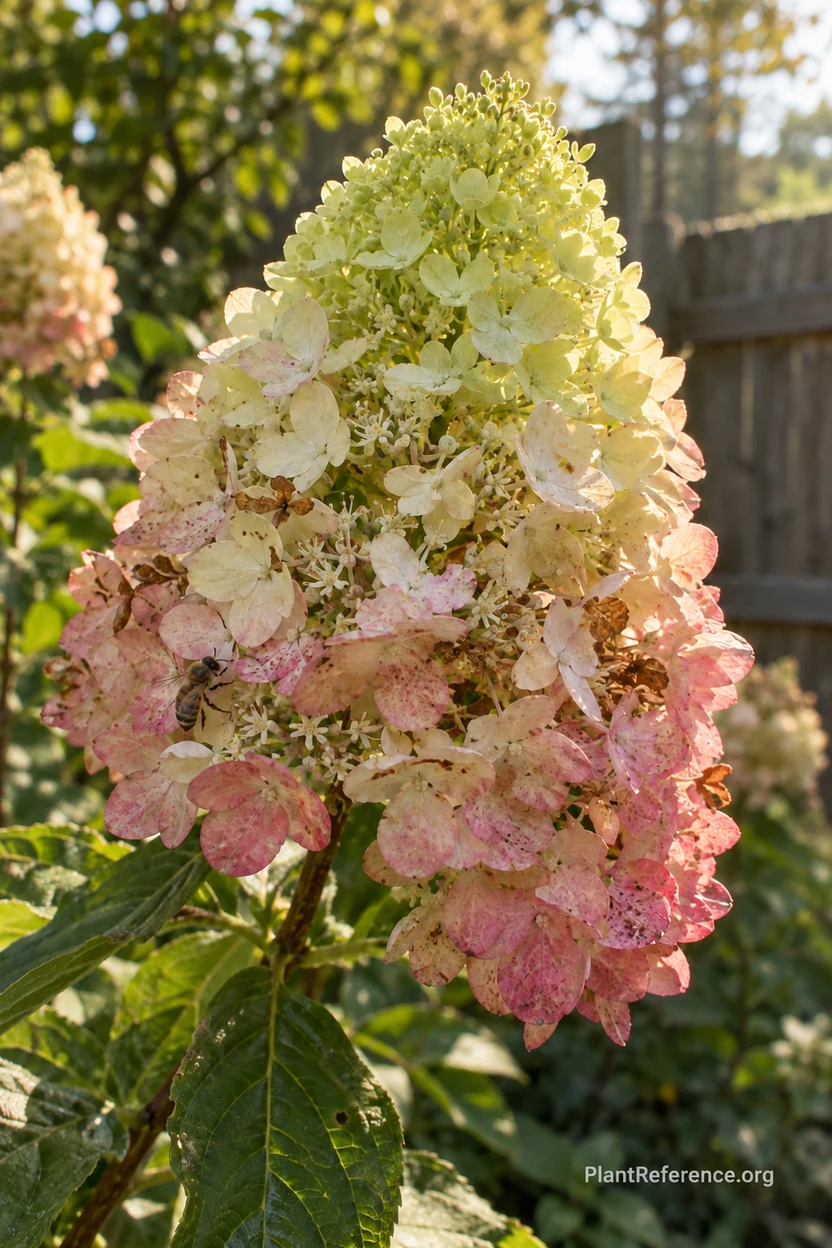
Panicle hydrangeas are easy to tell apart once you know what to look for. The name comes from the flower shape: a panicle is a branched, cone-shaped cluster, broader at the base and tapering to a point. That cone is the giveaway.
Leaves are oval, 3-6 inches (8-15 cm) long, and somewhat rough to the touch, noticeably smaller and thinner than the glossy leaves of a bigleaf hydrangea. Stems are woody and upright, with reddish-brown bark on older wood.
Each flower cone is a mix of two kinds of florets. Large, showy sterile florets provide the color, while small fertile florets tucked among them produce pollen and nectar. Cultivars with more fertile florets, like 🌿Hydrangea paniculata 'Tardiva', draw plenty of bees, which fits nicely into the approach in Best Perennials for Pollinators: Bees & Butterflies.
The Color Show
Most panicle hydrangeas open white or lime-green in midsummer, then age through cream, pink, rose, and sometimes burgundy as fall arrives. Cool nights and bright sun deepen those colors. Soil pH has no effect on paniculata flower color, so you can skip the aluminum sulfate entirely.
The Best Panicle Hydrangea Varieties
Breeders have given us dozens of paniculata cultivars. These are the ones I recommend most often, based on years of watching what comes back to the nursery happy and what comes back with complaints.
Limelight: The Gold Standard
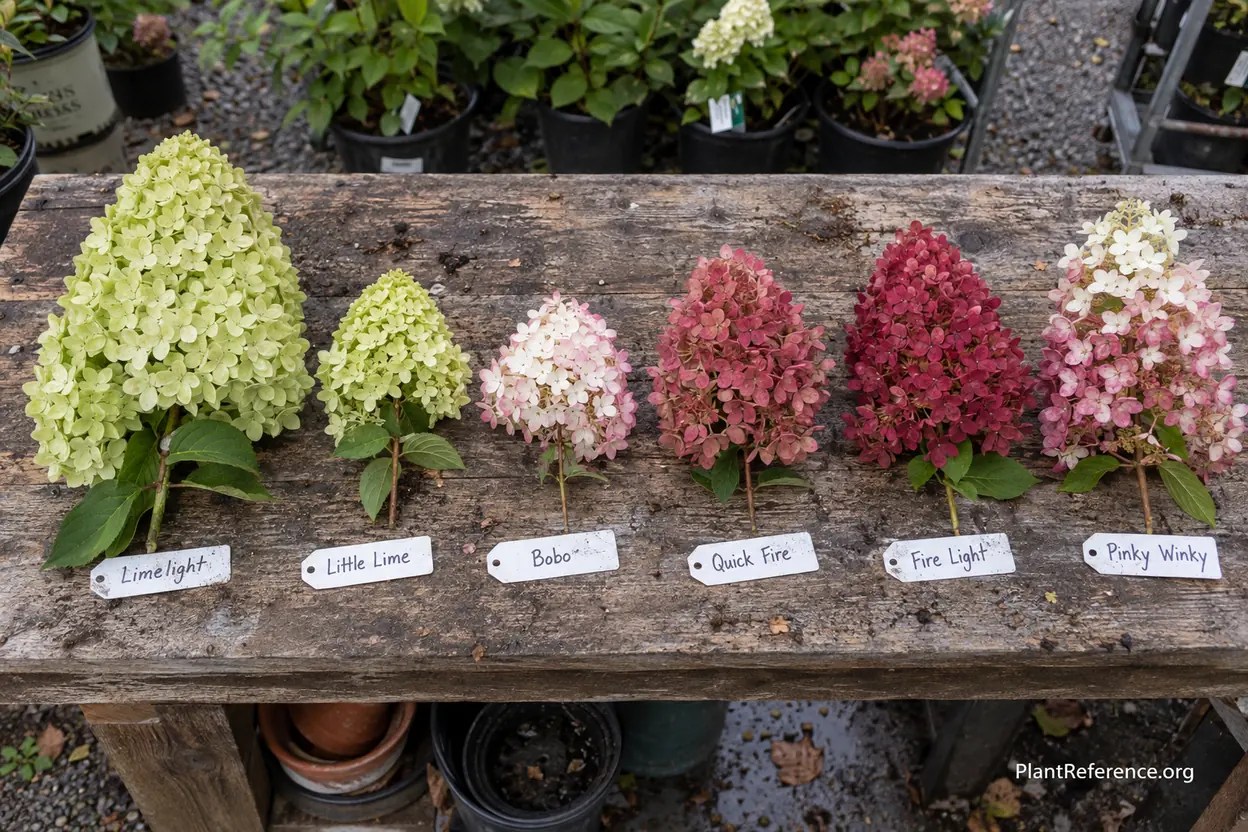
🌿Hydrangea paniculata 'Limelight' is the most popular panicle hydrangea for good reason. Its big, dense cones open chartreuse, turn creamy white in late summer, then blush pink and ruby as fall arrives. It grows 6-8 feet (1.8-2.4 m) tall and wide, and its sturdy stems hold the heavy flowers well once the shrub is established. It performs consistently in independent trials and in customers' yards alike.
Little Lime: Limelight for Smaller Yards
Hydrangea paniculata 'Little Lime' gives you the same color progression at 3-5 feet (0.9-1.5 m). I send a lot of these home with people who fell in love with Limelight but have a narrow foundation bed. It's also one of the best panicle hydrangeas for large containers.
Bobo: The Compact Bloom Machine
Hydrangea paniculata 'Bobo' is a Belgian-bred dwarf that stays about 2-3 feet (60-90 cm) tall. The white flowers age to pink and cover the plant so thickly you can barely see foliage. It's my go-to answer for front borders, small patios, and containers.
Quick Fire: The Early Bloomer
🌿Hydrangea paniculata 'Quick Fire' starts blooming in June, about a month ahead of most panicle hydrangeas. Flowers open white and turn deep pinkish-red early in the season. At 6-8 feet (1.8-2.4 m), it's a good way to stretch your hydrangea season if you plant it alongside later cultivars.
Fire Light: Strong Stems, Deep Red
🌿Hydrangea paniculata 'Fire Light' has large, full panicles on very strong stems that resist flopping. The white flowers age to a rich pomegranate red. It reaches 6-8 feet (1.8-2.4 m) and is my pick when a customer wants dramatic fall color without staking.
Pinky Winky: The Two-Tone
Hydrangea paniculata 'Pinky Winky' produces a bicolor effect: new white florets keep opening at the tip while the lower florets turn deep pink. It grows 6-8 feet (1.8-2.4 m) and makes a real statement at the back of a border.
Grandiflora (PeeGee): The Heritage Giant
🌿Hydrangea paniculata 'Grandiflora', the old PeeGee hydrangea, is the oldest widely grown panicle cultivar. It can reach 10-25 feet (3-7.6 m) and is often seen trained as a small tree in older neighborhoods. It needs room, but few shrubs give you that much flower for so little fuss.
Tardiva: The Late-Season Choice
🌿Hydrangea paniculata 'Tardiva' blooms late, in late summer into early fall, with looser, lacier cones that are popular with pollinators. Plant it alongside 🌿Hydrangea paniculata 'Quick Fire' and you'll have panicle hydrangea flowers from June to frost. Pairing bloom times is the same idea you'll find in Plan a Perennial Garden That Blooms Spring to Fall.
Panicle Hydrangea Size Comparison Chart
Picking the right size is the most important decision you'll make. The most common mistake I see is a full-size shrub squeezed into a 3-foot (90 cm) bed, followed by years of hacking it back.
Variety | Height x Width | Bloom Start | Flower Color Progression | Best Use |
|---|---|---|---|---|
Hydrangea paniculata 'Bobo' | 2-3 ft (60-90 cm) | July | White to pink | Containers, front borders |
Hydrangea paniculata 'Little Lime' | 3-5 ft (0.9-1.5 m) | July | Lime to cream to pink | Foundation beds, containers |
6-8 ft (1.8-2.4 m) | July | Lime to cream to pink-ruby | Specimen, hedge, tree form | |
6-8 ft (1.8-2.4 m) | June | White to deep pinkish-red | Early color, hedge | |
6-8 ft (1.8-2.4 m) | July | White to pomegranate red | Specimen, strong stems | |
Hydrangea paniculata 'Pinky Winky' | 6-8 ft (1.8-2.4 m) | July | White tips over pink base | Back of border |
8-10 ft (2.4-3 m) | August | White to light pink | Late season, pollinators | |
10-25 ft (3-7.6 m) | July | White to pink-bronze | Tree form, large spaces |
Bloom start dates shift a couple of weeks depending on your zone, earlier in the South and later in the North. All of these are hardy in Zones 3-8.
Where and How to Plant Panicle Hydrangeas
Sun Requirements
Panicle hydrangeas are the most sun-tolerant hydrangeas you can buy. In Zones 3-6, plant them in full sun, meaning at least 6 hours of direct light, and they'll produce their biggest, most colorful blooms. In Zones 7-8, especially in hot, dry areas, a spot with morning sun and light afternoon shade keeps foliage from scorching and flowers from browning early.
Too much shade is the most common reason a paniculata underperforms. Fewer than 4-5 hours of sun gives you floppy stems and sparse flowers.
Soil
Paniculata tolerates a wide range of soils, from clay to loam, and a broad pH range. What it won't tolerate is standing water. Choose a spot that drains within a few hours after a heavy rain. In heavy clay, work compost into the planting area rather than just the hole, so roots don't end up sitting in a bathtub.
Planting Steps
Spring and early fall are the best times to plant. Give the roots at least six weeks to settle before the ground freezes.
Dig a hole two to three times as wide as the root ball and no deeper than it
Loosen circling roots with your fingers or make a few vertical cuts on badly root-bound plants
Set the plant so the top of the root ball sits level with the surrounding soil
Backfill with native soil, firm gently, and water deeply
Spread 2-3 inches (5-8 cm) of mulch over the root zone, keeping it a few inches off the stems
Space full-size cultivars 6-8 feet (1.8-2.4 m) apart as individual shrubs, and dwarf types 3-4 feet (90-120 cm) apart. Panicle hydrangeas look good with ornamental grasses, coneflowers, and sedums; Perennial Combinations That Look Good Together has more pairing ideas.
Watering, Feeding, and Seasonal Care
Watering
Hydrangeas have shallow, fibrous roots, and they're usually the first shrubs in the yard to wilt in a dry spell. Aim for about 1-2 inches (2.5-5 cm) of water per week from rain or irrigation during the first two growing seasons. Water deeply at the base once or twice a week rather than a quick sprinkle every day.
Once established, panicle hydrangeas handle short dry spells better than bigleaf types, but they still bloom best with steady moisture. A little afternoon wilting on a hot day that recovers by evening is normal.
Fertilizing
Panicle hydrangeas are light feeders. A single application of balanced slow-release fertilizer in spring, as new growth begins, is plenty for most gardens. Too much nitrogen gives you lush leaves, weaker stems, and fewer flowers. Skip fertilizer after midsummer so the plant can harden off before winter.
Winter Care
In the ground, panicle hydrangeas need no winter protection in Zones 3-8. Leave the dried flower heads on through winter for structure; they look terrific with a cap of snow. Containers are different, since roots in a pot are far more exposed to cold. Move potted plants against a sheltered wall or into an unheated garage in Zones 3-5. How to Prepare Perennial Gardens for Winter by Species covers the rest of the fall cleanup.
How to Prune Panicle Hydrangeas
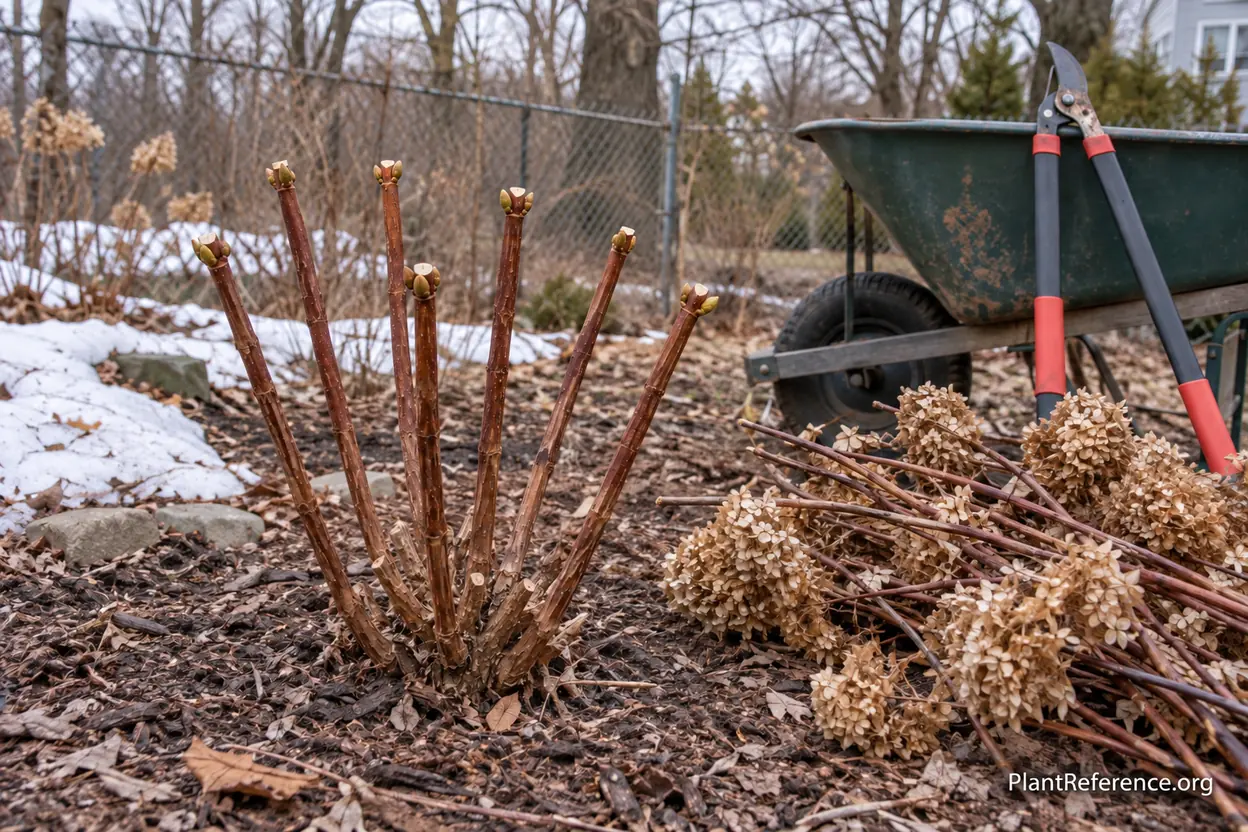
Pruning a panicle hydrangea is about as low-risk as garden chores get. Because it flowers on new wood, prune in late winter or early spring before buds break, and you can't cut off that year's flowers.
Remove dead, damaged, and crossing stems at their base
Thin out stems thinner than a pencil, which produce weak, floppy flowers
Keep 5-10 strong, well-spaced main stems
Cut remaining stems back by one-third to one-half, just above a pair of buds
A harder cut gives fewer, larger flowers; a lighter cut gives more, smaller ones. With large cultivars like 🌿Hydrangea paniculata 'Limelight', I leave a framework of about 24-36 inches (60-90 cm). That creates thicker stems that hold up heavy blooms. Dwarfs like Hydrangea paniculata 'Bobo' barely need anything beyond a tidy. The same clean-cut principles apply across woody plants, as you'll see in How to Prune Roses: When and How to Prune Every Type of Rose.
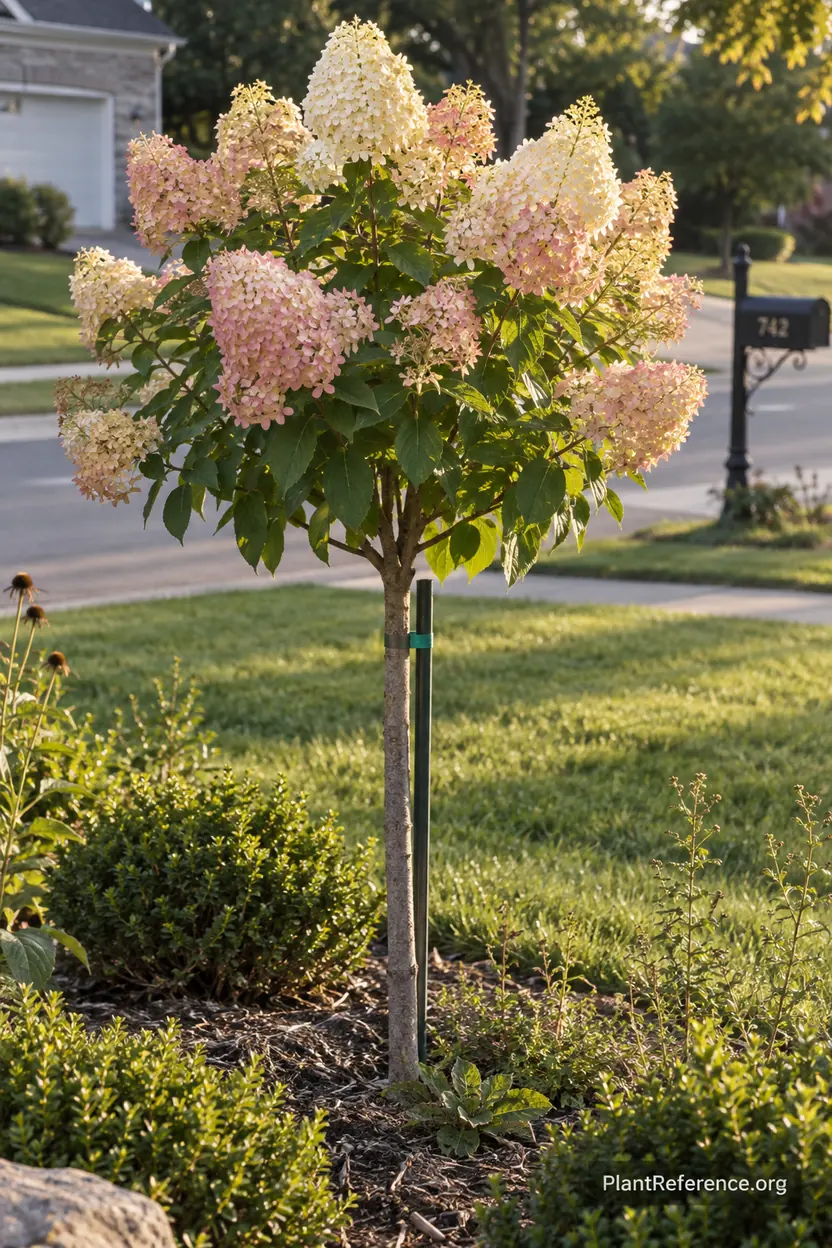
Training a Panicle Hydrangea Tree Form
Panicle hydrangea is the only hydrangea that trains reliably into a tree-form standard. You can buy one ready-made, but training your own is satisfying and takes about three years.
Starting a Tree Form
Choose a young plant with one strong, straight stem, or pick the best stem on an established shrub. Remove all the other stems at ground level. Drive a sturdy stake beside the chosen stem and tie it loosely at several points with soft tree tape.
As the stem grows, remove side shoots from the lower portion while leaving the top few sets of leaves to feed the plant. When the trunk reaches the height you want, usually 3-5 feet (0.9-1.5 m), pinch or cut the tip. That encourages branching into a rounded head.
Maintaining a Tree Form
Each late winter, cut the head branches back to two or three pairs of buds to keep the canopy compact and full. Remove any suckers from the base and shoots along the trunk as soon as you see them. Keep the stake in place for the first few years, because the heavy flower heads act like a sail in summer storms. 🌿Hydrangea paniculata 'Limelight', 🌿Hydrangea paniculata 'Quick Fire', and 🌿Hydrangea paniculata 'Grandiflora' are the most common tree-form choices. Structural thinking about trunks and scaffold branches is covered in more depth in Prescriptive Pruning: The PPQ Model for Structural Tree Care.
Using Panicle Hydrangeas as a Hedge
A row of panicle hydrangeas makes a flowering hedge that's green and lush in summer and covered in blooms from July to frost. It won't give you year-round privacy, since the shrubs drop their leaves in winter, but for a summer screen along a patio or property line, it's hard to beat.
Space plants closer than you would for individual specimens so they knit together. For full-size cultivars like 🌿Hydrangea paniculata 'Limelight', plant about 4-5 feet (1.2-1.5 m) on center. For a low hedge with Hydrangea paniculata 'Little Lime', 3 feet (90 cm) apart works well.
Prune the whole row at once in late winter to a consistent height so flowers form evenly across the top. Avoid shearing in summer, which cuts off developing flowers. A flowering hedge also makes a good low-mow edge along a lawn; Lawn Alternatives That Actually Work: 5 Options Beyond Grass has more ideas for shrinking turf.
Common Panicle Hydrangea Problems
Panicle hydrangeas are about as trouble-free as flowering shrubs get, but a few issues come up at the nursery counter every year.
Flopping Stems
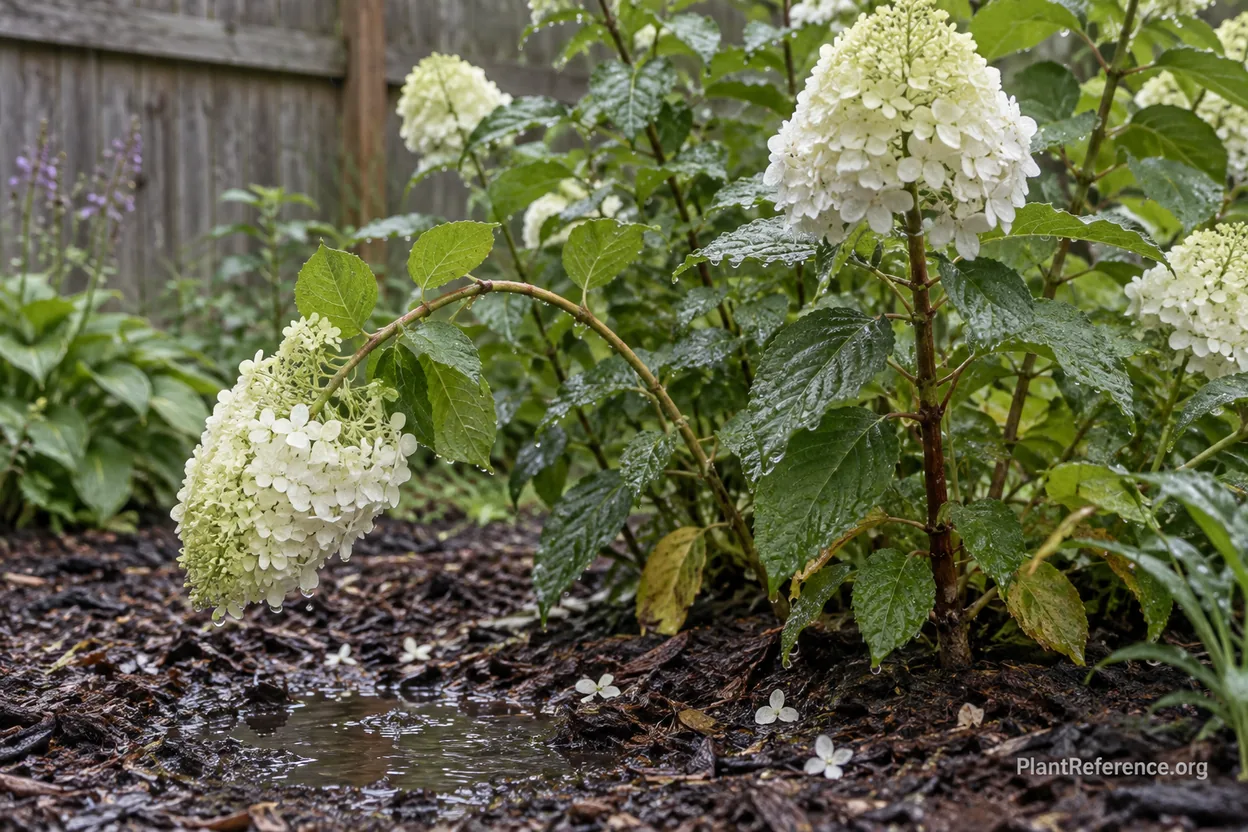
Heavy flowers, especially after rain, can bend stems to the ground. Keep a stronger framework when pruning, thin out weak stems, avoid excess nitrogen, and make sure the plant gets enough sun. Cultivars bred for strong stems, like 🌿Hydrangea paniculata 'Fire Light', flop least.
Few or Small Flowers
The usual culprits are too much shade, too much nitrogen, drought stress during bud development, or a very young plant still establishing roots. Give a newly planted shrub two seasons before judging it.
Browned Flowers and Scorched Leaves
In hot southern summers, flowers can brown quickly and leaf edges can crisp in full afternoon sun. Deep watering and mulch help, and a spot with afternoon shade prevents it.
Pests and Deer
Aphids and Japanese beetles occasionally feed on new growth and flowers. Hand-pick beetles into soapy water, and knock aphids off with a strong spray of water. Deer do browse panicle hydrangeas, but because flowers form on new wood, early-spring browsing rarely costs you the season. Late-summer browsing on flower buds is another story; see Deer-Resistant Perennials: A Zone-by-Zone Planting Guide for companions that help in deer country.
Choosing Low-Maintenance Companions
Once you've got a reliable panicle hydrangea anchoring a bed, surround it with plants that are just as easygoing. Best Low-Maintenance Perennials for Beginners: 10 Picks and Perennials That Bloom All Summer: 12 Longest Bloomers both offer good partners.
After all these years at the nursery, I still think the panicle hydrangea is the best value in the shrub aisle. Pick the right size, give it sun, prune it in late winter, and it'll bloom for you every summer for decades.
Frequently Asked Questions
Reading about plants and recognising them are different skills. These three build the second.
- Daily PlantIdentify the day’s mystery plant from a close-up photograph.
- Keyed OutWork a dichotomous key, lead by lead, to name a hidden specimen.
- Name That PlantName a specimen from botanical clues dealt hardest first.
Free to play, no account needed
Tagged with
Bill is a third-generation nurseryman who runs a small family garden center on the outskirts of Kansas City. His grandfather started the business in the 1960s, and Bill took over after working as an ag teacher for a decade. He knows the plants that work in the Kansas City area better than anyone—he's grown most of them himself and watched customers succeed or fail with the rest. Bill specializes in trees and shrubs for the Midwest, perennial borders that handle the region's hot summers and cold winters, and helping customers make sensible choices rather than impulse buys. He writes the way he talks to customers: patient, knowledgeable, and honest about what's worth the money and what isn't.