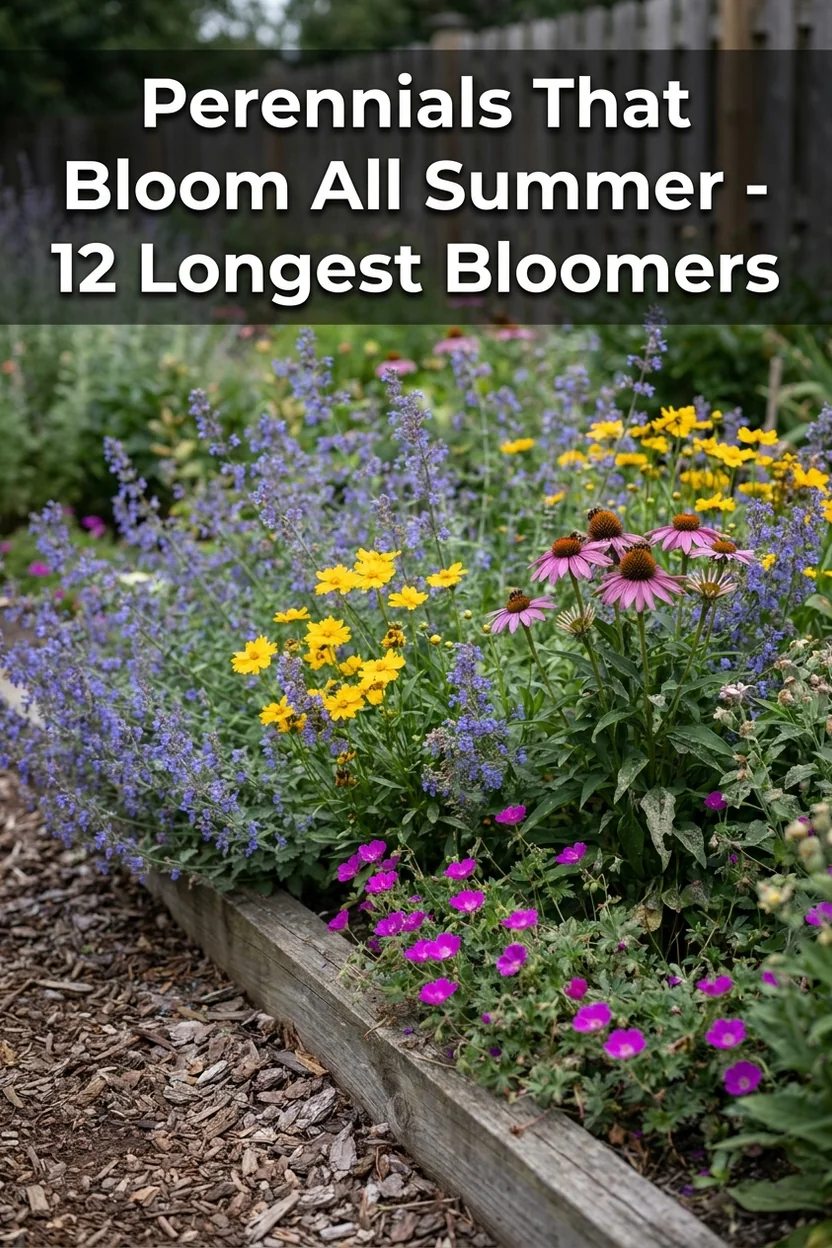
Perennials That Bloom All Summer: 12 Longest Bloomers
Pets & Toxicity
Recorded toxicity for plants linked in this guide. An unknown status is not a safety assessment.
Toxic to pets: Stella de Oro daylilyDetailsHide
Hemerocallis × 'Stella de Oro' — Toxicity Warning
Toxic to petsView Hemerocallis × 'Stella de Oro' plant profileCoreopsis verticillata 'Moonbeam' — Toxicity
Non-toxicView Coreopsis verticillata 'Moonbeam' plant profileLeucanthemum × superbum 'Becky' — Toxicity
Non-toxicView Leucanthemum × superbum 'Becky' plant profilePerovskia atriplicifolia 'Little Spire' — Toxicity
Non-toxicView Perovskia atriplicifolia 'Little Spire' plant profileHeuchera villosa 'Autumn Bride' — Toxicity
Non-toxicView Heuchera villosa 'Autumn Bride' plant profile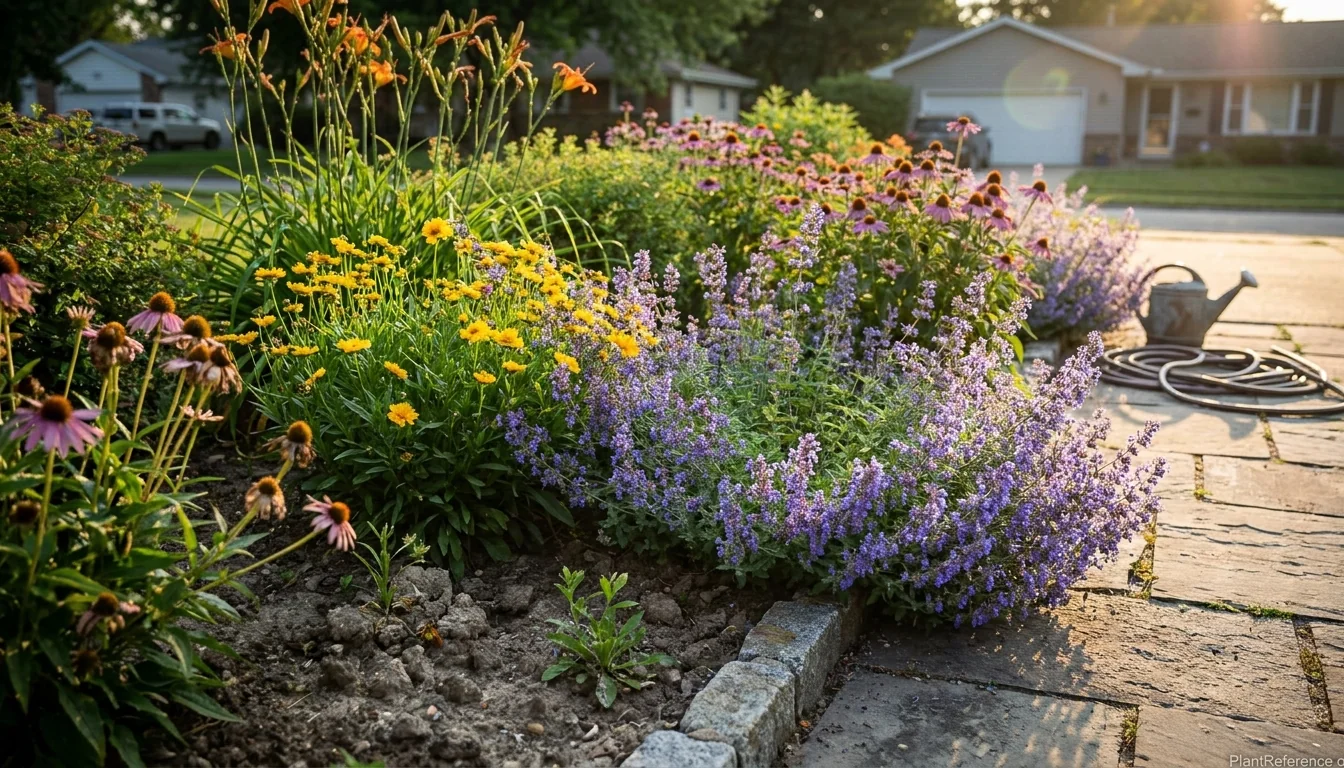
— Image © PlantReference.org 2026
Every spring somebody comes into the garden center holding a plant tag and asks me whether it really blooms all summer. Sometimes the answer is yes. More often the tag is describing what the plant does in a trial garden in Michigan with a full-time crew deadheading it. The perennials that bloom all summer in a normal backyard are a shorter list than the catalogs suggest, and knowing which ones actually deliver saves you a lot of money and a lot of disappointment in August.
What Actually Makes a Perennial Bloom All Summer
A plant flowers to make seed. Once seed is set, the hormonal signal to keep producing blooms shuts off. That single fact explains almost everything about long-blooming perennials.
The species with the longest bloom seasons are the ones that flower on new growth rather than on a single flush of buds formed the previous fall. Peonies and bearded iris form their buds months in advance, which is why they give you two glorious weeks and then quit no matter what you do. Catmint and coreopsis keep initiating new flower buds on new shoots all season, so every time you remove the spent flowers, the plant starts over.
The traits that predict a long bloom window:
Flowers borne on new growth, not on preformed buds
Sterile or low-fertility hybrids that never successfully set seed
Reblooming genetics, where the plant produces multiple flowering flushes per season
Basal foliage that stays intact after shearing, so the plant can regrow quickly
Heat tolerance, since most bloom failure in July and August is heat stress, not age
Sterility is the quiet hero here. Geranium wallichianum 'Rozanne' and 🌿Hemerocallis 'Stella de Oro' are both poor seed setters, and that failure to reproduce is exactly why they keep trying. It is worth understanding this before you shop, because it separates the genuine season-long bloomers from the plants that need constant intervention. If you want the full planning framework, Plan a Perennial Garden That Blooms Spring to Fall walks through the sequencing.
The 12 Longest-Blooming Perennials
These twelve are the ones I stock every year because customers come back and tell me they worked. Bloom windows below assume Zone 5 to 7 and normal deadheading.
Plant | Botanical Name | Bloom Window | Height | Zones | Light |
|---|---|---|---|---|---|
Catmint | Nepeta faassenii 'Walker's Low' | May-October, 16+ weeks | 24-30 in (60-75 cm) | 4-8 | Full sun |
Threadleaf coreopsis | June-September, 14 weeks | 18-24 in (45-60 cm) | 4-9 | Full sun | |
Hardy geranium | Geranium wallichianum 'Rozanne' | June-frost, 16+ weeks | 18-20 in (45-50 cm) | 5-8 | Sun to part shade |
Reblooming daylily | June-September, 12-14 weeks | 12-18 in (30-45 cm) | 3-9 | Full sun | |
Blanket flower | Gaillardia grandiflora 'Arizona Sun' | June-October, 14 weeks | 12-15 in (30-38 cm) | 3-9 | Full sun |
Yarrow | Achillea millefolium 'Moonshine' | June-September, 12 weeks | 18-24 in (45-60 cm) | 3-8 | Full sun |
Woodland sage | May-September, 12 weeks | 18-24 in (45-60 cm) | 4-8 | Full sun | |
Coneflower | July-September, 10 weeks | 30-36 in (75-90 cm) | 3-8 | Full sun | |
Black-eyed Susan | July-October, 12 weeks | 24-30 in (60-75 cm) | 3-9 | Full sun | |
Shasta daisy | July-September, 10 weeks | 36-40 in (90-100 cm) | 5-9 | Full sun | |
Russian sage | July-October, 12 weeks | 24-30 in (60-75 cm) | 4-9 | Full sun | |
Lavender | Lavandula angustifolia 'Sweet Romance' | June-September, 12 weeks | 12-18 in (30-45 cm) | 5-9 | Full sun |
Catmint
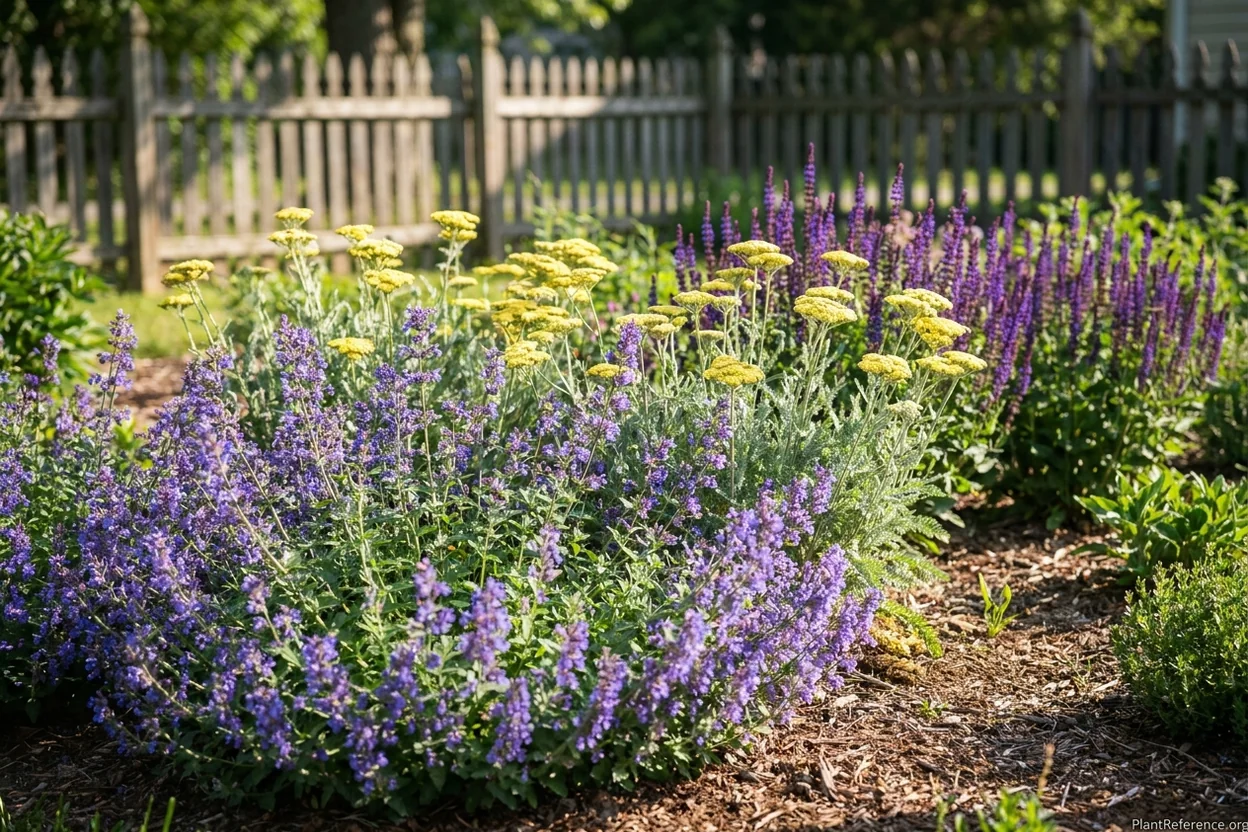
Nepeta faassenii 'Walker's Low' is the plant I recommend more than any other. It starts in May, and if you shear the whole mound back by half in early July, it reflowers within three weeks and carries to October. It handles heavy clay, tolerates drought once established, and deer leave it alone because of the aromatic oils in the foliage. Space plants 24 inches (60 cm) apart and give them room to flop.
Threadleaf Coreopsis
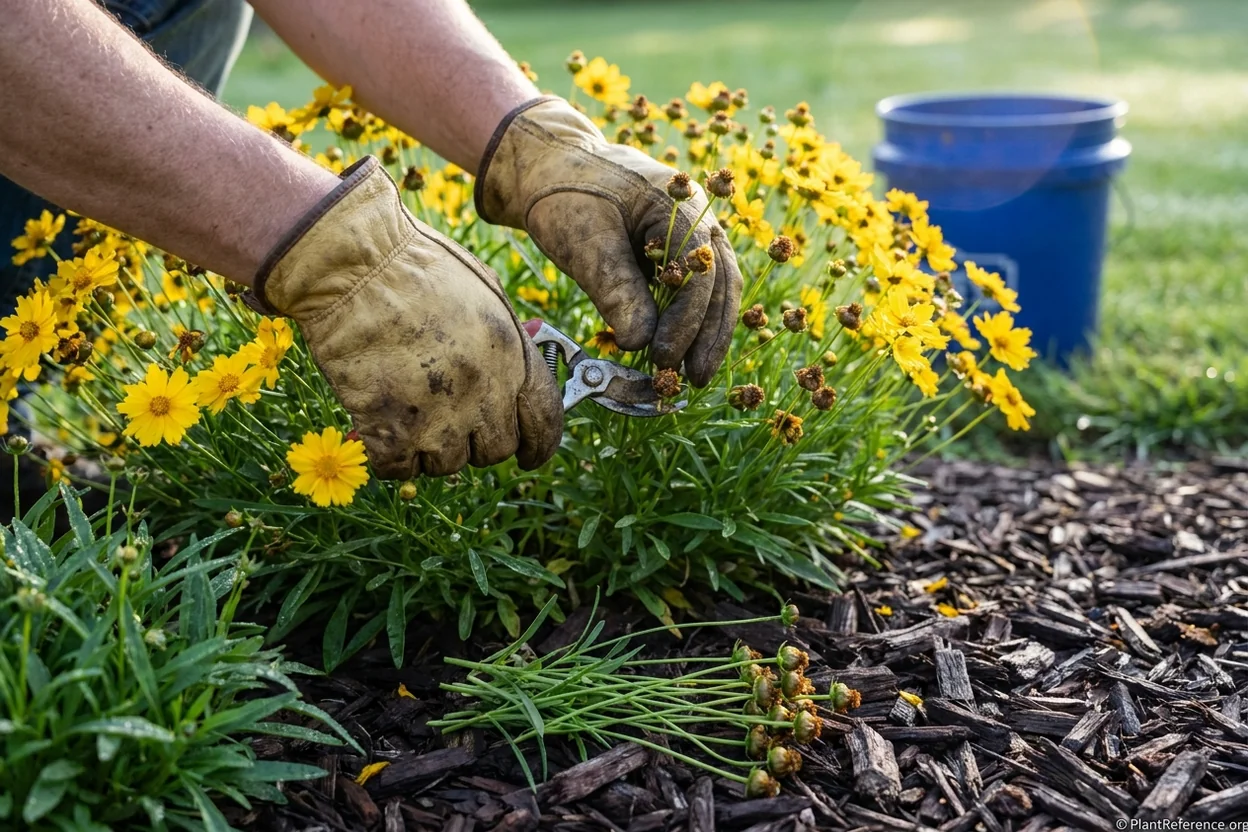
🌿Coreopsis verticillata 'Moonbeam' produces small pale yellow flowers over fine, ferny foliage from June through September. The threadleaf types are more heat-tolerant and longer-blooming than the large-flowered Coreopsis grandiflora selections, which tend to burn out in August. Shear 🌿Coreopsis verticillata 'Moonbeam' by one-third after the first heavy flush.
Hardy Geranium 'Rozanne'
Geranium wallichianum 'Rozanne' was named Plant of the Centenary by the Royal Horticultural Society, and the award was earned. Violet-blue flowers appear in June and do not stop until frost, with no deadheading required at all because the plant is functionally sterile. It spreads to 24-30 inches (60-75 cm) wide and weaves through neighboring plants rather than crowding them out.
Reblooming Daylily
🌿Hemerocallis 'Stella de Oro' changed landscape design when it was introduced, and it remains the most reliable rebloomer in the genus. Each flower lasts one day, but a mature clump pushes scape after scape from June into September. Remove spent scapes at the base to keep new ones coming. Divide every three to four years, as covered in How to Grow Daylilies: The Complete Guide to Division, or bloom count drops sharply. If yours have already slowed, Why Your Daylilies Stopped Blooming (And How to Fix It) covers the usual causes.
Blanket Flower
Gaillardia grandiflora 'Arizona Sun' is a short-lived perennial, which is the honest caveat. You may get three good years out of a plant. But those three years deliver red and gold daisies from June until hard frost in poor, dry, rocky soil where almost nothing else blooms. Do not amend the soil richly and do not overwater.
Yarrow
Achillea millefolium 'Moonshine' carries flat sulfur-yellow flower heads over silver-gray foliage. Cut the stems back to the basal foliage after the first flush and it repeats through September. Yarrow flops in rich soil and stands upright in lean soil, which is the opposite of what most gardeners expect.
Woodland Sage
🌿Salvia nemorosa 'May Night' is among the earliest perennials to flower, opening deep violet spikes in May. Left alone it finishes in June. Cut the spent spikes to the basal rosette and it reblooms through September. It belongs to the mint family, so deer and rabbits generally pass it by, which makes it a good perimeter plant in the buffer strategy described in Deer-Resistant Perennials: A Zone-by-Zone Planting Guide.
Coneflower
🌿Echinacea purpurea 'Magnus' carries 3 to 4 inch (7.5-10 cm) blooms on stems sturdy enough to skip staking. Its deep fibrous roots push through heavy clay and find moisture in drought. Deadhead through August to extend bloom, then stop and leave the cones standing for goldfinches. How to Grow Coneflowers (Echinacea) That Feed Pollinators gets into the pollinator side in more depth.
Black-eyed Susan
🌿Rudbeckia fulgida 'Goldsturm' is the workhorse of the late summer border, blooming from July into October when much of the garden is winding down. The fuzzy stems and leaves deter deer. It spreads slowly by rhizome, so give it 24 inches (60 cm) of space and expect to divide every four years.
Shasta Daisy
🌿Leucanthemum superbum 'Becky' is the one Shasta daisy that does not flop in a summer thunderstorm. Its 36 to 40 inch (90-100 cm) stems stay upright without staking, and the classic white daisies run July through September if deadheaded weekly. It needs sharp drainage in winter more than it needs anything else.
Russian Sage
🌿Perovskia atriplicifolia 'Little Spire' produces a haze of lavender-blue flowers on silver stems from July into October. The compact selection stays around 30 inches (75 cm) instead of the 4 feet (120 cm) the species reaches, which keeps it from splitting open in the middle of a bed. Cut it to 6 inches (15 cm) in spring, never in fall.
Lavender
Lavandula angustifolia 'Sweet Romance' blooms in June, and shearing the spent wands immediately brings a second flush in August. Lavender fails from drainage problems far more often than from cold. It needs full sun, gritty soil, and no mulch pressed against the crown. If you have lost one before, Why Your Lavender Died and How to Prevent It Next Time explains the usual sequence.
Long Bloomers for Part Shade
Almost every genuinely season-long perennial wants full sun. Shade gardens work on foliage contrast rather than continuous bloom, and pretending otherwise leads to disappointment. That said, three plants stretch further into shade than most:
Geranium wallichianum 'Rozanne' blooms well in four to six hours of morning sun, though flower count drops roughly a third
🌿Astilbe chinensis 'Visions' gives four to six weeks of plumes in July and August in moist shade, longer than most astilbes
🌿Heuchera villosa 'Autumn Bride' carries airy white flower spikes from August into October over evergreen foliage
For a shade bed, layer these with hostas and ferns and let texture do the work. Best Perennials for Shade: 12 Species That Thrive covers the full palette, and How to Grow Hostas: Varieties, Care & Pest Solutions handles the slug problem that comes with damp shade.
Deadheading and the Midsummer Shear
There are two separate techniques here and gardeners tend to conflate them.
Deadheading means removing individual spent flowers before seed forms. Do it every 10 to 14 days on 🌿Leucanthemum superbum 'Becky', 🌿Echinacea purpurea 'Magnus', Gaillardia grandiflora 'Arizona Sun', and 🌿Rudbeckia fulgida 'Goldsturm'. Cut back to the next leaf node or lateral bud rather than snipping the flower off at the top of a bare stem.
The midsummer shear is more aggressive. When a mounding plant like Nepeta faassenii 'Walker's Low', 🌿Coreopsis verticillata 'Moonbeam', or 🌿Salvia nemorosa 'May Night' finishes its main flush and starts looking tired, cut the entire plant back by one-third to one-half with hedge shears. It looks brutal for about ten days. Then it produces fresh basal growth and a second bloom cycle that carries to frost.
Timing matters. Shear too late in the season and the plant puts energy into soft growth that will not harden before winter. My rule for Zone 6 is to stop shearing after August 15.
Deadhead individual blooms: every 10-14 days, June through August
Midsummer shear of mounding plants: early to mid July, cut back one-third to one-half
Water deeply immediately after shearing to support regrowth
Stop all shearing six weeks before your average first frost
Leave 🌿Echinacea purpurea 'Magnus' and 🌿Rudbeckia fulgida 'Goldsturm' seed heads standing after September for birds
That last point matters more than it sounds. The cones on 🌿Echinacea purpurea 'Magnus' are oil-rich and feed goldfinches through winter. When to Cut Back Perennials in Fall (And What to Leave) breaks down the fall decision species by species.
Designing a Bed That Never Goes Blank
Twelve long-blooming plants do not automatically make a good bed. The mistake I see most often is buying one of everything and scattering them, which reads as noise from ten feet away.
Plant in groups of three or five of the same cultivar. Repeat those groups down the length of the bed. Anchor the rhythm with one plant that holds structure all season, which is usually 🌿Perovskia atriplicifolia 'Little Spire' or an ornamental grass.
Then layer for succession so that no single week depends on one species:
May to June: 🌿Salvia nemorosa 'May Night' and Nepeta faassenii 'Walker's Low' open the season
June to July: 🌿Coreopsis verticillata 'Moonbeam', Achillea millefolium 'Moonshine', and 🌿Hemerocallis 'Stella de Oro' take over
July to August: 🌿Echinacea purpurea 'Magnus', 🌿Leucanthemum superbum 'Becky', and Lavandula angustifolia 'Sweet Romance' peak
August to October: 🌿Rudbeckia fulgida 'Goldsturm' and 🌿Perovskia atriplicifolia 'Little Spire' carry the finish
All season: Geranium wallichianum 'Rozanne' and Gaillardia grandiflora 'Arizona Sun' fill every gap
Height layering is the other half. Put 🌿Leucanthemum superbum 'Becky' and 🌿Echinacea purpurea 'Magnus' at the back, mid-height plants in the middle, and let Nepeta faassenii 'Walker's Low' and Geranium wallichianum 'Rozanne' spill over the front edge to hide bare legs. Perennial Combinations That Look Good Together has worked examples if you want a starting template, and Best Low-Maintenance Perennials for Beginners: 10 Picks is a reasonable first shopping list.
Soil, Water, and Feeding for a Long Season
A plant blooming for four months is running a much longer metabolic marathon than one blooming for two weeks, and it needs support to finish.
Work 2 to 3 inches (5-7.5 cm) of finished compost into the top 8 to 10 inches (20-25 cm) of the bed before planting. Most of these plants want a pH between 6.0 and 7.0. Lavender is the exception and prefers 6.7 to 7.3 with sharp drainage. If you are building a new bed from scratch, Best Soil Mix for Raised Beds: Creating the Perfect Growing Medium covers the ratios.
Water deeply and infrequently rather than lightly and often. Established perennials want 1 inch (2.5 cm) of water per week delivered in one or two soakings that penetrate 12 to 18 inches (30-45 cm). Shallow daily watering builds shallow roots that collapse in the first heat wave.
Feed lightly. One application of a balanced organic fertilizer in early spring, and a second half-rate application right after the midsummer shear, is enough. Heavy nitrogen produces lush foliage and fewer flowers, and it makes Achillea millefolium 'Moonshine' and 🌿Leucanthemum superbum 'Becky' flop.
Maintain 2 to 3 inches (5-7.5 cm) of shredded hardwood mulch, pulled back 2 inches (5 cm) from every crown. Mulch piled against a crown traps moisture and causes rot, which is the single most common way I see a healthy perennial killed by good intentions.
Zone Adjustments From 3 to 10
The twelve plants above are calibrated for Zones 5 through 7. Outside that band, a few things change.
In Zones 3 and 4, drop 🌿Leucanthemum superbum 'Becky' and Lavandula angustifolia 'Sweet Romance', both of which are marginal. Lean on 🌿Hemerocallis 'Stella de Oro', 🌿Rudbeckia fulgida 'Goldsturm', Gaillardia grandiflora 'Arizona Sun', and Achillea millefolium 'Moonshine', all hardy to Zone 3. Apply 2 to 3 inches (5-7.5 cm) of wood chips or evergreen boughs after the ground freezes, not before, to stop the freeze-thaw cycle from heaving young crowns out of the soil.
In Zones 8 through 10, heat rather than cold is the limit. Nepeta faassenii 'Walker's Low' and 🌿Salvia nemorosa 'May Night' stall during the hottest six weeks and resume in September. Give plants that tolerate part shade in the North genuine afternoon shade in the South. Gaillardia grandiflora 'Arizona Sun' and 🌿Perovskia atriplicifolia 'Little Spire' handle heat best of the twelve.
Everywhere, plan on division every three to five years. A clump that dies out in the center and blooms around the edges is telling you it is overcrowded. How to Divide Perennials: A Species-by-Species Guide covers the technique, and Best Tools for Dividing Perennials: Forks, Knives, Spades covers what to divide it with. Replace what you remove with compost, roughly a wheelbarrow of compost for every wheelbarrow of plant material taken out.
Buy fewer species and more of each. A bed with five well-chosen long bloomers repeated in groups will look better in August than a bed with twenty singles, and it will cost you less to fill.
Frequently Asked Questions
Reading about plants and recognising them are different skills. These three build the second.
- Daily PlantIdentify the day’s mystery plant from a close-up photograph.
- Keyed OutWork a dichotomous key, lead by lead, to name a hidden specimen.
- Name That PlantName a specimen from botanical clues dealt hardest first.
Free to play, no account needed
Tagged with
Bill is a third-generation nurseryman who runs a small family garden center on the outskirts of Kansas City. His grandfather started the business in the 1960s, and Bill took over after working as an ag teacher for a decade. He knows the plants that work in the Kansas City area better than anyone—he's grown most of them himself and watched customers succeed or fail with the rest. Bill specializes in trees and shrubs for the Midwest, perennial borders that handle the region's hot summers and cold winters, and helping customers make sensible choices rather than impulse buys. He writes the way he talks to customers: patient, knowledgeable, and honest about what's worth the money and what isn't.