Flower Identification Guide: Petals, Shape & Color Explained
Pets & Toxicity
Recorded toxicity for plants linked in this guide. An unknown status is not a safety assessment.
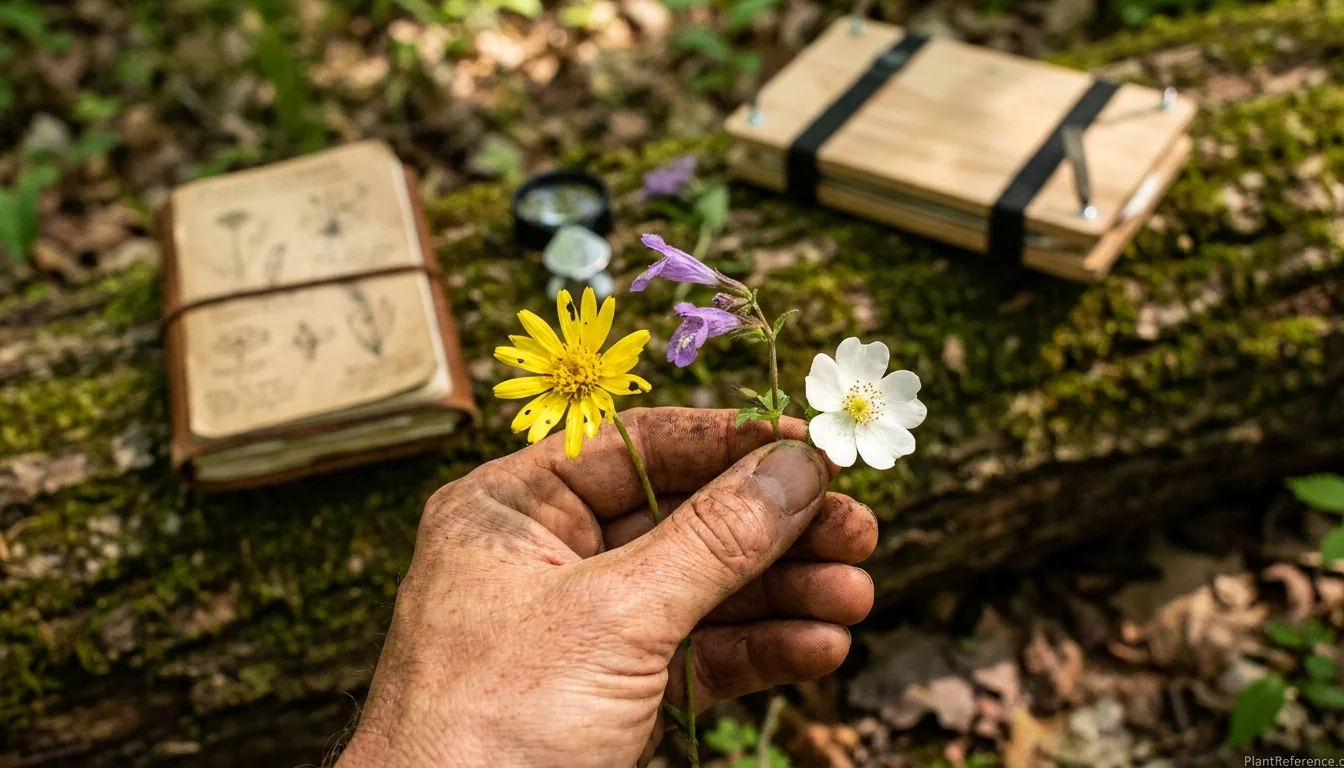
— Image © Plant Reference 2026
Most beginners try to identify flowers by color first—then get frustrated when their yellow-flower book contains 400 species. There's a better way, and it's the same approach botanists have used for centuries. Flowers and their reproductive structures are the most genetically conservative features of any plant, meaning they hold their shape across regions, soil types, and weather conditions in ways that leaves and stems don't. Once you learn to read floral architecture, you can place an unfamiliar flower into a family in under a minute and reach a confident species ID shortly after.
Why Flowers Are the Most Reliable Identification Trait
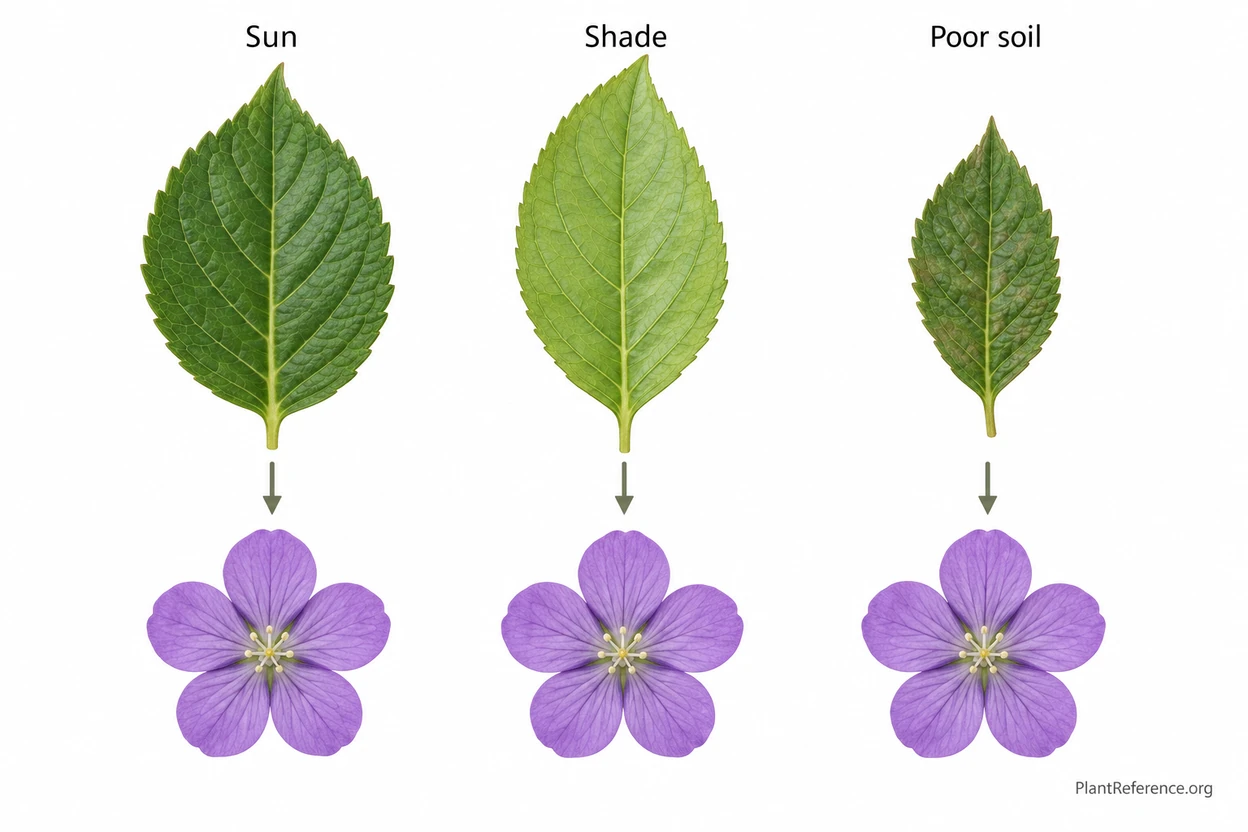
Leaves vary. A 🌿Acer rubrum (AY-ser RUB-rum) red maple growing in deep shade produces leaves twice the size of one in full sun, with different lobing patterns and color. The same plant in nutrient-poor soil might develop smaller, paler foliage with shorter petioles. This kind of phenotypic plasticity is the bane of leaf-only identification.
Flowers don't do this. The number of petals, the symmetry of the corolla, the position of the ovary relative to the other floral parts—these traits are encoded deep in the plant's developmental genetics and remain consistent across the entire geographic range of a species. When taxonomists construct keys to plant families, they almost always start with reproductive features for exactly this reason. As a field botanist, you'll benefit from the same logic.
This doesn't mean leaves are useless. They're a critical secondary filter once you've narrowed down a flower's family. But if a plant is in bloom, start with the flower. How to Identify Any Plant: A Beginner's Guide to Leaves, Flowers, and Stems covers the broader workflow for when you only have foliage to work with, and How to Identify Trees by Their Leaves: Shapes, Margins, and Venation Explained handles the related leaf-shape vocabulary you'll need for woody plants.
The Four Floral Whorls You Need to See
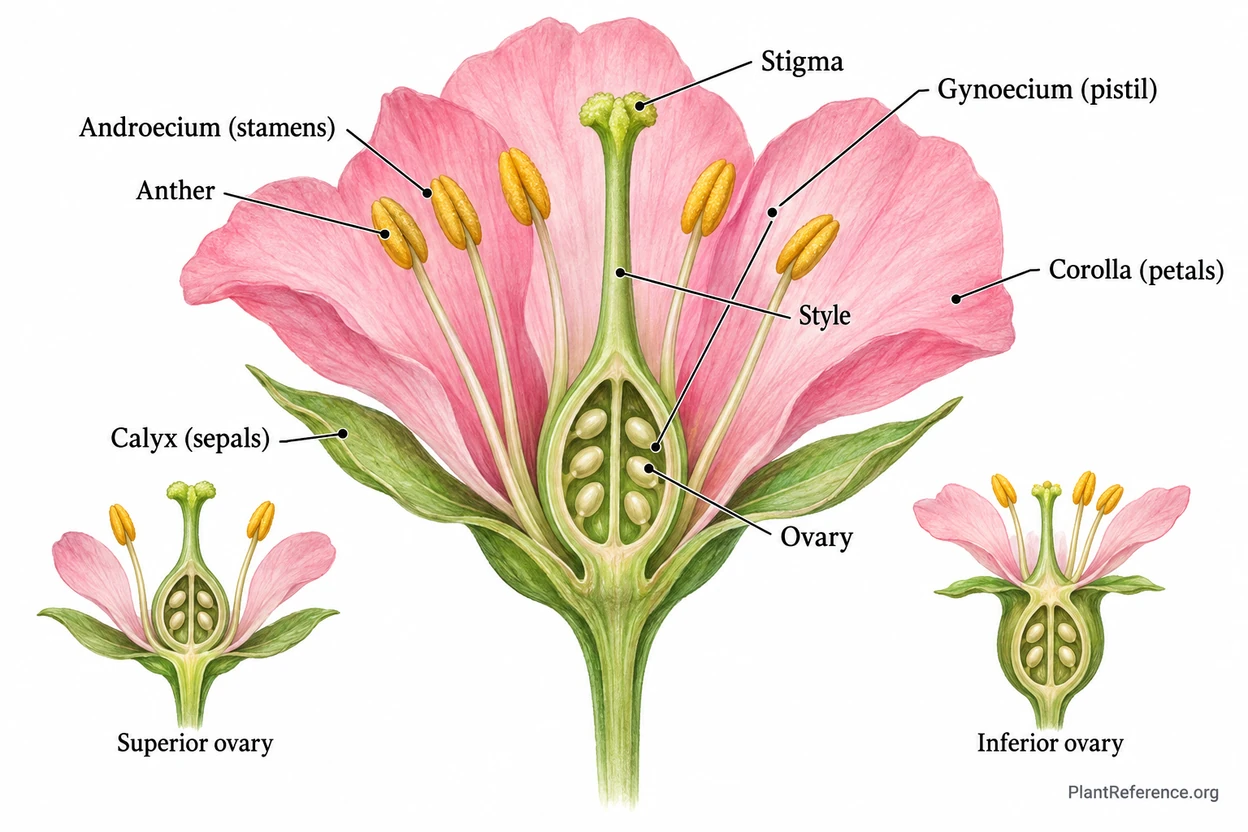
Every complete flower is built from four concentric rings, or whorls, of modified leaves. Recognizing all four trains your eye for the rest of this guide.
The calyx is the outermost whorl, composed of sepals—usually green and leaf-like, sometimes brightly colored. Sepals protect the developing bud. Pull back the outermost layer of any flower and you'll usually find them, even if they've turned brownish after the flower opens.
Inside the calyx sits the corolla, made of petals. This is what most people mean when they say "flower." Petals are often the showy, pollinator-attracting parts. Together the calyx and corolla form the perianth.
The reproductive whorls live at the center. The androecium (the "male" whorl) consists of stamens, each made of a stalk-like filament topped by a pollen-producing anther. Surrounding the very center is the gynoecium (the "female" whorl), made of one or more carpels or pistils. A typical pistil has three parts: a sticky stigma that catches pollen, a stalk called a style, and an ovary at the base containing future seeds.
The relative arrangement of these whorls is critical for family-level identification. When sepals, petals, and stamens attach below the ovary, the ovary is superior (hypogynous). When they attach above the ovary, it's inferior (epigynous). Apple flowers (Rosaceae) show a hybrid arrangement called perigynous, where a cup-shaped hypanthium surrounds the ovary without fusing to it—a Rosaceae hallmark you'll see repeatedly.
Floral Symmetry: The First Question to Ask
Symmetry is the single most useful diagnostic trait you can read on a flower. Hold the bloom face-on and ask: can I draw multiple lines through the center that divide it into mirror-image halves, or only one?
Actinomorphic (radial) flowers have multiple planes of symmetry, like a star or wheel. Roses, buttercups, lilies, and most mustards are radially symmetrical. You could rotate the flower 72° (for a five-petaled bloom) and it would look identical.
Zygomorphic (bilateral) flowers have only one plane of symmetry. They're shaped like a face or a mouth—orchids, snapdragons, peas, and members of the mint family. The asymmetry usually evolved alongside specialized pollinators like bees and hummingbirds that approach the flower from a specific direction.
Knowing whether a flower is actinomorphic or zygomorphic immediately rules out a large portion of the plant kingdom. Most peas (Fabaceae) and mints (Lamiaceae) are zygomorphic, while most roses (Rosaceae) and mustards (Brassicaceae) are actinomorphic. This single question can move you from "thousands of possibilities" to "a few dozen families."
A small note: a flower with five "petals" arranged radially but with one petal slightly larger or differently shaped is still considered zygomorphic. The plane of symmetry matters more than the count.
Counting Petals and Sepals
After symmetry, count. Petal number is one of the strongest family-level signals available, and it's usually conserved across an entire family of plants.
3 petals (or multiples of 3): Monocots—lilies (Liliaceae), irises (Iridaceae), orchids (Orchidaceae), and most grasses. The flower parts also typically come in multiples of three. Grass identification uses related vegetative traits—see What Type of Grass Do I Have? Identify Your Lawn in 5 Steps for the lawn-grass side.
4 petals: Mustards (Brassicaceae), evening primroses (Onagraceae), and dogwood "flowers" that are actually four white bracts surrounding a tiny true flower cluster.
5 petals (or multiples of 5): Roses (Rosaceae), mallows (Malvaceae), buttercups (Ranunculaceae), violets (Violaceae), and most eudicot families. By far the most common count.
Many petals (or "petal-like" structures): Often Asteraceae composite heads, where what look like petals are actually individual ray florets—each one a complete tiny flower.
The petal count is not always obvious. Composite heads (sunflowers, daisies, dandelions) look like single flowers with many petals, but each "petal" is itself a complete flower called a ray floret. The cluster of disk florets in the center is hundreds of tiny tube-shaped flowers. Recognizing a composite head as Asteraceae is itself a major identification step.
Sepals don't always look like sepals. In tulips and lilies, sepals and petals look identical—both are called tepals. In other species, the sepals are brightly colored and the true petals are reduced or absent. When sepals can be mistaken for petals, count all the perianth segments together and let symmetry guide your family choice.
Reading Inflorescence: How Flowers Are Arranged
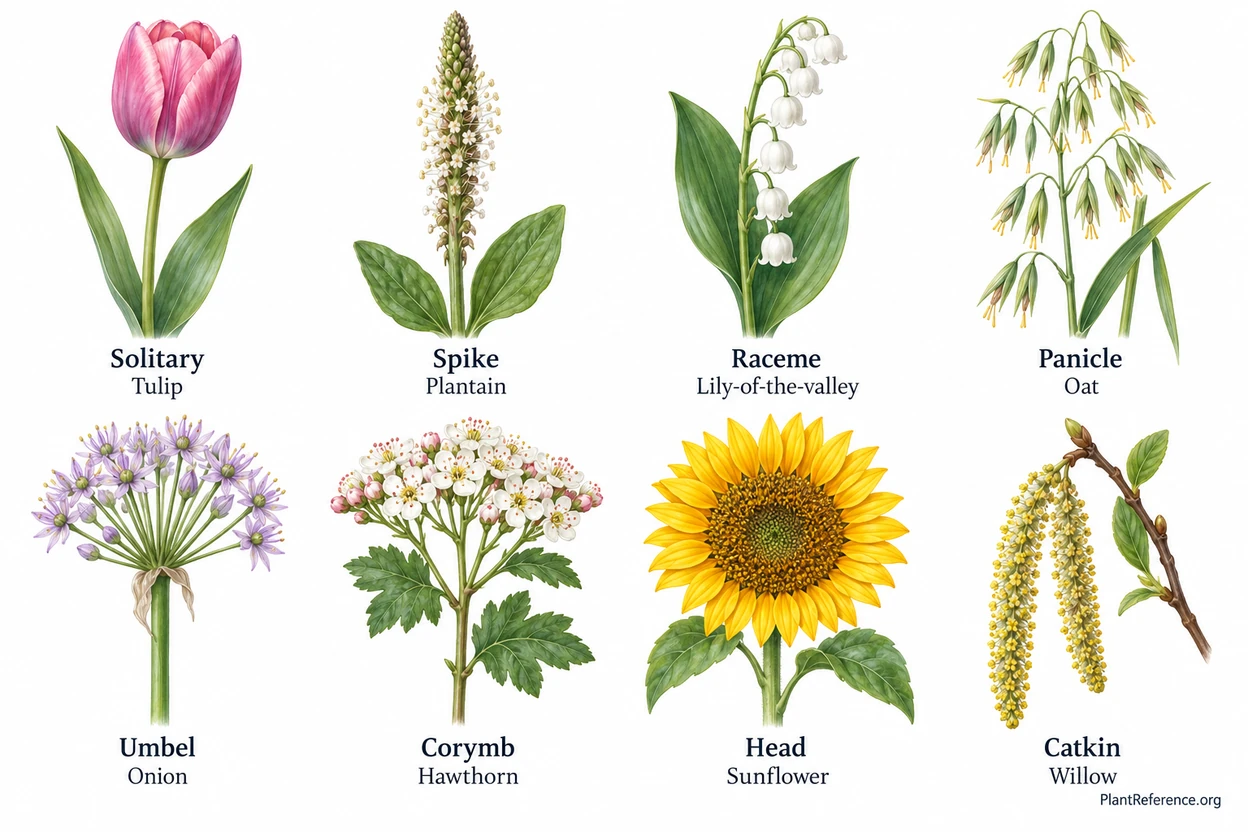
Plants don't always produce single flowers. The arrangement of multiple flowers on a stem—called the inflorescence—is itself a strong identification trait, often diagnostic at the family level.
Inflorescence | Structure | Examples |
|---|---|---|
Solitary | Single flower on a stem | Tulip, magnolia |
Spike | Flowers attached directly to a central axis with no stalks | Plantain, lavender |
Raceme | Flowers on short stalks along a central axis | Snapdragon, lily of the valley |
Panicle | A branched raceme | Lilac, oats |
Umbel | Flower stalks radiating from a single common point | Carrot, parsley, dill |
Corymb | Flat-topped cluster with outer stalks longer than inner | Yarrow, hawthorn |
Head (Capitulum) | Dense cluster of stalkless flowers on a common receptacle | Sunflower, daisy, dandelion |
Catkin | Spike-like, often hanging, falls as one unit | Willow, oak, birch |
Recognizing an umbel instantly narrows your search to the Apiaceae family (carrots, parsley, dill) or its relatives. A head (capitulum) points squarely to Asteraceae. A catkin indicates a wind-pollinated tree—usually willow, birch, oak, or alder. These shortcuts compress hours of trial-and-error into seconds of pattern matching. For wind-pollinated cone-bearing trees that lack true flowers entirely, How to Identify Conifers: Pines, Spruces, and Firs Simplified covers the cone-and-needle approach instead.
Color: Useful but Often Misleading
Color is the trait that most beginners reach for first, and it's the trait that most often leads them astray. The problem is that within a single species, flower color frequently varies—🌿Centaurea cyanus (sen-taw-REE-uh sy-AN-us), the classic blue cornflower, also produces white, pink, and purple selections in the same population. Garden cultivars multiply this variation tenfold.
That said, color is still useful as a final narrowing filter, especially in combination with the more reliable structural traits. A radially symmetric, five-petaled, yellow flower in a meadow is most likely buttercup (Ranunculaceae), Hypericum (St. John's wort), or one of several Potentilla species in the rose family. Color got you to a short list; structure tells you which one.
Use color carefully and check these caveats:
Faded flowers lose pigment over the bloom's lifespan. A flower that's now pale pink may have been deep red yesterday.
Albino forms exist in many normally pigmented species and can throw off ID by an entire color category.
Polymorphic species like trillium and columbine routinely produce multiple color forms in the same population.
Photographs distort color based on lighting, white balance, and time of day. The flower you're keying out by photo may not match the published reference image.
UV patterns are visible to pollinators but not to humans, meaning a flower that looks plain yellow may have a complex pattern that determines its species.
When using color-keyed field guides like Peterson or the National Audubon Society wildflower series, treat the color section as a starting point for browsing—not a final answer. Always confirm with structural features.
Major Flower Families to Recognize on Sight
The Pareto principle applies hard to plant identification: roughly 80% of the flowers you encounter in North America belong to maybe 20 families. Mastering the pattern signatures of these families is the single highest-leverage skill in field botany.
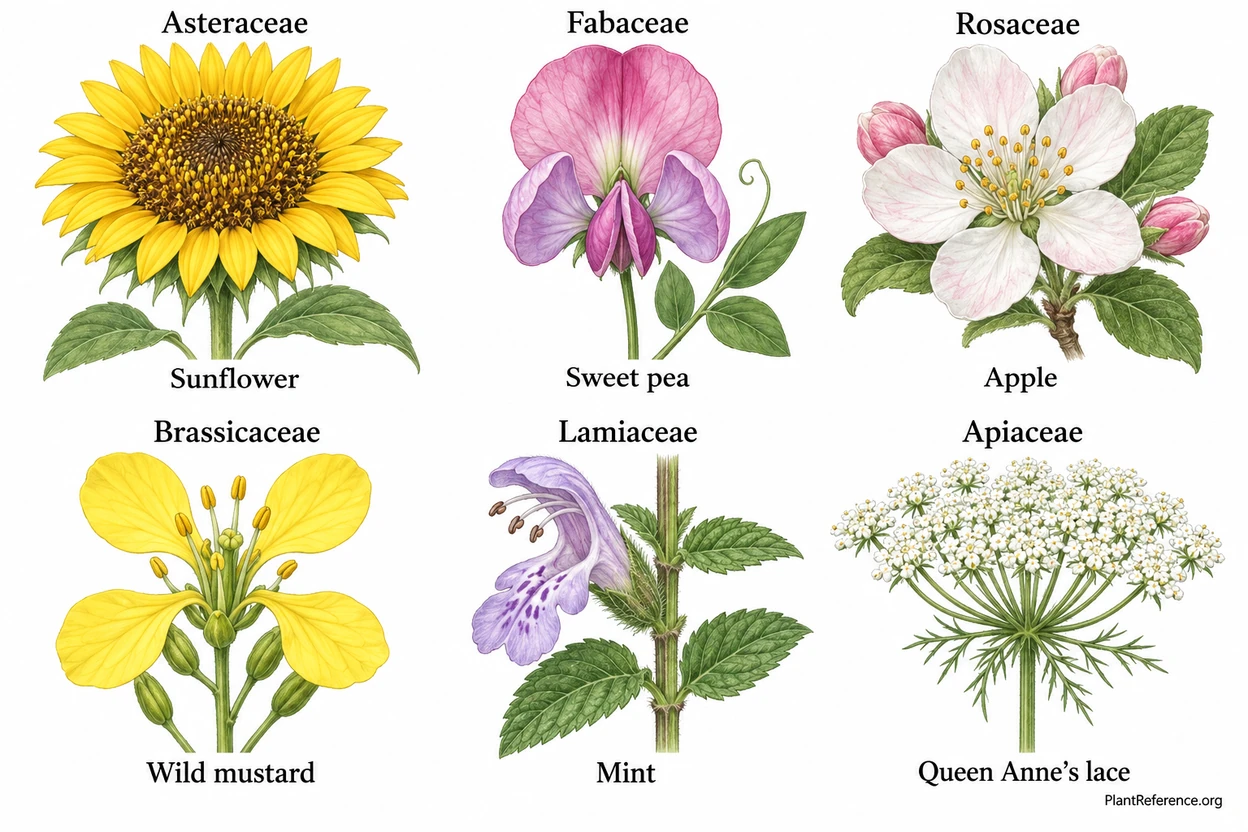
Asteraceae (Sunflower / Daisy Family)
The largest plant family in North America with over 23,000 species worldwide. Asteraceae heads look like single flowers but are actually dense clusters of many tiny flowers (florets) on a common receptacle. The "petals" around the edge are individual ray florets, each one a complete flower. The central button is a packed mass of tubular disk florets.
Asteraceae fruits are achene-like cypselas, often topped by a tuft of hairs or bristles called a pappus—the parachute on a dandelion seed is a pappus. If you see a "flower" with both ray petals around the edge and a central cluster of tiny tubes, you're almost certainly looking at an Asteraceae member.
Fabaceae (Pea / Legume Family)
The classic banner, wings, and keel flower structure makes Fabaceae one of the easiest families to spot. The upper petal is the banner (or standard), two side petals are the wings, and two lower petals fuse into a keel that encloses the reproductive organs. The fruit is a legume—a pod that splits along two seams when ripe.
Most legumes have compound leaves with small stipules at the petiole base. Many host nitrogen-fixing bacteria in root nodules, which is why farmers rotate beans, clover, and alfalfa with non-leguminous crops.
Rosaceae (Rose Family)
Five petals, five sepals, numerous stamens arranged in rings, and a hypanthium (cup beneath the flower). The Rosaceae signature shows up in apples, cherries, strawberries, raspberries, hawthorns, and ornamental roses. Leaves are usually alternate with serrated margins and distinct stipules.
Brassicaceae (Mustard Family)
The most distinctive flower shape in temperate North America: four petals in a cross or X pattern. Four sepals alternate with the petals. Inside you'll find six stamens—four tall and two short, called a tetradynamous arrangement. The fruit is a long pod (silique) or short pod (silicle) with a translucent center wall when ripe.
Cabbage, broccoli, mustard, arugula, radish, and many roadside weeds belong here. If you crush a leaf and smell pungent mustard oil, that's another strong Brassicaceae signal.
Lamiaceae (Mint Family)
Square stems, opposite leaves, aromatic foliage, and zygomorphic two-lipped flowers. The Lamiaceae stem cross-section is genuinely square—roll one between your fingers and you'll feel the four corners. Most members produce essential oils responsible for the family's culinary reputation: basil, sage, oregano, thyme, lavender, and the actual mints.
Apiaceae (Carrot / Parsley Family)
Compound umbels of small white, yellow, or pinkish flowers on hollow, often grooved stems. Leaves are usually deeply divided and feathery, with a sheathing base that wraps around the stem.
Critical safety note: This family includes both edible plants (carrot, parsley, dill, fennel) and deadly toxic ones (poison hemlock, water hemlock). Never assume an unidentified umbel is safe. Apiaceae identification at the species level requires hands-on confirmation of stem texture, fruit shape, and habitat—this is one of the few flower families where misidentification can kill you.
A Step-by-Step Field Identification Workflow
Pulling all of this together, here's the workflow I teach in my identification workshops. With practice, you'll move through these steps in under a minute.
Step 1 — Photograph or sketch. Take a clear photo of the whole plant in context, then close-ups of the flower from the side and face-on. Sketch a quick outline in a How to Use a Dichotomous Key: Step-by-Step Guide to Keying Out Any Plant field notebook if you can.
Step 2 — Determine symmetry. Radial or bilateral? This single question eliminates a huge fraction of possibilities.
Step 3 — Count petals and sepals. Watch for tepals (where sepals and petals look alike) and for composite heads where the "petals" are individual florets.
Step 4 — Identify the inflorescence. Single? Umbel? Head? Spike? This points to family.
Step 5 — Check leaf arrangement. Alternate, opposite, or whorled—use the MADCapHorse mnemonic for opposite trees. See Alternate vs Opposite Leaf Arrangement: The MADCapHorse Mnemonic Explained for the details.
Step 6 — Note habitat and date. A flower in a bog in May limits your possibilities much more than "yellow flower."
Step 7 — Use color as a final filter. Now that structure has narrowed your candidates, color separates the look-alikes.
Step 8 — Verify with a key or reference. Confirm with a regional dichotomous key, field guide, or vetted database.
Mobile apps like PictureThis, PlantNet, and iNaturalist can be useful starting points, but they vary widely in accuracy—anywhere from 40% to 95% depending on the plant group, photo quality, and your region. Use them as a hypothesis to verify, not as a final answer. The systematic approach above outperforms any single app once you've practiced for a few seasons.
This is also where the PlantReference flashcard system shines. Apps identify plants for you. PlantReference teaches you to identify plants yourself by showing you multiple images per species and spacing your review for long-term retention. The result is field-ready pattern recognition rather than dependence on phone signal in the woods.

Common Mistakes That Lead to Misidentification
Even experienced field botanists make a handful of recurring mistakes. Watching for these will save you hours of frustration.
Treating composite heads as single flowers. A dandelion is not one yellow flower with many petals—it's a dense head of hundreds of individual ray florets. Recognizing a head as a head puts you instantly in Asteraceae and away from comparable yellow flowers in other families.
Counting stamens instead of petals. Many flowers have prominent stamens that beginners mistake for petals or sepals. The stamens are the male parts—usually thread-like filaments with pollen anthers on top. They're inside the corolla, not part of it.
Misreading tepals. When sepals and petals look identical (tulips, lilies, magnolias), beginners count six "petals." It's six tepals, and the correct family-level reading is three petals plus three sepals.
Ignoring habitat and date. A flower's location and bloom time eliminate huge portions of the possibility space. A blue flower in dry chaparral in April is a completely different short list than a blue flower in a Northeast bog in August. How to Identify Any Plant: A Beginner's Guide to Leaves, Flowers, and Stems discusses how to systematically use habitat as an ID input, and Alternate vs Opposite Leaf Arrangement: The MADCapHorse Mnemonic Explained handles a related shortcut for woody plants.
Over-trusting app suggestions. Image recognition is improving but still gets confused by common species. When the app says it's confident at 60%, that means 4 out of 10 IDs will be wrong. Use apps to generate hypotheses, then verify with structural features.
Skipping the hand lens. Many family-level traits—glandular hairs, stipule type, hair direction on the stigma, anther attachment—are invisible without a 10x loupe. The Bausch & Lomb Hastings triplet I carry in the field has paid for itself many times over.
Identifying with only one flower. Bring back two or three blooms in different stages (bud, open flower, post-pollination fruit if available) for confirmation. The fruit is often the deciding character at the species level.
Frequently Asked Questions
Reading about plants and recognising them are different skills. These three build the second.
- Daily PlantIdentify the day’s mystery plant from a close-up photograph.
- Keyed OutWork a dichotomous key, lead by lead, to name a hidden specimen.
- Name That PlantName a specimen from botanical clues dealt hardest first.
Free to play, no account needed
Tagged with
Sarah earned her doctorate in plant biology and spent time working in botanical garden education before transitioning to freelance writing and consulting. Now based in Portland, Oregon, she teaches plant identification workshops at local community centers and maintains a modest collection of over 60 houseplants in her small apartment. Sarah specializes in helping beginners understand plant science without the jargon—her approach focuses on practical observation over theory. She's killed her fair share of fiddle leaf figs and finally cracked the code on keeping them alive.