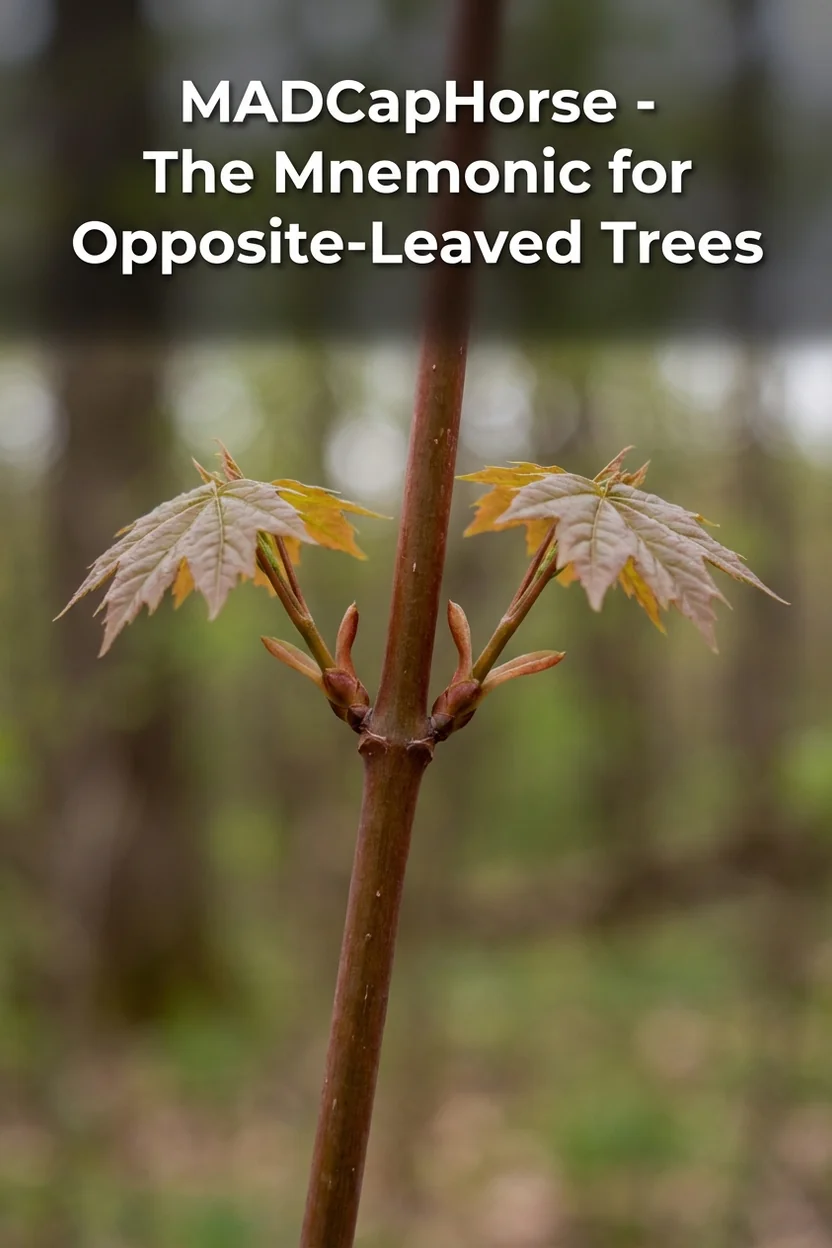
Alternate vs Opposite Leaf Arrangement: The MADCapHorse Mnemonic Explained
Pets & Toxicity
Recorded toxicity for plants linked in this guide. An unknown status is not a safety assessment.
Toxic to pets: pink dogwood, black walnut, buttonbush and 1 moreDetailsHide
Cephalanthus occidentalis — Toxicity Warning
Toxic to pets and humansView Cephalanthus occidentalis plant profileLonicera ligustrina var. yunnanensis 'Baggesen's Gold' — Toxicity
Non-toxicView Lonicera ligustrina var. yunnanensis 'Baggesen's Gold' plant profileAesculus × carnea 'Briotii' — Toxicity Warning
Toxic to pets and humansView Aesculus × carnea 'Briotii' plant profile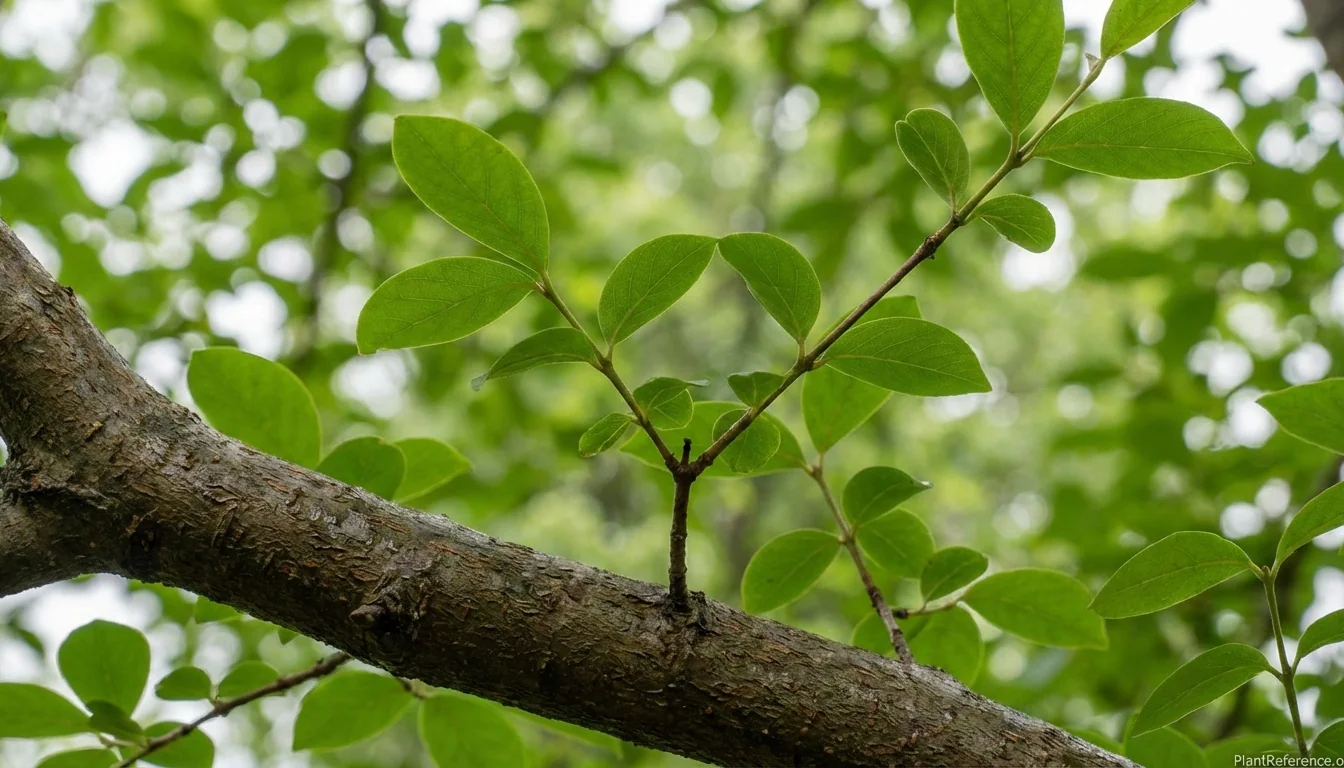
— Image © Plant Reference 2026
Leaf arrangement is the first question experienced botanists ask when identifying a tree — not leaf shape, not bark, not fruit. The reason is simple: arrangement divides all trees into two groups, and one of those groups is very small. If a tree has opposite leaves, you have reduced your candidates to about five genera. That is an enormous shortcut. How to Identify Any Plant: A Beginner's Guide to Leaves, Flowers, and Stems
Alternate vs. Opposite: What to Look For
Alternate Arrangement
One leaf per node. Leaves emerge singly, staggered along the stem — left, right, left, right (or spiraling around the stem). If you follow the leaves up a twig, no two emerge from the same point. The vast majority of North American trees — oaks, birches, cherries, elms, hickories, beeches, poplars, willows — have alternate leaves. How to Identify Trees by Their Leaves: Shapes, Margins, and Venation Explained
Opposite Arrangement
Two leaves per node. Leaves emerge in pairs, directly across from each other on the stem. Each pair is typically rotated 90 degrees from the pair above and below it (called decussate arrangement), creating a cross pattern when viewed from above.
Whorled Arrangement
Three or more leaves per node. Rare in trees but common in some herbaceous plants and a few shrubs (🌿Cephalanthus occidentalis, buttonbush). Not covered by MADCapHorse but worth noting as a third possibility.

How to Check Arrangement in the Field
The Node Test
Find a section of twig with healthy leaves attached. Look at the point (node) where each leaf petiole meets the stem. Does one leaf attach at each point, or do two leaves attach at the same point, directly across from each other?
On mature trees, check the youngest growth at branch tips. Older branches can lose leaves or develop adventitious growth that obscures the original pattern. Young twigs show arrangement most clearly.
Winter Verification
In winter, the same pattern is visible in bud and twig scar arrangement. Opposite-leaved trees have opposite buds and opposite leaf scars — the pattern persists year-round. This is why MADCapHorse works for winter identification too. Winter Tree Identification: Bark, Buds, and Branching When Leaves Are Gone
The Common Mistake
Beginners sometimes confuse compound leaflets with opposite leaves. A pinnately compound leaf (🌿Fraxinus ornus, 🌿Juglans nigra) has leaflets arranged along a rachis that can look like opposite arrangement. The bud test resolves this: true leaves have axillary buds at their base; leaflets do not. Simple vs Compound Leaves: How to Tell the Difference and Why It Matters
The MADCapHorse Mnemonic
MADCapHorse encodes the genera of North American trees with opposite leaves:
M — Maples (🌿Acer tataricum ssp. ginnala) — The most familiar opposite-leaved trees. All maples have opposite leaves, including box elder (🌿Acer negundo), which has compound leaves but still opposite arrangement. If the leaves are not opposite, it is not a maple. Poisonous Plants to Avoid: A Visual Safety Guide for Yards, Trails, and Gardens
A — Ash (🌿Fraxinus ornus) — The only common tree with opposite, pinnately compound leaves. If you find a tree with opposite compound leaves, it is almost certainly an ash (or a box elder, which has only 3-5 leaflets vs. ash's 5-11).
D — Dogwoods (🌿Cornus nuttallii) — Both tree-form dogwoods (🌿Cornus florida, 🌿Cornus kousa) and shrub dogwoods have opposite, simple leaves with entire margins and distinctive arcuate venation (veins that curve to follow the leaf margin).
Cap — Caprifoliaceae — The honeysuckle family, including viburnums (🌿Viburnum tinus) and honeysuckles (🌿Lonicera ligustrina var. yunnanensis 'Baggesen's Gold'). These are mostly shrubs rather than trees, but they are common in understory and hedgerow habitats.
Horse — Horsechestnuts/Buckeyes (🌿Aesculus × carnea 'Briotii') — Opposite, palmately compound leaves with 5-7 large leaflets radiating from a single point. Large, sticky buds in winter. Wildflower Identification by Color: How to Name Any Flower You Find

Each Genus Up Close
Letter | Genus | Leaf Type | Key ID Feature | Species Count (N. America) |
|---|---|---|---|---|
M | 🌿Acer tataricum ssp. ginnala (Maples) | Simple lobed (except box elder) | Opposite + lobed = maple | ~13 native species |
A | 🌿Fraxinus ornus (Ashes) | Pinnately compound, 5-11 leaflets | Only common tree with opposite compound leaves | ~16 native species |
D | 🌿Cornus nuttallii (Dogwoods) | Simple, entire margins | Arcuate venation (veins follow leaf edge) | ~10 native tree/shrub species |
Cap | 🌿Viburnum tinus, 🌿Lonicera ligustrina var. yunnanensis 'Baggesen's Gold' | Simple, variable margins | Mostly shrubs; opposite + shrub = check Caprifoliaceae | ~15 native Viburnum species |
Horse | 🌿Aesculus × carnea 'Briotii' (Buckeyes) | Palmately compound, 5-7 leaflets | Opposite + palmate compound = buckeye | ~6 native species |
A Decision Shortcut
When you find opposite leaves on a tree, ask one more question: simple or compound?
Opposite + simple lobed = Maple (🌿Acer tataricum ssp. ginnala) Opposite + simple entire = Dogwood (🌿Cornus nuttallii) or Caprifoliaceae Opposite + pinnately compound = Ash (🌿Fraxinus ornus) or box elder (🌿Acer negundo) Opposite + palmately compound = Buckeye (🌿Aesculus × carnea 'Briotii')
These two observations — arrangement + leaf type — identify the genus of any opposite-leaved tree in under 10 seconds. Flower Identification Guide: How to Use Petals, Shape, and Color to Name Any Flower

Why Arrangement Is Your First Question
It Eliminates the Most Candidates
Most identification keys start with leaf arrangement because it provides the highest information gain per observation. Checking arrangement takes 5 seconds and eliminates 80-90% of candidate species.
It Works Year-Round
Arrangement is visible in leaves (summer), buds (winter), leaf scars (winter), and branching pattern (any season). Unlike features tied to a specific season — flowers, fruit, fall color — arrangement is always available. Common Lawn Weeds Identification Guide: What's Growing in Your Yard
It Connects to Other Features
Opposite leaf arrangement in winter means opposite branching and opposite buds — the same MADCapHorse genera you memorized for leaves are the same genera you look for in winter twig identification. Learning arrangement once gives you a tool that works across all seasons.
Practice MADCapHorse with PlantReference's leaf arrangement flashcard set. The multi-image format shows each genus in both summer (leaves) and winter (buds/twigs) so you build cross-seasonal recognition. The spaced repetition system ensures MADCapHorse stays in your long-term memory permanently. Best Moisture Meter for Houseplants (FLF Owners)

Frequently Asked Questions
Reading about plants and recognising them are different skills. These three build the second.
- Daily PlantIdentify the day’s mystery plant from a close-up photograph.
- Keyed OutWork a dichotomous key, lead by lead, to name a hidden specimen.
- Name That PlantName a specimen from botanical clues dealt hardest first.
Free to play, no account needed
Tagged with
Sarah earned her doctorate in plant biology and spent time working in botanical garden education before transitioning to freelance writing and consulting. Now based in Portland, Oregon, she teaches plant identification workshops at local community centers and maintains a modest collection of over 60 houseplants in her small apartment. Sarah specializes in helping beginners understand plant science without the jargon—her approach focuses on practical observation over theory. She's killed her fair share of fiddle leaf figs and finally cracked the code on keeping them alive.