How to Identify Trees by Their Leaves: Shapes, Margins, and Venation Explained
Pets & Toxicity
Recorded toxicity for plants linked in this guide. An unknown status is not a safety assessment.
Gymnocladus dioicus — Toxicity Warning
Toxic to pets and humansView Gymnocladus dioicus plant profileCercidiphyllum japonicum 'Pendulum' — Toxicity
Non-toxicView Cercidiphyllum japonicum 'Pendulum' plant profileMagnolia × loebneri 'Leonard Messel' — Toxicity
Non-toxicView Magnolia × loebneri 'Leonard Messel' plant profileCercis canadensis 'Forest Pansy' — Toxicity
Non-toxicView Cercis canadensis 'Forest Pansy' plant profileRobinia pseudoacacia — Toxicity Warning
Toxic to pets and humansView Robinia pseudoacacia plant profile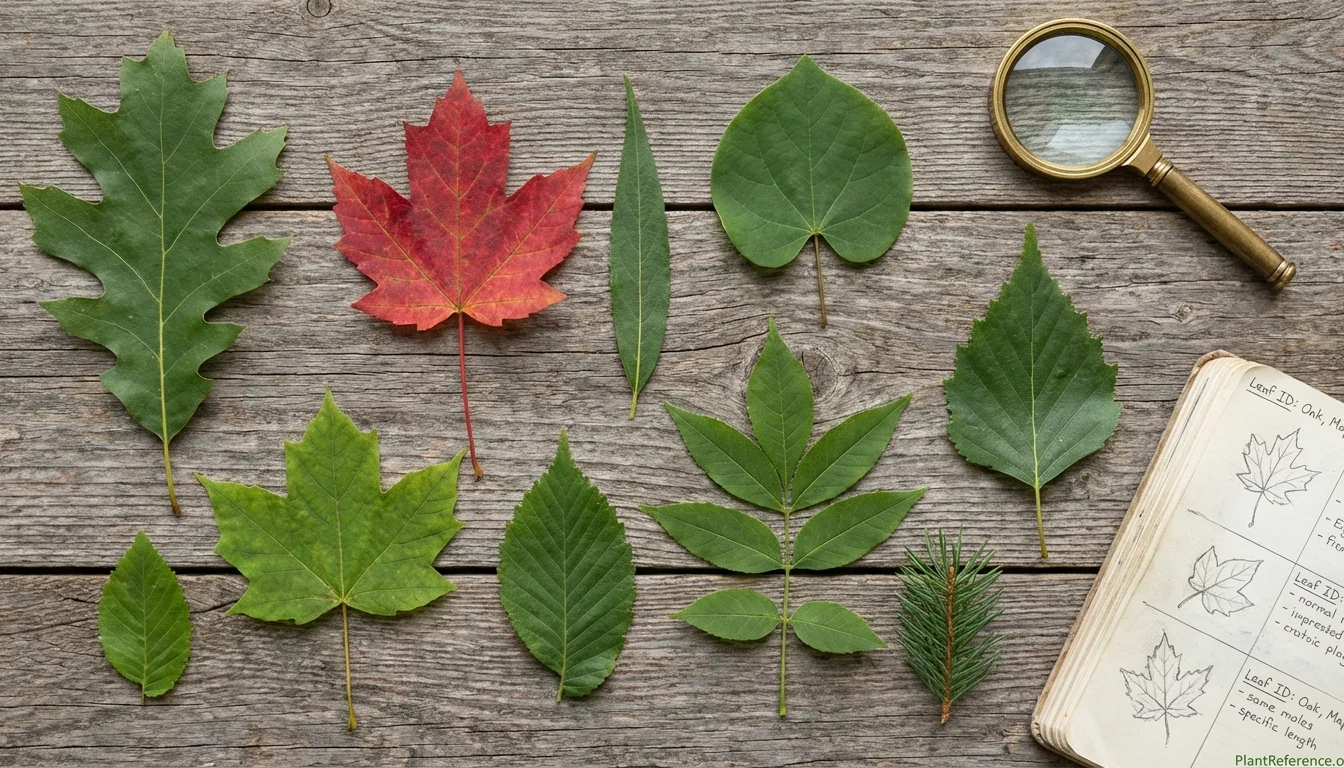
— Image © Plant Reference 2026
If you can identify trees, you can identify almost anything in the plant world. Trees are large, stationary, present year-round, and most North American regions have only 30-60 common species. Learn them first, and you build a permanent framework for recognizing shrubs, wildflowers, and everything else that grows in their company. The leaf is where that learning starts.
Step 1: Check Leaf Arrangement
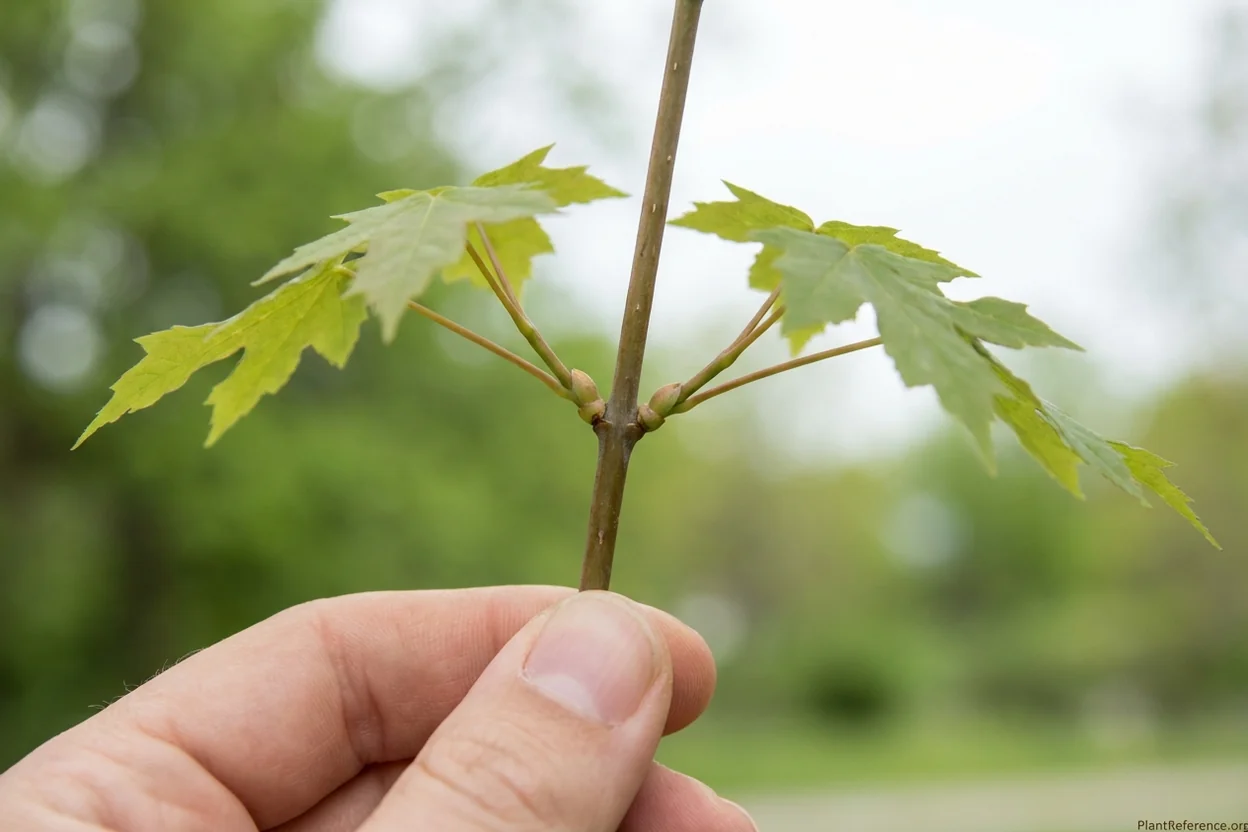
Before examining the leaf itself, look at how it attaches to the twig. Alternate leaves emerge one per node, staggered along the branch. Opposite leaves emerge in pairs, directly across from each other at the same node. This single observation immediately splits all North American trees into two groups. How to Identify Any Plant: A Beginner's Guide to Leaves, Flowers, and Stems
Most trees have alternate leaves — oaks (🌿Quercus sadleriana), birches (🌿Betula nigra 'Cully'), elms (🌿Ulmus procera), cherries (🌿Prunus lusitanica), beeches (🌿Fagus sylvatica), and all conifers. The opposite-leaved trees are a much shorter list, remembered by the mnemonic MADCapHorse: Maples (🌿Acer tataricum ssp. ginnala), Ash (🌿Fraxinus ornus), Dogwoods (🌿Cornus nuttallii), Caprifoliaceae (viburnums, honeysuckles), and Horsechestnuts (🌿Aesculus × carnea 'Briotii').
If a tree has opposite leaves, you only need to distinguish among these five groups — a dramatically easier task than searching through all possible species. This is why arrangement is always your first question.
Step 2: Simple or Compound?
Next, determine whether the leaf is simple (one continuous blade) or compound (divided into separate leaflets). This is the feature that trips up most beginners — a compound leaf can look like a small branch with many simple leaves.
The test is the axillary bud. Buds form in the angle between the petiole (leaf stalk) and the stem. A bud will always be present at the base of a true leaf, but never at the base of a leaflet. If you find a cluster of "leaves" with no buds at their individual bases, you are looking at one compound leaf.
Compound Leaf Types in Trees
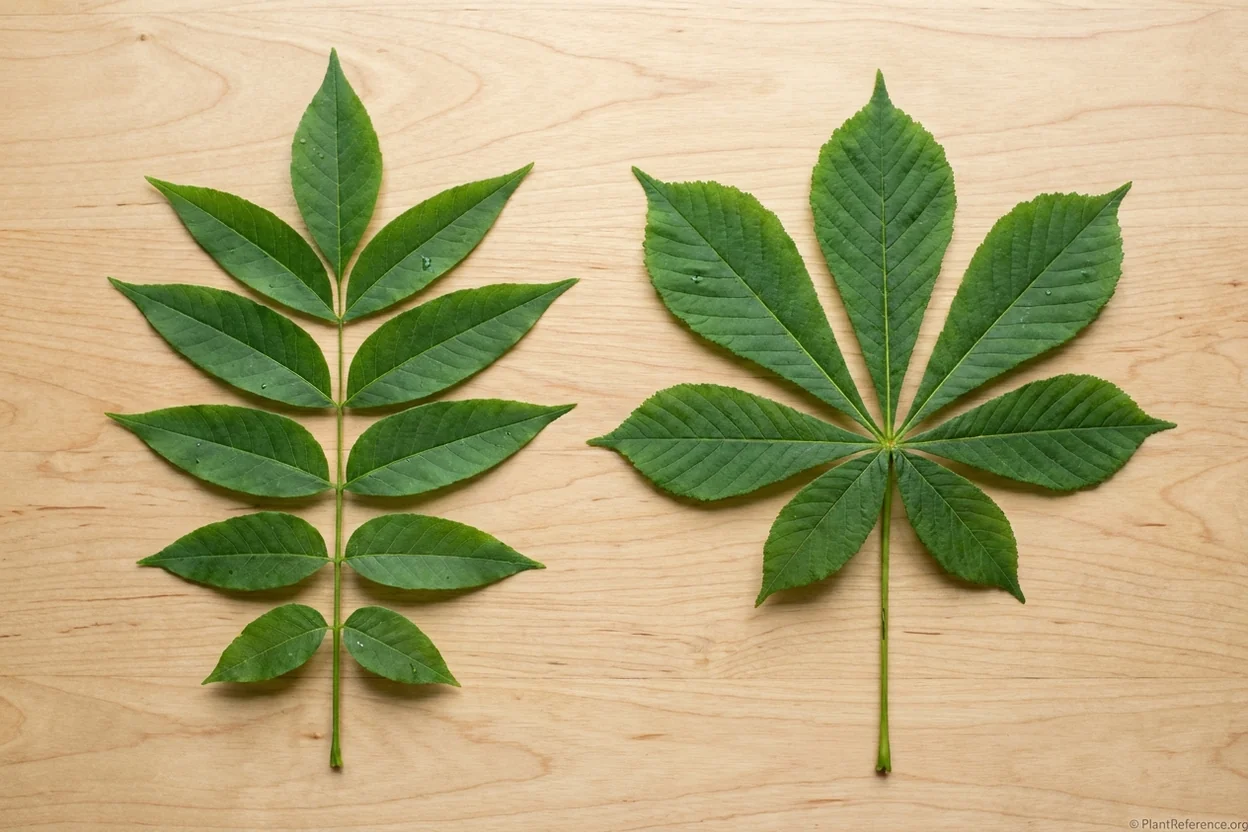
Pinnately compound — leaflets arranged along both sides of a central rachis. Common in ashes (🌿Fraxinus ornus), walnuts (🌿Juglans nigra), hickories (Carya spp.), and black locust (🌿Robinia pseudoacacia).
Palmately compound — leaflets radiating from a single point. Common in buckeyes and horsechestnuts (🌿Aesculus × carnea 'Briotii') and Acer negundo (box elder — the only native maple with compound leaves).
Bipinnately compound — the rachis branches again before producing leaflets. Distinctive and limited to a few genera: honey locust (🌿Gleditsia triacanthos), Kentucky coffeetree (Gymnocladus dioicus), and mimosa (🌿Albizia julibrissin).
Knowing that a tree has compound leaves immediately narrows candidates to a short list — far fewer trees have compound leaves than simple leaves. Fiddle Leaf Fig Care: The Complete Guide (2025)
Step 3: Read the Shape
Leaf shape — the overall outline of the blade — is the feature most people notice first. Botanical terminology is precise, but you only need about eight terms to cover the vast majority of North American trees.
Shape | Description | Example Trees |
|---|---|---|
Ovate | Egg-shaped, wider toward the base | 🌿Fagus grandifolia (American beech), 🌿Cornus florida (flowering dogwood) |
Obovate | Egg-shaped, wider toward the tip | Quercus alba (white oak), Magnolia virginiana (sweetbay magnolia) |
Lanceolate | Lance-shaped, long and narrow, widest near base | 🌿Salix scouleriana species (willows), Prunus serotina (black cherry) |
Cordate | Heart-shaped with a notch at the base | 🌿Cercis canadensis (eastern redbud), 🌿Tilia americana (American basswood) |
Orbicular | Nearly circular | 🌿Cercidiphyllum japonicum (katsura tree) |
Deltoid | Triangular, like an inverted triangle | Populus deltoides (eastern cottonwood) |
Elliptic | Oval, widest at the middle | 🌿Cornus kousa (kousa dogwood), Ulmus americana (American elm) |
Lobed | Deeply divided into rounded or pointed sections | 🌿Quercus rubra (red oak), 🌿Acer saccharum (sugar maple), 🌿Liriodendron tulipifera (tulip tree) |
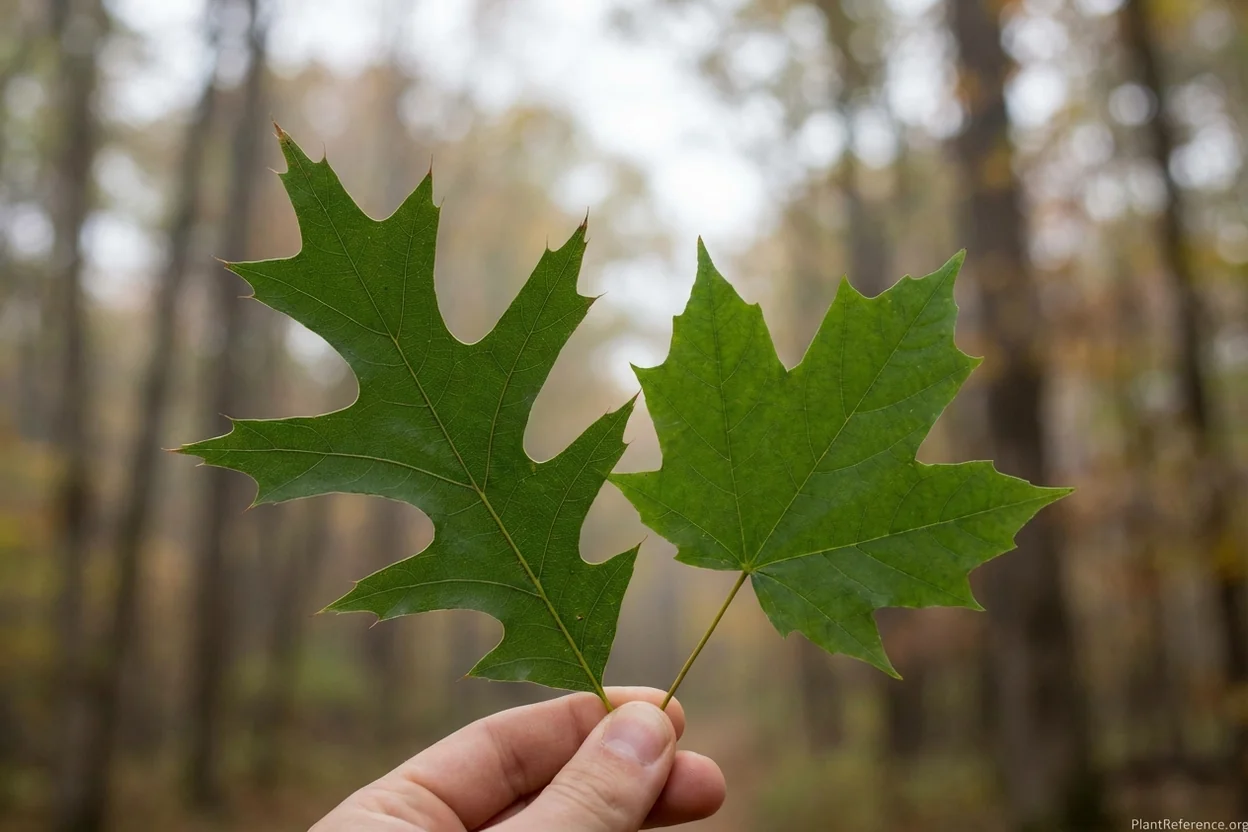
Lobed leaves deserve special attention because they are the most distinctive and often the easiest to identify. Oak lobes versus maple lobes are a fundamental identification split: oak lobes are pinnately arranged (emanating from a central midrib) while maple lobes are palmately arranged (radiating from the base). This difference alone separates the two largest genera of lobed-leaved trees in North America.
Step 4: Examine the Margin
The leaf margin — the edge of the blade — provides the fine-grained detail that separates species within a genus. Four margin types cover nearly all North American trees.
Entire — smooth, with no teeth or indentations. Entire margins are common in magnolias (🌿Magnolia stellata), dogwoods (🌿Cornus nuttallii), and many southern species like live oak (Quercus virginiana).
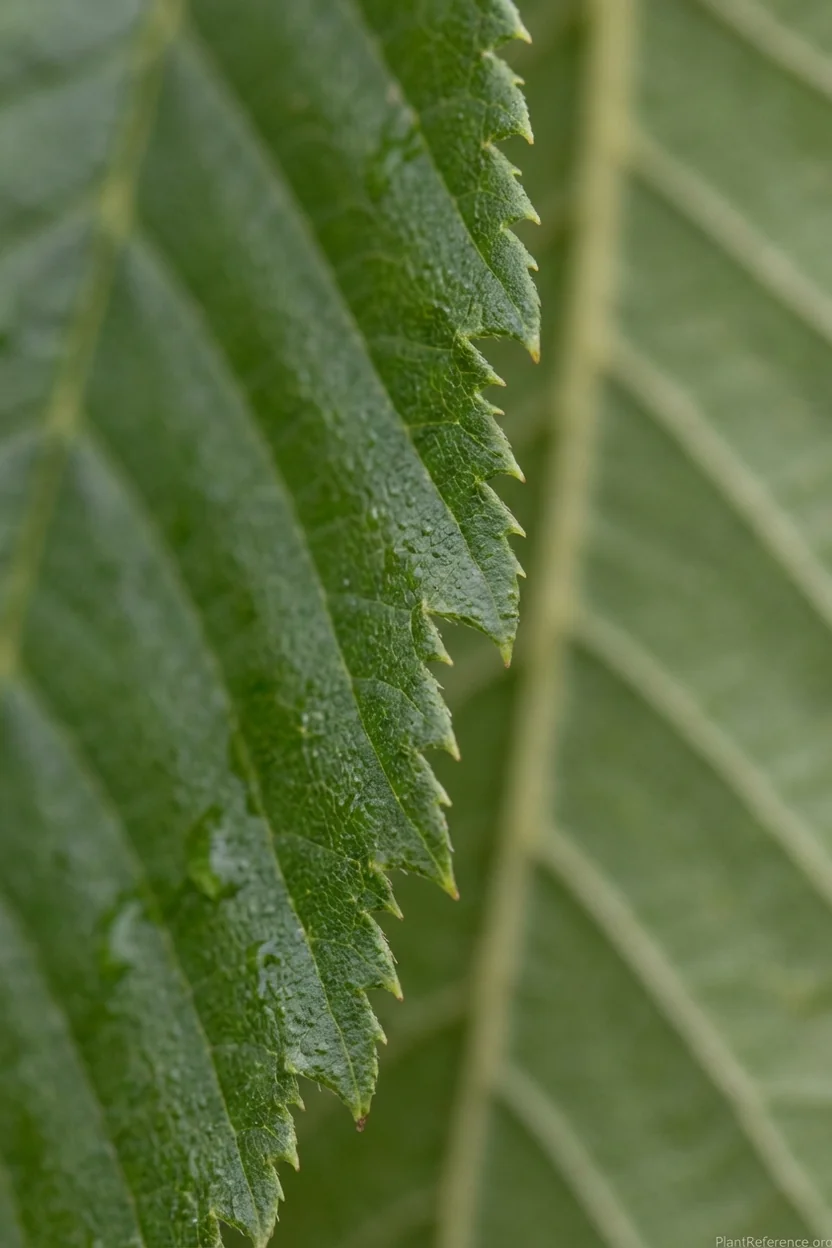
Serrate — sharp teeth pointing forward like a saw blade. Serrate margins are the most common toothed pattern, found in birches (🌿Betula nigra 'Cully'), elms (🌿Ulmus procera), and cherries (🌿Prunus lusitanica). Look closely: the teeth often have a characteristic uniformity, with each tooth roughly the same size. Brown Spots on Fiddle Leaf Fig: 7 Causes + Solutions
Doubly serrate — large teeth with smaller teeth on them. This distinctive pattern is a strong diagnostic feature for elms (🌿Ulmus procera) and some birches (🌿Betula nigra 'Cully') — if you see double serration, you have eliminated most other genera immediately.
Crenate — rounded, scallop-like teeth. Less common in trees than in herbaceous plants, but found in some hawthorns (🌿Crataegus monogyna) and witch hazel (🌿Hamamelis mollis).
Lobed — deep indentations that divide the blade. The sinuses (spaces between lobes) can be shallow or deep, rounded or sharp — features that distinguish species within 🌿Quercus sadleriana (white oak group has rounded sinuses; red oak group has pointed sinuses with bristle tips).
Step 5: Trace the Venation
Venation — the pattern of veins in the leaf — reflects evolutionary lineage and provides reliable genus-level identification.
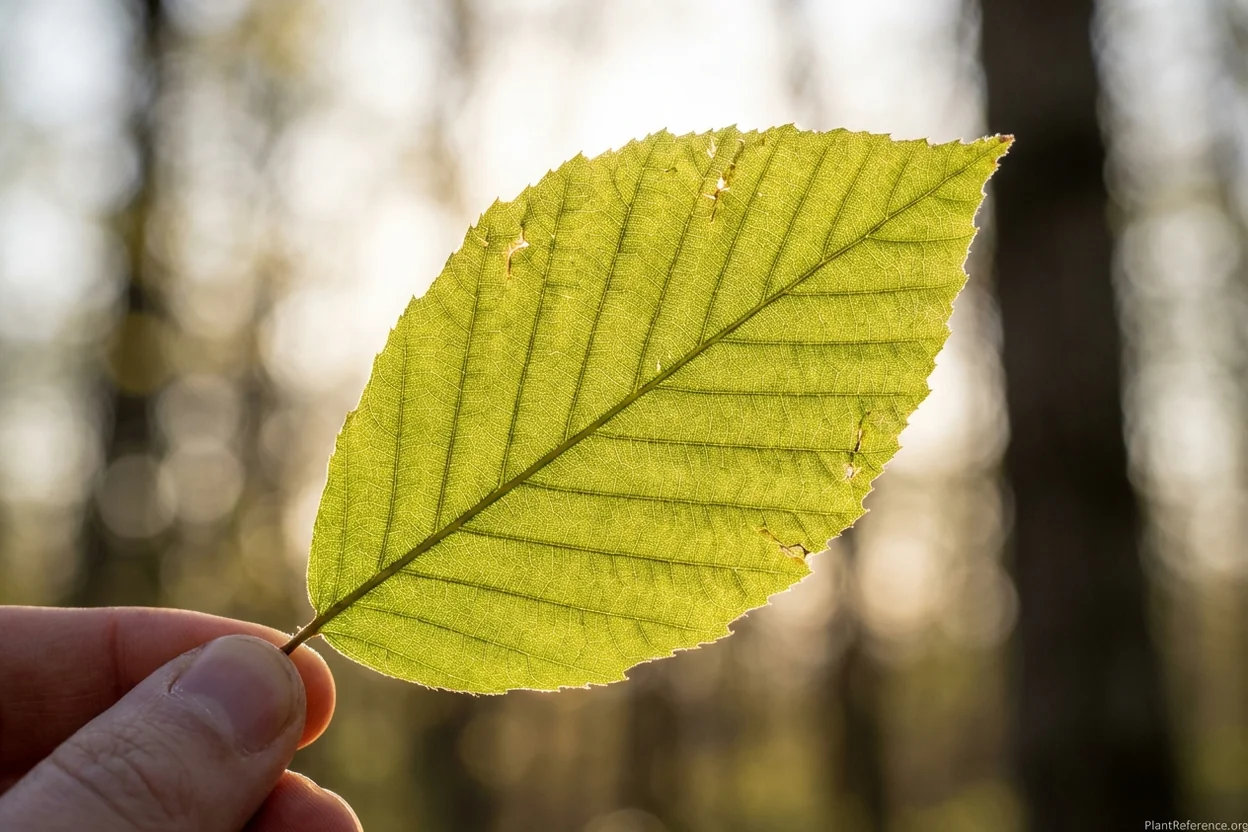
Pinnate venation is the most common pattern in broadleaf trees: a single prominent midvein runs from base to tip, with secondary veins branching off at intervals. Found in oaks (🌿Quercus sadleriana), birches (🌿Betula nigra 'Cully'), elms (🌿Ulmus procera), beeches (🌿Fagus sylvatica), and most other genera. The angle and spacing of the secondary veins vary by species — beech veins are remarkably straight and parallel, while oak veins curve toward the margin.
Palmate venation features multiple main veins radiating from the base of the leaf like fingers from a palm. This pattern is characteristic of maples (🌿Acer tataricum ssp. ginnala), sycamores (🌿Platanus × acerifolia), sweetgums (🌿Liquidambar styraciflua), and tulip trees (🌿Liriodendron tulipifera). If you see palmate venation on a simple, lobed leaf, the candidates are limited to these four genera. Best Pothos Varieties to Buy: Beginner to Collector Guide
Arcuate venation — secondary veins that curve inward and run parallel to the leaf margin — is the signature of dogwoods (🌿Cornus nuttallii). This pattern is so distinctive that any opposite-leaved tree with arcuate venation is almost certainly a dogwood.
One venation feature requires a hand lens: vein axil tufts. Small patches of hair in the angles where secondary veins meet the midvein are present in some species and absent in closely related ones. This reliably distinguishes 🌿Tilia americana (American basswood, tufts present) from Tilia europaea (European linden, tufts absent). A 10x hand lens makes these details immediately visible.
Quick-Reference: 15 Common Trees by Leaf
This table covers the trees you are most likely to encounter in yards, parks, and forests across eastern and central North America. Practice identifying these 15 and you will have a solid foundation.
Tree | Arrangement | Type | Shape | Margin | Venation |
|---|---|---|---|---|---|
🌿Acer saccharum Sugar maple | Opposite | Simple | 5-lobed, palmate | Smooth between lobes | Palmate |
🌿Acer rubrum Red maple | Opposite | Simple | 3-5 lobed, palmate | Serrate between lobes | Palmate |
🌿Quercus rubra Red oak | Alternate | Simple | Pinnately lobed, pointed tips | Bristle-tipped lobes | Pinnate |
Quercus alba White oak | Alternate | Simple | Pinnately lobed, rounded tips | Smooth, rounded lobes | Pinnate |
🌿Fagus grandifolia American beech | Alternate | Simple | Elliptic-ovate | Serrate, widely spaced | Pinnate, straight parallel |
🌿Betula papyrifera Paper birch | Alternate | Simple | Ovate | Doubly serrate | Pinnate |
Ulmus americana American elm | Alternate | Simple | Elliptic, unequal base | Doubly serrate | Pinnate |
🌿Fraxinus americana White ash | Opposite | Compound | 5-7 leaflets, pinnate | Serrate or entire | Pinnate |
🌿Cornus florida Flowering dogwood | Opposite | Simple | Ovate-elliptic | Entire (smooth) | Arcuate |
Prunus serotina Black cherry | Alternate | Simple | Lanceolate | Finely serrate | Pinnate |
🌿Liriodendron tulipifera Tulip tree | Alternate | Simple | 4-lobed, flat-topped | Smooth | Palmate |
Platanus occidentalis Sycamore | Alternate | Simple | Palmately lobed, broad | Dentate | Palmate |
🌿Cercis canadensis Eastern redbud | Alternate | Simple | Cordate (heart-shaped) | Entire | Palmate |
🌿Tilia americana American basswood | Alternate | Simple | Cordate, unequal base | Serrate | Pinnate |
🌿Robinia pseudoacacia Black locust | Alternate | Compound | 7-19 oval leaflets | Entire | Pinnate |
Practice these 15 species using PlantReference's tree flashcard sets. The spaced repetition system prioritizes species you struggle to remember, and the multi-image format shows each tree in different seasons and growth stages — so you learn to recognize the living tree, not just one leaf photograph. Fiddle Leaf Fig Pests: Identification & Treatment
Beyond Leaves: When You Need More
When Leaves Are Not Enough
Some tree genera contain dozens of species with nearly identical leaves. Oaks (🌿Quercus sadleriana) are the prime example — there are roughly 90 oak species in North America, and many have confusingly similar lobed leaves. In these cases, you need additional features: acorn cap shape (flat vs. deep, smooth vs. fringed), bark texture, twig characteristics, and habitat. A white oak growing on a dry ridgetop is likely Quercus alba; a white oak in a bottomland swamp might be Quercus bicolor (swamp white oak). Choosing Climate-Ready Trees: Species Selection for 2050 and Beyond
Winter Identification
From November through April in most of North America, deciduous trees have no leaves at all. Winter identification uses bark, buds, and branching pattern — an entirely different skill set. The good news: if you learn leaf identification first, you already know which trees to expect in your area, and winter ID becomes a matter of learning which bark and bud features match species you already know by leaf. ANSI A300 Tree Care Standards: What Every Arborist Needs to Know in 2026
Building Long-Term Recognition
The difference between a beginner and an expert is not the number of field marks they know — it is the speed and automaticity of recognition. An expert glances at a tree from 50 feet (15 m) away and knows the species. A beginner needs to walk up, examine the leaf, check the margin, and consult a guide.
That jump from conscious analysis to instant recognition comes from repeated exposure to variation. You need to see sugar maple leaves in spring (bright green, smooth), summer (dark green, full canopy), fall (brilliant orange-red), and across different sites (sun vs. shade, young vs. old). PlantReference's flashcard system is designed for exactly this — multiple images per species, spaced repetition for retention, and quizzes that test your ability to pull the name from memory rather than simply recognizing it when prompted. Best Moisture Meter for Houseplants (FLF Owners)
Frequently Asked Questions
Reading about plants and recognising them are different skills. These three build the second.
- Daily PlantIdentify the day’s mystery plant from a close-up photograph.
- Keyed OutWork a dichotomous key, lead by lead, to name a hidden specimen.
- Name That PlantName a specimen from botanical clues dealt hardest first.
Free to play, no account needed
Tagged with
Sarah earned her doctorate in plant biology and spent time working in botanical garden education before transitioning to freelance writing and consulting. Now based in Portland, Oregon, she teaches plant identification workshops at local community centers and maintains a modest collection of over 60 houseplants in her small apartment. Sarah specializes in helping beginners understand plant science without the jargon—her approach focuses on practical observation over theory. She's killed her fair share of fiddle leaf figs and finally cracked the code on keeping them alive.