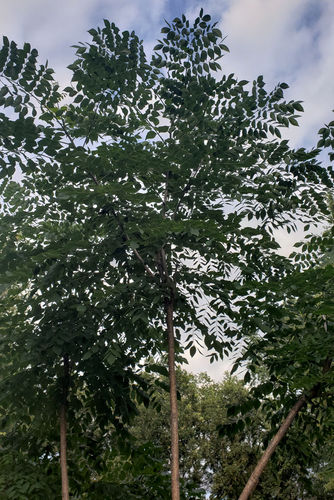
Gymnocladus dioicus

Kentucky coffee tree

At a Glance

TypeTree
HabitUpright
FoliageDeciduous
Height50–80 feet (15–24 m)
Width30–50 feet (9–15 m)
Maturity25 years

Growing Zones

USDA Hardiness Zones

3 - 8
These zones indicate the coldest temperatures this plant can typically survive.
Frost Tolerancehardy

Key Features

Maintenancelow

Overview

Gymnocladus dioicus, commonly called Kentucky coffee tree, is a large, architecturally striking deciduous tree in the family Fabaceae, native to moist bottomland forests and rich, deep-soiled woodland margins of the central and eastern United States. One of only two species in the genus, it is among the most distinctive large deciduous trees available for Pacific Northwest landscapes. The bipinnately compound leaves are the most massive of any native North American tree, reaching 2–3 feet (60–90 cm) long and nearly as wide, with numerous blue-green oval leaflets 1.5–2.5 inches (4–6.5 cm) long that create a bold, dramatic summer texture. Uniquely, the tree is essentially leafless for nearly six months of the year: leaves emerge late in spring (late April to May) and drop early in autumn (October), leaving a compelling winter silhouette of stout, blunt-ended branches with deeply furrowed, dark gray, scaly bark on a broadly columnar to oval crown 50–80 feet (15–24 m) tall. The botanical name Gymnocladus — naked branch — refers to this prolonged leafless period. Female trees produce large, woody, dark red-brown pods 4–10 inches (10–25 cm) long containing seeds historically roasted as a coffee substitute (raw seeds are toxic). Dioecious; male trees are fruitless. An exceptionally tough, long-lived urban tree with no serious pest or disease problems.

Native Range

Native to rich bottomland forests, moist woodland margins, and river terraces from New York, Pennsylvania, and southern Ontario west to Nebraska and Kansas, south to Tennessee and Oklahoma. Grows in deep, fertile, moist, well-drained soils in mixed hardwood forest, often on alluvial terraces alongside Celtis, Carya, and Juglans species. Historically more widespread; populations are now disjunct and often associated with disturbed sites. Native to North America.

Suggested Uses

Kentucky coffee tree is among the most architecturally distinctive large trees for Pacific Northwest landscapes: its massive bipinnate foliage, exceptional winter silhouette, deeply furrowed scaling bark, and urban tolerance make it outstanding as a bold specimen in parks, large gardens, and municipal plantings. Particularly effective where the winter silhouette can be appreciated against a clear sky or near lighting. Male fruitless selections recommended for street tree use. Of significant educational value in HORT 108 as an example of exceptional winter habit, dioecious reproduction, and deep seasonal structural interest. Combine with fine-textured trees such as Gleditsia and Fraxinus for dramatic textural contrast. Allow 30–40 feet (9–12 m) clearance from structures.

How to Identify

Kentucky coffee tree is identified by its massively bipinnately compound leaves 2–3 feet (60–90 cm) long — the largest compound leaves of any North American native tree — with numerous blue-green, oval leaflets 1.5–2.5 inches (4–6.5 cm) long. The stout, blunt-tipped twigs are notably thick (up to 0.75 inches / 2 cm) and conspicuous in winter, covered with dark brownish-pink, sticky pith when cut. Bark on mature trees is dark gray-brown with thick, hard, curving scales that curl outward at the edges. Female trees in autumn and winter carry large, woody, dark reddish-brown pods 4–10 inches (10–25 cm) containing hard, flat seeds embedded in sticky pulp. The massive bipinnate leaves, distinctively stout twigs, and curling-scaled bark together are immediately diagnostic.

Appearance

Size & Dimensions

Height50' - 80'
Width/Spread30' - 50'

Reaches mature size in approximately 25 years

Colors

Flower Colors

Foliage Colors

Fall Foliage Colors

Bloom Information

Bloom Period

~3 weeks
J
F
M
A
M
J
J
A
S
O
N
D
Kentucky coffee tree blooms in late spring to early summer (late May–June) as the leaves are fully expanding, producing fragrant, white to greenish-white flowers in large, terminal panicles 4–12 inches (10–30 cm) long. Male panicles are shorter; female panicles are larger. The flowers are fragrant and attract bees and other pollinators, though partially obscured by the emerging foliage. Female trees subsequently develop the large, persistent pods.

Detailed Descriptions

Flower Description

White to greenish-white; fragrant; terminal panicles 4–12 inches (10–30 cm); male panicles shorter, female panicles larger

Foliage Description

Alternate, bipinnately compound, 2–3 feet (60–90 cm) long; numerous blue-green oval leaflets 1.5–2.5 inches (4–6.5 cm); bold, coarse texture

Growing Conditions

Sun Requirements

Requires 6-12 hours of direct sunlight daily
• Full Sun: 6+ hours of direct sunlight
• Partial Shade: 3-6 hours of direct sunlight
• Full Shade: Less than 3 hours of direct sunlight

Soil Requirements

pH Range5.5 - 8.0(Neutral)
357912
Soil Types
Drainagewell drained

Water & Climate

Water Needs

Low

Frost Tolerance

hardy

Time to Maturity

20–30 years

Drought Tolerance

Drought tolerant when established

Care & Maintenance

Care Guide

Plant in full sun in deep, fertile, moist, well-drained soil for best growth, though Kentucky coffee tree tolerates a wide range of conditions once established — including drought, compacted soils, alkaline pH, wind exposure, and urban stress. Water regularly for the first two to three years; established trees are remarkably self-sufficient. Minimal fertilization required on most Pacific Northwest soils. No significant pest or disease problems — one of the most trouble-free large trees in cultivation. Pods and leaflets can create seasonal litter; plant away from paved areas and gutters if this is a concern. Raw seeds and pods are toxic — select male fruitless cultivars ('Espresso', 'Prairie Titan') for high-use public spaces.

Pruning

Prune for structural form in the first five to ten years to establish a central leader or high, well-spaced scaffold limbs, in late winter (February–March) while dormant. The species naturally develops a strong, self-supporting structure and requires minimal intervention once established. Remove dead or crossing branches as needed. Avoid large pruning wounds on mature trees — they heal slowly.

Pruning Schedule

J
F
M
A
M
J
J
A
S
O
N
D
early spring

Maintenance Level

low

⚠️ Toxicity Warning

Toxic to pets and humans