Overview
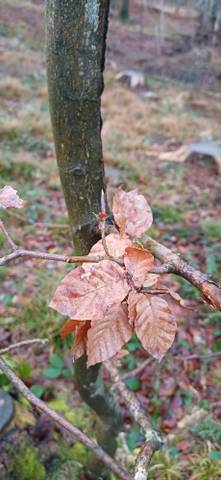
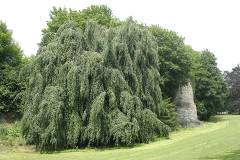
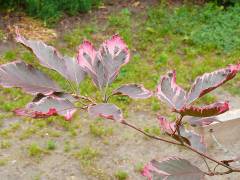
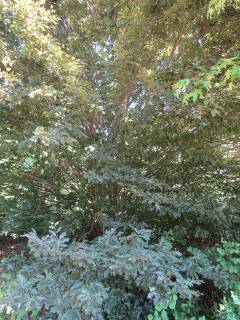
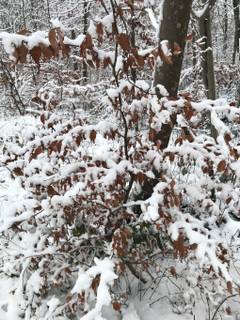
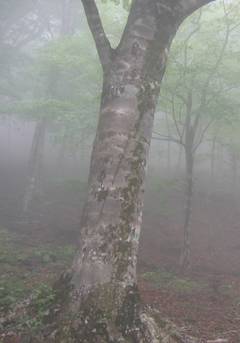
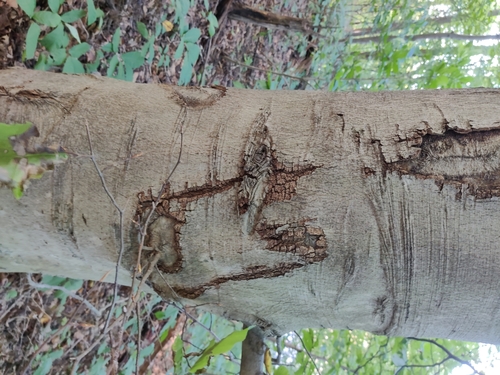
Fagus grandifolia is a large upright to broadly spreading deciduous tree in the beech family (Fagaceae) reaching 50–80 feet (15–24 m) tall with a spread of 40–60 feet (12–18 m). The species stands as the only beech native to North America and anchors the beech-maple forest association that dominates large portions of the eastern North American hardwood belt. Bark is smooth thin silvery-gray and remains smooth even on mature trunks, which functions as a year-round identification feature shared with the European beech F. sylvatica. Leaves are elliptic to oblong 3–5 inches (8–13 cm) long with coarsely serrated margins and 9–14 pairs of prominent parallel veins — larger and with more vein pairs than F. sylvatica at 2–4 inches and 5–9 vein pairs. The leaves emerge pale green in spring, mature to dark green through summer, and turn golden-bronze to copper-brown in fall. The dried leaves often persist on lower branches through winter, which is a marcescence habit that separates beeches and oaks from most other deciduous trees in the North American flora. Flowers are inconspicuous in April–May — male catkins and small female clusters. Triangular beechnuts 0.5–0.75 inch (1–2 cm) in prickly husks ripen in September–October. Growth rate is slow at 8–12 inches (20–30 cm) per year. The canopy produces dense shade. Hardy to zone 3.
Native Range
Fagus grandifolia is native to eastern North America, from Nova Scotia and southern Ontario south to northern Florida and east Texas, where it occurs in rich moist well-drained deciduous forests and often forms pure stands or co-dominant associations with sugar maple (Acer saccharum) in the beech-maple forest type.Suggested Uses
Grown as a specimen shade tree in large landscapes that can accommodate 50–80 feet of height and 40–60 feet of spread at maturity. The smooth silvery-gray bark, dense shade cast by the mature canopy, and golden-bronze fall color serve as the primary ornamental features across the year. The persistent marcescent winter leaves add winter structural interest that separates beeches from maples and other deciduous trees. The species functions as a native alternative to F. sylvatica in North American landscapes where native-plant emphasis matters for ecological or restoration reasons. Small gardens, compacted soils, urban sites with root-zone restrictions, and areas with established beech bark disease pressure are not suitable given the mature size, soil requirements, and disease vulnerability.How to Identify
Appearance
Size & Dimensions
Height50' - 80'
Width/Spread40' - 60'
Bloom Information
Inconspicuous flowers open in April–May: male flowers in pendant globose catkins 1 inch (2.5 cm) across on long stalks; female flowers in small paired clusters. Triangular beechnuts 0.5–0.75 inch (1–2 cm) in prickly husks ripen September–October. Mast years — seasons of particularly heavy beechnut production — occur every 2–3 years, which matches the species reproductive strategy of alternating high and low seed output to manage seed-predator populations.
Detailed Descriptions
Foliage Description
Pale green emerging; dark green summer; golden-bronze to copper-brown fall; elliptic to oblong 3-5 inches long with coarsely serrated margins and 9-14 pairs of parallel veinsGrowing Conditions
Sun Requirements
Requires 3-8 hours of direct sunlight daily
• Full Sun: 6+ hours of direct sunlight
• Partial Shade: 3-6 hours of direct sunlight
• Full Shade: Less than 3 hours of direct sunlight
Care & Maintenance
Care Guide
Grows in partial shade to full sun in moist well-drained acidic to neutral soil at pH 5.0–7.0, tolerating loam and sand. The species tolerates shade at levels that most large canopy trees cannot match, which makes it a dominant component of shaded old-growth hardwood forests in the native range. Hardy to zone 3. The shallow root system makes it difficult to grow grass or other plants beneath the dense canopy, and soil disturbance within the root zone is poorly tolerated. Compacted soil, root zone disturbance during construction, and poor drainage all cause rapid decline. Transplanting is most reliably done when the tree is young and should use balled-and-burlapped or container-grown stock — mature trees resent transplanting at any size. Beech bark disease (caused by the beech scale insect Cryptococcus fagisuga combined with Neonectria fungi) is a serious threat in northeastern populations and has altered beech demographics across parts of the native range.Pruning
Pruning is done in late summer to early fall to minimize the bleeding that heavy spring sap flow can produce. The naturally dense broadly spreading form develops without intervention, and pruning is limited to removal of dead, damaged, or crossing branches. Basal sucker removal may be needed on an ongoing basis — F. grandifolia produces more basal suckers than F. sylvatica and the clump form can develop if suckers are left in place.Pruning Schedule
Prune: August–September
summerfall