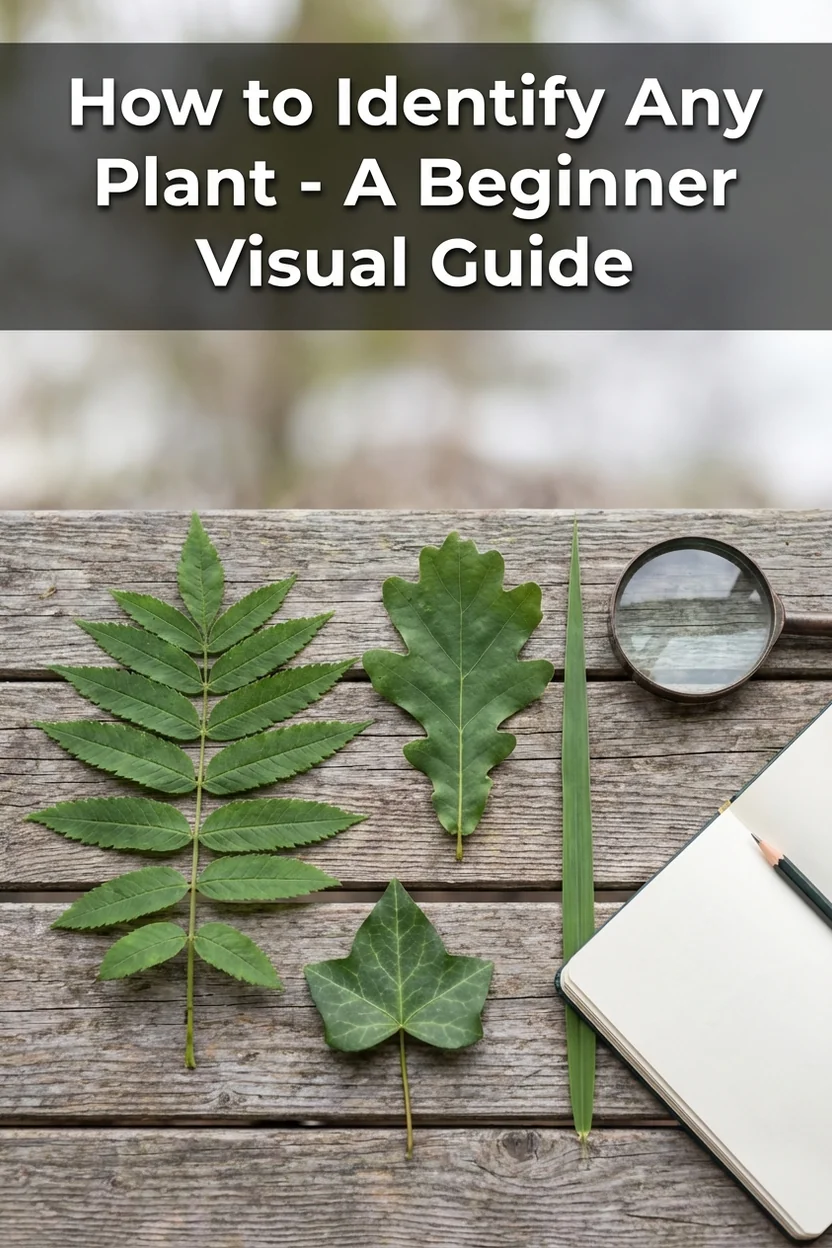
How to Identify Any Plant: A Beginner's Guide to Leaves, Flowers, and Stems
Pets & Toxicity
Recorded toxicity for plants linked in this guide. An unknown status is not a safety assessment.
Toxic to pets: black walnut, Sadler's oak, poison ivies and oaks and 3 moreDetailsHide
Quercus sadleriana — Toxicity Warning
Toxic when leaves or acorns are eaten in quantity, especially by horses and grazing livestock; human ingestion toxicity is generally low.View Quercus sadleriana plant profileAesculus × carnea 'Briotii' — Toxicity Warning
Toxic to pets and humansView Aesculus × carnea 'Briotii' plant profileToxicodendron radicans — Toxicity Warning
Toxic to pets and humansView Toxicodendron radicans plant profileCercis canadensis 'Forest Pansy' — Toxicity
Non-toxicView Cercis canadensis 'Forest Pansy' plant profile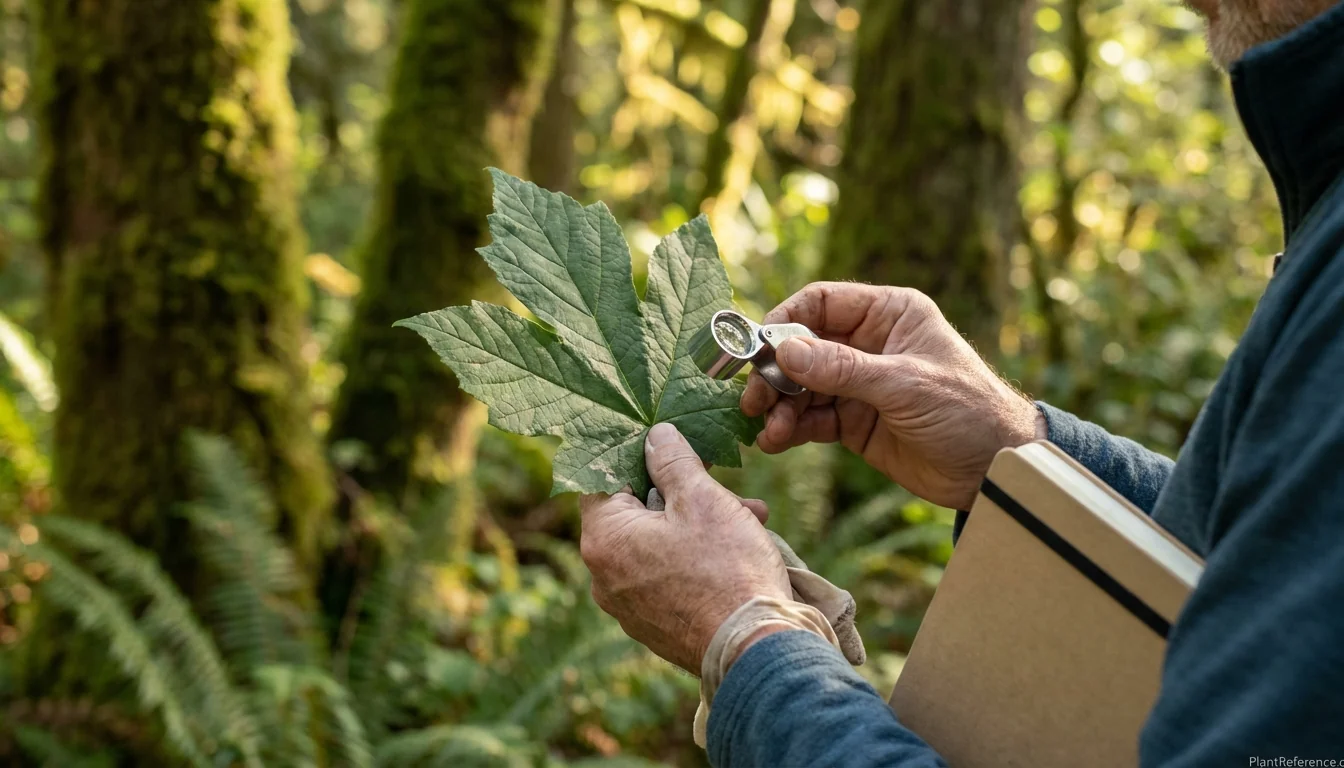
— Image © Plant Reference 2026
You are standing in front of a plant you have never seen before. You could pull out your phone and let an app guess — and it might be right. But if you learn to observe three things with your own eyes, you can identify that plant yourself. And once you learn to see these features, you start recognizing plants everywhere without any tool at all. That skill stays with you permanently.
Start With the Leaves
Alternate vs. Opposite: Your First Question
The very first thing to look at on any unknown plant is how the leaves attach to the stem. This feature — called phyllotaxy (fill-oh-TAX-ee) — is so reliable that it immediately cuts your identification candidates in half.
Alternate leaves emerge one at a time from the stem, staggered on different sides at each node. The majority of flowering plants have alternate leaves, including oaks (🌿Quercus sadleriana species), roses (🌿Rosa spp. species), and most members of the sunflower family.
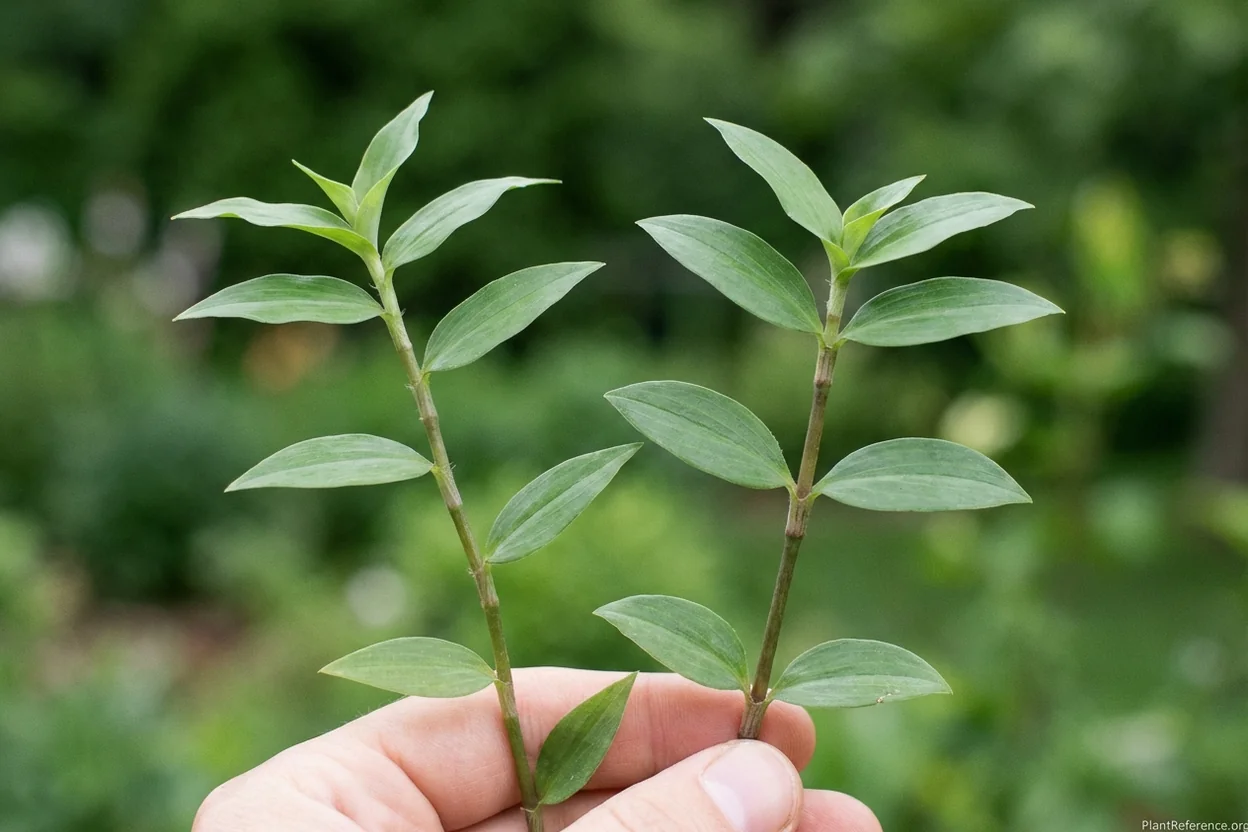
Opposite leaves emerge in pairs, two at a time on opposite sides of the same node. Fewer plant families have opposite leaves, which makes this arrangement more diagnostic — if a tree has opposite leaves, it belongs to a short list of families. Botanists use the mnemonic MADCapHorse to remember them: Maples (🌿Acer tataricum ssp. ginnala), Ash (🌿Fraxinus ornus), Dogwoods (🌿Cornus nuttallii), Caprifoliaceae (honeysuckle family), and Horsechestnuts (🌿Aesculus × carnea 'Briotii'). How to Identify Trees by Their Leaves: Shapes, Margins, and Venation Explained
Whorled leaves — three or more emerging from a single node in a ring — are uncommon but distinctive. 🌿Galium aparine (bedstraws) and some 🌿Lilium spp. species show this pattern.
Simple vs. Compound: The First Fork in the Road
After checking arrangement, determine whether each leaf is simple or compound. This distinction is the single most useful identification fork for beginners.
A simple leaf has one continuous blade — it may be deeply lobed (like a maple or oak), but the blade is a single piece of tissue. A compound leaf is divided into separate leaflets — completely independent segments attached to a central stalk called the rachis.
The trick is distinguishing a compound leaf from a small branch with several simple leaves. The test: look for the axillary bud. Buds form where a leaf's petiole (stalk) meets the stem — never at the base of a leaflet. If there is no bud at the base of what looks like a leaf, it is a leaflet, and the whole structure is one compound leaf. Fiddle Leaf Fig Care: The Complete Guide (2025)
Types of Compound Leaves
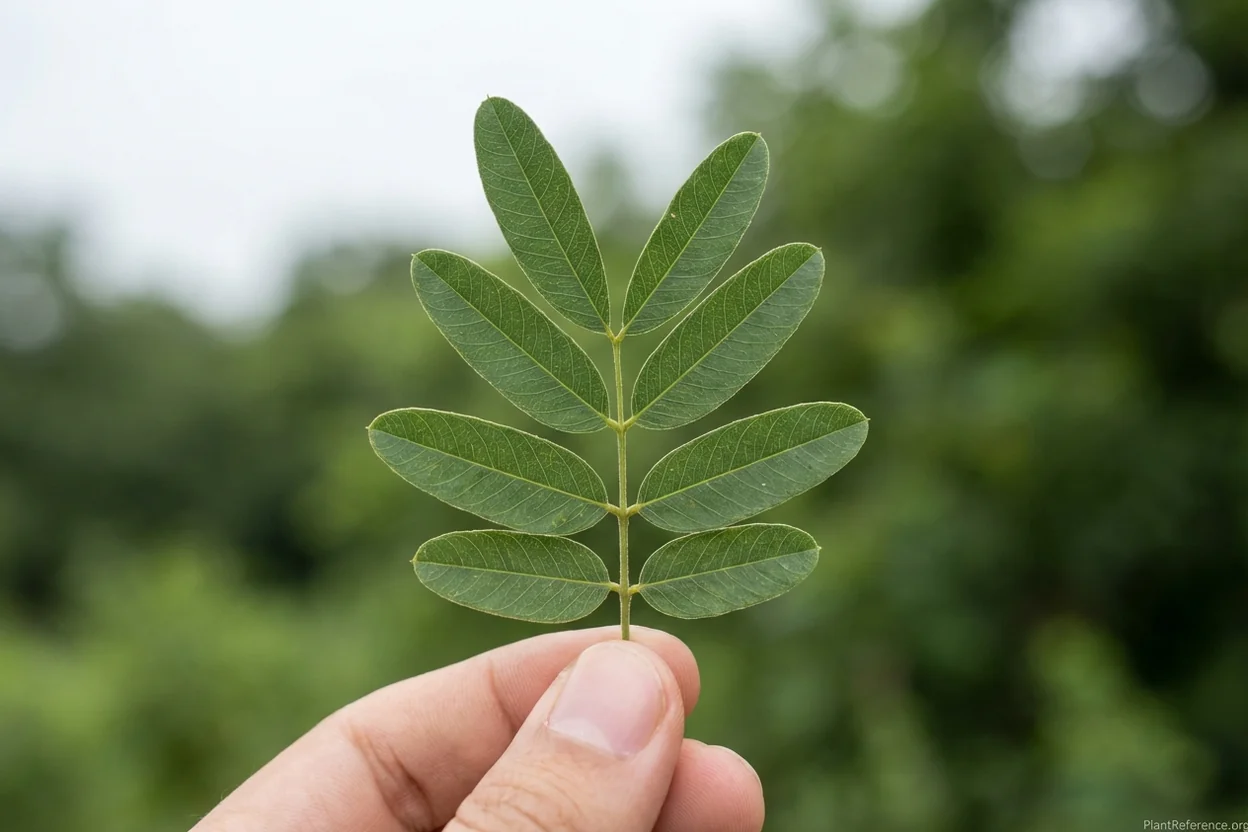
Pinnately compound leaves have leaflets arranged on both sides of the rachis like a feather — think ash (🌿Fraxinus ornus) or walnut (🌿Juglans nigra). Palmately compound leaves have leaflets radiating from a single point at the tip of the petiole, like fingers on a hand — think buckeye (🌿Aesculus × carnea 'Briotii'). Trifoliate leaves have exactly three leaflets — clovers (Trifolium spp.), poison ivy (🌿Toxicodendron radicans), and beans (🌿Phaseolus lunatus 'Fordhook 242').
Feature | Simple Leaf | Compound Leaf |
|---|---|---|
Blade | One continuous piece | Divided into separate leaflets |
Axillary bud | At base of petiole | At base of petiole only (not at leaflet bases) |
Common examples | Oaks, maples, elms, birches | Ashes, walnuts, hickories, clovers |
Subtypes | Lobed, unlobed | Pinnate, palmate, trifoliate |
Leaf Shape, Margins, and Venation
Once you know arrangement (alternate/opposite) and type (simple/compound), three more leaf features help narrow your identification to genus or species level.
Shape
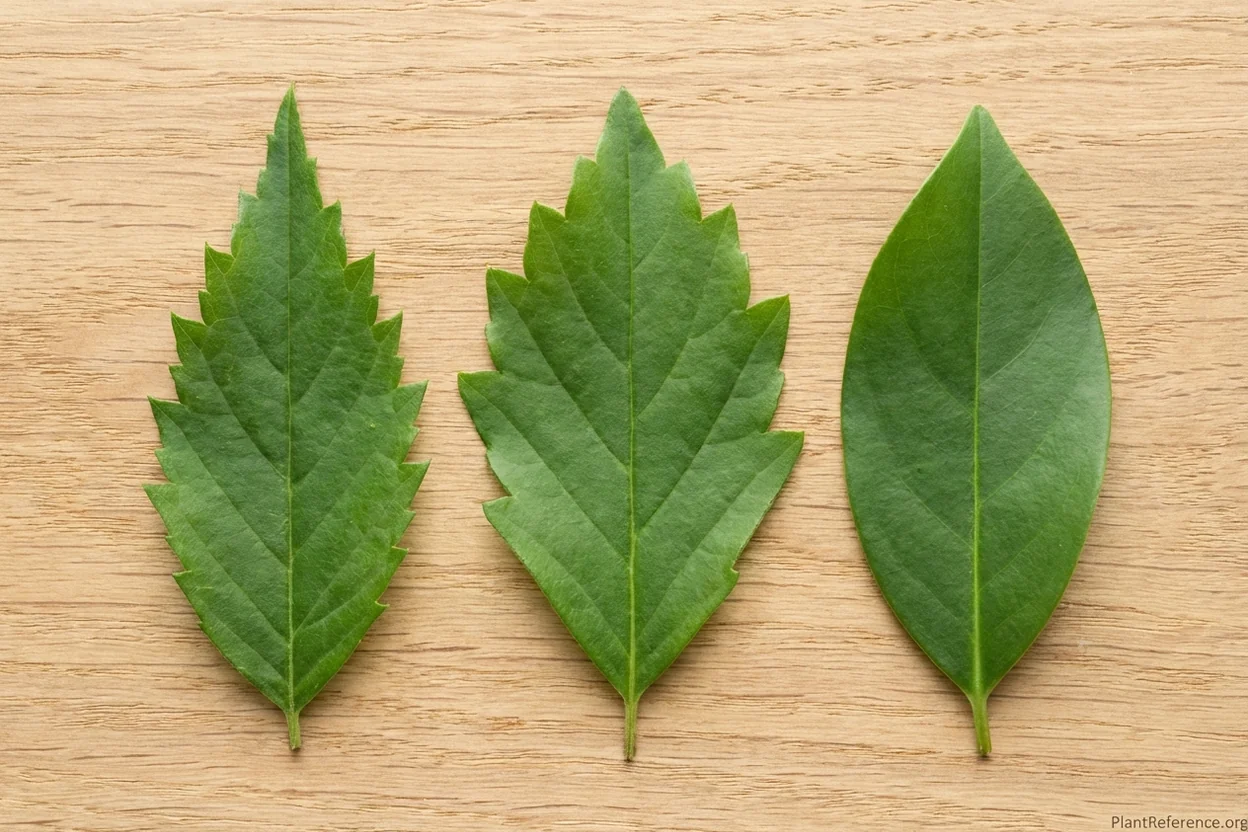
Leaf shape has precise botanical terminology, but beginners can start with broad categories. Linear leaves are long and narrow with parallel sides (grasses, irises). Ovate leaves are egg-shaped, wider at the base. Cordate leaves are heart-shaped with a notch at the base — think basswood (🌿Tilia americana) or redbud (🌿Cercis canadensis 'Forest Pansy'). Lanceolate leaves are lance-shaped, wider near the base and tapering to a point.
Margins
The leaf edge — its margin — provides fine-grained diagnostic detail. Entire margins are smooth with no teeth. Serrate margins have sharp, forward-pointing teeth like a saw blade. Dentate margins have teeth that point outward. Crenate margins have rounded, scallop-like teeth. Lobed margins have deep indentations dividing the blade into rounded or pointed sections. Brown Spots on Fiddle Leaf Fig: 7 Causes + Solutions
Venation
The vein pattern reflects deep evolutionary divisions. Parallel venation — veins running side by side from base to tip — identifies monocots (grasses, lilies, irises, orchids). Pinnate venation — a single midrib with branching secondary veins — is common in most broadleaf trees. Palmate venation — multiple main veins radiating from the leaf base — is seen in maples, sweetgums, and sycamores.
Reading the Stem
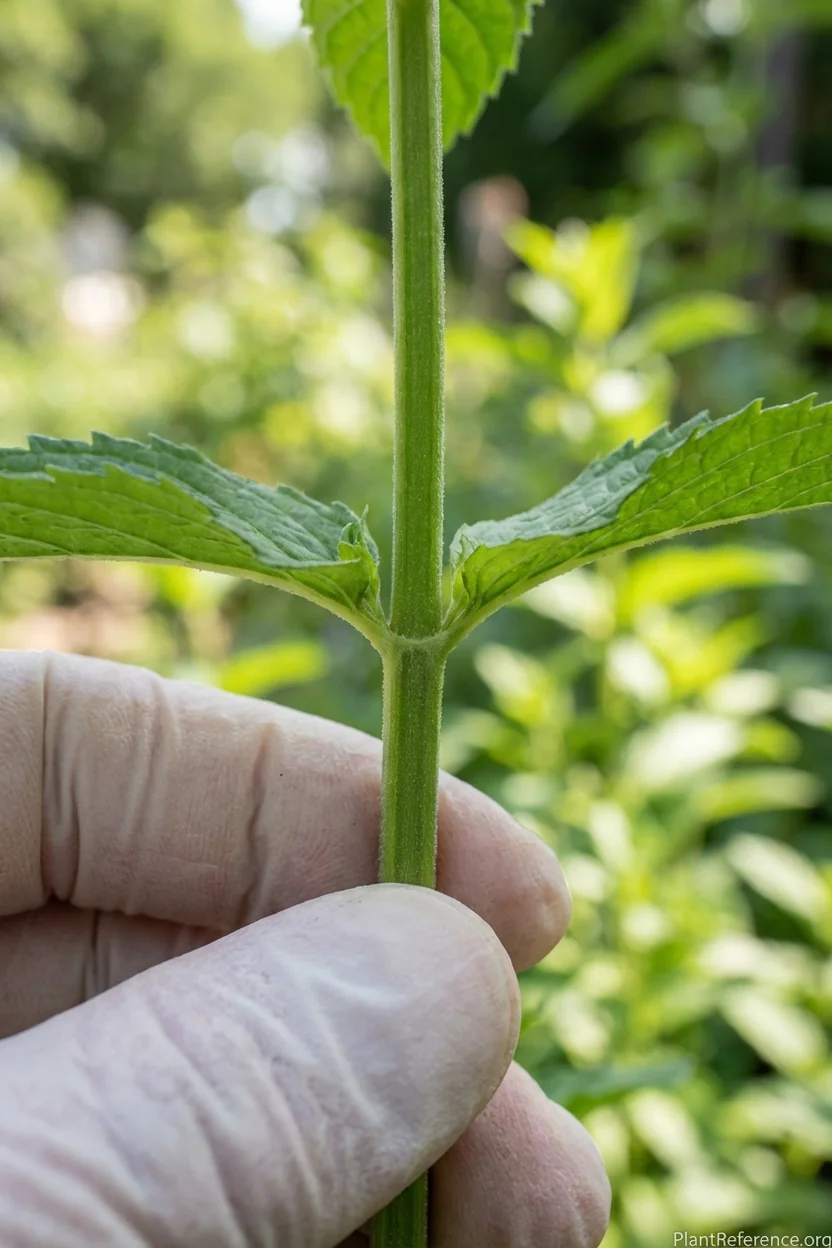
The stem provides identification clues that many beginners overlook. Square stems are a signature of the mint family (Lamiaceae spp.) — if you find a plant with opposite leaves, square stems, and aromatic foliage, it is almost certainly a mint relative. Roll the stem between your fingers; a square stem feels distinctly angular. Best Fertilizer for Monstera: Organic vs Synthetic Tested
Thorns, spines, and prickles differ in origin and provide family-level clues. Thorns are modified branches (hawthorn), spines are modified stipules or leaves (cacti, barberry), and prickles arise from the bark surface (roses). Note their presence, position, and shape.
Stem cross-section separates grasses, sedges, and rushes — three groups that confuse beginners constantly. The mnemonic "sedges have edges, rushes are round, grasses have nodes all the way to the ground" captures the key differences. Grass stems (Poaceae spp.) are round and usually hollow with solid, swollen nodes. Sedge stems (Cyperaceae spp.) are triangular and solid. Rush stems (Juncaceae spp.) are round and solid.
Flowers: The Most Reliable ID Feature
Flowers are the gold standard for plant identification. Leaves can vary with sun exposure, soil, and age — but flower structure is genetically fixed and remarkably consistent within a species. If a plant is in bloom, start your identification here.
Petal Count and Symmetry
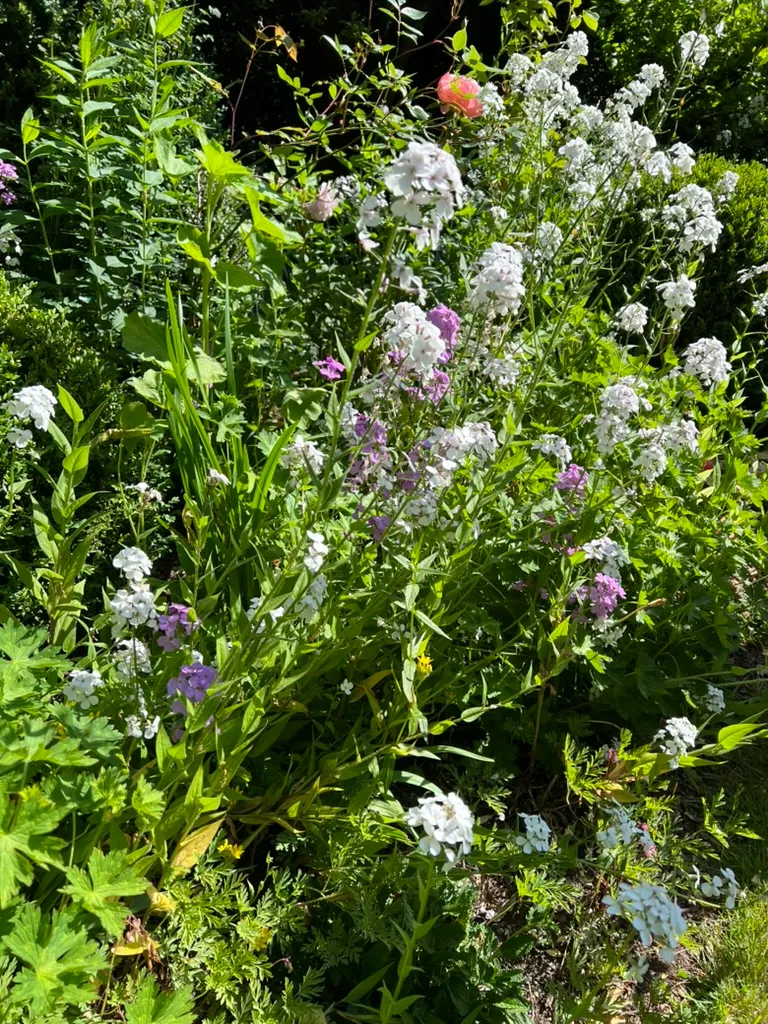
Count the petals (or petal-like structures). Monocots (grasses, lilies, irises, orchids) typically have flower parts in multiples of three — 3 petals, 6 stamens. Eudicots (the majority of flowering plants) have parts in multiples of four or five — 4 petals in mustards (Brassicaceae spp.), 5 in roses (Rosaceae spp.), buttercups (Ranunculaceae spp.), and many others. Best Pothos Varieties to Buy: Beginner to Collector Guide
Symmetry is equally diagnostic. Radial symmetry (actinomorphic) means the flower can be divided into equal halves along multiple planes — like a daisy or a buttercup. Bilateral symmetry (zygomorphic) means only one plane divides the flower into mirror halves — like a pea flower, an orchid, or a snapdragon. Bilateral symmetry immediately suggests specific families: Fabaceae spp. (peas), Lamiaceae spp. (mints), and Orchidaceae spp. (orchids).
Composite Flower Heads
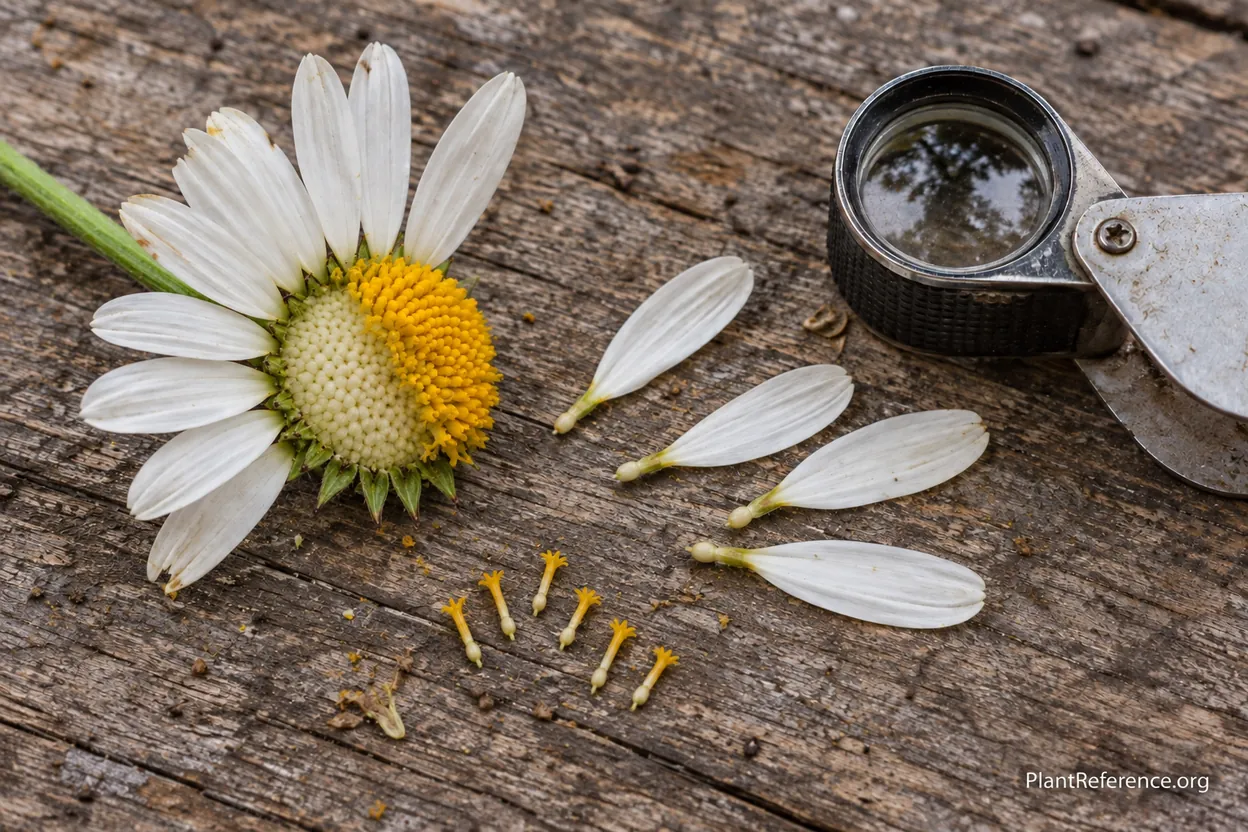
The sunflower family (Asteraceae spp.) creates an identification trap for beginners. What looks like a single flower — a daisy, a dandelion, a sunflower — is actually a composite head of dozens or hundreds of tiny individual flowers called florets. The "petals" are actually separate ray florets surrounding a disk of tiny tube-shaped disk florets. Once you recognize this pattern, you can identify members of Asteraceae spp. instantly — it is the largest plant family in North America.
Ovary Position
One more floral feature helps at the family level: ovary position. A superior ovary sits above the attachment point of the petals and sepals — you can see it inside the flower. An inferior ovary sits below the petals, embedded in the receptacle — the flower appears to sit on top of the ovary. Roses (Rosaceae spp.) have a distinctive perigynous arrangement where a cup-shaped structure (the hypanthium) surrounds the ovary without being fused to it. Ovary position is used in every botanical key and becomes second nature after examining a few dozen flowers. Fiddle Leaf Fig Root Rot: How to Save Your Plant
The Pea Flower Pattern
The legume family (Fabaceae spp.) is the third-largest plant family and one of the easiest to recognize by its flowers. The "butterfly" flower has five petals arranged in a specific pattern: one large upper banner petal, two side wing petals, and two lower petals fused into a boat-shaped keel. This banner-wings-keel pattern appears in garden peas, beans, clovers, lupines, wisteria, and hundreds of wildflowers. The fruit is always a legume — a dry pod that splits along two seams. Once you learn this pattern, you will see it everywhere.
Putting It All Together: The 5-Minute Field Method
Here is the systematic approach I teach in my plant identification workshops. It works for any flowering plant you encounter.
Step 1: Leaf arrangement. Alternate, opposite, or whorled? This single observation eliminates half of all possibilities.
Step 2: Leaf type. Simple or compound? If compound, pinnate or palmate?
Step 3: Leaf details. Note the shape, margin (smooth, toothed, lobed), and venation (parallel or netted). Sketch or photograph both surfaces — hair patterns on the underside are often diagnostic. Fiddle Leaf Fig Pests: Identification & Treatment
Step 4: Stem features. Round or square? Hollow or solid? Thorns or smooth? Woody or herbaceous?
Step 5: Flowers and fruits. Count petals, check symmetry, note color. If fruits are present, describe their type (berry, capsule, pod, achene). How to Water a Fiddle Leaf Fig (Never Kill Yours Again)
With these five observations recorded, you have enough information to use a field guide, a dichotomous key, or the PlantReference database to reach a species-level identification. You also have the right features photographed for an ID app to give you an accurate answer — apps perform dramatically better when you photograph the diagnostic parts rather than snapping the whole plant from a distance.
Why This Method Works Better Than Apps Alone
Photo-ID apps like PictureThis and PlantNet are useful tools, but they have a fundamental limitation: they give you a name without teaching you to see the features that define that species. The next time you encounter the same plant in a different season, a different growth stage, or a different region, the app starts from scratch. You start from scratch.
The 5-minute field method trains your eyes. After examining 20 plants this way, you begin noticing leaf arrangements automatically. After 50, you start recognizing families before you even look closely. After 100, you are genuinely identifying plants — not just matching photos. The difference is the difference between using a translation app to read a menu and actually learning the language.
PlantReference's study tools bridge this gap. The flashcard system shows you multiple images of each species — different seasons, growth stages, and photographic angles — so you learn to recognize the plant, not one photograph. The spaced repetition algorithm focuses your study time on the species you find hardest to remember. And the quizzes test your ability to retrieve species names from memory, which is the active recall that builds permanent identification skill. Best Propagation Stations for Pothos and Other Vining Plants (2025)
Practice this method on 10 plants in your yard and you will be surprised how quickly patterns emerge. Within a few weeks, you will start recognizing plant families on sight — the opposite leaves and square stems of mints, the composite heads of daisies, the three leaflets of clovers. That pattern recognition is the foundation of all botanical expertise, and PlantReference's flashcard and spaced repetition tools are designed to accelerate exactly this kind of visual learning.
Frequently Asked Questions
Reading about plants and recognising them are different skills. These three build the second.
- Daily PlantIdentify the day’s mystery plant from a close-up photograph.
- Keyed OutWork a dichotomous key, lead by lead, to name a hidden specimen.
- Name That PlantName a specimen from botanical clues dealt hardest first.
Free to play, no account needed
Tagged with
Sarah earned her doctorate in plant biology and spent time working in botanical garden education before transitioning to freelance writing and consulting. Now based in Portland, Oregon, she teaches plant identification workshops at local community centers and maintains a modest collection of over 60 houseplants in her small apartment. Sarah specializes in helping beginners understand plant science without the jargon—her approach focuses on practical observation over theory. She's killed her fair share of fiddle leaf figs and finally cracked the code on keeping them alive.