Overview
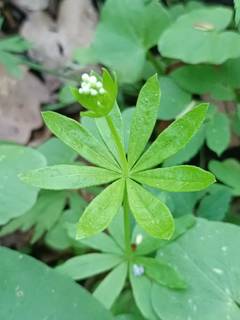
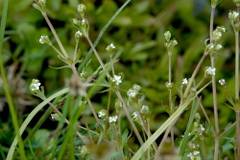
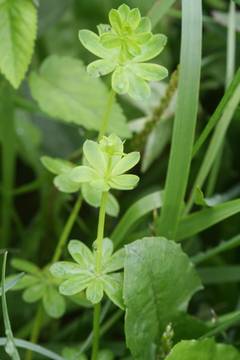
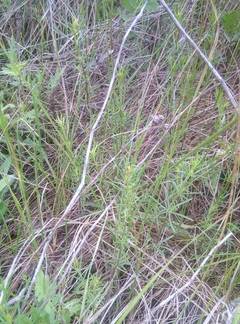
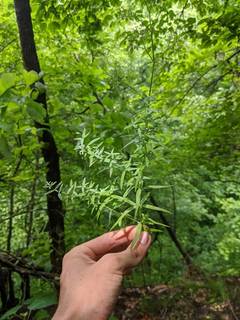
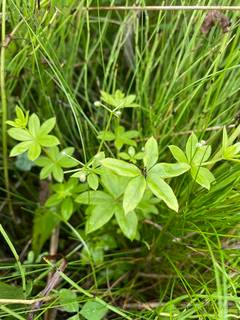
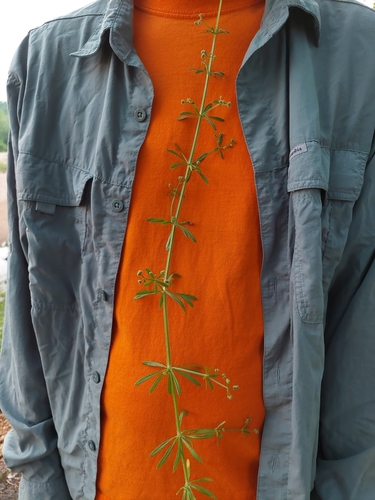
Galium aparine is a scrambling, clinging winter annual in the coffee family (Rubiaceae) reaching 12-60 inches (30-150 cm) in length with a 12-36 inch (30-90 cm) spread. Stems are square in cross-section, weak, and unable to support themselves; they climb over adjacent vegetation and structures using tiny recurved hooks (retrorse prickles) along the stem angles and leaf margins. Leaves are linear to oblanceolate, 0.5-2 inches (1-5 cm) long, in whorls of 6-8 at each node. Flowers are tiny, white, four-petaled, 0.04-0.08 inch (1-2 mm) across, borne in small axillary clusters. Fruit is a pair of globose nutlets 0.1-0.15 inch (2.5-4 mm) in diameter, densely covered in hooked bristles that adhere to animal fur, feathers, and clothing. A single plant produces 100-400 seeds. Seeds germinate primarily in fall, forming winter rosettes that bolt and climb rapidly in spring. The hooked bristles on all surfaces are the diagnostic tactile feature; pulling a stem through fingers reveals the clinging texture. The species has a circumboreal distribution and is native to both North America and Eurasia; it also functions as a weed in gardens, hedgerows, and cultivated ground throughout temperate regions.
Native Range
Galium aparine has a circumboreal distribution and is native to both North America and Eurasia, occurring in moist, partially shaded habitats including woodland edges, hedgerows, streambanks, gardens, and cultivated fields from sea level to approximately 7,000 feet (2,100 m). Recorded across all 50 U.S. states, all Canadian provinces, and throughout Europe and Asia.Suggested Uses
Used in weed identification courses for teaching Rubiaceae whorled-leaf morphology and adhesive seed dispersal mechanisms. The clinging hooks serve as a teaching example of passive animal dispersal (epizoochory). Historically used as a coffee substitute (roasted seeds) and as a spring potherb. Seeds are consumed by ground-feeding birds.How to Identify
Appearance
Size & Dimensions
Height1' - 5'
Width/Spread1' - 3'
Bloom Information
Flowers appear April through July. Individual flowers open for 1-2 days. Small clusters of 1-3 flowers in leaf axils bloom sequentially along the elongating stems over 6-8 weeks. The species is self-pollinating. Hooked fruits mature 2-3 weeks after flowering and adhere to passing animals and clothing for dispersal. In the Pacific Northwest, flowering peaks in May through June.
Detailed Descriptions
Flower Description
White, tiny, four-petaled, 0.04-0.08 inch (1-2 mm) across in small axillary clustersFoliage Description
Medium green, linear to oblanceolate, in whorls of 6-8 at each node; covered in tiny recurved hooksGrowing Conditions
Sun Requirements
Requires 3-8 hours of direct sunlight daily
• Full Sun: 6+ hours of direct sunlight
• Partial Shade: 3-6 hours of direct sunlight
• Full Shade: Less than 3 hours of direct sunlight