How to Identify Conifers: Pines, Spruces, and Firs Simplified
Pets & Toxicity
Recorded toxicity for plants linked in this guide. An unknown status is not a safety assessment.
No linked plant is recorded as toxicDetailsHide
Picea orientalis 'Aureospicata' — Toxicity
Non-toxicView Picea orientalis 'Aureospicata' plant profile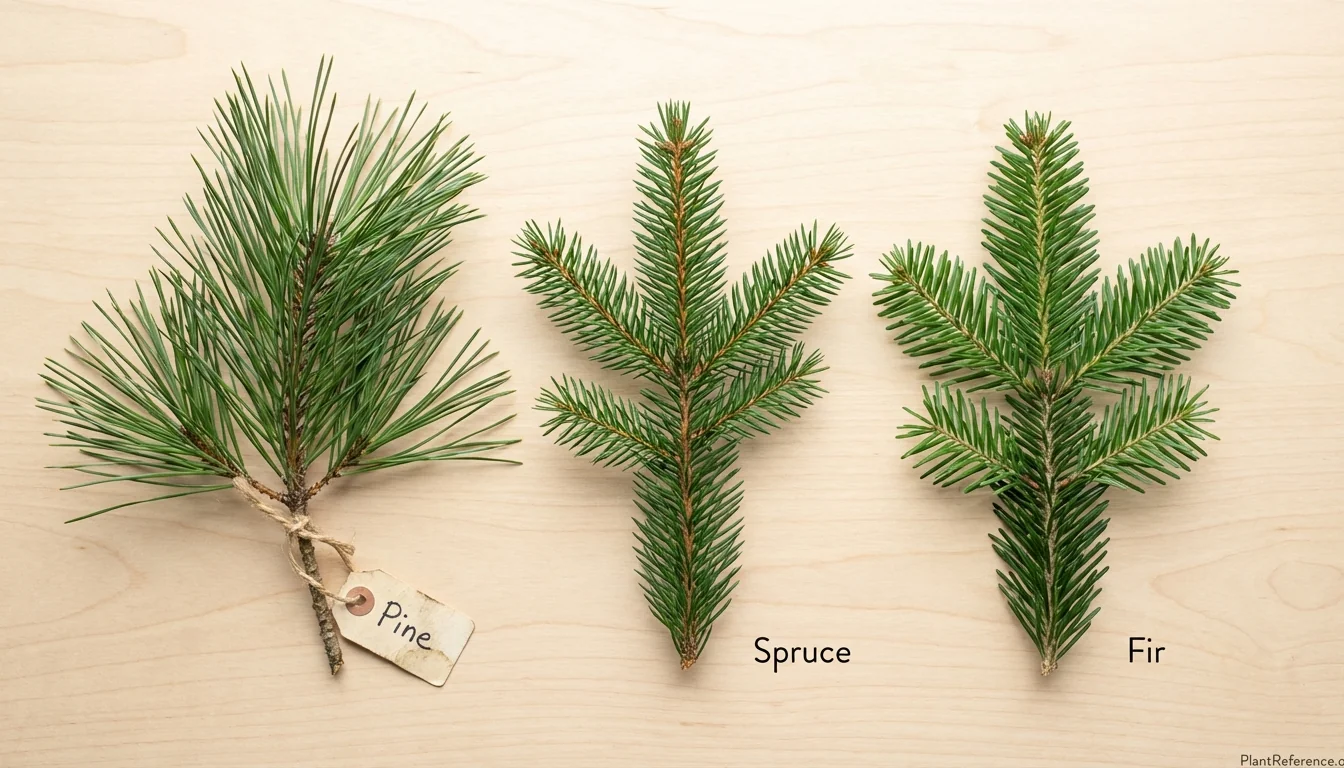
— Image © Plant Reference 2026
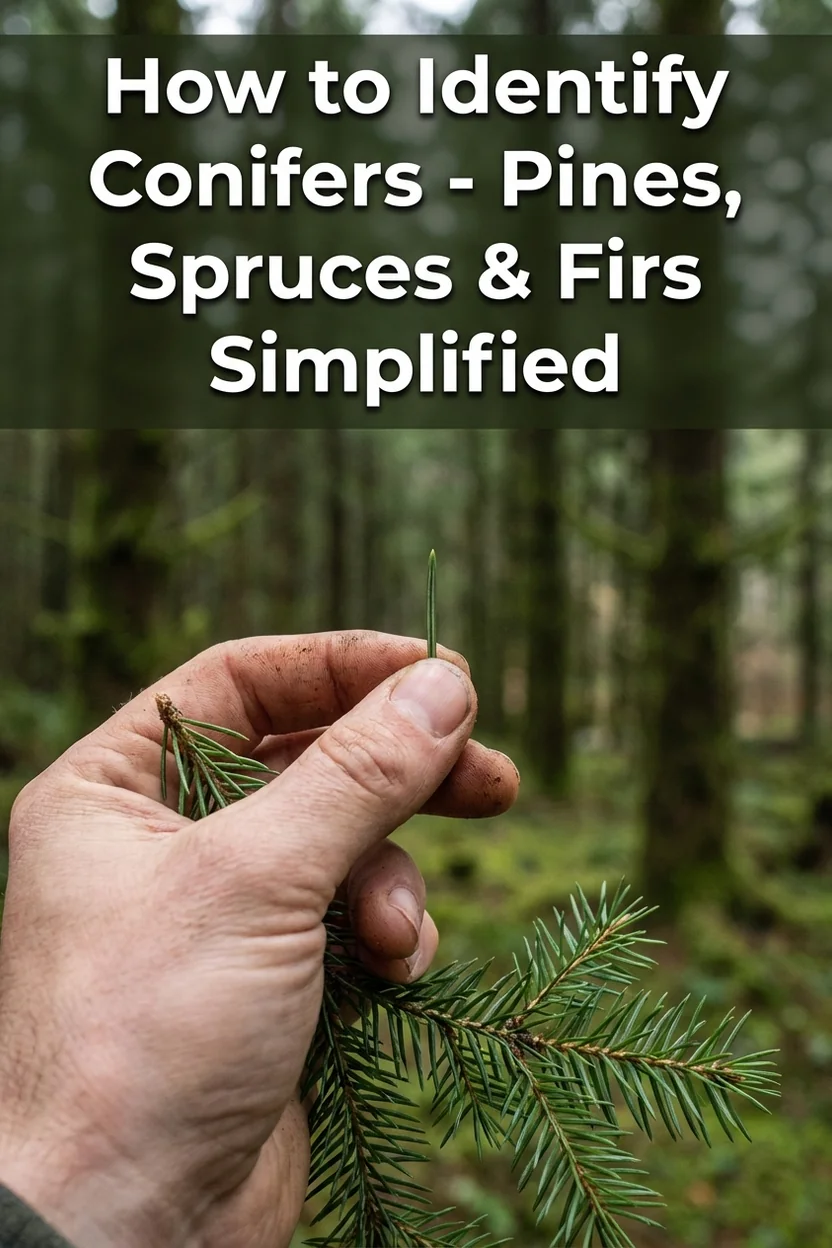
"Is that a pine tree?" is one of the most common identification questions — and the answer is usually no. People call every conifer a "pine," but pines, spruces, and firs are three distinct genera with different needles, cones, and ecological roles. Telling them apart requires no equipment, no expertise, and about 10 seconds. How to Identify Any Plant: A Beginner's Guide to Leaves, Flowers, and Stems
The Confusion
The confusion exists because all three genera are evergreen conifers with needle-like leaves. From a distance they look similar. But up close, the differences are obvious and consistent. Once you learn the three tests, you will never confuse them again. How to Identify Trees by Their Leaves: Shapes, Margins, and Venation Explained
The three genera — 🌿Pinus thunbergii (pines), 🌿Picea abies 'Reflexa' (spruces), and 🌿Abies concolor (firs) — represent the majority of conifers people encounter in North American forests, parks, and yards. Other conifers (hemlocks, cedars, larches, Douglas-fir) have their own distinctive features.
Test 1: Bundled or Single Needles
This is the fastest test and the one to start with.
Pines: Needles in Bundles
🌿Pinus thunbergii species are the only common conifers with needles in fascicles (bundles). Each bundle contains a specific number of needles — 2, 3, or 5 — held together at the base by a papery sheath. If you see bundled needles, it is a pine. No spruce or fir bundles its needles.
The bundle number narrows the species: 2 needles — red pine (🌿Pinus resinosa), Scots pine (🌿Pinus sylvestris), Austrian pine (🌿Pinus nigra). 3 needles — loblolly pine (🌿Pinus taeda), pitch pine (🌿Pinus rigida), ponderosa pine (🌿Pinus ponderosa). 5 needles — eastern white pine (🌿Pinus strobus), western white pine (🌿Pinus monticola), sugar pine (🌿Pinus lambertiana). Choosing Climate-Ready Trees: Species Selection for 2050 and Beyond
Spruces and Firs: Single Needles
Both 🌿Picea abies 'Reflexa' (spruces) and 🌿Abies concolor (firs) attach needles individually to the twig. This immediately separates them from pines. To distinguish spruce from fir, move to Test 2.

Test 2: Roll the Needle
Pull a single needle from the twig and roll it between your thumb and forefinger.
Spruce: It Rolls
🌿Picea abies 'Reflexa' needles are square or diamond-shaped in cross-section. When you roll a spruce needle between your fingers, it rotates smoothly. Spruce needles are also stiff and sharp-pointed — they poke you. If the needle rolls and pokes, it is a spruce. Winter Tree Identification: Bark, Buds, and Branching When Leaves Are Gone
Fir: It Will Not Roll
🌿Abies concolor needles are flat in cross-section — two-sided, like a tiny ribbon. When you try to roll a fir needle, it resists because the flat surfaces grip your skin. Fir needles are also soft and flexible. If the needle will not roll and feels soft, it is a fir.
This "roll test" correctly separates spruce from fir in virtually all cases.

Test 3: Cone Direction
Fir: Cones Stand Upright
🌿Abies concolor cones stand upright on the branch like candles. They grow near the top of the tree and disintegrate on the branch — the scales fall off individually, leaving a bare central spike. You almost never find intact fir cones on the ground. If you see upright cones on a conifer, it is a fir.
Spruce and Pine: Cones Hang Down
🌿Picea abies 'Reflexa' cones hang downward and fall to the ground intact. 🌿Pinus thunbergii cones also hang downward and fall intact. Spruce cones are generally smaller and thinner-scaled than pine cones. Pine cones have thick, woody scales often armed with a small prickle. Wildflower Identification by Color: How to Name Any Flower You Find

Test 4: Feel the Twig
After you pull a needle off, feel the bare twig.
Spruce: Rough Twig
When a spruce needle falls, it leaves a small woody peg (sterigma) projecting from the twig. These pegs make bare spruce twigs feel rough and bumpy.
Fir: Smooth Twig
When a fir needle falls, it leaves a smooth, flat circular scar flush with the twig surface. Bare fir twigs feel smooth. Simple vs Compound Leaves: How to Tell the Difference and Why It Matters
This test works even on dead branches with no needles remaining.

Quick-Reference Comparison
Feature | Pine (🌿Pinus thunbergii) | Spruce (🌿Picea abies 'Reflexa') | Fir (🌿Abies concolor) |
|---|---|---|---|
Needle attachment | Bundled (2, 3, or 5) | Single | Single |
Needle cross-section | N/A (use bundle count) | Square — rolls | Flat — will not roll |
Needle feel | Long, flexible | Short, stiff, sharp | Short, soft, flexible |
Cone orientation | Hanging or angled | Hanging downward | Upright on branch |
Cone on ground? | Yes (intact) | Yes (intact) | No (disintegrates on branch) |
Bare twig texture | Scaly | Rough (woody pegs) | Smooth (flat scars) |
Common species | 🌿Picea abies, 🌿Picea glauca 'Conica', 🌿Picea pungens 'Glauca' |
What About Douglas-Fir?
🌿Pseudotsuga menziesii (Douglas-fir) is not a true fir — the hyphen in "Douglas-fir" signals this. Its cones hang downward and have distinctive three-pointed bracts protruding between the scales. Its needles are flat like firs but attach on a small stalk rather than directly to the twig. Flower Identification Guide: How to Use Petals, Shape, and Color to Name Any Flower
What About Hemlocks?
🌿Pseudotsuga menziesii (hemlocks) have short, flat needles with two white stripes on the undersurface and needles of varying lengths on the same twig. Hemlock cones are tiny (0.5-1 inch / 1-2.5 cm) and hang downward.
Practice identifying these conifer genera with PlantReference's conifer flashcard set. The multi-image format includes needle close-ups, bark patterns, cone photos, and whole-tree silhouettes. Spaced repetition ensures you retain the roll test and twig texture test permanently. Common Lawn Weeds Identification Guide: What's Growing in Your Yard

Frequently Asked Questions
Reading about plants and recognising them are different skills. These three build the second.
- Daily PlantIdentify the day’s mystery plant from a close-up photograph.
- Keyed OutWork a dichotomous key, lead by lead, to name a hidden specimen.
- Name That PlantName a specimen from botanical clues dealt hardest first.
Free to play, no account needed
Tagged with
Sarah earned her doctorate in plant biology and spent time working in botanical garden education before transitioning to freelance writing and consulting. Now based in Portland, Oregon, she teaches plant identification workshops at local community centers and maintains a modest collection of over 60 houseplants in her small apartment. Sarah specializes in helping beginners understand plant science without the jargon—her approach focuses on practical observation over theory. She's killed her fair share of fiddle leaf figs and finally cracked the code on keeping them alive.