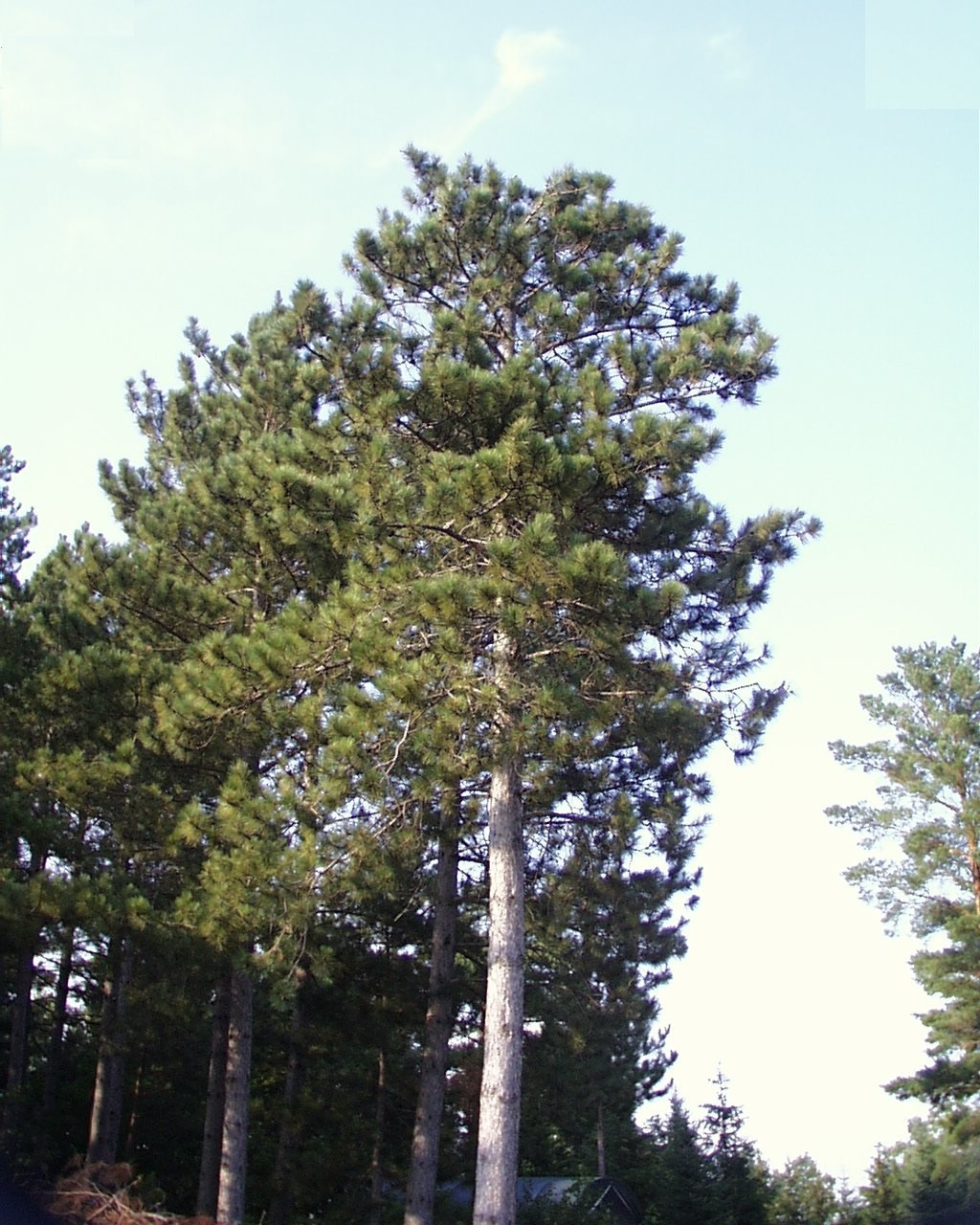
Carnby, no rights reserved (CC0) · Wikimedia Commons
Pinus, Genus, resinosa, Species,
- Genus & species
red pine
Northeastern North America (Nova Scotia and Manitoba south through Pennsylvania, Michigan, Minnesota; sandy plains, rocky ridges, glaciated landscapes; near-uniform population genetics across the species range)
Overview
Pinus resinosa is an evergreen conifer in the pine family (Pinaceae) reaching 50–80 feet (15–24 m) tall with a spread of 25–40 feet (7.6–12 m), carrying a broadly conical to oval crown that opens into a flat-topped silhouette with age. This two-needle pine carries needles 4–6 inches (10–15 cm) long, dark green in color, flexible in texture, held in fascicles of 2 — the needles snap cleanly when bent double, which runs as a reliable field identification test for the species. The bark develops reddish-brown to pinkish-red broad flat scaly plates across mature trunks, which gives the species its primary common name. Cones run ovoid at 1.5–2.5 inches (4–6 cm) long with prickle-free outer scales. Growth rate runs moderate. Hardy to zone 2. The species shows exceptionally low genetic variation across populations — approaching near-uniform genetic composition at the species level, which makes it an outlier across North American tree species in population genetics terms. The species is the state tree of Minnesota.
Native Range
Pinus resinosa is native to northeastern North America, where wild populations range from Nova Scotia and Manitoba south through Pennsylvania, Michigan, and Minnesota. The species grows in sandy plains, on rocky ridges, and across glaciated landscape formations within the native range.Suggested Uses
Grown as a specimen tree, screen planting, or grove installation at 20–30 foot (6–9 m) spacing on sandy acidic sites. The reddish-pink plated bark carries the primary ornamental feature on mature trees — the bark character develops gradually across decades of growth and reads most clearly on specimens of 40 or more years. The species is a North American native tree and carries zone 2 cold hardiness into cold inland climate zones where most pines fail. Alkaline soils, urban planting sites with pollution and road salt exposure, and heavy clay substrates are all unsuitable given the cultural profile.How to Identify
Appearance
Size & Dimensions
Height50' - 80'
Width/Spread25' - 40'
Bloom Information
Male strobili release pollen during May. Female cones mature across a 2-year development cycle to 1.5–2.5 inches (4–6 cm) long, ovoid in outline, with prickle-free outer scales rather than the stout prickles that many pine species carry on their cones.
Detailed Descriptions
Flower Description
Male strobili during May; female cones ovoid 1.5-2.5 inches long with prickle-free outer scales on a 2-year maturation cycleFoliage Description
Dark green flexible needles 4-6 inches long in fascicles of 2; needles snap cleanly when bent doubleGrowing Conditions
Sun Requirements
Requires 6-12 hours of direct sunlight daily
• Full Sun: 6+ hours of direct sunlight
• Partial Shade: 3-6 hours of direct sunlight
• Full Shade: Less than 3 hours of direct sunlight