Image 1 of 9
1 / 9
Plant Reference
Picea, Genus, glauca, Species, 'Conica', Cultivar,
- Genus & species
- Cultivar
dwarf alberta spruce
Cultivar discovered near Lake Laggan, Alberta, Canada (1904); species native across northern North America
Overview
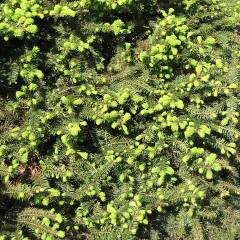
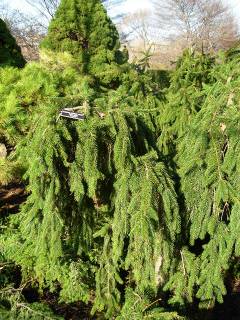
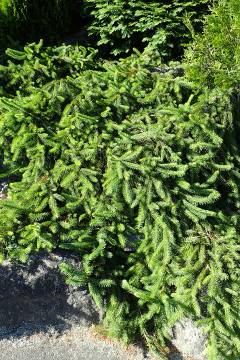
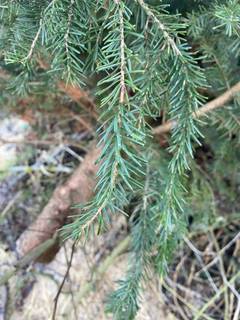
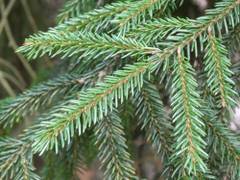
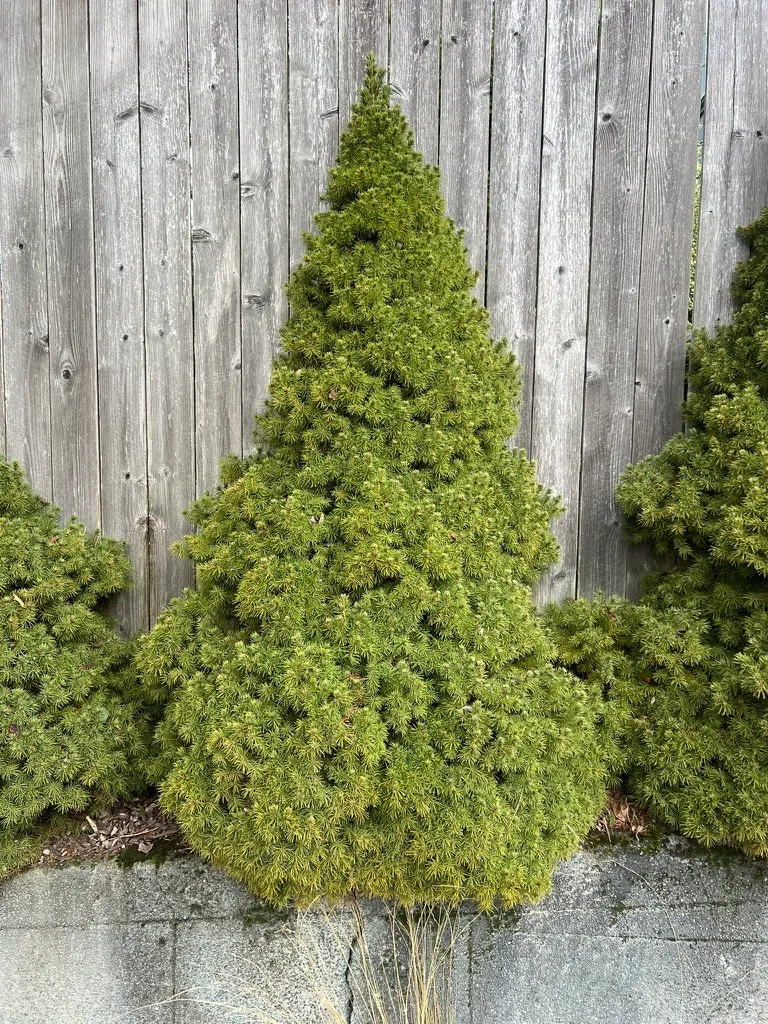
Picea glauca 'Conica' is a dwarf conical cultivar of white spruce that forms a dense symmetrical cone without pruning. Growth rate is slow at 2-4 inches (5-10 cm) per year; plants reach 6-8 feet (1.8-2.4 m) tall and 3-4 feet (0.9-1.2 m) wide in 25 years, with old specimens occasionally reaching 10-12 feet (3-3.7 m). Needles are 0.25-0.5 inch (6-12 mm), soft to the touch, and four-sided in cross-section, emerging bright yellow-green in spring and transitioning to medium green by summer. Needles are densely packed on upward-angled branch tips, producing a close-knit small-scale texture. The cultivar is consistently conical from base to apex without visible gaps or a dominant leader on the exterior. Spider mites are a serious recurring pest in this cultivar, causing interior needle browning and drop that can disfigure the plant permanently in severe infestations; the dense foliage creates microhabitat favored by mites during hot, dry weather above 80°F (27°C). 'Conica' was discovered in 1904 near Lake Laggan, Alberta, Canada, as a chance seedling of the northern North American species. Non-toxic. Deer-resistant.
Native Range
Species native to a broad band across northern North America from Alaska east to Newfoundland and south into the northern United States. Cultivar 'Conica' discovered in 1904 near Lake Laggan, Alberta, Canada, as a chance seedling.Suggested Uses
Grown in foundation plantings, formal garden settings, and entryway flanking pairs, spaced 4-5 feet (1.2-1.5 m) from adjacent plants. Planted in containers of at least 15 gallons (57 L); root-bound container plants show faster decline than ground-planted specimens. The slow growth rate limits the need for relocation, but the eventual 6-12 foot (1.8-3.7 m) height requires advance planning in low-clearance foundation sites. Non-toxic. Hardy in zones 2-8.How to Identify
Appearance
Size & Dimensions
Height6' - 12'
Width/Spread3' - 5'
Bloom Information
Male strobili are reddish, producing pollen in April-May. Female cones are small, 1-1.5 inches (2.5-4 cm), oval-cylindrical, ripening from green to pale brown in the first season. Cone production is irregular on young plants and more consistent on specimens over 15 years old.
Detailed Descriptions
Flower Description
reddish male strobili releasing pollen in April-May; small oval-cylindrical female cones 1-1.5 inches (2.5-4 cm) ripening from green to pale brown in the first seasonFoliage Description
medium green; new spring growth emerges bright yellow-green and transitions to medium green by summer; needles are 0.25-0.5 inch (6-12 mm), soft to the touch, densely packed on upward-angled branch tipsGrowing Conditions
Sun Requirements
Requires 4-8 hours of direct sunlight daily
• Full Sun: 6+ hours of direct sunlight
• Partial Shade: 3-6 hours of direct sunlight
• Full Shade: Less than 3 hours of direct sunlight
Care & Maintenance
Care Guide
Site in full sun to partial shade (4-8 hours direct sun) in well-drained soil with a pH of 4.5-6.0. Water weekly during the first two growing seasons; established plants tolerate two weeks without rain in cool climates but show needle browning more quickly in heat above 85°F (29°C). Spider mites cause interior needle browning and drop, particularly in July and August; tapping a branch over white paper to detect moving mites allows early intervention. Heavy interior needle drop leaves permanent bare patches, as new growth does not emerge from old wood. Cytospora canker and white pine weevil are occasional problems; weevil damage kills the central leader and causes forking that distorts the conical shape. In climates with consistent summer heat above 90°F (32°C), afternoon shade reduces heat stress and mite pressure. Non-toxic. Deer-resistant. Hardy in zones 2-8.Pruning
No pruning is required to maintain the conical form. Dead interior branches can be removed in early spring (March). If the central leader is killed by weevil, a side branch can be trained upward as a replacement; this partially restores the conical shape but does not fully recover symmetry. Light shearing to slow growth is possible in early spring but is not needed for form maintenance.Pruning Schedule
Prune: March
early spring
Container Growing
Suitable for container growing
Minimum container size: 15 gallons