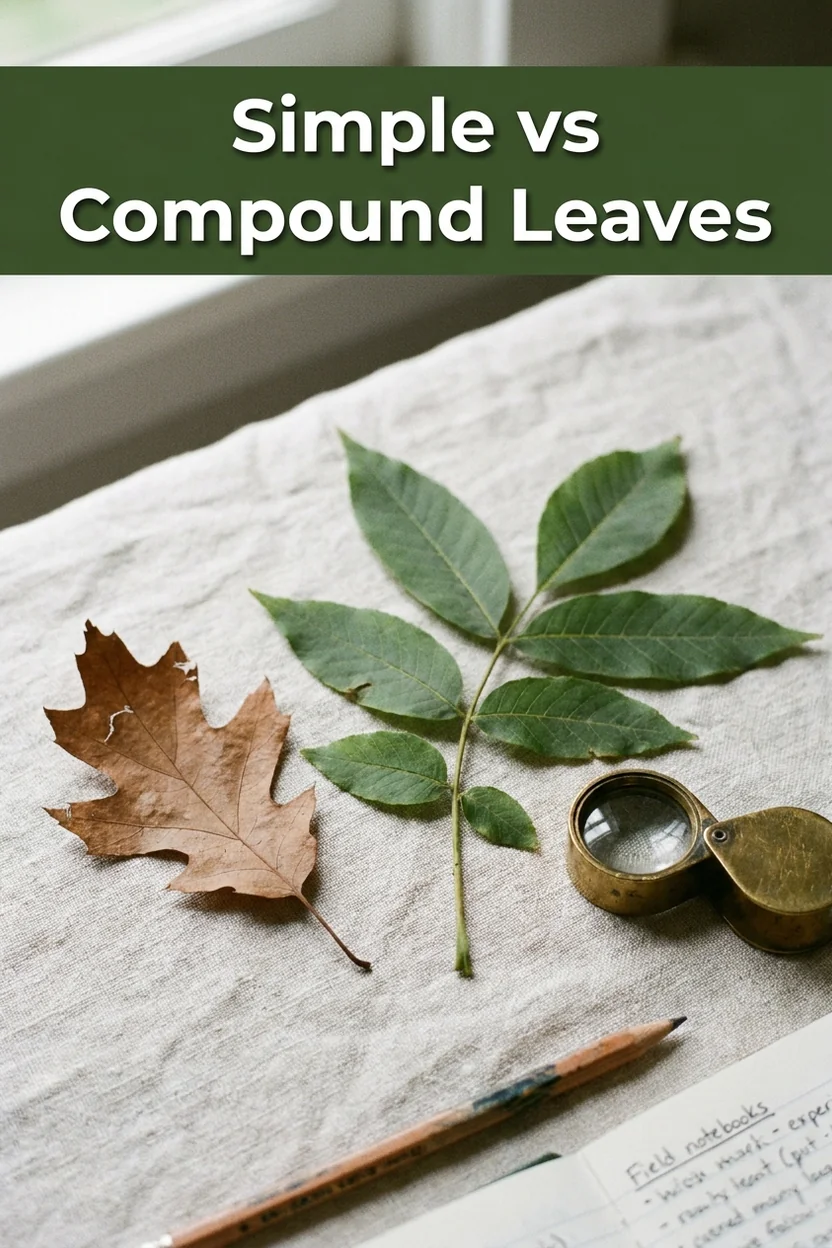
Simple vs Compound Leaves: How to Tell the Difference
Pets & Toxicity
Recorded toxicity for plants linked in this guide. An unknown status is not a safety assessment.
Aesculus hippocastanum — Toxicity Warning
Toxic to pets and humansView Aesculus hippocastanum plant profileToxicodendron radicans — Toxicity Warning
Toxic to pets and humansView Toxicodendron radicans plant profile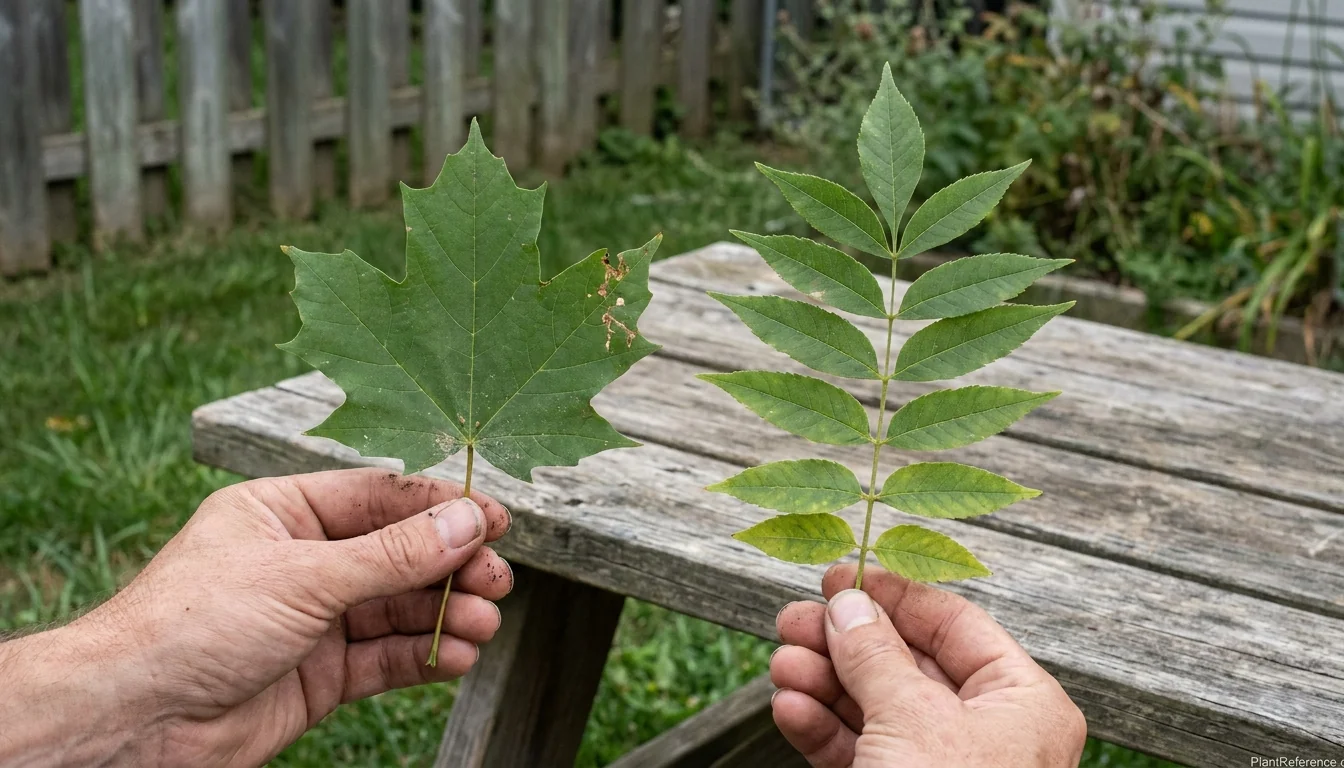
— Image © PlantReference.org 2026
If you have ever tried to identify a tree and gotten stuck on the very first question in the field guide, you are not alone. The simple vs compound leaves distinction trips up more beginners than any other single concept in plant identification, yet it is the fork that almost every identification key asks you to navigate first. Get it wrong, and every branch of the key that follows leads you to the wrong answer.
The Core Difference at a Glance
A simple leaf consists of a single, continuous blade attached to the stem by its stalk, or petiole. That blade can be smooth-edged, toothed, or even deeply cut into lobes—a maple (🌿Acer rubrum) (AY-ser ROO-brum) leaf is dramatically lobed but still a single simple leaf, because the cuts never reach all the way down to a central stalk.
A compound leaf, by contrast, is divided into two or more fully separate subunits called leaflets. The leaflets of an ash (🌿Fraxinus americana) (FRAK-sih-nus) attach to a central axis called the rachis, and each leaflet has its own small stalk but no bud of its own. The whole arrangement looks like several leaves, but botanically it is one leaf.
This is exactly where beginners go wrong. A compound leaf can carry a dozen leaflets that each look like a tidy little leaf, so the eye says "many leaves on a twig" when the plant is really showing you one leaf. The good news is that there is a single, dependable test that settles the question every time.
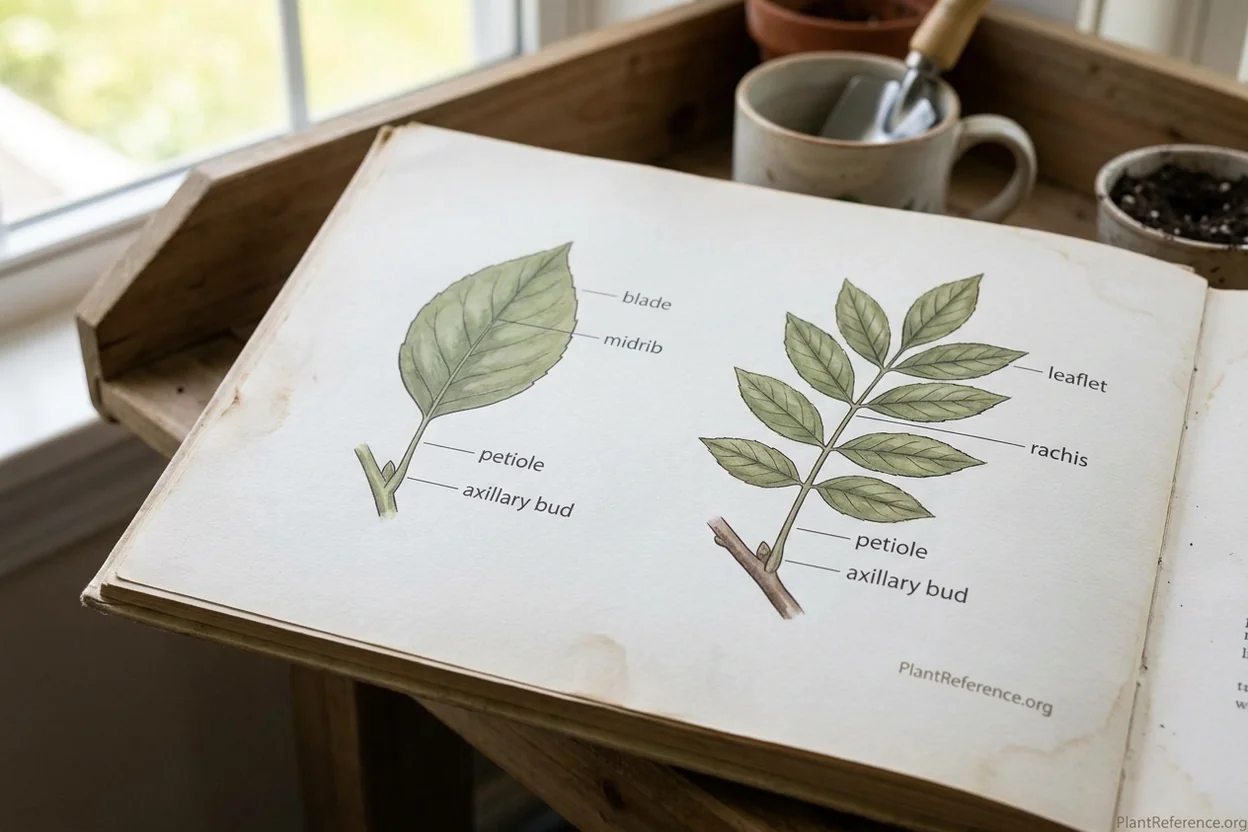
The Axillary Bud Test
Here is the rule that professional botanists rely on: an axillary bud sits in the angle, or axil, between a leaf and the stem that bears it. Buds form at the base of a true leaf and nowhere else. They never appear at the base of a leaflet.
So when you are unsure whether you are looking at one compound leaf or several simple leaves, trace each green unit back toward the woody twig and look for a small bud at the junction.
If you find a bud where the stalk meets the woody stem, that entire structure—every leaflet included—is one compound leaf.
If each individual blade has its own bud at its base, you are looking at several separate simple leaves.
Leaflets of a compound leaf attach to a green, non-woody rachis and have no bud; the rachis itself is soft, not bark-covered.
A second quick clue supports the bud test. Leaflets on a compound leaf almost always lie flat in a single plane, like the vanes of a feather. Separate simple leaves on a twig usually spiral around the stem at different angles. When you sight down a structure and every blade lines up flat, you are probably holding one compound leaf. For a fuller walkthrough of reading a plant from the twig outward, see How to Identify Any Plant: A Beginner's Guide to Leaves, Flowers, and Stems.
The bud test also pairs naturally with checking leaf arrangement. Once you know you have a true leaf, you can ask whether leaves sit opposite or alternate along the stem—a separate diagnostic covered in Alternate vs Opposite Leaf Arrangement: The MADCapHorse Mnemonic Explained.
Types of Compound Leaves
Once you confirm a leaf is compound, its architecture narrows the identification further. Botanists sort compound leaves by how the leaflets are arranged.
Pinnately compound leaves resemble a feather, with leaflets attached along both sides of the central rachis. Ash (🌿Fraxinus americana), hickory (🌿Carya ovata) (KAIR-ee-uh oh-VAY-tuh), and black walnut (🌿Juglans nigra) (JOO-glanz NY-gruh) all show this feather-like pattern. When the rachis itself branches and carries leaflets on those secondary axes, the leaf is bipinnately compound, as in honey locust (🌿Gleditsia triacanthos) (gleh-DIT-see-uh).
Palmately compound leaves have three or more leaflets radiating from a single point at the tip of the petiole, like fingers spreading from a palm. Horse chestnut (🌿Aesculus hippocastanum) (ESS-kew-lus) is the classic example.
Trifoliate leaves are a common special case with exactly three leaflets, seen across the clover genus and in poison ivy (🌿Toxicodendron radicans) (tox-ih-koh-DEN-dron)—the source of the familiar "leaves of three, let it be" warning.
Compound Leaf Type | Leaflet Arrangement | Example Species |
|---|---|---|
Pinnately compound | Leaflets paired along a central rachis | |
Bipinnately compound | Rachis branches; leaflets on secondary axes | |
Palmately compound | Leaflets radiate from one point | |
Trifoliate | Exactly three leaflets |
Why the Distinction Matters for Identification
This is not academic hair-splitting. Whether a leaf is simple or compound is genetically conserved and reliable, which is why it sits near the top of nearly every dichotomous key. A maple has simple leaves and an ash has compound leaves, and no amount of seasonal variation changes that. When you commit to the correct branch early, the rest of the key—margin, venation, arrangement—narrows quickly toward a species.
Get it backward, though, and you can spend twenty minutes keying a single ash leaflet as if it were a whole simple leaf, arriving confidently at a plant that does not exist. I have watched students do exactly this, and the fix is always the same: go back to the twig and find the bud. The broader process of working from leaf to flower to stem is laid out in How to Identify Any Plant: A Beginner's Guide to Leaves, Flowers, and Stems.
The distinction also feeds directly into the other major leaf traits. After you settle simple versus compound, the next questions are usually about the leaf margin and the venation pattern—both covered in How to Identify Trees by Their Leaves: Shapes, Margins, and Venation Explained. Parallel venation points toward monocots, while netted venation points toward the broadleaf trees that show most compound forms. Conifers play by different rules entirely, which is why needle-leaved trees get their own approach in How to Identify Conifers: Pines, Spruces, and Firs Simplified.
Common Mistakes and Tricky Cases
A few situations fool even careful observers, so it helps to know them in advance.
The deeply lobed simple leaf is the most common trap. Japanese maple, oak (🌿Quercus alba) (KWER-kus AL-buh), and sweetgum all have blades cut so deeply they look segmented. The test still works: the lobes connect to one continuous blade with no rachis and no leaflet stalks, and a single bud sits at the base of the whole leaf. Reading those margins and lobes correctly is its own skill, detailed in How to Identify Trees by Their Leaves: Shapes, Margins, and Venation Explained.
The opposite trap is the compound leaf in winter or early in the season, when leaflets may not be fully expanded. Trace back to the bud and rachis rather than trusting the silhouette.
Lobed but simple: oak, maple, and sweetgum keep one continuous blade despite deep cuts.
One bud, many leaflets: any time you count a single bud serving multiple blades, it is compound.
Soft green rachis versus woody twig: leaflets attach to a non-woody rachis, so if the central axis is bark-covered, you are looking at separate leaves.
Doubly compound confusion: honey locust and mimosa can look like a cloud of tiny leaves but are single bipinnate leaves.
When a specimen still resists, collect it and key it at home with a hand lens. The same bud-first logic that solves leaves also organizes the broader identification process, from flowers to stems, and connects to color-based shortcuts described in Flower Identification Guide: Petals, Shape & Color Explained. With the axillary bud test in hand, the simple vs compound leaves question stops being a stumbling block and becomes the fast, confident first step it was meant to be.
Frequently Asked Questions
Reading about plants and recognising them are different skills. These three build the second.
- Daily PlantIdentify the day’s mystery plant from a close-up photograph.
- Keyed OutWork a dichotomous key, lead by lead, to name a hidden specimen.
- Name That PlantName a specimen from botanical clues dealt hardest first.
Free to play, no account needed
Tagged with
Sarah earned her doctorate in plant biology and spent time working in botanical garden education before transitioning to freelance writing and consulting. Now based in Portland, Oregon, she teaches plant identification workshops at local community centers and maintains a modest collection of over 60 houseplants in her small apartment. Sarah specializes in helping beginners understand plant science without the jargon—her approach focuses on practical observation over theory. She's killed her fair share of fiddle leaf figs and finally cracked the code on keeping them alive.