How to Use a Dichotomous Key: Step-by-Step Guide to Keying Out Any Plant
Pets & Toxicity
Recorded toxicity for plants linked in this guide. An unknown status is not a safety assessment.
No linked plant is recorded as toxicDetailsHide
Picea orientalis 'Aureospicata' — Toxicity
Non-toxicView Picea orientalis 'Aureospicata' plant profile
— Image © Plant Reference 2026
A dichotomous key is the most precise plant identification tool that exists. Field guides use pictures. Apps use algorithms. But a dichotomous key uses logic — a structured sequence of two-choice questions that systematically eliminates species until only one remains. The word "dichotomous" comes from the Greek for "cutting in two," and that is exactly what happens at each step. How to Identify Any Plant: A Beginner's Guide to Leaves, Flowers, and Stems
What Is a Dichotomous Key
A dichotomous key is a structured identification tool built from couplets — pairs of contrasting statements. At each couplet, you observe a specific feature and choose which statement matches. Your choice directs you to either another couplet or a final identification.
Keys exist at every taxonomic level. A family-level key might start with "flowers with petals fused into a tube vs. petals separate." A genus-level key might ask "leaves alternate vs. leaves opposite." A species-level key might ask "leaf undersurface hairy vs. glabrous."
The power of dichotomous keys is their systematic completeness. A well-constructed key for a regional flora accounts for every species in the area. How to Identify Trees by Their Leaves: Shapes, Margins, and Venation Explained
How to Read a Key: Anatomy of a Couplet
The Paired Statements
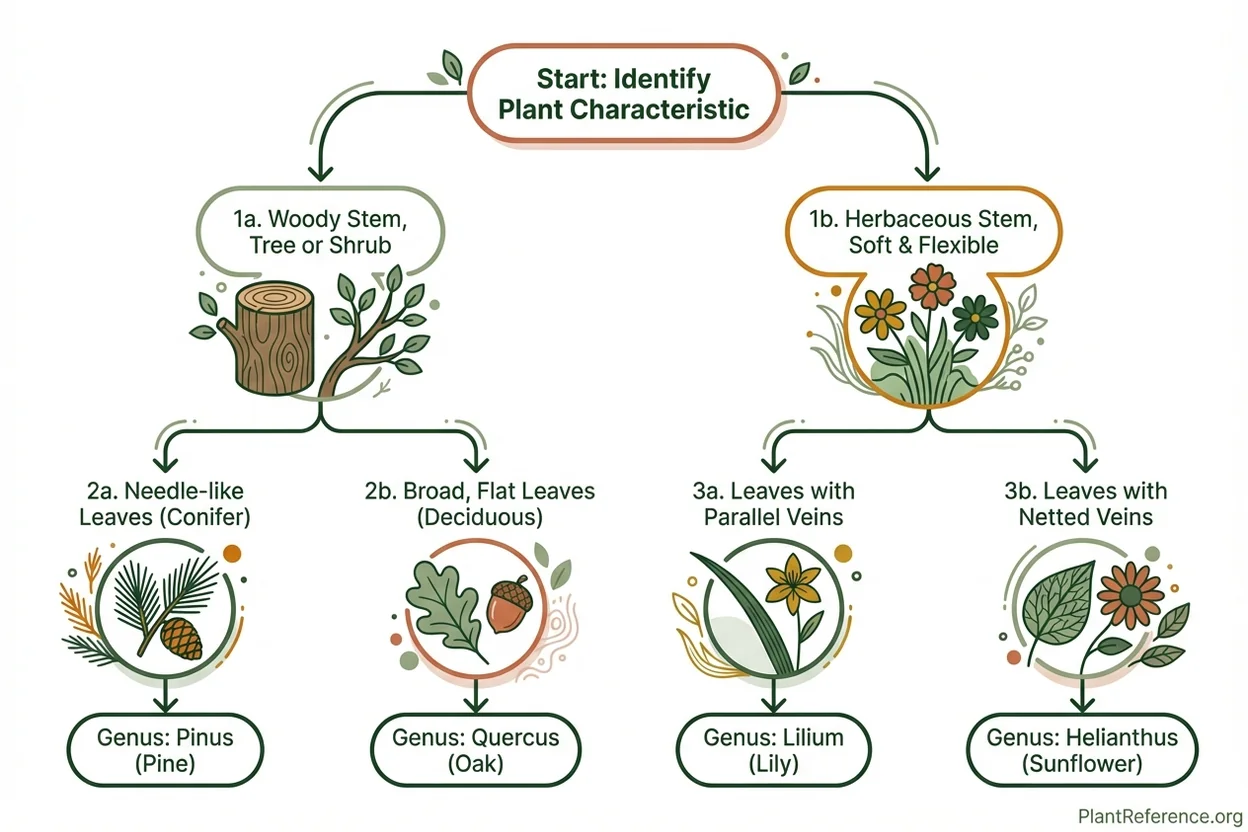
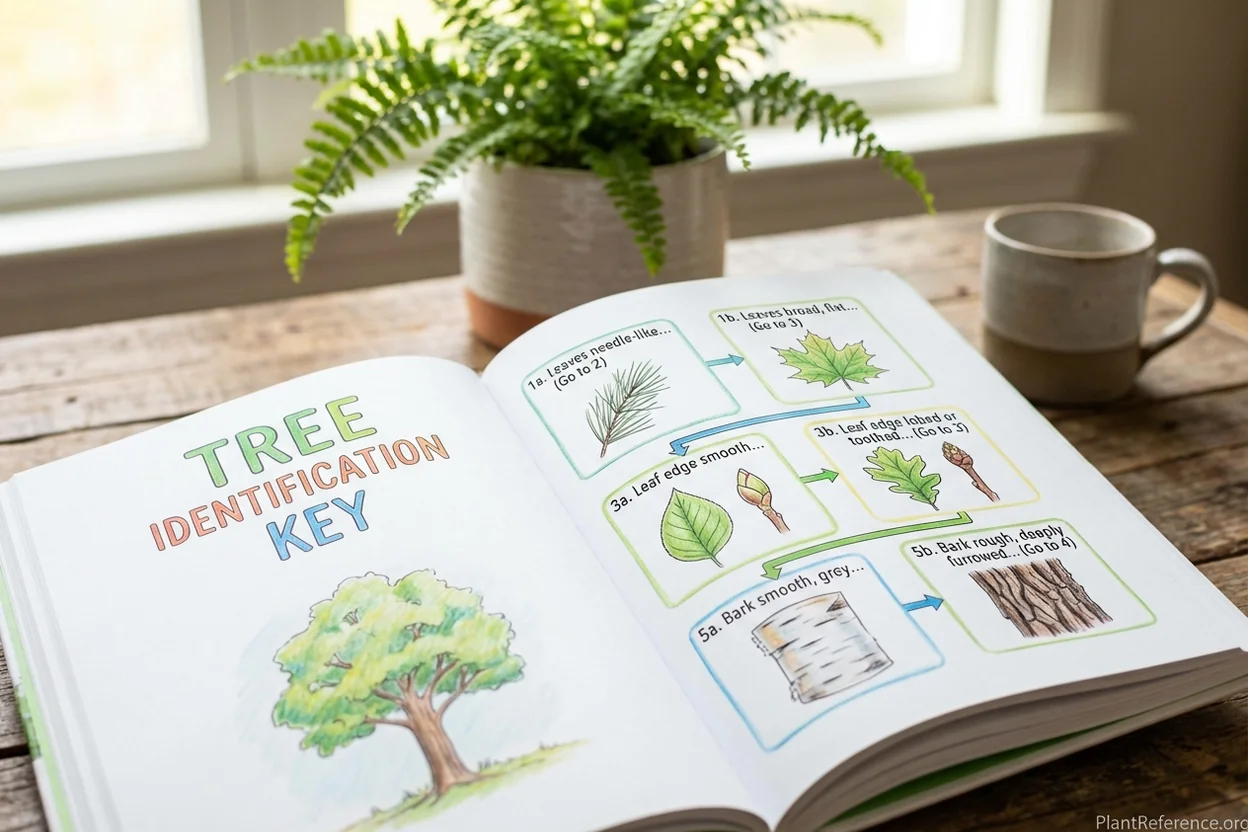
Each couplet contains two statements describing contrasting features. Here is a simplified example:
1a. Leaves needle-like or scale-like; plant bears cones → Go to 2 1b. Leaves broad, flat blades; plant bears flowers → Go to 5
2a. Needles in bundles of 2, 3, or 5 → 🌿Pinus thunbergii (Pine) 2b. Needles attached singly to twig → Go to 3
3a. Needles square in cross-section, roll between fingers → 🌿Picea abies 'Reflexa' (Spruce) 3b. Needles flat, will not roll between fingers → Go to 4
Each couplet forces a decision based on one observable feature. How to Identify Conifers: Pines, Spruces, and Firs Simplified
The Two Formats
Keys come in two formats: indented (couplet pairs visually nested, showing branching structure) and bracketed (couplet pairs numbered sequentially). Both contain the same information.
Keying Out a Plant: A Worked Example
Step 1: Gather the specimen — a twig with several leaves attached, showing both surfaces. Collect flowers or fruit if available. Flower Identification Guide: How to Use Petals, Shape, and Color to Name Any Flower
Step 2: Start at couplet 1, which typically separates major groups.
Step 3: At each couplet, examine the specific feature described. Do not guess — look at the actual specimen. Alternate vs Opposite Leaf Arrangement: The MADCapHorse Mnemonic Explained
Step 4: Follow the path indicated by your choice.
Step 5: When you reach a species name, verify by reading the full species description. The key gives you a candidate; the description confirms it. If it does not match, recheck your couplet choices.

When You Get Stuck
Neither Statement Fits
Try both paths. Follow each statement to its conclusion and see which final identification matches better.
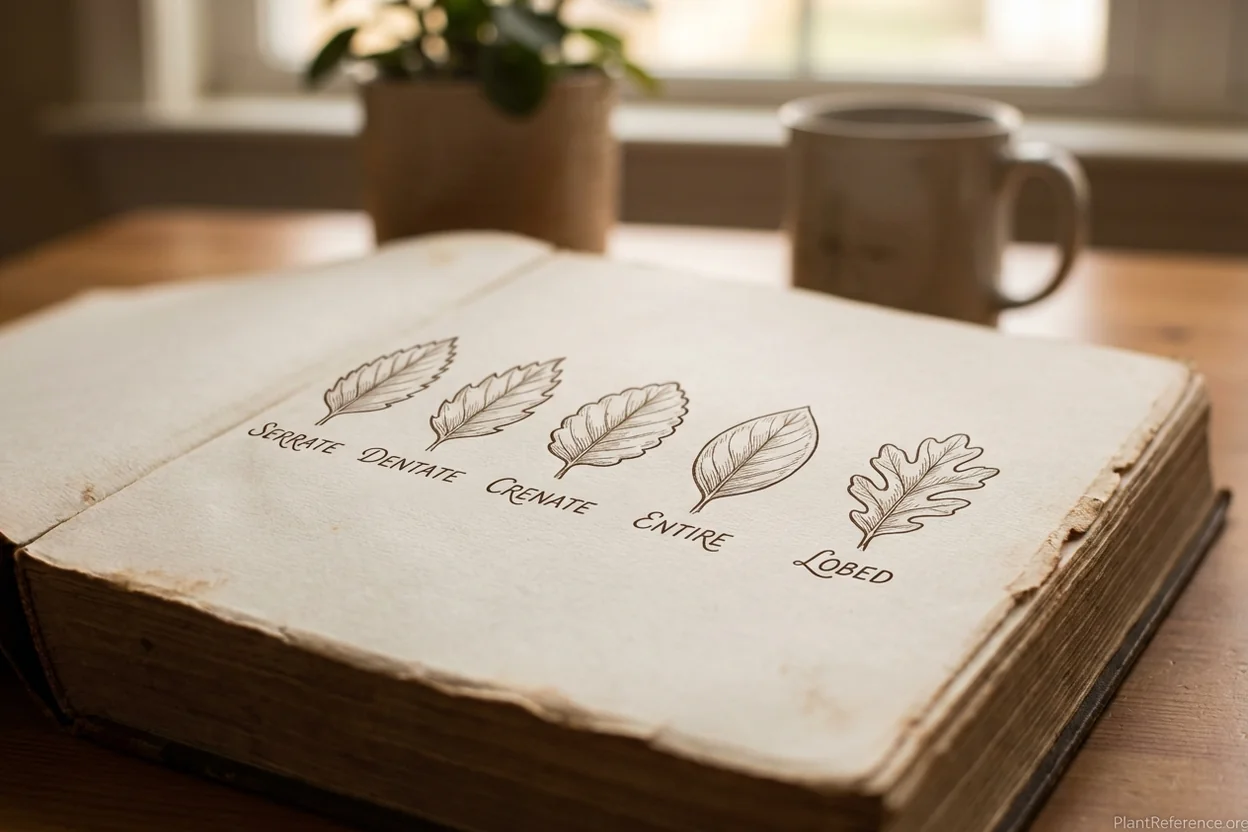
Check the glossary. "Serrate" means something different from "dentate," and "glabrous" means something different from "glaucous." Misunderstanding a term sends you down the wrong path. Simple vs Compound Leaves: How to Tell the Difference and Why It Matters
Get a better specimen. Many keying errors result from incomplete specimens.
You Reach the Wrong Species
Back up to the last uncertain couplet and take the other path. The error almost always occurred at one specific decision point.
The Plant Is Not in the Key
Regional keys only cover species found in a specific area. If your tree is a landscape ornamental from Asia, it may not be in a native flora key. When a key fails completely, check whether your specimen is a cultivated species outside the key's scope.
Why Keys Build Better Skills Than Apps
Keys Force Feature Observation
Every couplet requires you to examine a specific feature. After keying out 20 plants, you have practiced observing dozens of features across multiple species. This observation practice is the skill that apps never develop. How Accurate Are Plant Identification Apps? What They Get Right, Wrong, and Miss
Keys Teach Botanical Vocabulary
Using keys exposes you to precise terminology — "pinnately compound," "actinomorphic," "stipulate," "glabrous." Learning this vocabulary through use makes field guides and scientific descriptions accessible. Winter Tree Identification: Bark, Buds, and Branching When Leaves Are Gone
Keys Reveal Relationships
As you work through a key, you see how species are related — which features they share and which separate them. This structural knowledge transforms scattered species knowledge into a coherent framework.
Getting Started with Keys
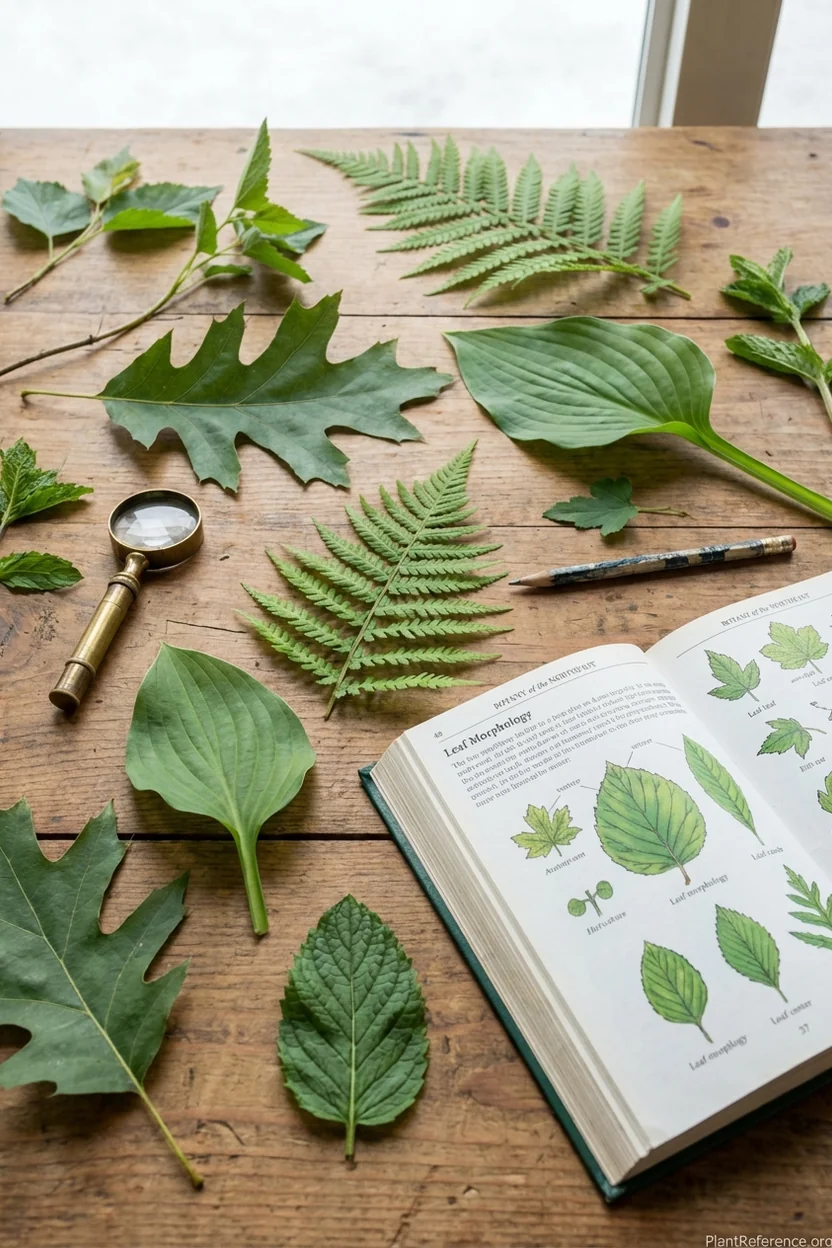
Start with a simple, illustrated key for a limited group — "Trees of Your State" or "Common Wildflowers of Your County." These keys are shorter, use more common vocabulary, and often include illustrations alongside each couplet.
PlantReference's plant database supports keying — each species description includes the diagnostic features that keys ask about. The flashcard system reinforces the botanical vocabulary you encounter in keys, making each subsequent keying session faster. Common Lawn Weeds Identification Guide: What's Growing in Your Yard
Frequently Asked Questions
Reading about plants and recognising them are different skills. These three build the second.
- Daily PlantIdentify the day’s mystery plant from a close-up photograph.
- Keyed OutWork a dichotomous key, lead by lead, to name a hidden specimen.
- Name That PlantName a specimen from botanical clues dealt hardest first.
Free to play, no account needed
Tagged with
Sarah earned her doctorate in plant biology and spent time working in botanical garden education before transitioning to freelance writing and consulting. Now based in Portland, Oregon, she teaches plant identification workshops at local community centers and maintains a modest collection of over 60 houseplants in her small apartment. Sarah specializes in helping beginners understand plant science without the jargon—her approach focuses on practical observation over theory. She's killed her fair share of fiddle leaf figs and finally cracked the code on keeping them alive.