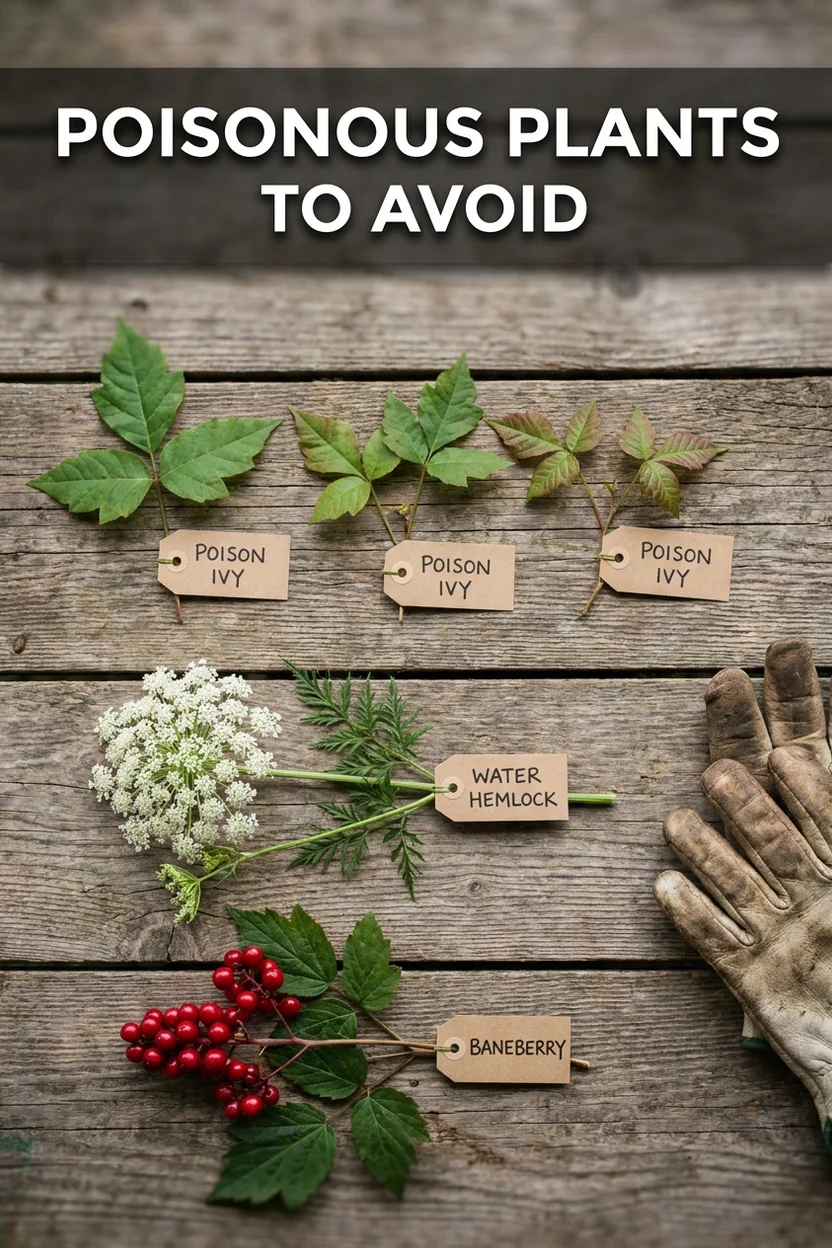
Poisonous Plants to Avoid: A Visual Safety Guide
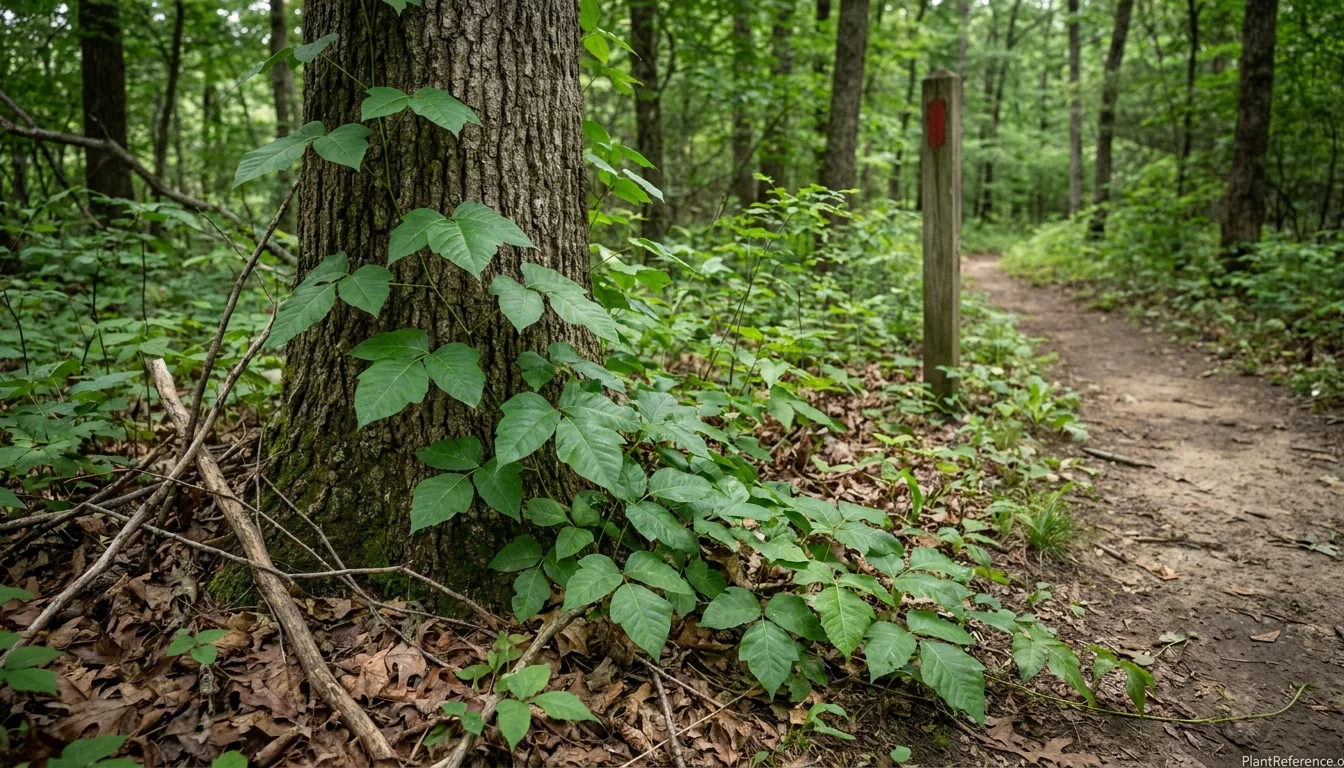
— Image © PlantReference.org 2026
Poisonous plants identification is one of the few botanical skills with genuine safety stakes. The vast majority of plant injuries—itchy rashes, accidental childhood poisonings, and the rare serious toxin exposure—trace back to a surprisingly small group of species. You do not need to memorize a flora to stay safe; you need to recognize perhaps a dozen plants reliably and respect one firm rule: never eat a wild plant you cannot positively identify. This guide walks through the poisonous plants you are genuinely likely to meet in yards, on trails, and in the garden, and the field marks that set each one apart.
The Big Three: Poison Ivy, Oak, and Sumac
The genus Toxicodendron (tox-ih-koh-DEN-dron) contains the three most important contact-dermatitis plants in North America, and together they cause more plant-related misery than everything else combined. All three produce urushiol, an oily resin that triggers an allergic rash in roughly 85 percent of people who touch it. The resin clings to skin, clothing, tools, and pet fur, and it remains active for months, so indirect contact is a common way people get caught.
Poison ivy, 🌿Toxicodendron radicans (tox-ih-koh-DEN-dron RAD-ih-kanz), is the one to learn first. It carries compound leaves of three leaflets arranged alternately on the stem, and its single most reliable field mark is that the terminal leaflet sits on a noticeably longer stalk than the two side leaflets. The old rhyme "leaves of three, let it be" starts you off, but the longer middle stalk is what confirms it. Growth habit varies wildly—a ground creeper, a low shrub, or a hairy vine climbing a tree—so never rely on shape alone.
Poison oak, 🌿Toxicodendron diversilobum (tox-ih-koh-DEN-dron dy-ver-sih-LOH-bum), is primarily a western species whose three leaflets have rounded lobes resembling small oak leaves. Poison sumac, 🌿Toxicodendron vernix (tox-ih-koh-DEN-dron VER-nix), grows in wet, swampy ground as a shrub or small tree with pinnately compound leaves bearing 7 to 13 smooth-margined leaflets—a very different look from the harmless, toothed-leaved staghorn sumac of dry roadsides.
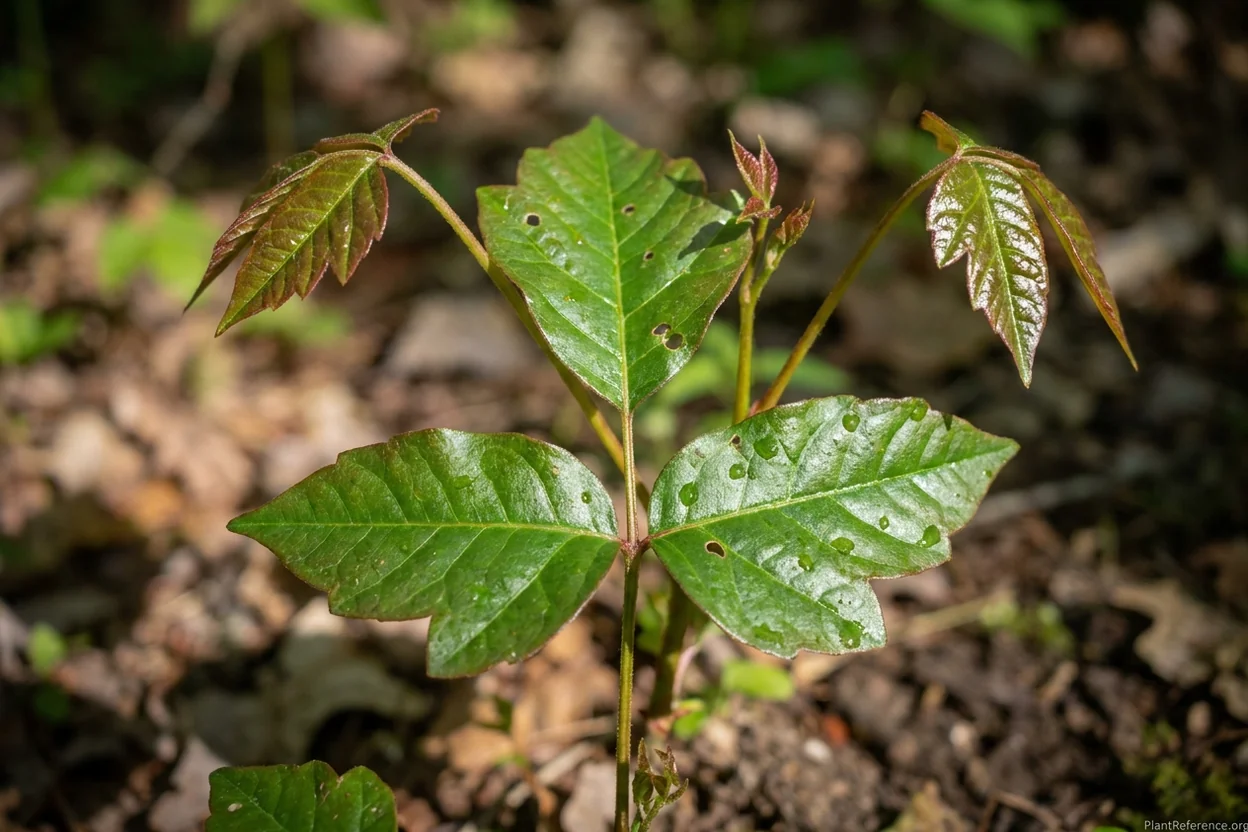
A critical safety note: never burn any Toxicodendron plant. Urushiol becomes airborne in the smoke and can cause severe respiratory reactions if inhaled, on top of the skin rash. Learning to recognize these three on sight is the highest-return identification skill most people will ever acquire, and the leaf-arrangement logic behind it carries straight over to Alternate vs Opposite Leaf Arrangement: The MADCapHorse Mnemonic Explained.
Deadly Lookalikes in the Carrot Family
The Apiaceae, the carrot or parsley family, is where plant identification turns genuinely dangerous, because it contains both beloved edibles and some of the most toxic plants on the continent—and they look remarkably alike. Every member shares the family's signature flat-topped compound umbel of tiny white flowers, so the umbel itself tells you nothing about safety. The differences are in the stem, the leaves, the scent, and the habitat.
Poison hemlock, 🌿Conium maculatum (KOH-nee-um mak-yoo-LAH-tum), is the classic deadly lookalike to Queen Anne's lace, 🌿Daucus carota (DAW-kus kar-OH-tah). Hemlock rides on a smooth, hairless stem splashed with distinctive purple-red blotches, towers 6 to 10 feet (1.8 to 3 m) tall, has finely dissected fern-like leaves, and gives off a musty, unpleasant odor when crushed. Queen Anne's lace, by contrast, stands only 2 to 4 feet (60 to 120 cm) tall on a hairy stem, smells like carrot, and produces spiny seed clusters rather than hemlock's smooth ribbed fruits.
Far more dangerous still is water hemlock, 🌿Cicuta maculata (sih-KEW-tah mak-yoo-LAH-tah), considered the most toxic plant native to North America. It favors wet ground—streambanks, ditches, and marsh edges—and its definitive field mark is a chambered, hollow rootstock divided by horizontal partitions, visible when the base is cut lengthwise. Its twice-compound leaves bear sharply serrated leaflets with veins that end in the notches between teeth rather than at the tips.
Plant | Stem | Height | Key Confirming Trait |
|---|---|---|---|
Hairy, green | 2-4 ft (60-120 cm) | Carrot scent, spiny seed cluster—not toxic | |
Smooth, purple-blotched | 6-10 ft (1.8-3 m) | Musty odor, fern-like leaves—deadly | |
Smooth, often streaked | 3-6 ft (0.9-1.8 m) | Chambered hollow rootstock, wet habitat—most toxic |
The takeaway from the carrot family is absolute: never eat any wild plant with white umbel flowers unless an expert has confirmed it. The cost of a mistake here is not a rash but a hospital visit or worse. This is precisely the kind of high-stakes pairing that rewards careful study with multiple reference images, the approach detailed in How to Identify Any Plant: A Beginner's Guide to Leaves, Flowers, and Stems.
Toxic Berries and Garden Ornamentals
Many of the most poisonous plants in North America are not wild weeds but the ornamentals planted deliberately in yards and gardens, where curious children and pets encounter them. Bright berries are the usual hazard, because they look edible and sit at a child's eye level.
Several beloved garden plants are seriously toxic. 🌿Digitalis purpurea (dij-ih-TAH-lis pur-PUR-ee-ah), foxglove, contains cardiac glycosides in every part; its tall spikes of tubular flowers are striking but dangerous if eaten, and learning to read flower structure as shown in Flower Identification Guide: Petals, Shape & Color Explained helps you tell it from harmless garden lookalikes. 🌿Convallaria majalis (kon-vah-LAR-ee-ah mah-JAH-lis), lily of the valley, hides the same class of heart-affecting toxins behind sweet white bells and bright red berries. Nerium oleander (NEER-ee-um oh-lee-AN-der), oleander, is among the most toxic ornamental shrubs grown, and even small amounts of leaf or flower are hazardous.
Other landscape plants carry hidden risk. The seeds of 🌿Taxus baccata (TAX-us bah-KAH-tah), yew, are highly toxic even though the red flesh around them is not, and 🌿Ricinus communis (RIH-sih-nus koh-MEW-nis), castor bean, produces seeds containing ricin, one of the most poisonous natural substances known. 🌿Aconitum napellus (ah-koh-NY-tum nah-PEL-us), monkshood, is dangerous even to handle for sensitive individuals. The yew is technically a conifer, and recognizing needled evergreens by their foliage—covered in How to Identify Conifers: Pines, Spruces, and Firs Simplified—helps you flag this toxic shrub before children reach its tempting red arils.
Teach children one firm rule: never taste any berry, leaf, or seed from a plant
Identify every berried shrub in your own yard before kids or pets arrive
Wear gloves when handling oleander, monkshood, or castor bean
Keep the Poison Control number (1-800-222-1222 in the U.S.) saved and visible
Knowing which ornamentals are toxic does not mean ripping them out—many are perfectly safe in a household without small children or pets. It means making an informed choice and supervising accordingly. When you are planning replacements, a non-toxic groundcover or Lawn Alternatives That Actually Work: 5 Options Beyond Grass can reduce risk in high-traffic family areas.
Poisonous Houseplants to Know
The houseplant boom has put a surprising number of mildly toxic species inside our homes, where pets and toddlers reach them easily. The family Araceae (the aroids) dominates the indoor market and shares a common defense: needle-like crystals of calcium oxalate that cause intense burning and swelling of the mouth and throat if chewed.
The popular pothos, 🌿Epipremnum aureum (eh-pih-PREM-num OR-ee-um), and the many Philodendron (fil-oh-DEN-dron) species both carry these crystals, as do Dieffenbachia (deef-en-BAH-kee-ah), aptly nicknamed "dumb cane" for the temporary speechlessness severe exposure can cause, and the peace lily, Spathiphyllum (spath-ih-FIL-um). The reaction is painful and frightening but rarely life-threatening in humans; in cats and dogs it warrants a veterinary call.
Distinguishing these aroids from one another is a useful skill, since care and toxicity notes travel with the correct name. Telling pothos from philodendron, for instance, comes down to subtle leaf and stem details that reward close looking, the same approach used in Pothos Varieties: 15 Types and How to Identify Them. Learning to name your houseplants accurately is the first step to knowing how to keep them—and your household—safe.
Safety Practices and Exposure Response
Identification is prevention, but knowing what to do after contact matters just as much. The responses differ sharply between a urushiol rash, an ingestion, and a child or pet exposure, so it helps to have the basics clear before anything happens.
For urushiol contact from poison ivy, oak, or sumac, the resin binds to skin within minutes, but washing thoroughly with soap and cool water as soon as possible can still remove some before it bonds fully. Wash any clothing, tools, and pet fur that may carry the oil, since reactivated contact is a common cause of "mystery" rashes days later. The rash itself is not contagious and cannot spread through its own fluid.
Wash skin with soap and cool water immediately after suspected urushiol contact
Launder exposed clothing separately and wipe down tools and pet fur
For any ingestion, call Poison Control (1-800-222-1222 in the U.S.) right away
Do not induce vomiting unless a medical professional instructs you to
Bring a photo or sample of the plant when seeking medical help
For any suspected ingestion of a toxic plant, the single most important step is to call Poison Control or emergency services immediately rather than waiting for symptoms. Bring a clear photo or an intact sample of the plant if you can do so safely—accurate identification dramatically speeds appropriate treatment. The same systematic photography that aids identification in the field, covered in How to Identify Trees by Their Leaves: Shapes, Margins, and Venation Explained, is exactly what a poison center or physician needs.
Building Real Identification Skill
The safest gardeners and hikers are the ones who recognize dangerous plants instantly, without hesitating over a key. That kind of fluency is a pattern-recognition skill, and cognitive science shows it develops only through repeated, structured exposure to a species across its natural variation—different seasons, ages, and growth habits. A single textbook photo of poison ivy will not prepare you for the hairy climbing vine version on a tree trunk in November.
This is where identification apps fall short for safety. An app may name a plant for you, but it will not build the instant recognition that keeps you from brushing against poison ivy in the first place, and its accuracy on tricky groups is far from guaranteed. Apps identify plants for you; the goal here is to identify dangerous plants yourself, every time, automatically.
Three study techniques build that reliability fastest. Multi-image study exposes you to the full range of how a species can look, so poison ivy is unmistakable in every form. Spaced repetition reviews the most dangerous species more frequently until recognition is automatic. And active recall through quizzes uses the testing effect to cement names and field marks far better than passive rereading. PlantReference is built around exactly these methods: an identification-focused database with multiple images per species, a spaced-repetition flashcard system, and quizzes that turn looking into knowing. You can build a personal flashcard set of the poisonous plants in your region and drill them until they are second nature. As your eye sharpens, even unwanted-plant management tasks like those in Raised Bed Weeds: Prevention Strategies and Control Methods and identifying What Type of Grass Do I Have? Identify Your Lawn in 5 Steps become routine.
Stay safe by keeping the rule simple and the knowledge deep: learn the dangerous dozen on sight, never taste what you cannot name, and let structured practice turn caution into confidence.
Reading about plants and recognising them are different skills. These three build the second.
- Daily PlantIdentify the day’s mystery plant from a close-up photograph.
- Keyed OutWork a dichotomous key, lead by lead, to name a hidden specimen.
- Name That PlantName a specimen from botanical clues dealt hardest first.
Free to play, no account needed
Tagged with
Sarah earned her doctorate in plant biology and spent time working in botanical garden education before transitioning to freelance writing and consulting. Now based in Portland, Oregon, she teaches plant identification workshops at local community centers and maintains a modest collection of over 60 houseplants in her small apartment. Sarah specializes in helping beginners understand plant science without the jargon—her approach focuses on practical observation over theory. She's killed her fair share of fiddle leaf figs and finally cracked the code on keeping them alive.