How to Identify Poison Ivy, Poison Oak & Sumac
Pets & Toxicity
Recorded toxicity for plants linked in this guide. An unknown status is not a safety assessment.
Toxicodendron radicans — Toxicity Warning
Toxic to pets and humansView Toxicodendron radicans plant profileToxicodendron diversilobum — Toxicity Warning
Toxic to pets and humansView Toxicodendron diversilobum plant profileToxicodendron vernix — Toxicity Warning
Toxic to pets and humansView Toxicodendron vernix plant profile
— Image © PlantReference.org 2026
Poison ivy identification trips up beginners because the plant changes its appearance constantly—it can creep along the ground, climb a tree as a hairy vine, or stand up as a small shrub. Poison oak and poison sumac add even more confusion. The good news is that all three share a single genus, a single toxin, and a handful of reliable field marks. Once you learn those marks, you can spot every one of them before they ever touch your skin.
One Genus, One Toxin: Meet Toxicodendron
Poison ivy, poison oak, and poison sumac are not random unrelated plants—they are three members of the genus Toxicodendron (tox-ih-koh-DEN-dron), which translates literally to "poison tree." All three produce urushiol, an oily resin found in the sap, leaves, stems, and roots. Urushiol triggers allergic contact dermatitis in roughly 85% of people, and sensitivity often increases with repeat exposure.
Because the toxin is identical across the genus, the rash looks the same no matter which species you brushed against. That shared chemistry is good news for identification: you only need to learn one family of plants, not three unrelated ones. The differences come down to leaf shape, leaflet count, growth habit, and habitat. Poisonous Plants to Avoid: A Visual Safety Guide
All three live in the genus Toxicodendron and produce urushiol
The rash is identical regardless of species
Urushiol stays active on tools, gloves, and pet fur for months
None of the three have thorns—if it has thorns, it is not Toxicodendron

How to Identify Poison Ivy
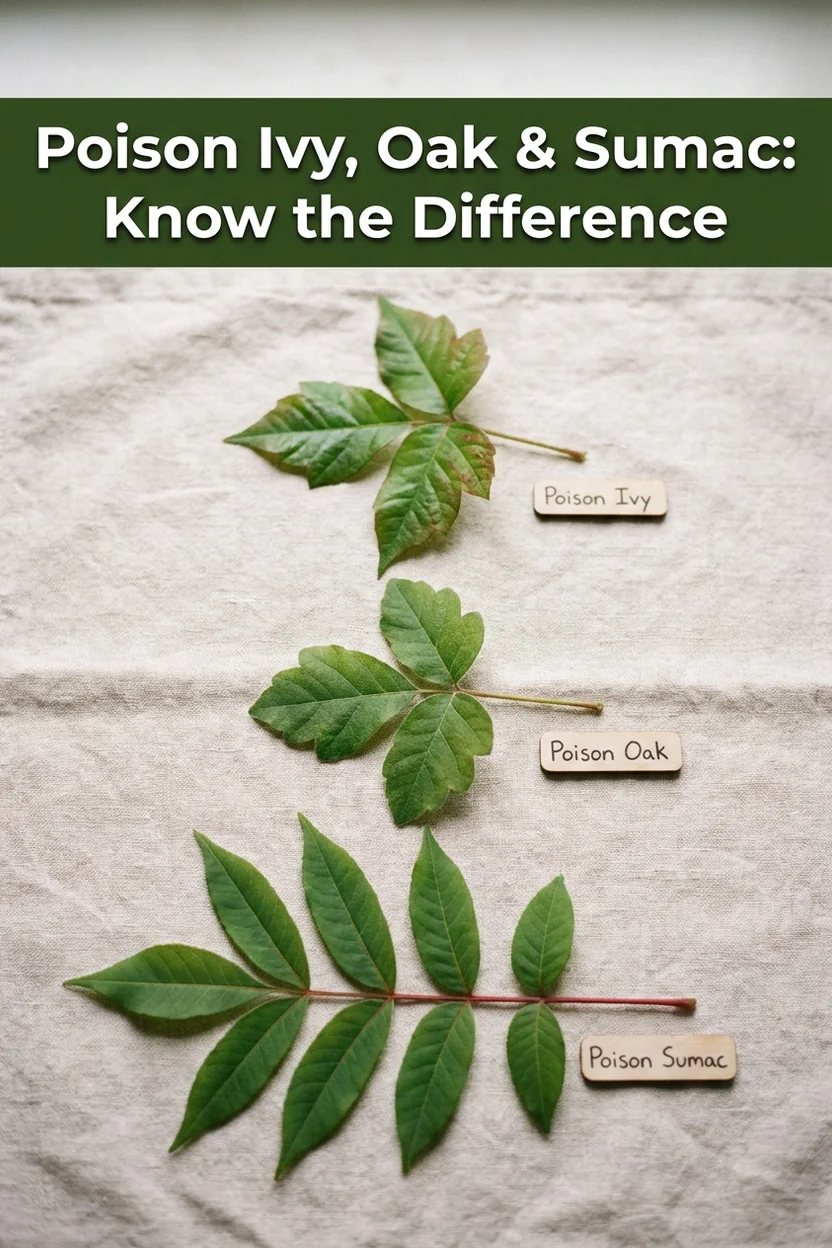
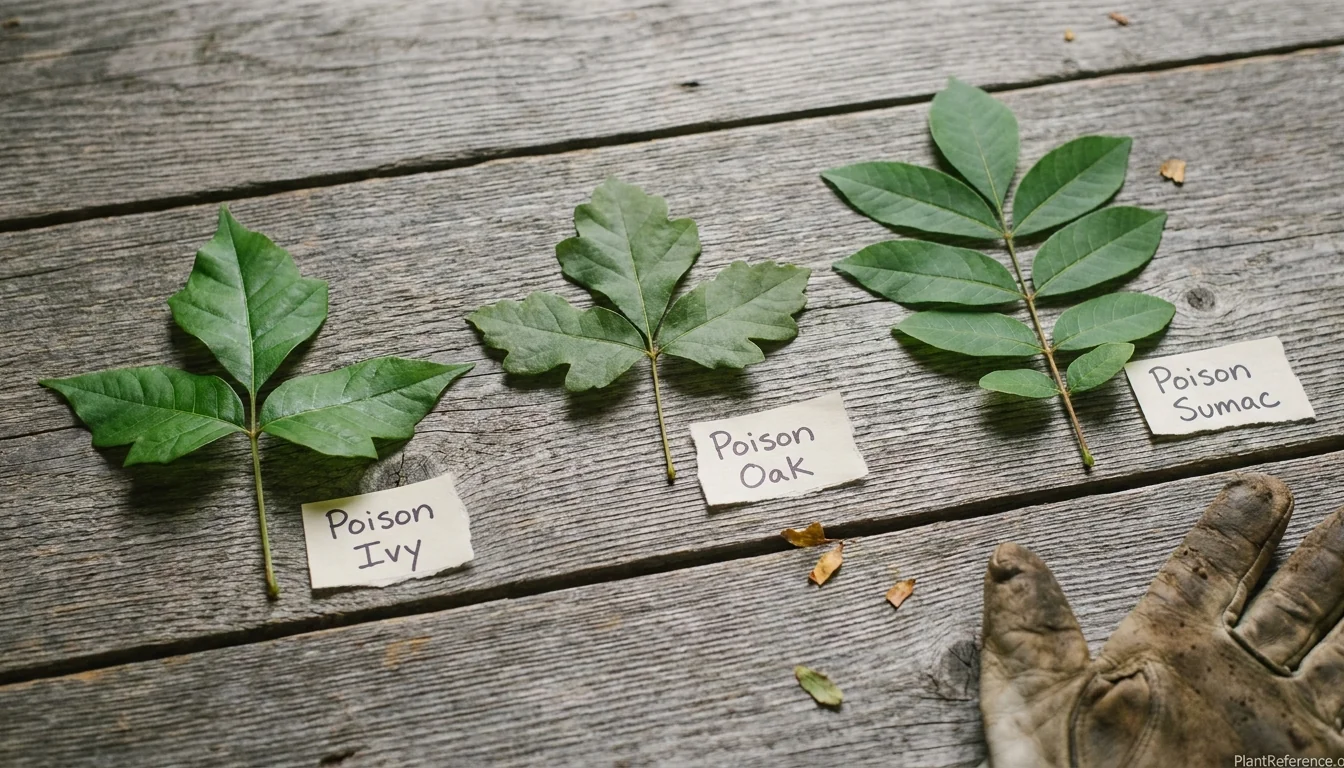
🌿Toxicodendron radicans is the most widespread of the three, growing across nearly all of the eastern and central United States and southern Canada. Its single most famous field mark is the rule "leaves of three, let it be." Each leaf is divided into three leaflets, and the arrangement of leaves along the stem is alternate—one leaf per node, never paired.
The most reliable detail is the terminal leaflet stalk. On 🌿Toxicodendron radicans, the center leaflet sits on a noticeably longer stalk than the two side leaflets, which attach almost directly to the stem. The leaflets themselves are pointed at the tip, and the margins may be smooth, toothed, or shallowly lobed—margin shape alone is unreliable, which is why the longer middle stalk matters so much.
Leaf color shifts through the season: reddish and glossy in spring, dull green in summer, and brilliant red, orange, or yellow in fall. Growth habit also varies. The plant may sprawl as a groundcover, stand as a knee-high shrub, or climb trees and fences as a thick vine covered in reddish-brown aerial rootlets that give the stem a "hairy rope" look. Simple vs Compound Leaves: How to Tell the Difference
Three pointed leaflets; alternate arrangement on the stem
Center leaflet on a longer stalk than the two side leaflets
No thorns; climbing vines look hairy with aerial roots
Whitish-green berries (drupes) in late summer and fall
How to Identify Poison Oak
Poison oak comes in two species: 🌿Toxicodendron diversilobum (Pacific or western poison oak) along the West Coast, and Toxicodendron pubescens (Atlantic poison oak) in the Southeast. Both follow the "leaves of three" pattern, but their leaflets are lobed and rounded, resembling the leaves of a true oak—hence the name.
The lobes give poison oak a softer, scalloped outline compared to poison ivy's pointed leaflets. Leaf surfaces are often slightly fuzzy, and the undersides can be noticeably paler. 🌿Toxicodendron diversilobum usually grows as a dense shrub in chaparral, oak woodland, and along trails, though it can climb in shadier sites. Atlantic poison oak tends to stay a low shrub in sandy soils.
Like poison ivy, poison oak has no thorns and produces small greenish-white berries. It also turns vivid red and orange in autumn, which makes it tempting to pick for fall arrangements—a mistake that sends people to urgent care every year. If you live in the West and see a knee-high shrub with three oak-like leaflets along a trail, treat it as poison oak until proven otherwise. How to Identify Trees by Their Leaves: Shapes, Margins, and Venation Explained
How to Identify Poison Sumac
🌿Toxicodendron vernix is the odd one out. Instead of three leaflets, it carries 7 to 13 leaflets arranged in pairs along a central axis, with one leaflet at the very tip—a pinnately compound leaf. The leaflets are oval, smooth-edged, and come to a point, with a smooth surface that often looks glossy.
The standout field mark is the red stem (rachis) connecting the leaflets. That reddish midrib, combined with smooth leaflet margins, separates poison sumac from harmless sumacs like staghorn sumac, which have toothed leaflet edges and fuzzy red stems. Poison sumac also produces drooping clusters of whitish-green berries, while harmless sumacs hold upright clusters of fuzzy red fruit.
Habitat is your biggest clue. 🌿Toxicodendron vernix grows only in very wet ground—bogs, swamps, and the saturated edges of ponds and wetlands across the eastern United States. If you are walking on dry soil, you are almost certainly not looking at poison sumac. It grows as a tall shrub or small tree, reaching 5-20 feet (1.5-6 m). Poison Hemlock vs Queen Anne's Lace: How to Tell Them Apart
7-13 smooth-edged leaflets in pairs, plus one at the tip
Red central stem (rachis) connecting the leaflets
Drooping whitish-green berry clusters, not upright red ones
Found only in wet, swampy habitats
Feature | Poison Ivy (🌿Toxicodendron radicans) | Poison Oak (🌿Toxicodendron diversilobum) | Poison Sumac (🌿Toxicodendron vernix) |
|---|---|---|---|
Leaflets | 3, pointed | 3, lobed and rounded | 7-13, smooth, in pairs |
Middle leaflet | Longer stalk | Lobed, oak-like | Part of a pinnate row |
Stem clue | Hairy climbing vines | Often slightly fuzzy leaves | Red central stem |
Habitat | Woods, edges, yards | Western chaparral; SE sandy soils | Wet bogs and swamps only |
Range | Eastern & central North America | West Coast; Southeast | Eastern wetlands |
Harmless Lookalikes People Confuse
Plenty of innocent plants get mistaken for the toxic trio, and learning the lookalikes builds confidence. Virginia creeper is the classic poison ivy double, but it has five leaflets, not three—count carefully before you panic. Boxelder seedlings show three leaflets like poison ivy, but they grow opposite on the stem rather than alternate, and the plant is a maple.
For poison sumac, the key contrasts are staghorn sumac and smooth sumac, both harmless. These have toothed leaflet margins, fuzzy or smooth red stems, and upright cone-shaped clusters of fuzzy red berries. They also grow in dry, sunny spots—poison sumac never does. How to Identify Any Plant: A Beginner's Guide to Leaves, Flowers, and Stems
When you are unsure, default to caution and use the structured field marks rather than a single feature. A plant identification app can offer a starting guess, but apps misfire on exactly these high-stakes lookalikes, so never bet your skin on a single phone snapshot. Plant Identification App Accuracy: Why Apps Get It Wrong
What Urushiol Does and How to Respond
Urushiol binds to skin within minutes, so fast action matters. If you suspect contact, wash the area with cool water and dish soap or a dedicated urushiol-removing cleanser within about 10 minutes, scrubbing under the nails too. Hot water early on can spread the oil, so keep it cool until the resin is off.
The oil also clings to tools, gloves, boots, and pet fur, where it stays active for months and can cause a rash long after the hike. Wash contaminated gear with soap and water, and bathe pets that may have run through a patch. The rash itself is not contagious—the fluid in blisters does not spread it—but unwashed urushiol on skin or objects absolutely does.
Never burn any Toxicodendron plant. Burning vaporizes urushiol into smoke that can cause severe, dangerous reactions in the lungs and eyes. For removal, cut and bag the plants while wearing disposable gloves, or call a professional for large infestations. Common Lawn Weeds Identification Guide
Train Your Eye Before You Need It
The difference between a ruined weekend and a confident walk in the woods is pattern recognition built before you are standing in front of the plant. Apps identify plants for you, but PlantReference teaches you to identify plants yourself—so the knowledge is in your head when there is no signal on the trail.
Our plant database shows multiple images of each Toxicodendron species across seasons and growth forms, because a single spring photo will not help you in autumn. Pair that with the flashcard system and spaced-repetition quizzes, and the three-leaflet rule, the red rachis, and the wetland habitat clue become automatic. Alternate vs Opposite Leaf Arrangement: The MADCapHorse Mnemonic Explained
Quiz yourself on the Toxicodendron species with our plant identification flashcard set, and you will recognize poison ivy, poison oak, and poison sumac long before they recognize you.
Frequently Asked Questions
Reading about plants and recognising them are different skills. These three build the second.
- Daily PlantIdentify the day’s mystery plant from a close-up photograph.
- Keyed OutWork a dichotomous key, lead by lead, to name a hidden specimen.
- Name That PlantName a specimen from botanical clues dealt hardest first.
Free to play, no account needed
Tagged with
Sarah earned her doctorate in plant biology and spent time working in botanical garden education before transitioning to freelance writing and consulting. Now based in Portland, Oregon, she teaches plant identification workshops at local community centers and maintains a modest collection of over 60 houseplants in her small apartment. Sarah specializes in helping beginners understand plant science without the jargon—her approach focuses on practical observation over theory. She's killed her fair share of fiddle leaf figs and finally cracked the code on keeping them alive.