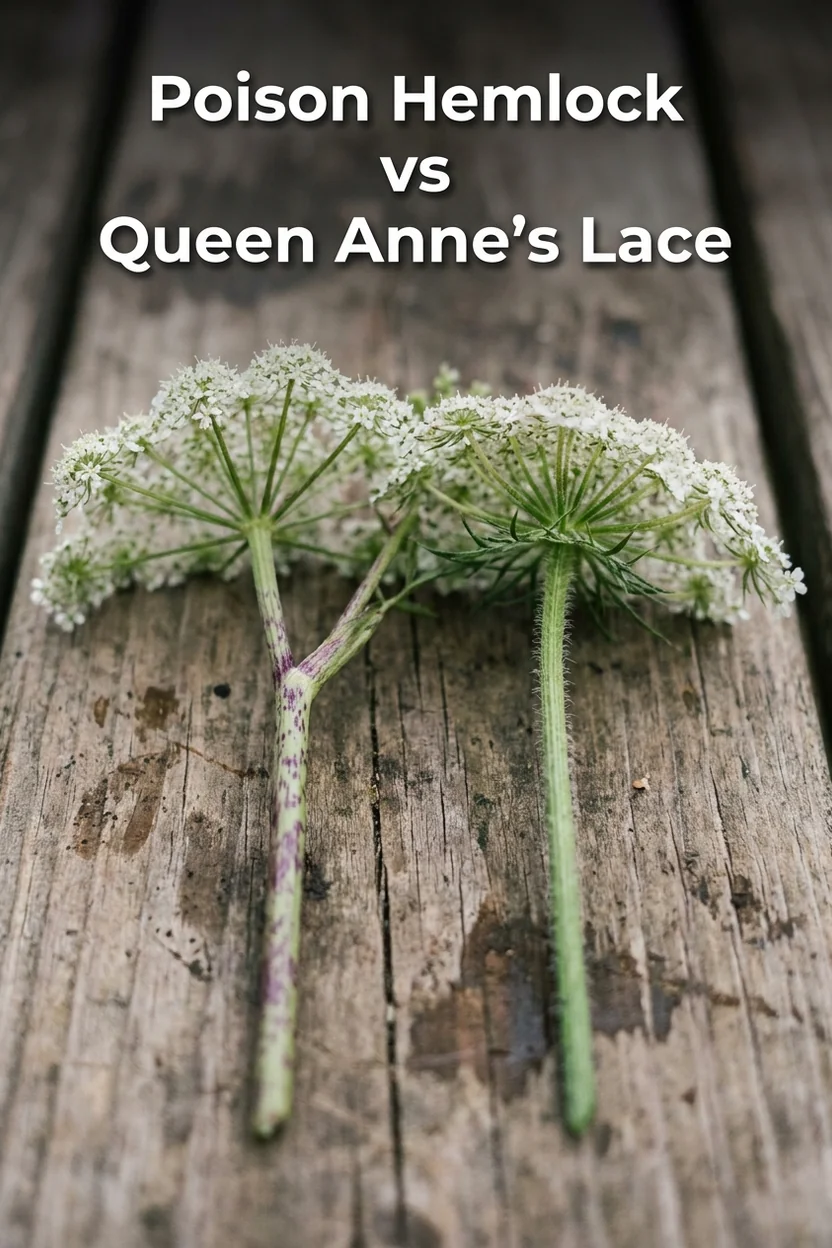
Plant Identification
Poison Hemlock vs Queen Anne's Lace: How to Tell Them Apart
Poison hemlock vs Queen Anne's lace: tell these deadly lookalikes apart by stem color, hairs, smell, and the single dark central floret. A botanist's safety guide to the dangerous members of the carrot family.
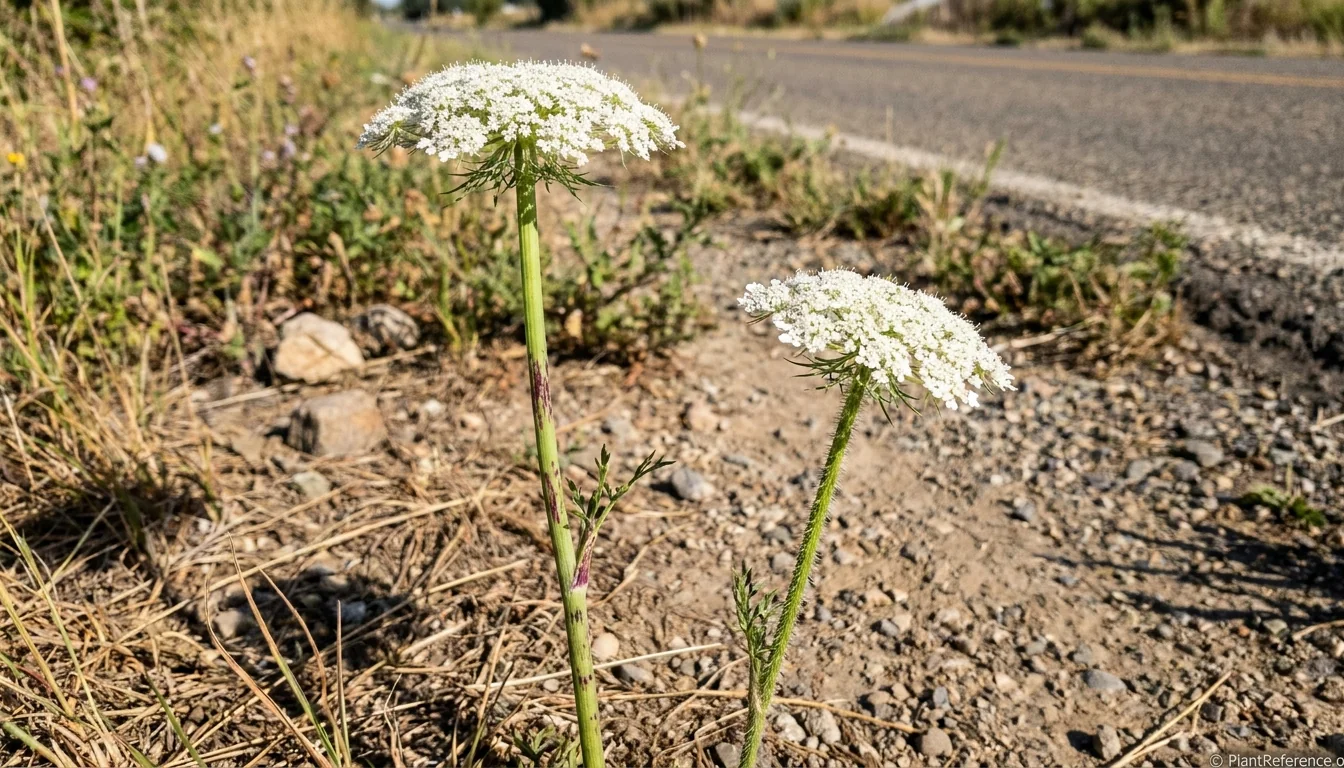
— Image © PlantReference.org 2026
Quick Answer
Poison hemlock has purple-blotched, hairless stems and a musty smell. Queen Anne's lace has hairy green stems and a single dark floret at the flower's center.
On This Page
Key points
Poison hemlock and Queen Anne's lace are both lacy white-flowered members of the carrot family (Apiaceae), but one is deadly toxic and the other is harmless. The fastest tells: poison hemlock has smooth, hairless stems with purple-red blotches and a musty, mousy smell, while Queen Anne's lace has hairy green stems, a single dark purple floret in the center of each flower head, and a carrot scent. When in doubt, never touch, forage, or burn either plant.
Frequently Asked Questions
Brushing against intact poison hemlock is far less dangerous than eating it, but it is still wise to avoid bare-skin contact. The toxin coniine is concentrated inside the plant tissues, so casual contact rarely causes serious harm. Still, wash with soap and water after any contact and never touch your face, eyes, or mouth before washing. The real danger is ingestion and, secondarily, getting sap into a cut or mucous membrane. Always wear gloves when handling or removing it.
Queen Anne's lace is Daucus carota, the wild ancestor of the cultivated carrot, and is generally considered non-toxic. The root is edible when young, though woody and bitter compared to a garden carrot. The danger is not the plant itself but misidentification. Because it shares its habitat and flower shape with deadly poison hemlock and water hemlock, eating wild "carrot" you have not positively confirmed is extremely risky. Never forage carrot-family plants without absolute certainty.
Check the stem first. Poison hemlock has a smooth, hairless stem marked with purple-red blotches, while Queen Anne's lace has a solid green stem covered in fine hairs and no blotching. This single feature separates them almost every time. Confirm with a second trait: Queen Anne's lace usually has one dark floret at the center of its flower head and smells like carrot, while hemlock is all white and smells musty.
Apps can help, but they should never be your only check for a potentially deadly plant. Image-recognition tools struggle with carrot-family species because so many look nearly identical in photos, and accuracy drops sharply without clear shots of the stem, bracts, and fruit. Use an app as a starting point, then verify the stem color, hairs, central floret, and smell yourself. For high-stakes identifications, cross-check against a trusted field guide or expert.
Both favor disturbed, sunny ground: roadsides, ditches, fence lines, pastures, vacant lots, and field edges. Their ranges overlap across much of North America, and they often bloom at the same time in early to mid-summer, which is a major reason the two are so frequently confused. Poison hemlock tends to prefer slightly moister, richer soil and can form dense, towering stands, while Queen Anne's lace is common in drier, poorer ground.
Reading about plants and recognising them are different skills. These three build the second.
- Daily PlantIdentify the day’s mystery plant from a close-up photograph.
- Keyed OutWork a dichotomous key, lead by lead, to name a hidden specimen.
- Name That PlantName a specimen from botanical clues dealt hardest first.
Play today’s games
Free to play, no account needed
Tagged with
Written By
D
Sarah earned her doctorate in plant biology and spent time working in botanical garden education before transitioning to freelance writing and consulting. Now based in Portland, Oregon, she teaches plant identification workshops at local community centers and maintains a modest collection of over 60 houseplants in her small apartment. Sarah specializes in helping beginners understand plant science without the jargon—her approach focuses on practical observation over theory. She's killed her fair share of fiddle leaf figs and finally cracked the code on keeping them alive.