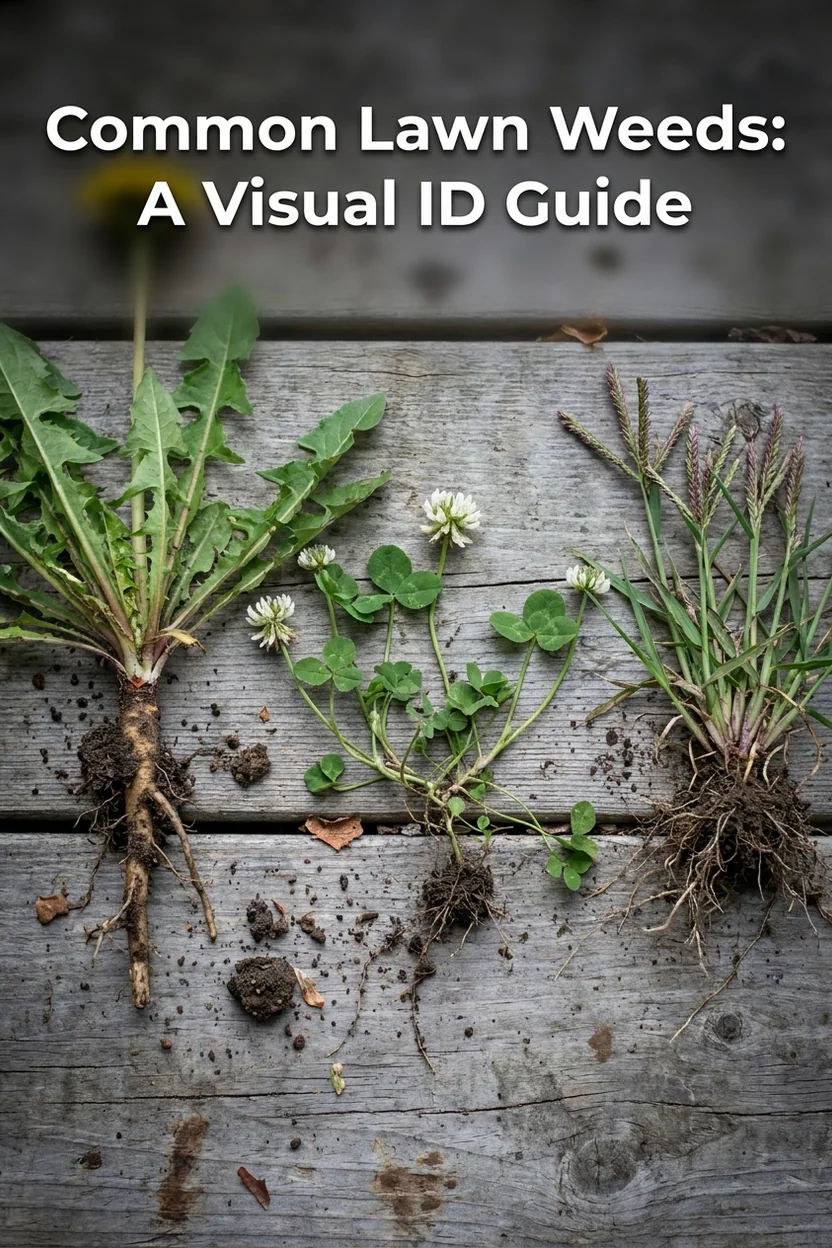
Common Lawn Weeds Identification Guide
Pets & Toxicity
Recorded toxicity for plants linked in this guide. An unknown status is not a safety assessment.
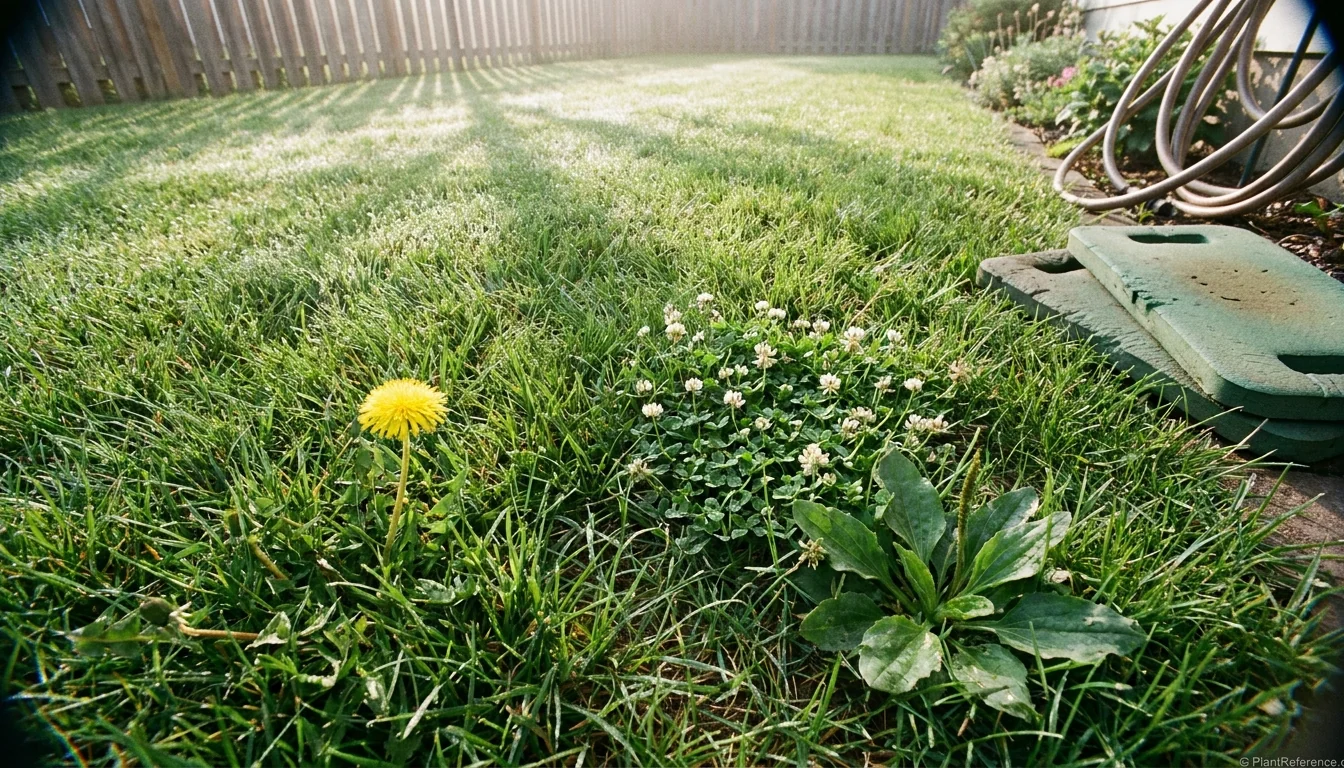
— Image © Plant Reference 2026
If you've ever stood over your lawn wondering what exactly is growing where grass should be, you're already doing the most important part of weed control: looking closely. A common lawn weeds identification guide isn't just about putting names to plants. Identification is the prerequisite for every good decision that follows, because the right management approach depends entirely on what you're actually dealing with. A treatment that erases dandelions will do nothing to nutsedge, and a product that scorches crabgrass can leave your turf worse off if you've misread the plant.
The Three Groups of Lawn Weeds
Before learning individual species, it helps to understand the framework botanists use. Nearly every lawn weed belongs to one of three functional groups, and recognizing the group narrows your search dramatically. This is the same principle behind systematic plant identification generally, which I cover in How to Identify Any Plant: A Beginner's Guide to Leaves, Flowers, and Stems—you move from broad categories to specific names rather than guessing.
The first group is broadleaf weeds, technically eudicots. These stand out against turfgrass because their leaves are wider and display netted (reticulate) venation, where veins branch and rejoin in a web pattern. Dandelions, clover, and plantain all fall here. Their seedlings emerge with two seed leaves (cotyledons), a developmental signature of the dicot lineage.
The second group is grassy weeds, which are monocots like your desirable turf. This is what makes them frustrating—they share the same basic architecture as the lawn you're trying to protect: narrow blades with parallel venation, jointed stems, and a single seed leaf at germination. Telling a grassy weed from your turfgrass means looking at subtler features: leaf color, blade width, growth habit, and the structures where the blade meets the stem.
The third group is sedges, which look grassy at a glance but belong to an entirely different family, the Cyperaceae. The classic botanical mnemonic captures the key difference: "sedges have edges, rushes are round, grasses have nodes all the way to the ground." Sedge stems are triangular in cross-section and solid, where grass stems are round or flat and hollow with swollen joints.
Common Broadleaf Weeds
Broadleaf weeds are the easiest group for beginners because their forms are so distinct from grass. Once you learn the half-dozen most common species, you'll recognize them everywhere.
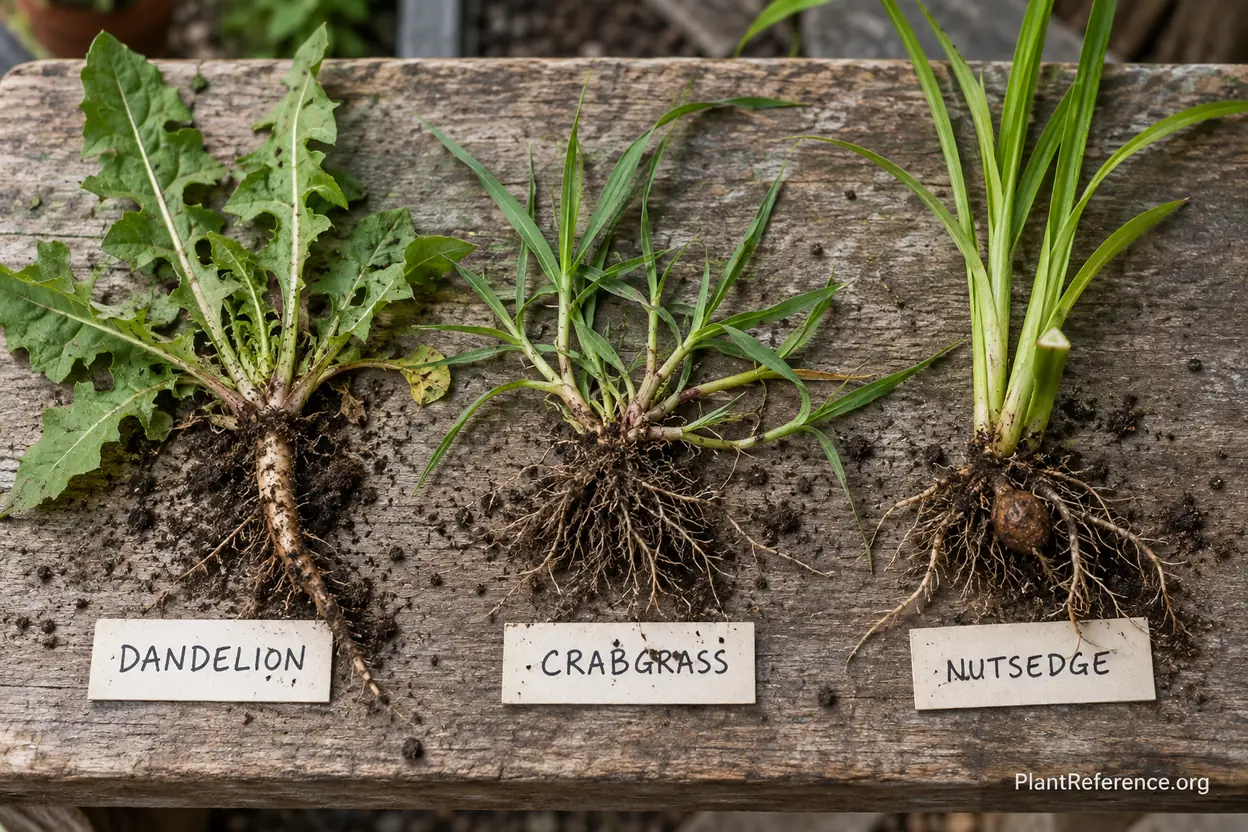
Dandelion (🌿Taraxacum officinale (tuh-RAK-suh-kum oh-fiss-ih-NAH-lee)) is the one everyone knows. Its deeply toothed leaves form a flat rosette—the genus name even references the "lion's tooth" margin. The hollow flower stalk exudes a milky latex when broken, and the familiar yellow composite flower matures into a spherical seed head. The thick taproot is what makes 🌿Taraxacum officinale so persistent; snap it off and the root regenerates a new plant.
White clover (🌿Trifolium repens (try-FOH-lee-um REE-penz)) spreads in low mats of three-parted (trifoliate) leaves, each leaflet often marked with a pale crescent. As a legume, 🌿Trifolium repens hosts nitrogen-fixing bacteria in root nodules, which is why it thrives precisely where your turf is starved for nitrogen. The white-to-pinkish flower heads are beloved by bees.
Broadleaf plantain (🌿Plantago major (plan-TAY-go MAY-jor)) forms a ground-hugging rosette of oval leaves with prominent parallel-looking ribs and a distinctive squat seed spike rising from the center. It tolerates compaction beautifully, so it often marks paths, play areas, and high-traffic strips.
Common chickweed (🌿Stellaria media (steh-LAIR-ee-uh MEE-dee-uh)) is a cool-season sprawler with small egg-shaped leaves and tiny white star-shaped flowers. A single line of hairs running along one side of the stem is a reliable confirming mark. Henbit (🌿Lamium amplexicaule (LAY-mee-um am-plek-sih-KAW-lee)), a winter annual in the mint family, shows the family's tell-tale square stem, opposite scalloped leaves, and small purple tubular flowers in early spring.
Weed | Key Field Marks | Growth Habit | Season |
|---|---|---|---|
Dandelion (🌿Taraxacum officinale) | Toothed rosette, milky latex, taproot | Perennial rosette | Spring–fall |
White clover (🌿Trifolium repens) | Three-part leaves, pale crescent mark | Creeping mats | Spring–summer |
Broadleaf plantain (🌿Plantago major) | Oval ribbed leaves, squat seed spike | Compaction-tolerant rosette | Summer |
Common chickweed (🌿Stellaria media) | Small leaves, single hair line on stem | Low sprawling annual | Cool season |
Henbit (🌿Lamium amplexicaule) | Square stem, purple tubular flowers | Upright winter annual | Late winter–spring |
A quick note on flowers: when a broadleaf weed blooms, the flower structure is often the most decisive clue, because reproductive features stay consistent even when leaves vary with shade or mowing. If you want to lean into floral characters, Flower Identification Guide: Petals, Shape & Color Explained breaks down how petal count and symmetry point to plant families.
Grassy Weeds: The Convincing Mimics
Grassy weeds are the hardest to identify because they look so much like the lawn around them. The trick is to stop comparing them to broadleaf weeds and start comparing them to your turf, blade by blade. Color, width, growth habit, and the junction where blade meets sheath all carry information.
Large crabgrass (🌿Digitaria sanguinalis (dij-ih-TAIR-ee-uh san-GWIN-ah-lis)) is the most common warm-season annual invading cool-season lawns. It grows in a low, spreading, star-like rosette that radiates outward from a central point, and its lighter green color stands out against darker turf in summer heat. The mature seed heads are the giveaway: several finger-like spikes radiating from one point, like the ribs of an umbrella. 🌿Digitaria sanguinalis germinates as soil warms in late spring and dies at the first hard frost, leaving bare gaps.
Annual bluegrass (🌿Poa annua (POH-uh AN-yoo-uh)) is a cool-season weed identifiable by its boat-shaped leaf tips—the very end of each blade curves up like the prow of a canoe—and its tendency to push up whitish seed heads even when mowed short. It thrives in compacted, moist, shaded spots and turns the lawn patchy and pale.
Quackgrass (🌿Elymus repens (EL-ih-mus REE-penz)) is a tougher perennial. Its most reliable mark is a pair of auricles—small claw-like appendages that clasp the stem where the blade meets the sheath. Beneath the surface, 🌿Elymus repens spreads by aggressive white rhizomes, which is why pulling the visible blades never seems to end the problem.
Color: Is the weed lighter or darker green than your turf? Crabgrass reads light; many turfgrasses are deeper green.
Growth habit: Does it spread flat in a star (crabgrass) or grow upright in clumps (quackgrass)?
Leaf tip: Boat-shaped and curled (🌿Poa annua) or tapered to a fine point?
Auricles and ligules: The collar region where blade meets stem differs by species—claw-like auricles signal 🌿Elymus repens.
Seed head: Finger-like spikes (🌿Digitaria sanguinalis) versus narrow upright spikes give species away fast.
Because grassy weeds and turfgrasses share parallel venation and jointed stems, a hand lens earns its keep here. Examining the collar region—the ligule and auricles where the blade wraps the stem—is often the only way to separate similar species with confidence. When crabgrass leaves gaps after frost, those bare patches invite more weeds the next year, so addressing them matters; How to Fix Bare Spots in Your Lawn Fast walks through repair, and How to Overseed Your Lawn: Timing, Seed Selection, and Technique covers thickening turf so weeds have nowhere to establish.
Sedges: Edges Give Them Away
Sedges fool a lot of people because they sprout among grass and grow with a similar narrow, upright blade. But they belong to the family Cyperaceae, and one simple test settles the question every time: roll the stem between your fingers. A sedge stem is triangular—you'll feel three distinct edges—and it's solid all the way through, with no hollow center and no swollen joints.
Yellow nutsedge (🌿Cyperus esculentus (sy-PEER-us es-kew-LEN-tus)) is the most common offender in home lawns. It grows faster than turf, so it often appears as pale yellow-green spears standing taller than the mowed lawn within days of cutting. Its leaves are arranged in three ranks (three vertical rows around the stem), another Cyperaceae signature, and they have a waxy, glossy surface with a prominent midrib. Beneath the soil, 🌿Cyperus esculentus produces small tubers called nutlets, which is exactly why hand-pulling rarely works—the nutlets stay behind and resprout.
Purple nutsedge (🌿Cyperus rotundus (sy-PEER-us roh-TUN-dus)) is similar but generally more aggressive and more common in warmer regions, with darker foliage and reddish-purple seed heads. Both species strongly prefer wet or poorly drained soil, so a recurring nutsedge problem is usually telling you something about your lawn's drainage rather than just its weed pressure.
Stem shape: Triangular and solid—roll it to feel the three edges. This alone confirms a sedge.
Growth speed: Sedges outgrow mowed turf, appearing as taller spears within days.
Leaf rank: Three vertical rows of leaves rather than the two-ranked arrangement of grasses.
Texture: Waxy, glossy blades with a stiff prominent midrib.
Habitat clue: Persistent nutsedge points to chronically wet or compacted, poorly drained soil.
The grass-versus-sedge distinction is one of the most useful skills in all of plant identification, and it extends well beyond lawns to wetlands and meadows. The leaf-arrangement reasoning is closely related to what I describe in Alternate vs Opposite Leaf Arrangement: The MADCapHorse Mnemonic Explained and the broader venation logic in How to Identify Trees by Their Leaves: Shapes, Margins, and Venation Explained—in every case, you're reading structural pattern rather than memorizing pictures.
What Your Weeds Reveal About Your Lawn
Here's the part most weed guides skip: weeds are diagnostic. Each species thrives under specific conditions, so a chronic weed problem is often a symptom of an underlying issue in the lawn's environment. Treating the weed without correcting the cause guarantees its return.
Abundant white clover (🌿Trifolium repens) usually signals low soil nitrogen. Because clover fixes its own nitrogen through root-nodule bacteria, it outcompetes nitrogen-hungry turfgrass on poor soils. The lasting fix is improving fertility, not just removing the clover—Best Organic Lawn Fertilizer: 5 Products for Every Season covers feeding turf so it can crowd clover out.
Broadleaf plantain (🌿Plantago major) and annual bluegrass (🌿Poa annua) both flag soil compaction. They tolerate dense, oxygen-poor soil that stresses turfgrass roots, so where they dominate, the soil is usually compacted. Core aeration relieves this; Best Manual Lawn Aerator: 5 Core Aerators Tested for Home Lawns explains the tools. Persistent nutsedge (🌿Cyperus esculentus) points to poor drainage or overwatering, often from a sprinkler running too long or too often—Best Lawn Sprinkler for Even Coverage: 5 Types Compared helps dial in watering. And weeds that proliferate under tree shade may simply mean the turf species there is wrong for the light; Best Grass Seed for Shade Under Trees: 5 Species That Actually Work addresses that mismatch.
Identify First, Then Manage
The reason identification comes before management is biological. A pre-emergent herbicide timed for crabgrass germination does nothing once the plant is up and growing. A selective broadleaf product clears dandelions and clover but won't touch a sedge, which needs an entirely different active ingredient. And hand-pulling—satisfying as it is—fails against taprooted dandelions and tuber-forming nutsedge unless you remove the underground structures completely.
Match your approach to the plant's biology:
Taprooted broadleaf weeds (🌿Taraxacum officinale): remove the entire root with a weeding tool, or the crown regrows.
Mat-forming legumes (🌿Trifolium repens): correct nitrogen levels so turf can compete, rather than fighting the clover alone.
Annual grassy weeds (🌿Digitaria sanguinalis): prevention through dense turf and proper timing beats post-emergence battles.
Rhizomatous perennials (🌿Elymus repens): persistent removal of the rhizomes, since fragments resprout.
Tuber-forming sedges (🌿Cyperus esculentus): improve drainage and target the nutlets; pulling tops alone never works.
I want to be candid about a tool people reach for: 30% horticultural vinegar and similar contact treatments burn the visible top growth of young weeds, but they don't reach taproots, rhizomes, or tubers. They're most useful on small annual weeds in cracks and edges, and far less so on established perennials. Whatever you choose, identifying the plant first tells you whether that tool will actually work or just waste an afternoon.
The deeper payoff of learning to identify weeds is that the skill compounds. Once you can read leaf venation, stem cross-sections, and growth habit, you're not memorizing a fixed list—you're decoding any plant you meet. That's the philosophy behind PlantReference: apps identify a plant for you in a single tap, but they don't build the underlying recognition. Our flashcard system shows multiple images of each weed across its growth stages and seasons, and uses spaced repetition so the field marks move into long-term memory. Quiz yourself on a set of common lawn weeds and within a couple of weeks you'll name them at a glance, the way an experienced gardener does. Start there, observe closely, and your lawn will start telling you what it needs.
Frequently Asked Questions
Reading about plants and recognising them are different skills. These three build the second.
- Daily PlantIdentify the day’s mystery plant from a close-up photograph.
- Keyed OutWork a dichotomous key, lead by lead, to name a hidden specimen.
- Name That PlantName a specimen from botanical clues dealt hardest first.
Free to play, no account needed
Tagged with
Sarah earned her doctorate in plant biology and spent time working in botanical garden education before transitioning to freelance writing and consulting. Now based in Portland, Oregon, she teaches plant identification workshops at local community centers and maintains a modest collection of over 60 houseplants in her small apartment. Sarah specializes in helping beginners understand plant science without the jargon—her approach focuses on practical observation over theory. She's killed her fair share of fiddle leaf figs and finally cracked the code on keeping them alive.