Overview
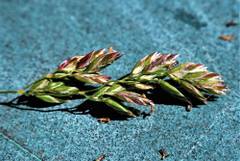
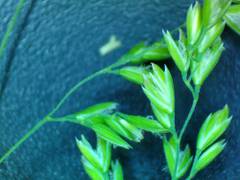
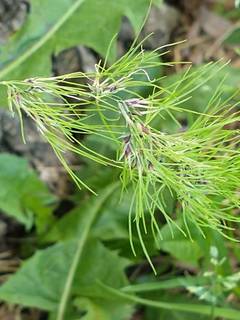
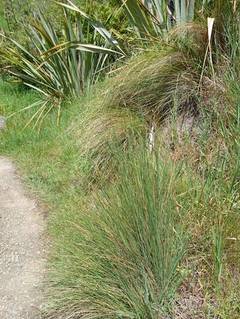
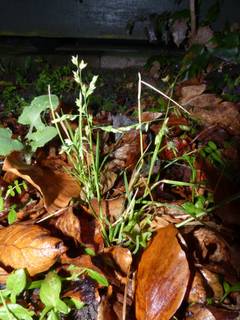
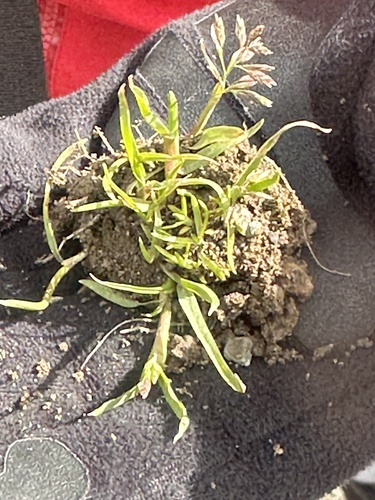
Poa annua is a low-growing tufted annual (occasionally short-lived perennial) grass in the family Poaceae reaching 2–12 inches (5–30 cm) tall and 2–8 inches (5–20 cm) wide per tuft. Culms are erect to spreading, smooth, slightly flattened, often bent at the lower nodes and rooting at the base where prostrate stems touch moist soil. Leaves are bright light green (noticeably paler than the deeper green of most turf grasses, so Poa annua patches read as light-green bands against a darker turf background), smooth, soft, 1–4 inches (2.5–10 cm) long, with a boat-shaped (keeled, prow-like) tip — the primary vegetative identification character, visible when the leaf tip is folded along its length. Two parallel grooves (tram lines) run visible on either side of the midrib. The ligule is membranous, 1–3 mm long, rounded at the apex. Panicles are small open pyramidal to triangular 1–3 inches (2.5–8 cm) long, with spreading branches carrying spikelets of 3–5 florets each 3–5 mm long; the lemma base lacks the cobwebby hairs present in Poa pratensis. A single plant produces 100–2,000 seeds. Seeds germinate primarily in fall and early spring, completing the life cycle in 6–8 weeks and producing multiple overlapping generations per year in mild climates. Established globally as a cosmopolitan turf weed — present in every populated temperate country and forming bright light-green patches in lawn, sports-turf, and golf-course positions that are particularly conspicuous in winter and early spring. Not known to be toxic to pets or humans.
Native Range
Poa annua is native to Europe, occurring in lawns, footpaths, sports turf, golf courses, and disturbed ground from sea level to approximately 12,000 feet (3,600 m) elevation. The species is naturalized across all 50 U.S. states and all Canadian provinces, and ranks as a cosmopolitan turf weed distributed in every populated temperate country globally.Suggested Uses
Used in turfgrass weed identification coursework as the principal grass weed species for teaching boat-shaped leaf tip morphology and the Poa panicle structure. The boat-shaped leaf-tip fold test is the standard grass vegetative identification exercise used in turf certification programs across the U.S. Studied in turf management, pre-emergent herbicide timing relative to soil temperature, and seed bank ecology. The species is a case study in weed adaptation to intensively managed landscapes — the ability to flower and set viable seed at 0.25-inch mowing heights represents evolved selection under the cutting pressure of managed turf.How to Identify
Appearance
Size & Dimensions
Height2" - 1'
Width/Spread2" - 8"
Bloom Information
Small open pyramidal panicles 1–3 inches (2.5–8 cm) long of green-to-whitish spikelets appear year-round in the Pacific Northwest, with peak seed production from April through June and a secondary flush from September through November. Individual plants complete the flowering life cycle in 6–8 weeks from germination to seed maturity. Panicles form even at mowing heights as low as 0.25 inch (6 mm) on golf greens — the species has evolved to set viable seed below the cutting height of intensively managed turf, which is the principal reason mowing alone does not control populations. The species is self-pollinating. Seeds germinate primarily when soil temperatures are 50–65°F (10–18°C).
Detailed Descriptions
Flower Description
Green to whitish; small open pyramidal panicles 1-3 inches long with spreading branches; year-round in mild climatesFoliage Description
Bright light green (paler than most turf grasses), smooth, soft, 1-4 inches long, with a boat-shaped (keeled, prow-like) tip and two tram-line grooves on either side of the midribGrowing Conditions
Sun Requirements
Requires 4-10 hours of direct sunlight daily
• Full Sun: 6+ hours of direct sunlight
• Partial Shade: 3-6 hours of direct sunlight
• Full Shade: Less than 3 hours of direct sunlight