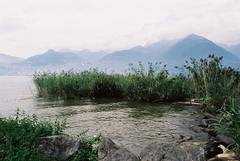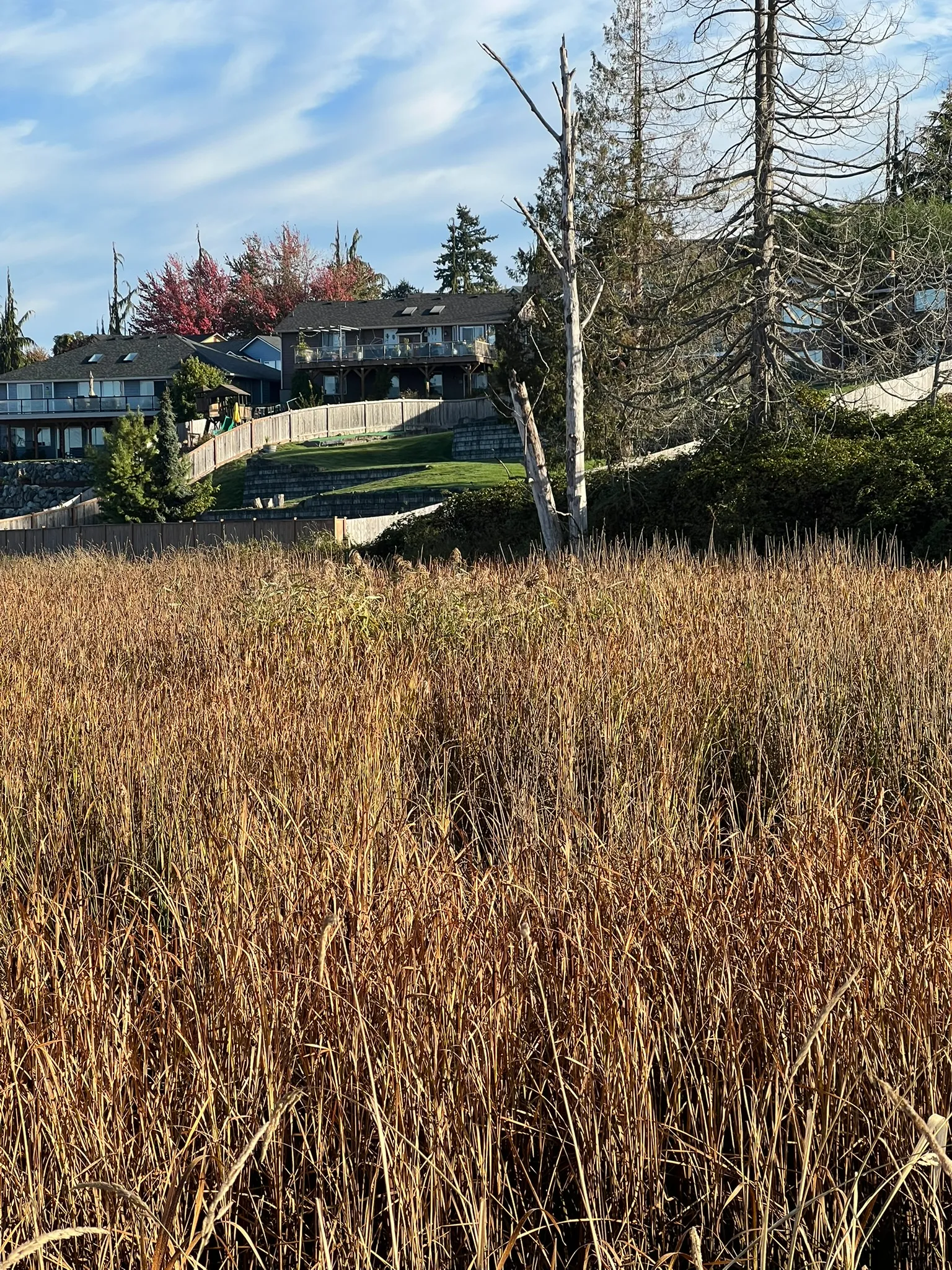
Image 1 of 14
Plant Reference
1 / 14
Phragmites, Genus, australis, Species,
- Genus & species
common reed
Cosmopolitan globally; native North American subsp. americanus in scattered non-dominant wetland patches; invasive European subsp. australis introduced via ship ballast in the 1800s and dominant in degraded wetlands across eastern North America and expanding in the Pacific Northwest
Overview
Phragmites australis is a massive rhizomatous perennial grass in the family Poaceae reaching 6–15 feet (1.8–4.5 m) tall and 3–8 feet (0.9–2.4 m) wide per individual stem cluster, forming dense monoculture stands in wetlands, estuaries, roadside ditches, and tidal marshes. Stems (culms) are erect, cane-like, stiff, up to 0.6 inch (15 mm) in diameter, hollow, with prominent nodes running the length of the stem. Leaves are flat, gray-green to dark green, up to 2 inches (5 cm) wide and 24 inches (60 cm) long, held at a wider angle from the stem than most grasses. The ligule is a fringe of hairs 0.04–0.08 inch (1–2 mm) long — a trait that separates this genus from Phalaris, which carries a membranous ligule. Panicles are large plume-like structures 6–16 inches (15–40 cm) long, purplish to silvery at flowering and becoming tawny-tan and fluffy at seed maturity, persisting upright through winter and into the following spring. Spikelets have 3–7 florets with long silky hairs on the rachilla that give the mature plume its characteristic feathery appearance. Rhizomes are thick (0.4–0.8 inch / 10–20 mm diameter), extending 6+ feet (1.8+ m) deep and spreading laterally 15+ feet (4.5+ m) per year under favorable conditions. Both a native North American subspecies (P. australis ssp. americanus) and an introduced European subspecies (P. australis ssp. australis) occur across North America — the invasive European genotype has largely displaced the native in many regions since its introduction in the 1800s. The native subspecies carries reddish stems, smooth leaf sheaths, and lower stand density; the European genotype carries tan stems, ridged sheaths, and forms tall dense impenetrable monocultures. Not known to be toxic to pets or humans.
Native Range
Phragmites australis has a cosmopolitan distribution on all continents except Antarctica. The native North American genotype (P. australis ssp. americanus) occurs in scattered non-dominant patches in natural wetlands across the continent. The invasive European genotype (P. australis ssp. australis) was likely introduced to the eastern seaboard via ship ballast in the 1800s and has expanded aggressively across the eastern half of the continent and more recently into the Pacific Northwest. Both genotypes occur in the Pacific Northwest; the European genotype dominates degraded wetlands, estuarine margins, roadside ditches, and retention basins while the native persists mostly in undisturbed high-quality wetland remnants.Suggested Uses
Used in wetland invasive species management training alongside Phalaris arundinacea as the two dominant invasive wetland grasses of North America. The native versus invasive genotype distinction (stem color, sheath texture, stand density) is the primary identification exercise in Pacific Northwest wetland restoration coursework. Studied in estuarine ecology, tidal wetland conversion, and climate-change effects on wetland invasive ranges — P. australis is expanding northward with warming temperatures. The persistent tawny winter plumes are used in dried floral arrangements, and the ornamental trade has contributed to secondary dispersal. Historically used in thatching, mat-making, and musical reed production — clarinet and saxophone reeds are cut from related species in the genus.How to Identify
Appearance
Size & Dimensions
Height6' - 15'
Width/Spread3' - 8'
Bloom Information
Large plume-like panicles 6–16 inches (15–40 cm) long appear from August through October, emerging purplish to silvery and becoming tawny and fluffy as seeds mature. The species is wind-pollinated. Seed viability runs low in many invasive populations — vegetative spread via rhizomes and stolon-like runners is the principal expansion mechanism rather than seed dispersal. Mature plumes persist on upright stems through winter and into the following spring, providing year-round field-visible identification of established stands.
Detailed Descriptions
Flower Description
Purplish to silvery at flowering, becoming tawny-tan and fluffy at seed maturity; large plume-like panicles 6-16 inches long; wind-pollinatedFoliage Description
Gray-green to dark green; flat broad blades up to 2 inches (5 cm) wide and 24 inches (60 cm) long; held at a wider angle from the stem than most grasses; tapering to a long pointGrowing Conditions
Sun Requirements
Requires 4-12 hours of direct sunlight daily
• Full Sun: 6+ hours of direct sunlight
• Partial Shade: 3-6 hours of direct sunlight
• Full Shade: Less than 3 hours of direct sunlight