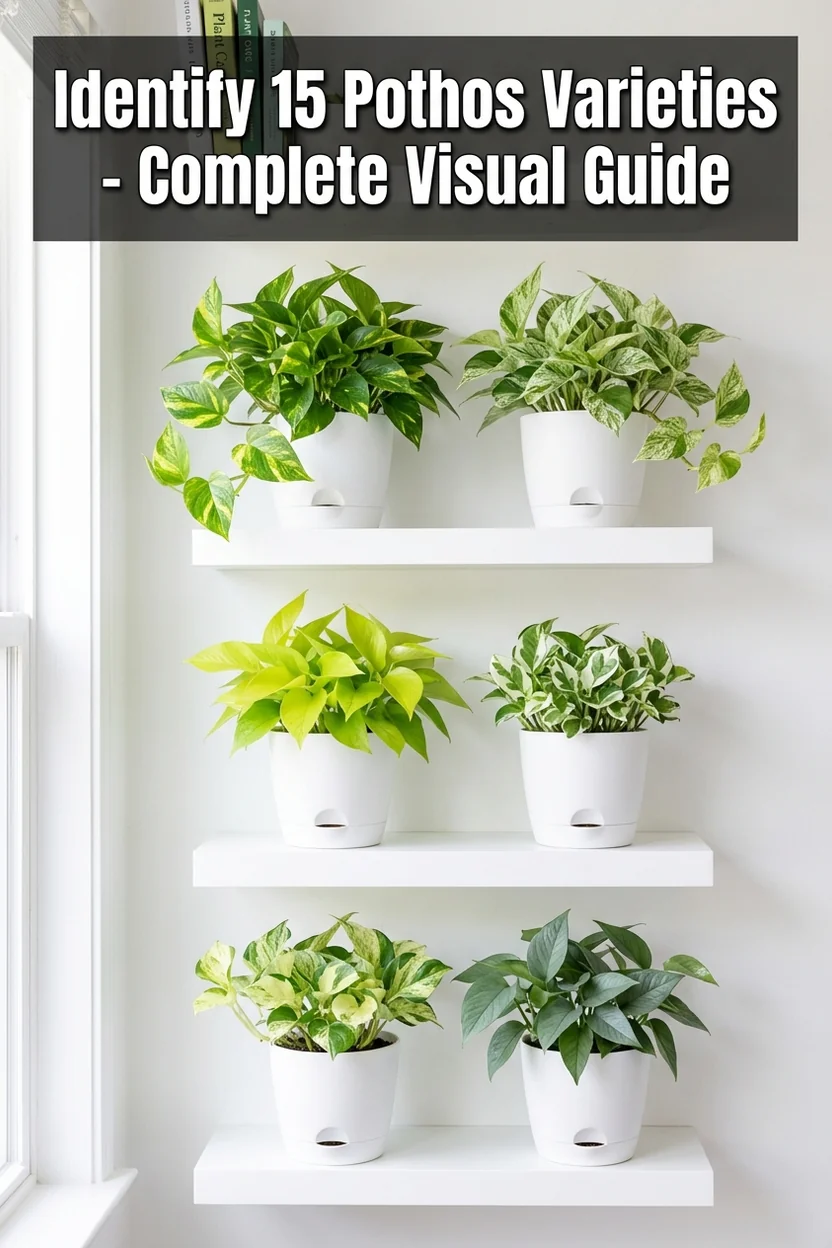
Pothos Varieties: 15 Types and How to Identify Them
Pets & Toxicity
Recorded toxicity for plants linked in this guide. An unknown status is not a safety assessment.
Toxic to pets: golden pothos, dragon tail plantDetailsHide
Epipremnum aureum — Toxicity Warning
Toxic to pets and humans. All parts contain insoluble calcium oxalate crystals that cause mouth pain, swelling, and drooling if ingested.View Epipremnum aureum plant profileEpipremnum pinnatum — Toxicity Warning
Toxic to pets and humansView Epipremnum pinnatum plant profile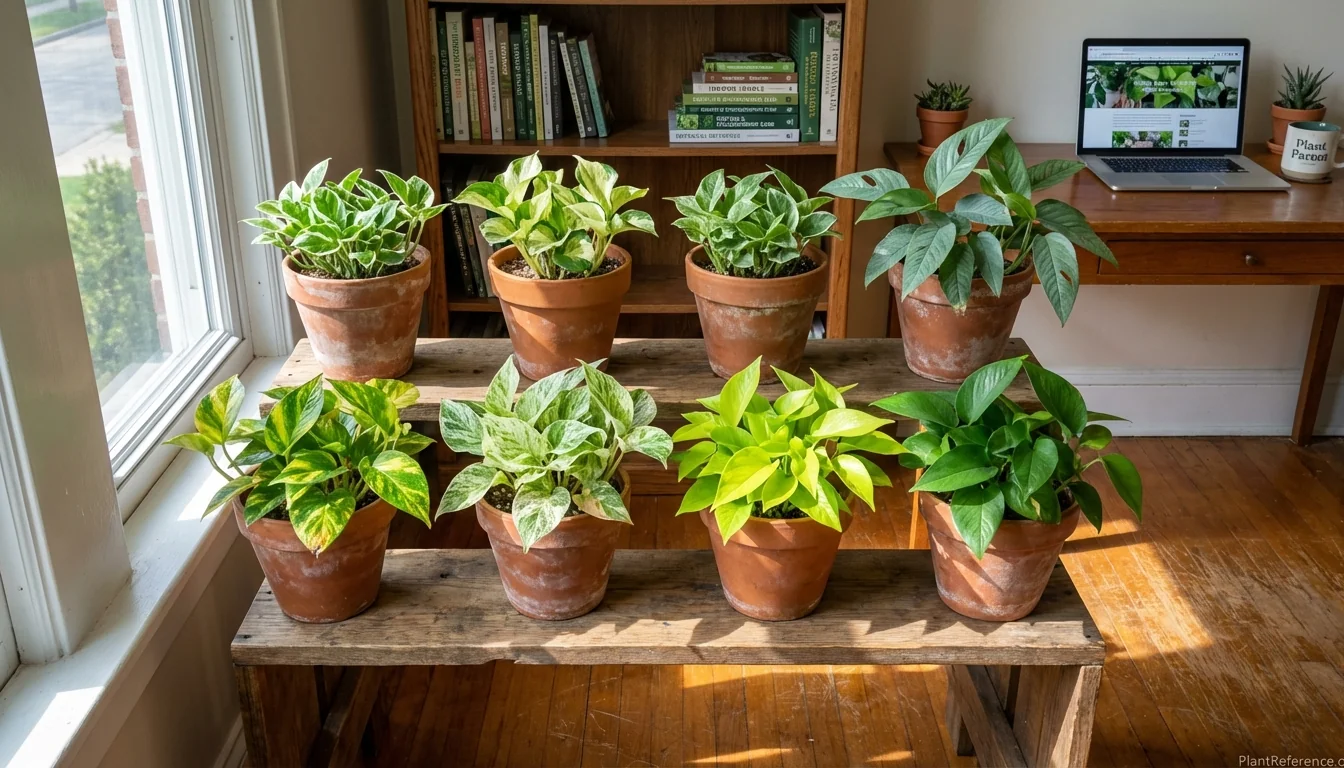
— Image © Plant Reference 2026
Wondering what types of pothos exist beyond the classic golden variety you see everywhere? There are actually 15+ distinct pothos varieties available to houseplant enthusiasts, each with unique leaf patterns, colors, and growth characteristics that make identification both fascinating and sometimes challenging.
The beauty of pothos lies not just in their care simplicity, but in the incredible diversity of variegation patterns nature has created. From the classic golden splashes of 🌿Epipremnum aureum (ep-ih-PREM-num AW-ree-um) 'Golden' to the rare fenestrated leaves of Baltic Blue, each variety offers something unique for collectors and casual plant parents alike.
Most Popular Pothos Varieties (The Big 5)
These five varieties represent 90% of pothos you'll encounter in nurseries, making them the perfect starting point for identification.
Golden Pothos
Scientific name: 🌿Epipremnum aureum 'Golden' Identification: Heart-shaped leaves with irregular golden-yellow splashes and streaks on green background. Variegation appears random and asymmetrical. Size: 4-8 inches (10-20 cm) leaves, vines to 10+ feet Rarity: Most common variety, available everywhere Care difficulty: Easiest—tolerates neglect and low light
Golden pothos remains the most recognizable variety because it's nearly impossible to kill. The chlorophyll-rich green sections allow survival in low light conditions that would cause other variegated varieties to struggle. New plant parents often start here before expanding their collection.

Marble Queen Pothos
Scientific name: 🌿Epipremnum aureum 'Marble Queen' Identification: Creamy white and green marbled pattern covering 40-60% of each leaf. White sections appear more extensive than Golden's yellow areas. Size: 3-6 inches (7-15 cm) leaves, slower growing than Golden Rarity: Very common in nurseries Care difficulty: Easy, but requires bright indirect light to maintain white variegation
The extensive white variegation makes Marble Queen stunning but also more demanding. White leaf sections contain no chlorophyll, so the plant relies entirely on green areas for photosynthesis. Insufficient light causes new growth to emerge increasingly green as the plant prioritizes survival over aesthetics.
Neon Pothos
Scientific name: 🌿Epipremnum aureum 'Neon' Identification: Solid bright chartreuse-yellow leaves with no variegation. New growth emerges almost fluorescent yellow-green before maturing to lighter green. Size: 4-7 inches (10-18 cm) leaves Rarity: Common, gaining popularity Care difficulty: Easy—solid leaves tolerate lower light than variegated types
Don't mistake Neon for a severely light-stressed Golden pothos. True Neon maintains its vibrant color even in adequate lighting, while Golden losing variegation indicates insufficient light. The uniform color distribution across entire leaves distinguishes Neon from any variegated variety.
Jade Pothos
Scientific name: 🌿Epipremnum aureum 'Jade' Identification: Solid dark forest green leaves with glossy surface. No variegation present. Leaves often larger than variegated varieties. Size: 5-10 inches (12-25 cm) leaves—often the largest of common varieties Rarity: Common but less popular than variegated types Care difficulty: Easiest—solid green provides maximum chlorophyll
Jade pothos often goes unrecognized because people expect pothos to be variegated. However, the solid green coloration allows faster growth and larger leaves than variegated siblings. This variety excels in lower light conditions and develops impressive vine length quickly.

N'Joy Pothos
Scientific name: 🌿Epipremnum aureum 'N'Joy' Identification: Compact leaves with sharp, defined white and green sections. White patches have clean borders rather than the blended marbling of Marble Queen. Size: 2-4 inches (5-10 cm) leaves—noticeably smaller than other varieties Rarity: Increasingly common Care difficulty: Moderate—needs consistent bright light for crisp variegation
N'Joy's compact size and precise variegation pattern make it perfect for smaller spaces. The clearly defined white sections create a cleaner appearance than Marble Queen's soft marbling, but this distinct pattern requires consistent lighting to maintain sharp borders between colors.
For comprehensive pothos care basics that apply to all varieties, check out our Pothos Care: The Complete Beginner's Guide (2025) which covers universal requirements like watering, light, and soil needs.
Variegated Pothos Varieties (White and Cream Patterns)
Beyond the popular Marble Queen and N'Joy, several varieties showcase stunning white and cream variegation patterns.
Pearls and Jade Pothos
Scientific name: 🌿Epipremnum aureum 'Pearls and Jade' Identification: Green leaves with white variegation plus silver-gray speckles throughout. The unique gray speckling distinguishes it from pure white varieties. Size: 3-5 inches (7-12 cm) leaves Rarity: Moderately common Care difficulty: Easy to moderate
The silver-gray speckling occurs as a genetic sport of Marble Queen, creating a three-color effect that's subtle but distinctive. This variety was discovered at the University of Florida and represents one of the newer additions to common pothos varieties.
Manjula Pothos
Scientific name: 🌿Epipremnum aureum 'Manjula' Identification: Broad heart-shaped leaves with cream, white, and green variegation. Leaves have wavy, slightly ruffled edges—unique among pothos varieties. Size: 4-6 inches (10-15 cm) leaves with distinctive wavy margins Rarity: Less common but gaining popularity Care difficulty: Moderate—needs bright light for cream coloration
The wavy leaf edges immediately distinguish Manjula from all other pothos varieties. This texturing comes from uneven cell development along leaf margins and remains consistent regardless of growing conditions. The cream and white variegation can fade to green in insufficient light, but the wavy edges persist.

Glacier Pothos
Scientific name: 🌿Epipremnum aureum 'Glacier' Identification: Small leaves with white and green variegation similar to N'Joy but with more rounded leaf shape and softer color transitions. Size: 2-3 inches (5-7 cm) leaves—among the smallest pothos varieties Rarity: Less common than N'Joy Care difficulty: Moderate to challenging—compact size makes it sensitive to overwatering
Glacier pothos often gets confused with N'Joy due to similar size and coloration. The key difference lies in leaf shape: Glacier has more rounded leaves while N'Joy maintains the classic heart shape. Glacier also tends to have softer transitions between white and green sections.
Rare and Collector Pothos Varieties
These varieties command higher prices and may require special ordering from specialty nurseries.
Baltic Blue Pothos
Scientific name: 🌿Epipremnum pinnatum 'Baltic Blue' Identification: Blue-green leaves with silver variegation. Mature plants develop fenestrations (splits) in leaves—unique among pothos. Size: 3-8 inches (7-20 cm), can reach 12+ inches with fenestrations Rarity: Rare and expensive ($40-100+) Care difficulty: Moderate—needs bright light and climbing support for fenestrations
Baltic Blue represents a different species (Epipremnum pinnatum rather than aureum), explaining its unique characteristics. The fenestrated leaves only develop on mature plants given adequate light and climbing support, making it particularly exciting for collectors willing to provide optimal conditions.
Cebu Blue Pothos
Scientific name: 🌿Epipremnum pinnatum 'Cebu Blue' Identification: Elongated lance-shaped leaves with blue-silver coloration. Leaf shape distinctly different from heart-shaped aureum varieties. Size: 4-10 inches (10-25 cm) long, narrow leaves Rarity: Moderately rare ($20-50) Care difficulty: Easy to moderate
The lance-shaped leaves immediately distinguish Cebu Blue from all Epipremnum aureum varieties. Young plants show subtle blue tinting that becomes more pronounced with age and proper lighting. Like Baltic Blue, mature specimens can develop fenestrations with adequate support.

Global Green Pothos
Scientific name: 🌿Epipremnum aureum 'Global Green' Identification: Dark green leaves with lighter green marbled variegation. Lacks white or yellow coloring entirely. Size: 4-6 inches (10-15 cm) leaves Rarity: New variety, moderately rare Care difficulty: Easy
Global Green offers subtle beauty through tonal green variegation rather than high-contrast colors. This newer variety appeals to collectors seeking understated elegance and those whose decor doesn't suit bright yellow or white variegated plants.
Shangri-La Pothos
Scientific name: 🌿Epipremnum aureum 'Shangri-La' Identification: Heavily curled and ruffled leaves with yellow-green variegation. Extreme leaf curling is genetic, not environmental stress. Size: 3-5 inches (7-12 cm) leaves with pronounced curling Rarity: Rare, specialty nurseries only Care difficulty: Moderate—curled leaves can trap moisture leading to fungal issues
The extreme leaf curling makes Shangri-La unmistakable but also challenging. Water can collect in the curled leaf structures, creating fungal problems if humidity is too high or air circulation insufficient.
How to Identify Your Pothos Variety
Use this systematic approach to identify any pothos variety you encounter.
Step 1: Examine Leaf Shape
Heart-shaped: Most Epipremnum aureum varieties (Golden, Marble Queen, Neon, Jade, N'Joy)
Lance-shaped/Elongated: Epipremnum pinnatum varieties (Baltic Blue, Cebu Blue)
Heart-shaped with wavy edges: Manjula only
Heavily curled: Shangri-La only
Step 2: Assess Variegation Pattern
No variegation (solid color): Jade (dark green) or Neon (chartreuse)
Yellow variegation: Golden pothos
White/cream variegation: Marble Queen, N'Joy, Pearls and Jade, Manjula, Glacier
Blue/silver tinting: Baltic Blue, Cebu Blue
Green-on-green: Global Green
Step 3: Note Variegation Distribution
For white/cream variegated varieties:
Soft, blended marbling: Marble Queen
Sharp, defined patches: N'Joy
Gray speckles included: Pearls and Jade
Cream coloring (not pure white): Manjula
Small, compact distribution: Glacier

Step 4: Consider Leaf Size
Large (5+ inches): Jade, mature Baltic Blue with fenestrations
Medium (3-6 inches): Golden, Marble Queen, Manjula, Global Green
Small (2-4 inches): N'Joy, Glacier, young specimens of any variety
Elongated: Baltic Blue, Cebu Blue (different measurement system due to shape)
Care Differences Between Pothos Varieties
While most pothos varieties share identical basic care requirements, understanding these subtle differences optimizes growth and variegation.
Light Requirements by Variety
Lower light tolerance (50-150 foot-candles):
Jade (solid green = maximum chlorophyll)
Neon (solid color, no variegation to maintain)
Golden (enough green sections for photosynthesis)
Bright indirect light needed (200-400 foot-candles):
Marble Queen (extensive white sections)
N'Joy (crisp pattern requires consistent energy)
Manjula (cream coloration fades without adequate light)
Baltic Blue (fenestration development requires energy)
Moderate light tolerance (100-250 foot-candles):
Pearls and Jade (mixed variegation provides flexibility)
Cebu Blue (solid coloring but different species needs)
Glacier (small size makes efficient use of available light)
For detailed watering guidance that works for all varieties, see our How to Water Pothos: The Foolproof Beginner Method article.
Growth Rate Differences
Solid green varieties (Jade, Neon) grow fastest because all leaf surface area contributes to photosynthesis. Heavily variegated varieties (Marble Queen, Manjula) grow slower due to reduced chlorophyll content. Rare varieties (Baltic Blue, Cebu Blue) may grow slowly initially but accelerate once established.
Propagation Success Rates
All pothos varieties propagate easily in water, but some show better success rates:
Highest success (95%+ rooting):
Golden, Jade, Neon
Good success (85-95% rooting):
Marble Queen, Pearls and Jade, Global Green
Moderate success (70-85% rooting):
N'Joy, Manjula, Glacier (lower chlorophyll affects energy for root development)
Variable success (60-80% rooting):
Baltic Blue, Cebu Blue (different species may have different rooting requirements)

Where to Buy Different Pothos Varieties
Common Varieties (Widely Available)
Big box stores (Home Depot, Lowes):
Golden, Marble Queen, Jade, occasionally Neon
Grocery stores (Trader Joe's, Whole Foods):
Golden, Marble Queen
General nurseries:
All common varieties plus N'Joy, Pearls and Jade
Specialty and Rare Varieties
Online specialty nurseries:
Gabriella Plants, Steve's Leaves, The Plant Farm
Best selection of Baltic Blue, Cebu Blue, Global Green, Shangri-La
Local plant swaps and Facebook groups:
Excellent for propagations and cuttings
Often the most affordable way to try new varieties
High-end plant boutiques:
Carry rare varieties but at premium prices
Good for immediate gratification if budget allows
Seasonal Availability
Spring (March-May) offers the best selection as nurseries stock up for growing season. Rare varieties often sell out quickly during this period. Fall can offer good deals as nurseries clear inventory, but selection may be limited.
For specific product recommendations on growing supplies that work for all varieties, check our Best Pots for Pothos: Drainage and Style Comparison.
Common Pothos Identification Mistakes
Confusing N'Joy and Glacier
Both varieties feature small leaves with white and green variegation, leading to frequent mix-ups at nurseries.
N'Joy identification: Heart-shaped leaves with sharp, defined borders between white and green sections Glacier identification: More rounded leaves with softer, blended transitions between colors
Mistaking Reverted Golden for Jade
When Golden pothos loses variegation due to insufficient light, new growth emerges solid green, resembling Jade pothos.
True Jade: Consistently dark forest green with glossy surface, larger leaves Reverted Golden: Lighter green with some older variegated leaves still present on plant
Assuming All Solid Green is Jade
Both Jade and Neon pothos lack variegation but show distinctly different colors.
Jade pothos: Dark forest green, similar to what you'd see on reverted variegated plants Neon pothos: Bright chartreuse-yellow that's unmistakably different from any green

Overlooking Manjula's Unique Edges
The wavy, ruffled leaf edges are Manjula's most distinctive feature, yet people often focus only on variegation patterns when identifying this variety.
Key reminder: If leaf edges are wavy or ruffled, it's Manjula regardless of color pattern variations.
Understanding these common identification mistakes helps avoid purchasing the wrong variety or misidentifying plants you already own. Each pothos variety offers unique beauty, and accurate identification ensures you provide appropriate care for optimal growth and variegation maintenance.
Frequently Asked Questions
Reading about plants and recognising them are different skills. These three build the second.
- Daily PlantIdentify the day’s mystery plant from a close-up photograph.
- Keyed OutWork a dichotomous key, lead by lead, to name a hidden specimen.
- Name That PlantName a specimen from botanical clues dealt hardest first.
Free to play, no account needed
Jessica transformed her small Brooklyn balcony into a thriving container garden after moving to New York City. What started as a pandemic hobby turned into a plant care consulting business serving urban apartment dwellers across the city. She specializes in small-space gardening, indoor plant troubleshooting, and helping clients keep houseplants alive in less-than-ideal conditions (dim light, dry heat, tiny spaces). Jessica completed a home gardening certificate program and shares her plant wins and failures on her modest Instagram following. Her partner, Maya, jokes that their apartment is now 40% plants, 60% living space. Jessica's passionate about making plant care accessible to renters who think they don't have room to garden.