Pacific Northwest Gardening Guide: Climate, Soil & Plant Selection
Pets & Toxicity
Recorded toxicity for plants linked in this guide. An unknown status is not a safety assessment.
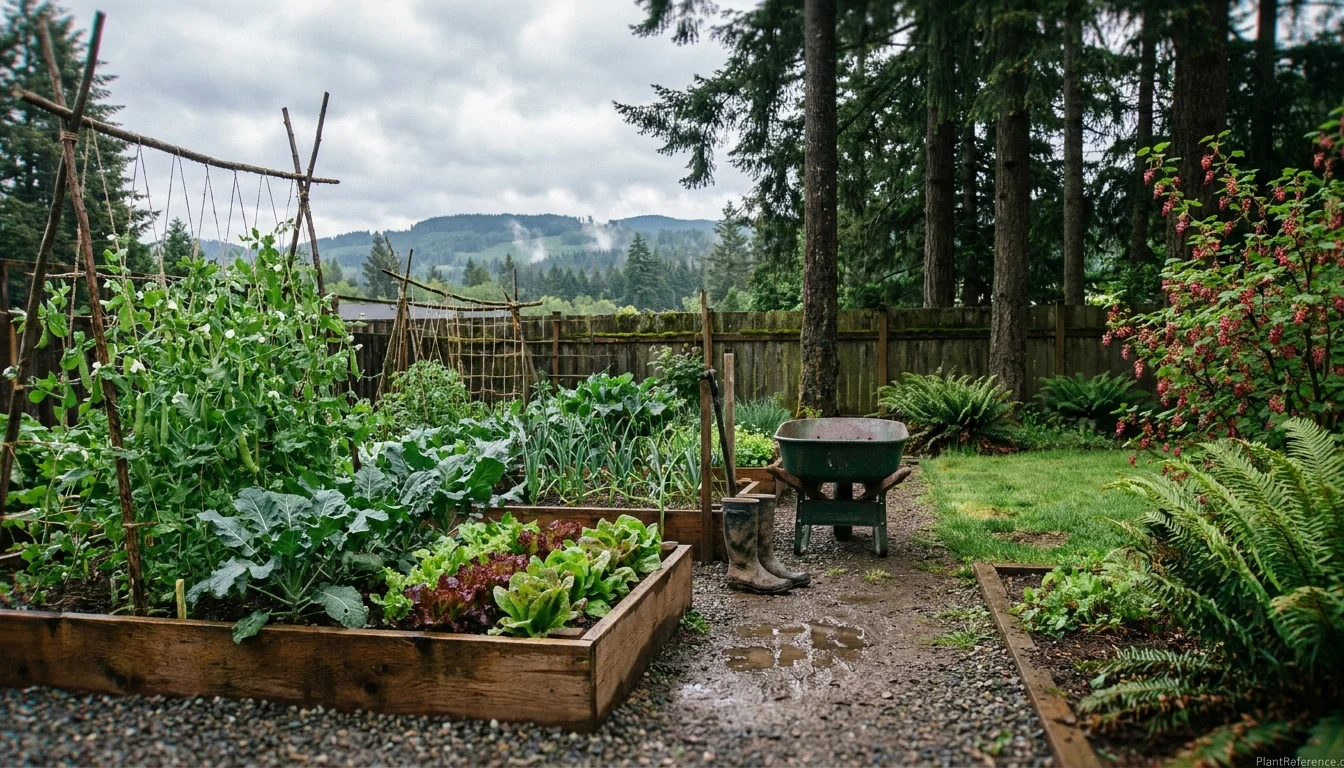
— Image © Plant Reference 2026
Pacific Northwest gardening is shaped by a single geological fact: the Cascade Range splits the region into two radically different growing environments. West of the crest, the maritime corridor receives 35 to 60 inches of annual rainfall, holds mild winters, and never quite reaches the summer heat that tomatoes and peppers prefer. East of the crest, the inland PNW gets less than 15 inches of rain, plunges below 0°F in some winters, and bakes through summer afternoons in the 90s. Successful gardens in either zone start with understanding which side of that divide you actually live on.
Understanding the Pacific Northwest's Two Climates
The maritime PNW—the I-5 corridor from Vancouver, BC down through Eugene, Oregon—is a textbook Mediterranean-adjacent climate with a twist. Winters are cool and saturated rather than truly cold. Summers are dry, sunny, and surprisingly cool at night. The growing season runs roughly 220 to 230 frost-free days, but that long calendar is misleading. Many of those days are too cool for heat-loving crops to gain meaningful growth. A Seattle July night averages 56°F (13°C), well below the 65°F (18°C) nighttime threshold tomatoes need for rapid fruit development.
The inland PNW behaves like an entirely different continent. Spokane, Yakima, and the Columbia Basin sit in the Cascade rain shadow, getting their annual precipitation in winter snow and brief spring storms. The frost-free window shrinks to 150–170 days, but daytime heat units accumulate fast. The Yakima Valley produces commercial-scale melons, eggplants, and stone fruit precisely because its summers are hot enough to ripen what the maritime PNW cannot.
A third, smaller climate zone matters too: the immediate coast (Long Beach, Ocean Shores, the outer Olympic Peninsula). Here ocean buffering pushes the frost-free window past 250 days, but persistent cloud cover, fog, and salt spray create their own crop limitations.
PNW Hardiness Zones and the Cascade Divide
The 2023 USDA Plant Hardiness Zone Map places the Pacific Northwest in Zones 4b through 9a, a wider span than most regions. That range reflects real horticultural reality: a fig tree thriving in a Portland courtyard would die outright in a Spokane winter, and a cold-hardy Alaska variety bred for Anchorage would bolt in Eugene's mild climate. Zone alone doesn't tell the whole story, but it does set the outer limits of what's possible.
Sub-Region | USDA Zone | Last Frost | First Frost | Frost-Free Days |
|---|---|---|---|---|
Coastal (Long Beach, Ocean Shores) | 9a | Late February | Late November | 250+ |
Puget Sound (Seattle, Tacoma) | 8b | March 25 – April 20 | Oct 17 – Nov 15 | 220–230 |
Willamette Valley (Portland, Salem) | 8b | Early April | Late October | 200–210 |
Yakima Valley (Central WA) | 7a | May 5–10 | Sept 26 – Oct 5 | 150–160 |
Spokane (Eastern WA) | 6b | May 13 | October 5 | 160 |
High Cascades / Olympics | 4b–5a | Late June | Early September | Under 100 |
Within those zones, microclimate engineering can shift outcomes dramatically. South-facing walls and dark stone or brick retain solar heat through cool maritime nights, sometimes raising a pocket's effective zone by half a step. Conversely, low-lying spots collect cold air and create frost pockets that strike late in May when surrounding gardens are safely warm. Before placing heat-sensitive crops, walk your property after a clear, cold night and notice where frost lingers longest.
Why PNW Soil Is Acidic (and What to Do About It)
Maritime PNW soils trend acidic for a specific chemical reason. Rainwater absorbs atmospheric carbon dioxide and forms weak carbonic acid (H₂CO₃), which slowly leaches calcium and magnesium out of the upper soil profile each winter. After centuries of high rainfall, the result is a soil pH that often sits between 5.0 and 5.8—too low for most vegetables, which prefer 6.0 to 6.8.
The consequences are biochemical. Below pH 5.5, aluminum minerals begin to dissolve into the soil solution. Soluble aluminum is toxic to plant roots: it stunts elongation, damages cell membranes at the root tip, and interferes with phosphorus uptake even when phosphorus is abundant in the soil. Yellowing brassicas and stunted lettuce in an otherwise well-fed Western Washington garden are often acid-and-aluminum problems, not nutrient deficiencies.
The fix is calcium carbonate—agricultural lime—applied in fall so it has months to react before spring planting. For most maritime PNW gardens, dolomitic lime is the better choice because it supplies both calcium and magnesium, and Western Oregon and Washington soils are commonly magnesium-depleted. Apply 5–10 lbs (2.3–4.5 kg) per 100 square feet (9.3 m²) based on a soil test, water in, and retest the following year. Raised Bed Soil pH Problems: Testing, Adjusting, and Maintaining Balance
The inland PNW has the opposite problem. East of the Cascades, low rainfall leaves base cations in place and soils trend alkaline, often pH 7.5 to 8.5. Here elemental sulfur is the amendment—2–4 lbs (0.9–1.8 kg) per 100 square feet (9.3 m²) for a half-point pH drop, worked in well ahead of planting. Blueberries and acid-loving ornamentals are functionally impossible in inland PNW garden beds without container culture and a dedicated acidic potting mix.
Glacial Till, Hardpan, and the Case for Raised Beds
The Puget Sound basin sits on a layer of compacted glacial till—commonly called hardpan—that typically begins 18 to 36 inches (45–90 cm) below the surface. This concrete-like subsoil was compressed under the weight of continental ice sheets and resists root penetration and water infiltration almost completely. The result is winter saturation in the rooting zone: water arrives faster than the hardpan can transmit it downward, the top layer turns anaerobic, and roots rot.
The solution most PNW gardeners arrive at, often after losing a season or two to root rot, is raised beds as the default rather than the exception. A 10–12 inch (25–30 cm) raised bed filled with a properly draining mix takes the rooting zone above the saturated layer entirely. The Complete Guide to Raised Bed Gardening for Beginners (2025) For deeper-rooted vegetables like tomatoes or carrots, build to 18 inches (45 cm) and your problems largely vanish.
The mix matters. PNW raised beds perform best with a coarser-than-average soil blend—roughly 50% screened topsoil, 30% well-finished compost, and 20% pumice or coarse sand for drainage. Best Soil for Raised Beds: 6 Commercial Mixes Tested and Compared The pumice fraction matters most: pure compost-and-topsoil mixes settle, compact, and reproduce the same drainage problem at a smaller scale within a year or two. Raised Bed Soil Settling and Compaction: Prevention and Solutions
For in-ground beds on sloped sites, French drains are the next tool: gravel-filled trenches with perforated pipe that intercept subsurface water and redirect it away from the garden. They're more work than raised beds but preserve mature trees and existing landscape structure.
A Plant Selection Framework for PNW Gardens
Plant selection in the PNW comes down to four questions, asked in order. Which side of the Cascades are you on? What's your specific microclimate? How wet does your soil stay in winter? How much summer heat does the spot collect? Answering those four questions before you buy anything narrows the field dramatically.
For maritime PNW gardens, lean into cool-season strengths. The region grows brassicas, peas, alliums, salad greens, root vegetables, berries, stone fruit (with chill caveats), apples, pears, and an enormous range of ornamentals from woodland natives to Mediterranean dry-shade selections. Push thermophilic crops—tomatoes, peppers, eggplant, melons—only with serious season extension or early-maturity varieties.
For inland PNW gardens, the calculation flips. Heat-loving crops are easy. Cool-season crops need protection from late spring freezes and brief, scorching summer windows. Drought-tolerant ornamentals (lavender, Russian sage, ornamental grasses) thrive without supplemental irrigation, while moisture-loving woodland plants struggle.
A practical framework: pick a small number of crops or plants that genuinely match your conditions and grow them well. The maritime PNW gardener who insists on growing watermelons usually ends up with one small, late-ripening fruit and a frustrated summer. The same effort applied to peas, kale, and 🌿Brassica oleracea 'Lacinato' (BRASS-i-ka oh-ler-AY-see-uh) produces baskets of food.
Best Native Plants for Pacific Northwest Landscapes
Native plants have co-evolved with the PNW's wet-winter, dry-summer pattern and outperform most introduced ornamentals once established. They require no supplemental fertilizer, far less summer irrigation, and they support the specialized native pollinators that introduced species often cannot feed. A native-anchored landscape is the lowest-input, highest-resilience garden style available in the region.
Key taxa worth knowing:
🌿Ribes sanguineum (Red-flowering Currant)—deciduous shrub blooming early spring, critical nectar source for returning rufous hummingbirds
🌿Mahonia aquifolium (Oregon Grape)—evergreen with holly-like leaves and yellow late-winter flowers, Oregon's state flower
🌿Vaccinium ovatum (Evergreen Huckleberry)—tolerates sun to deep shade, produces edible black berries
🌿Polystichum munitum (Western Sword Fern)—defining PNW understory plant, drought-tolerant once established
🌿Acer circinatum (Vine Maple)—multi-trunked small tree with brilliant scarlet fall foliage
🌿Camassia quamash (Camas Lily)—perennial bulb with periwinkle May flowers, historically a major Indigenous food crop
🌿Cornus sericea (Red-osier Dogwood)—wet-tolerant shrub with bright red winter stems
🌿Iris tenax (Oregon Iris)—drought-tolerant native iris for mesic zones
A research caveat worth understanding: "nativars"—cultivars developed from native species—vary in their pollinator value. Selections with minor changes (like color shifts in 'Sauvie Star' aster) generally retain pollinator function, but heavily modified cultivars bred for double blooms often have inaccessible reproductive parts and produce less nectar. When the goal is supporting specialized native bees, wild-type natives are typically the safer choice.
Cool-Season vs. Warm-Season Vegetables in the PNW
PNW vegetable gardens follow a distinctive two-cycle pattern: cool crops in spring and fall, warm crops squeezed into the narrow summer window. Understanding which category a plant belongs to is the difference between productive beds and frustration.
Cool-Season Crops (the PNW's strength)
Peas, brassicas, lettuce, spinach, kale, chard, alliums, carrots, beets, radishes, and turnips thrive between 40°F and 70°F (4–21°C). They tolerate frost—some, like Brassica oleracea (kale), actually improve in flavor after light freezes as cold triggers starches to convert into sugars. Most cool-season crops can be grown in two cycles per year: a spring sowing for early summer harvest and a late-summer sowing for fall and winter harvest. When to Plant Kale in Portland: Complete Guide + Best Varieties for Zone 8b
Garlic is the most regionally specific timing question. Plant cloves in September or October, mulch heavily for winter, and harvest the following July. Hardneck varieties handle the maritime winter well; softneck types store longer and tolerate the inland PNW's colder dormancy.
Onions need a careful variety match: PNW summers run long-day, so long-day or day-neutral varieties are required for proper bulbing. Short-day onions bred for the South will fail here. When to Plant Onions in Portland: Complete Guide + Best Varieties for Zone 8b
Warm-Season Crops (the PNW's challenge)
Tomatoes, peppers, eggplant, melons, cucumbers, beans, corn, and winter squash all need consistent warmth that the maritime PNW only sometimes delivers. The strategy is selecting early-maturity varieties and accepting that some heat-loving crops are not worth the trouble.
For tomatoes, choose varieties under 70 days to maturity. Cold-tolerant slicers like 'Glacier' (55 days) and 'Siberian' (58 days) actually set fruit when night temperatures dip into the 40s, where standard slicers stall completely. Paste varieties like 'Roma' (65 days) handle the maritime climate adequately. When to Plant Tomatoes in Portland: Complete Guide + Best Varieties for Zone 8b
For peppers, expect modest yields without a tunnel or wall-trained microclimate. 'Yankee Bell' and 'Sweet Banana' (60–70 days) are realistic maritime PNW choices. Hot peppers struggle even more than sweet types because they need higher accumulated heat units to develop capsaicin properly.
Managing Slugs, Mildew, and Cool-Wet Pest Pressure
The maritime PNW's mild, damp conditions create textbook habitat for specific pest and disease problems. Three dominate.
Slugs are the region's defining garden pest. They emerge after dusk, target tender new growth (lettuce, brassica seedlings, hosta), and can decimate a spring planting overnight. Cultural controls help most: remove debris where slugs shelter, water early in the day so foliage and surfaces dry before evening, and avoid heavy mulches against plant stems. Physical barriers like copper tape around containers and raised bed edges deter movement.
For active control, iron phosphate baits (sold as Sluggo and equivalents) are the organic gold standard—non-toxic to pets and wildlife, and the active ingredient breaks down into soil nutrients. Apply at first sighting and after every heavy rain. Avoid metaldehyde baits, which are toxic to dogs.
Powdery and downy mildew thrive in PNW humidity. Both prevention strategies are the same: select resistant cultivars, space plants generously for airflow, trellis vining crops vertically, water at the soil rather than overhead, and prune lower foliage on densely planted beds. Once mildew establishes, you're managing decline rather than curing—catch it early or live with reduced yields.
Aphids target nitrogen-rich new growth on roses, brassicas, and fruit trees. Heavy nitrogen feeding actually invites them. Blast colonies off with strong water sprays, plant flat-headed flowers (yarrow, alyssum, dill) to attract lacewings and parasitic wasps, and tolerate small populations rather than spraying immediately. Spray programs eliminate the beneficials that would have controlled the next generation. Raised Bed Pest Problems: Identification and Organic Control Methods
Season Extension: Cloches, Cold Frames, and Tunnels
For warm-season crops in the maritime PNW, architectural intervention often determines whether you get a meaningful harvest. Three tools cover most situations.
Wall-o-Waters and water-filled cloches are individual plant cocoons that store solar heat in water columns during the day and release it overnight. They protect tender transplants down to 16°F (-9°C) and can advance tomato planting by 3–4 weeks in maritime gardens. They're labor-intensive to fill and remove but the most affordable per-plant option.
Cold frames—bottomless boxes with translucent lids over a planting area—serve two functions: hardening off spring-started seedlings before transplant, and extending the harvest of cold-tolerant crops (lettuce, spinach, mache, claytonia) deep into winter. The key operational rule is venting on sunny days: even December sun can spike internal temperatures past 90°F (32°C) and cook the crop you're trying to protect.
Hoop houses and high tunnels are the largest investment but transform what's possible. A 10x20 ft (3x6 m) tunnel allows in-ground production of large-fruited tomatoes, full-season peppers, and cucumbers that simply won't ripen outdoors in maritime conditions. The major caveat: no rainfall reaches the soil inside, so salt buildup from irrigation water and fertilizers eventually accumulates. Plan for occasional deep flushing or annual soil amendment to maintain fertility.
Adapting Your PNW Garden to a Changing Climate
The PNW is experiencing measurable climate shift, and gardens are showing the changes first. Summer heat extremes (the 2021 heat dome reached 116°F/47°C in Portland), shorter wet seasons, more frequent drought-driven water restrictions, and reduced winter chill hours all affect plant selection going forward.
For maritime gardens, three adaptations are worth thinking about now. First, shift toward heat-tolerant cultivars in vegetables and ornamentals. The 'Sungold' tomato that struggled in 2010 ripens reliably now in many Puget Sound gardens. Second, invest in water capture: rain barrels, cisterns, and rain gardens turn winter abundance into summer reserve. Third, monitor chill-hour requirements for fruit trees. Some traditional apple and cherry varieties bred for colder winters are starting to fail to set fruit in the warmest maritime pockets. Low-chill cultivars (under 300 hours) hedge against this trend.
For inland gardens, the pressures are different: longer hot windows, more variable winter snow cover, and shifting frost dates. Drought-tolerant Mediterranean species (lavender, Russian sage, ornamental grasses) and California natives may earn a place alongside traditional PNW selections.
The deeper shift is garden design philosophy. A garden built around carbon-positive practices—no-till soil management, generous compost, peat-free potting mixes, electric rather than gas-powered tools—remains productive while contributing less to the underlying problem. The PNW gardener who builds soil organic matter year after year creates a garden that's both more resilient to climate stress and a meaningful carbon sink. That dual benefit is the highest leverage choice available to home gardeners in the region right now.
Frequently Asked Questions
Reading about plants and recognising them are different skills. These three build the second.
- Daily PlantIdentify the day’s mystery plant from a close-up photograph.
- Keyed OutWork a dichotomous key, lead by lead, to name a hidden specimen.
- Name That PlantName a specimen from botanical clues dealt hardest first.
Free to play, no account needed
Tagged with
Sarah earned her doctorate in plant biology and spent time working in botanical garden education before transitioning to freelance writing and consulting. Now based in Portland, Oregon, she teaches plant identification workshops at local community centers and maintains a modest collection of over 60 houseplants in her small apartment. Sarah specializes in helping beginners understand plant science without the jargon—her approach focuses on practical observation over theory. She's killed her fair share of fiddle leaf figs and finally cracked the code on keeping them alive.