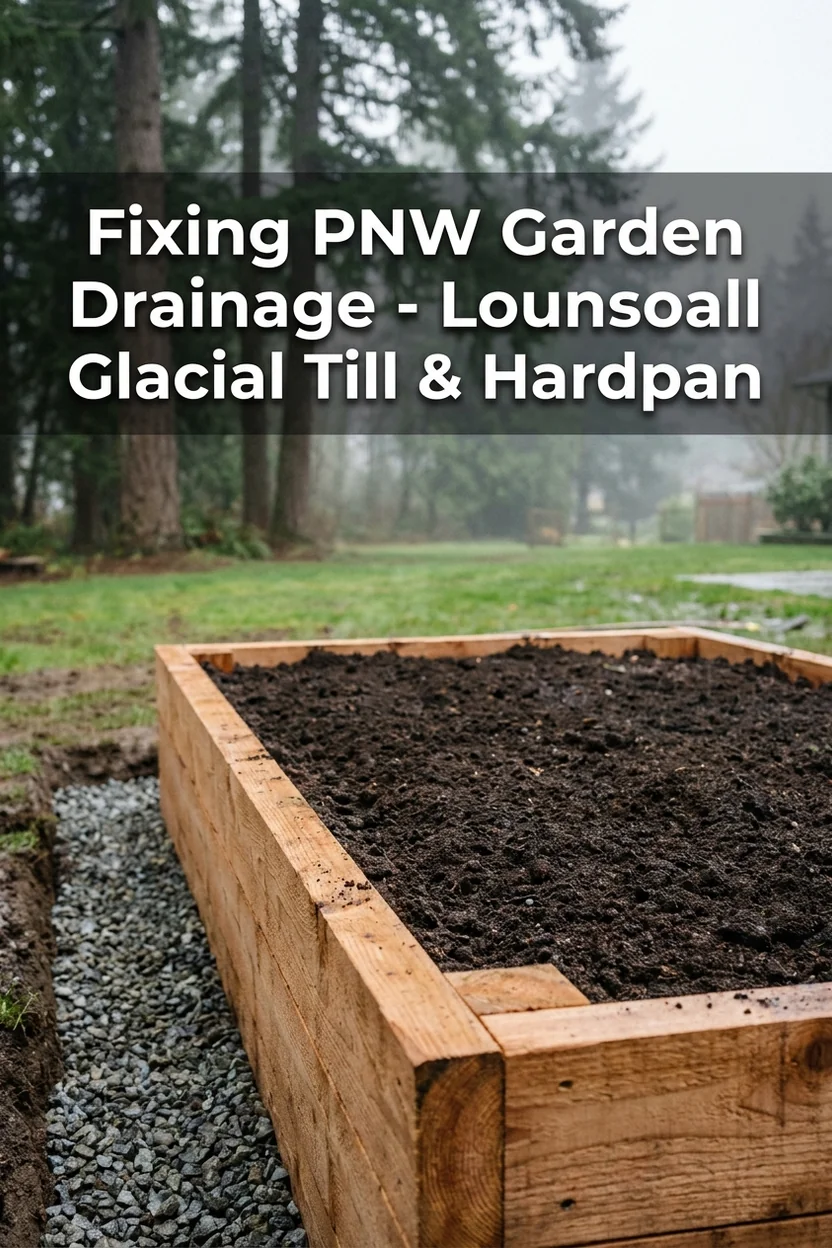
Fix PNW Garden Drainage: Glacial Till, Hardpan & Raised Beds
Pets & Toxicity
Recorded toxicity for plants linked in this guide. An unknown status is not a safety assessment.
— Image © Plant Reference 2026
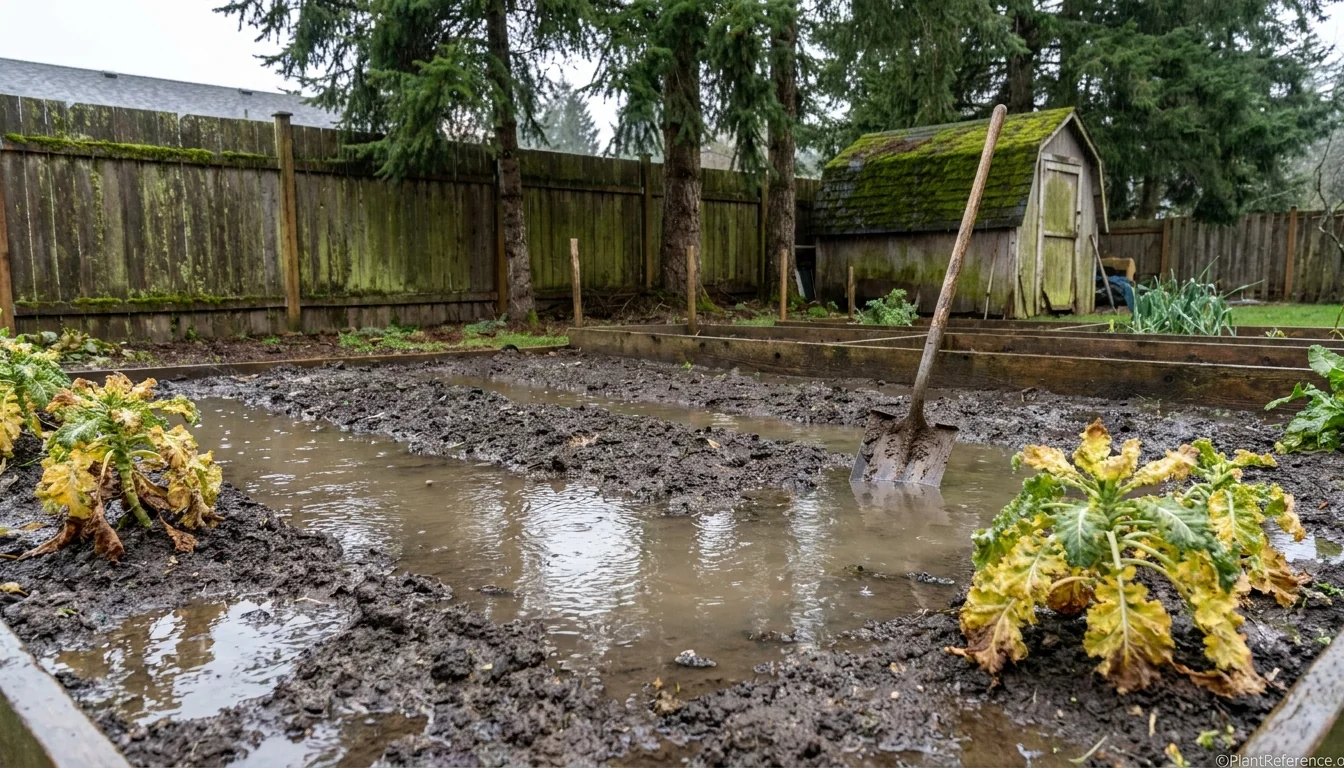
If your Pacific Northwest garden turns into a shallow pond every November and stays soggy until June, the problem almost certainly isn't your topsoil. Across the maritime PNW, the real culprit for poor drainage is a buried layer of glacial till hardpan that traps water below the root zone. Understanding that layer is the key to fixing drainage problems for good instead of fighting them every winter.
Why Pacific Northwest Gardens Drain So Poorly
Healthy garden soil is roughly half solids and half pore space, and those pores do two different jobs. Large channels called macropores—carved by roots and earthworms—handle drainage and let air reach roots. Tiny micropores hold water against gravity through capillary action. Sandy soils are macropore-dominated and drain fast; clay soils are packed with micropores, holding moisture beautifully but starving roots of oxygen during our long wet winters.
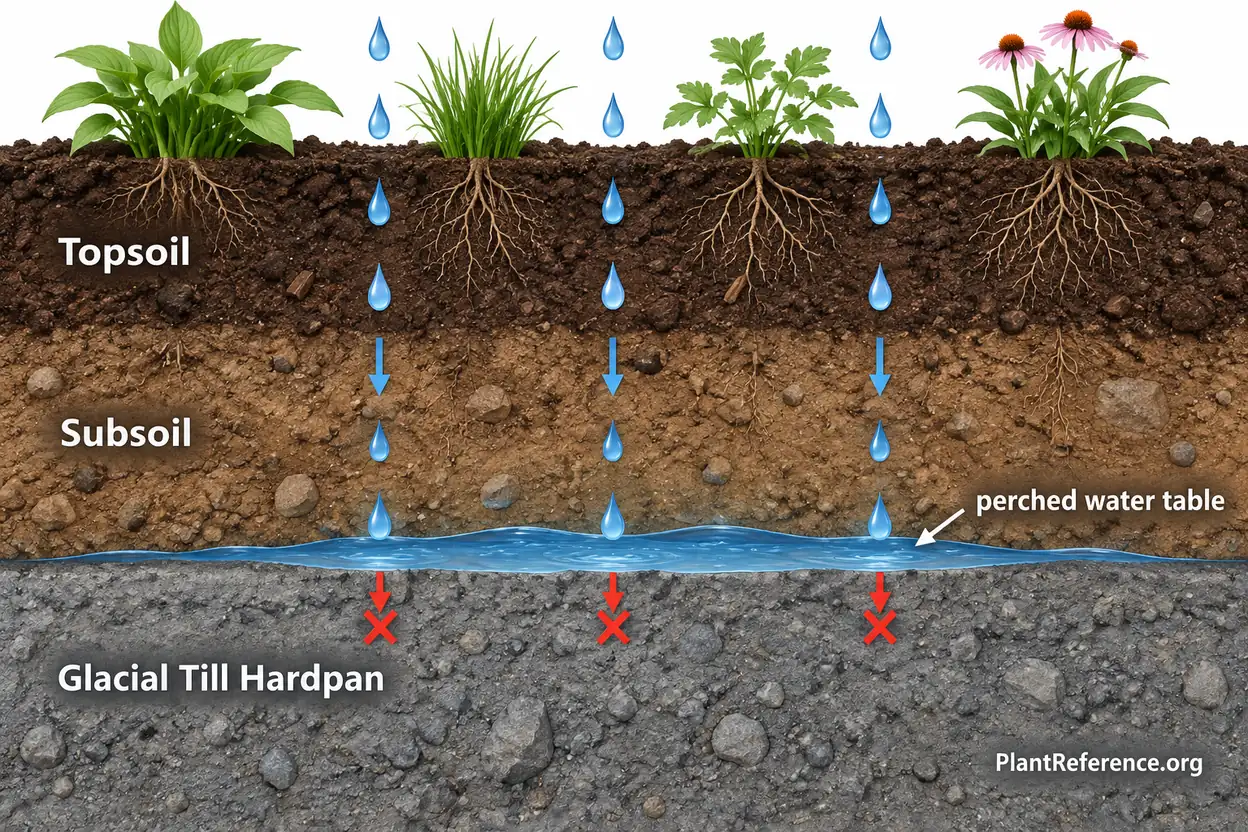
In much of the Puget Sound basin, the trouble runs deeper than soil texture. A dense, compacted layer of glacial till—often called hardpan—sits 18 to 36 inches (45-90 cm) below the surface. It has the permeability of poured concrete. Rain soaks through your topsoil, hits that layer, and stops. The result is a saturated, oxygen-starved root zone that invites root rot in everything from tomatoes to rhododendrons.
This is why amending the top few inches with compost rarely solves a real PNW drainage problem. You can build the most beautiful loam in the region, but if water can't escape below it, you've just built a bathtub. The maritime climate compounds the issue: our heavy October-through-May rainfall keeps that perched water table topped up for months at a time. Pacific Northwest Gardening Guide: Climate, Soil & Plant Selection
How to Diagnose Your Drainage Problem
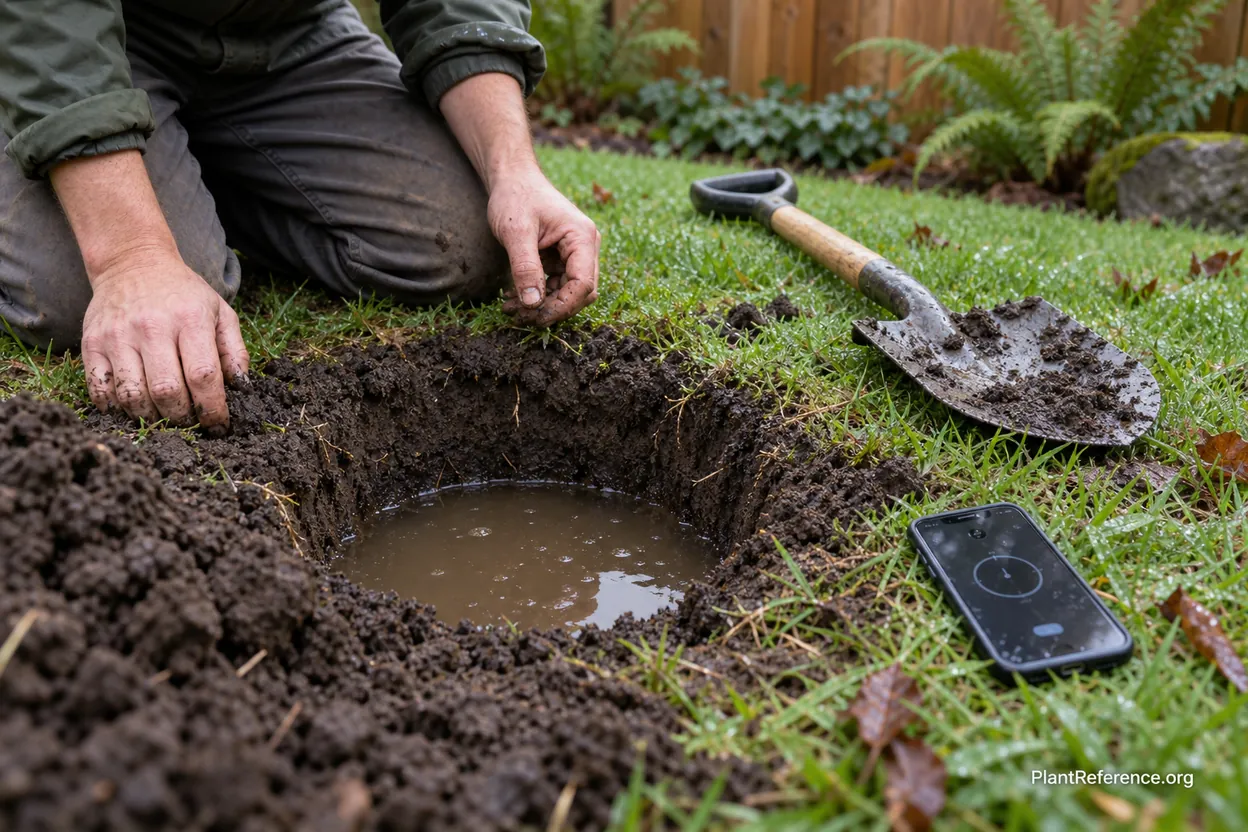
Before you dig a single trench, find out what you're actually dealing with. The simplest tool is a percolation test, and it costs nothing but an afternoon.
Dig a hole about 12 inches (30 cm) deep and 12 inches (30 cm) wide. Fill it with water and let it drain completely once to saturate the surrounding soil. Refill it, then time how fast the water level drops.
Draining more than 2 inches (5 cm) per hour: your drainage is excellent—most likely sandy or well-amended ground.
Draining 1-2 inches (2.5-5 cm) per hour: workable for most vegetables and ornamentals.
Draining less than 1 inch (2.5 cm) per hour: poor drainage that needs intervention.
Water still standing after 24 hours: a classic hardpan signature—you're sitting on glacial till or heavy compaction.
Dig a little deeper while you're at it. If your spade hits a layer so dense it feels like striking pavement somewhere in that 18-36 inch (45-90 cm) band, you've found your hardpan. Note where water sits on your property after a hard rain, too. Low spots that pool are frost-pocket cousins—cold, dense air and standing water both collect in the same dips. Poor Drainage in Raised Beds: Causes and Fixes for Waterlogged Soil
Match the diagnosis to the fix before you spend money:
Symptom | Likely Cause | Best Solution |
|---|---|---|
Standing water 24+ hours, flat ground | Glacial till hardpan | Raised beds |
Water flows toward house or beds on a slope | Surface and subsurface runoff | French drain |
Roof and driveway runoff flooding garden | Concentrated stormwater | Rain garden |
Soggy only in one low corner | Localized compaction | Raised bed or regrade |
Solution 1: Raised Beds (Your Default Answer)
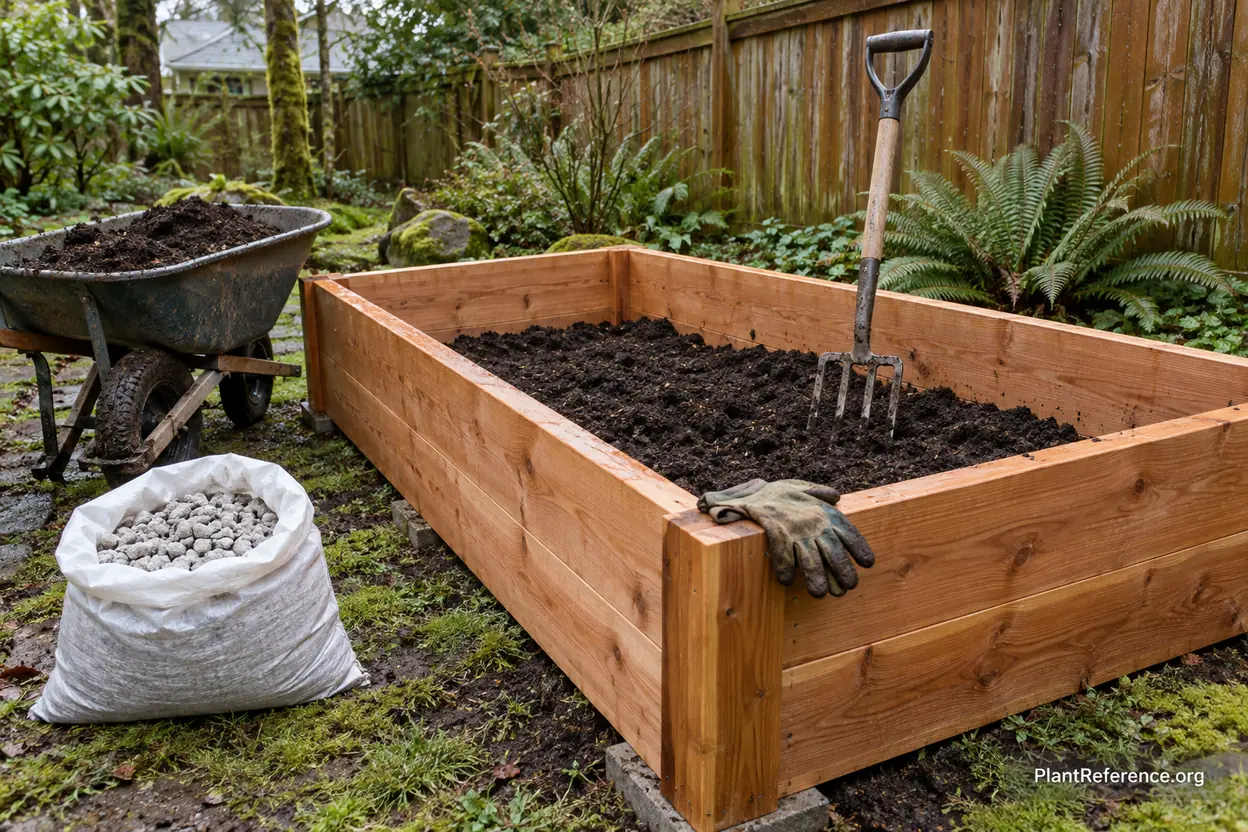
For flat ground sitting on hardpan, raised beds aren't a nice-to-have in the PNW—they're the default. Instead of fighting to drain a layer you can't realistically remove, you lift the entire root zone above it. This single decision solves more PNW drainage problems than anything else you can do.
Build beds at least 12 inches (30 cm) tall; 16-18 inches (40-45 cm) is better if your hardpan is shallow or you're growing deep-rooted crops. Use cedar or untreated Douglas fir for the frame. Yes, cedar costs more upfront, but in our wet climate you'll build the bed once instead of rebuilding it in three years when cheaper lumber rots out. Buy once, cry once. The Complete Guide to Raised Bed Gardening for Beginners (2025)
Before you fill the bed, break up the hardpan directly beneath it with a digging fork if you can reach it. You don't need to excavate the whole layer—just fracture it enough to give water a slow escape route and let roots probe deeper over time. Lay a sheet of cardboard or landscape fabric at the base only if you're battling perennial weeds; otherwise leave the soil contact open so worms and roots can connect the two zones.
Fill with a free-draining mix rather than straight topsoil. A blend of roughly 60% quality topsoil to 40% compost drains well and holds nutrients, and adding a few inches of pumice or coarse bark to the bottom third improves percolation further. Best Soil Mix for Raised Beds: Creating the Perfect Growing Medium Avoid the temptation to fill a tall bed with fine clay-heavy soil—you'll just relocate the bathtub. Raised Bed Soil Settling and Compaction: Prevention and Solutions
Solution 2: French Drains for Slopes and Standing Water
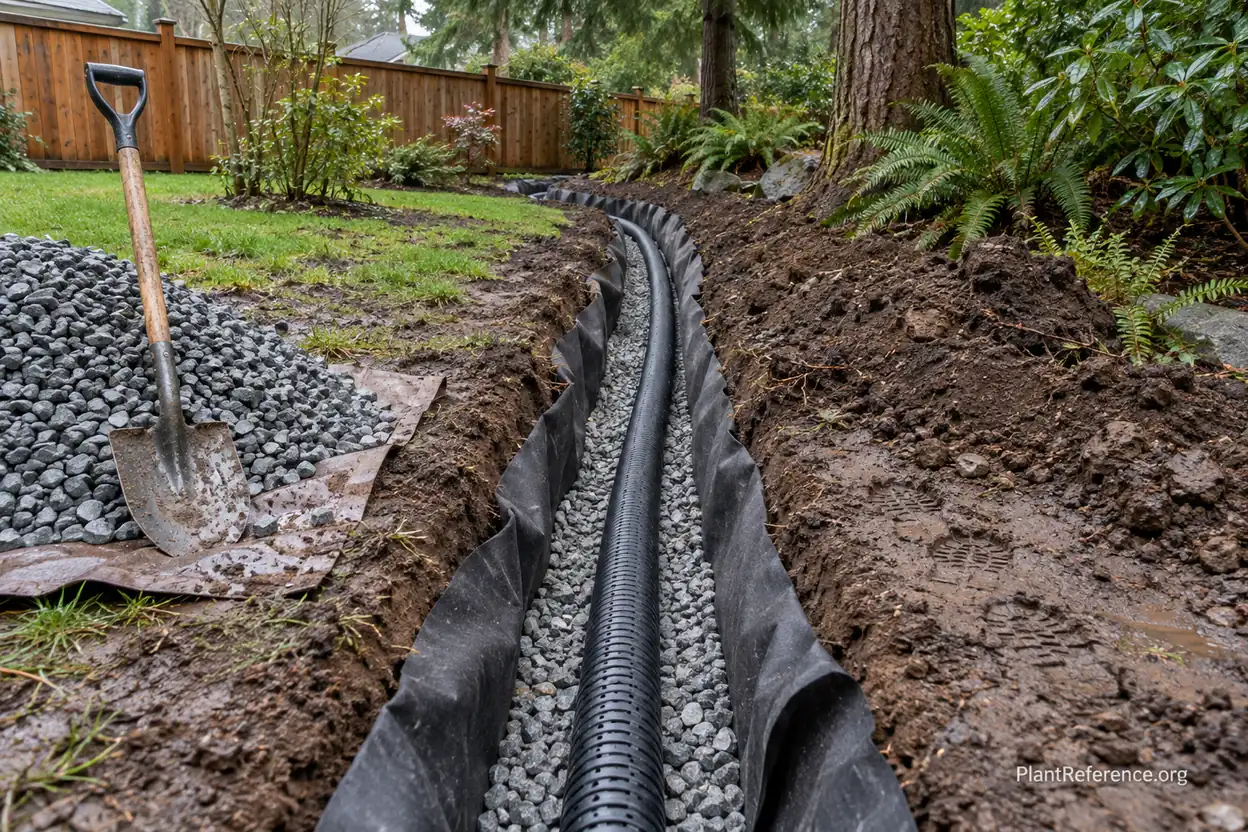
When water moves across your property—flowing toward the house, a patio, or your beds—a raised bed alone won't redirect it. That's a job for a French drain: a gravel-filled trench with a perforated pipe at the bottom that intercepts water and carries it somewhere safer.
Dig a trench 18-24 inches (45-60 cm) deep, sloping it at least 1 inch per 8 feet (1%) toward the discharge point—a dry well, a rain garden, or a daylight outlet downhill. Line the trench with permeable landscape fabric, add 2-3 inches (5-8 cm) of washed gravel, lay perforated drainpipe with the holes facing down, then backfill with more gravel and fold the fabric over the top. The fabric keeps soil from clogging the gravel while still letting water in.
Position the drain uphill of whatever you're protecting so it catches water before it arrives. On a sloped Seattle-area lot, a single well-placed French drain across the top of a garden terrace can take a chronically swampy bed and make it plantable. Just be sure the discharge point genuinely drains—piping water from one hardpan pocket into another accomplishes nothing.
Solution 3: Rain Gardens for Roof and Driveway Runoff
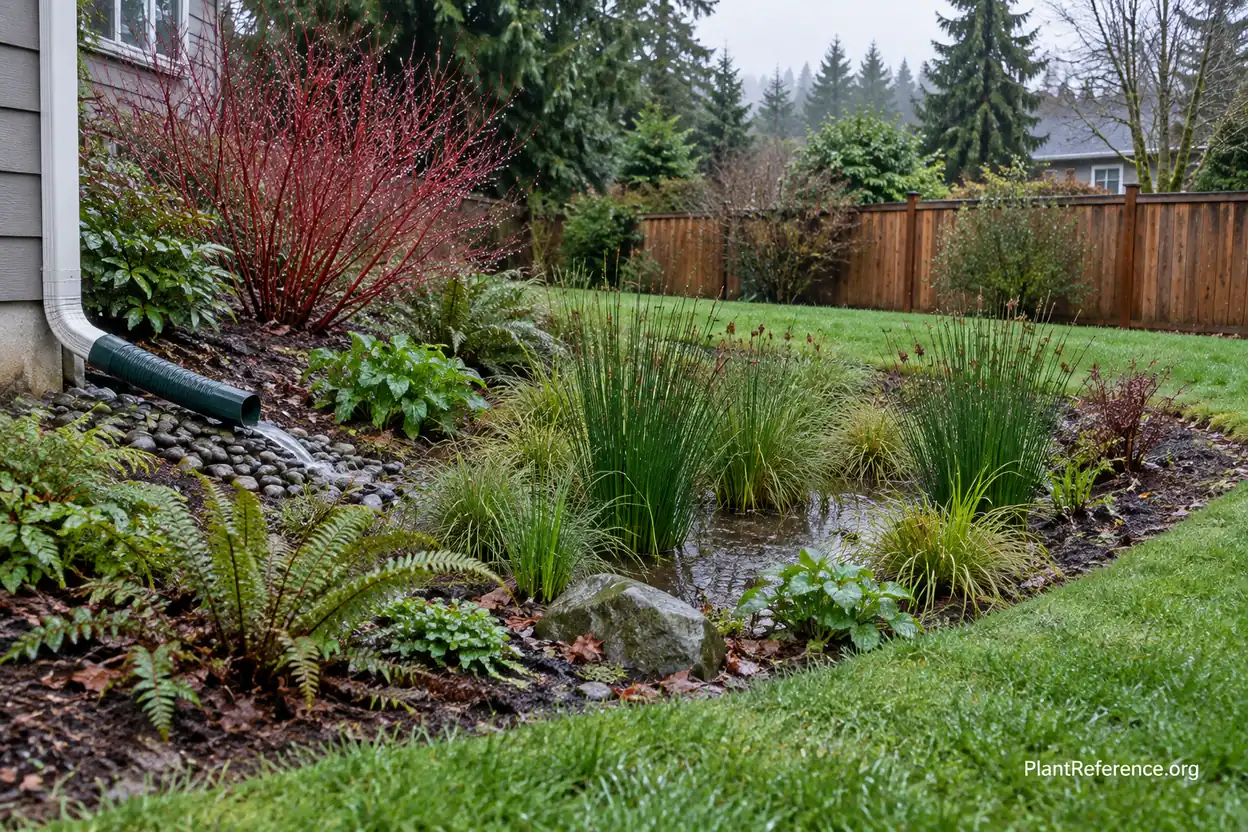
If the water flooding your garden is coming off your roof or driveway, the smartest move is to give it a destination it actually wants. A rain garden is a shallow, planted basin engineered to capture runoff from hard surfaces, let it soak in slowly, and recharge groundwater instead of overwhelming your beds or the storm drain.
Build the basin where runoff naturally collects, but at least 10 feet (3 m) from your foundation. Excavate 6-12 inches (15-30 cm) deep and backfill with a fast-filtering mix—about 50% native soil, 30% compost, and 20% pumice. Then plant it in moisture zones, because the bottom stays wet far longer than the rim.
Rain Garden Zone | Conditions | Suitable PNW Plants |
|---|---|---|
Wet zone (basin floor) | Saturated much of the year | Carex (KAIR-eks) sedges, Juncus (JUNG-kus) rushes |
Moist zone (lower slope) | Frequent winter flooding | 🌿Cornus sericea (KOR-nus ser-IH-see-uh) red-osier dogwood |
Mesic zone (upper slope) | Winter wet, summer dry | 🌿Iris tenax (EYE-ris TEN-aks) Oregon iris |
Dry zone (berm) | Excellent drainage | Drought-tolerant native grasses and shrubs |
Native plants shine here because they evolved with exactly this feast-or-famine moisture pattern. Carex and Juncus thrive in the saturated center, 🌿Cornus sericea handles the flood-prone middle, and 🌿Iris tenax bridges the seasonally dry upper edge. A well-built rain garden empties within 24-48 hours after a storm, so it never becomes a mosquito pond. Pacific Northwest Gardening Guide: Climate, Soil & Plant Selection
Watering Smart in Well-Drained Soil
Once you've fixed drainage, your watering habits need to change with it. Raised beds and amended ground drain fast in summer—which is the whole point in winter, but a real consideration during our July-through-September dry gap. The answer is deep, infrequent watering rather than frequent shallow sprinkles. Soaking the soil thoroughly and then letting the top inch dry pushes roots downward into cooler, moister layers and builds drought-resilient plants.
Drip irrigation or soaker hoses deliver water straight to the root zone at around 90% efficiency, with almost no loss to evaporation or wind. 5 Best Drip Irrigation Kits for Raised Beds (Tested for Easy Installation) Top it off with a 2-3 inch (5-8 cm) layer of organic mulch—wood chips, straw, or shredded leaves—which can cut summer watering needs by up to half while keeping the soil structure you worked so hard to build. Raised Bed Irrigation Systems: Watering Solutions for Consistent Growth
Fix the drainage once, water with intention, and your PNW garden stops swinging between winter swamp and summer concrete. That's a garden that works with our climate instead of against it. Too Much Water in Raised Beds: Signs and Solutions for Overwatering
Frequently Asked Questions

Reading about plants and recognising them are different skills. These three build the second.
- Daily PlantIdentify the day’s mystery plant from a close-up photograph.
- Keyed OutWork a dichotomous key, lead by lead, to name a hidden specimen.
- Name That PlantName a specimen from botanical clues dealt hardest first.
Free to play, no account needed
Tagged with
Mike's been designing residential landscapes in the Seattle area, with a particular focus on Pacific Northwest natives and sustainable practices. He's a Washington State Master Gardener and worked in construction before landscaping, which gives him a practical edge when it comes to building raised beds and hardscaping projects. He runs a small side business propagating and selling unusual perennials at farmers markets on weekends. His property serves as a testing ground for low-maintenance, wildlife-friendly garden designs. Mike's philosophy: if it requires weekly maintenance, it's not sustainable.