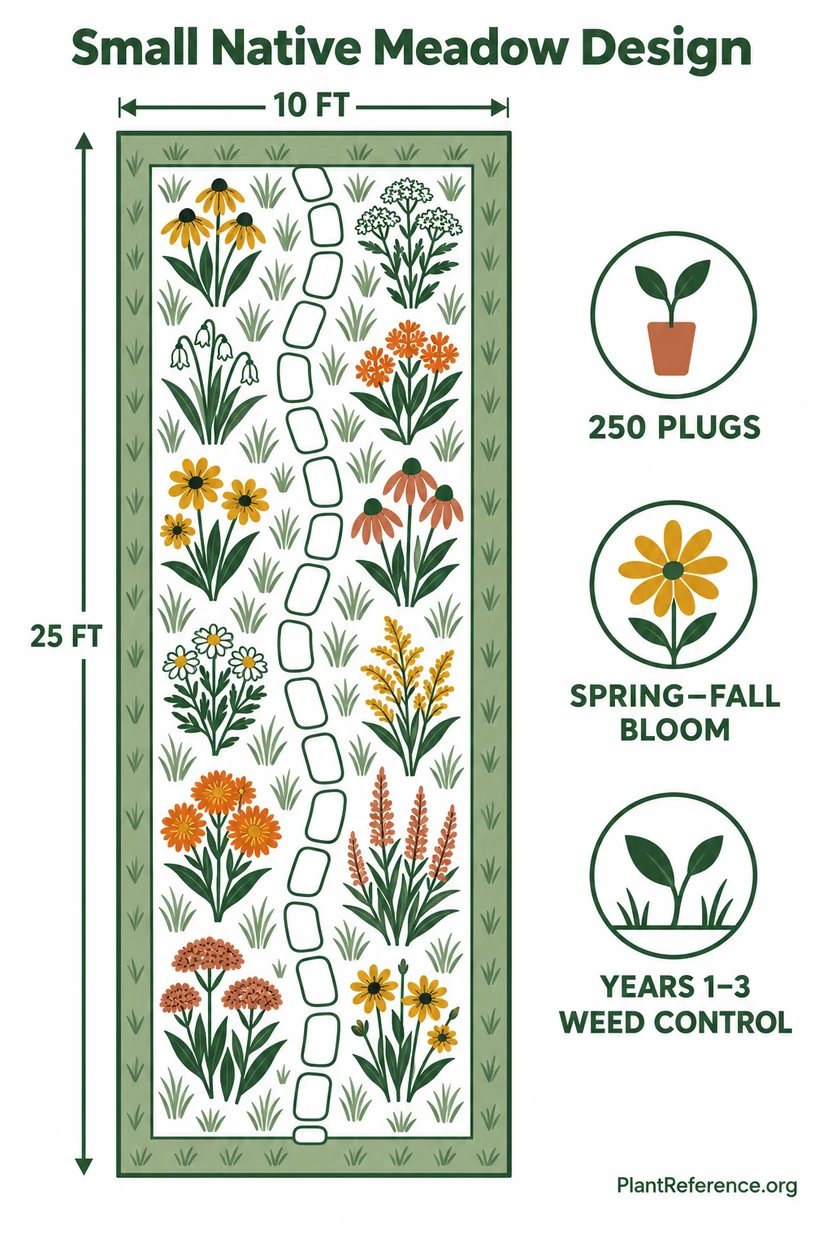
Small Native Meadow Design: 250-Square-Foot Plan
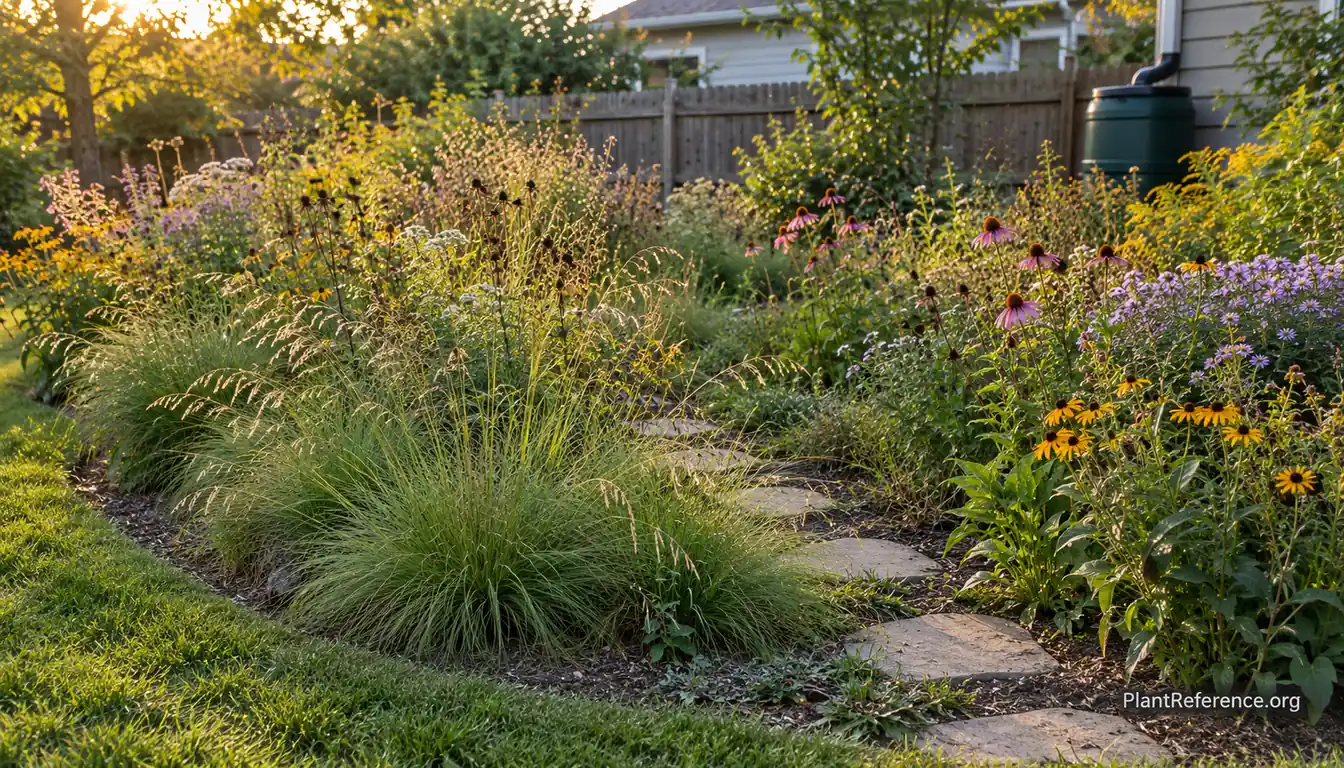
— Image © PlantReference.org 2026
Pets & Toxicity
Recorded toxicity for plants linked in this guide. An unknown status is not a safety assessment.
Toxic to pets: wild columbine, butterfly weedDetailsHide
Aquilegia canadensis — Toxicity Warning
Toxic to pets and humansView Aquilegia canadensis plant profileAsclepias tuberosa — Toxicity Warning
Toxic to pets and humans (cardiac glycosides — cardenolides — at moderate concentration; less toxic than other milkweed species but still toxic if ingested in quantity)View Asclepias tuberosa plant profileA small native meadow design can replace 250 square feet (23 m²) of lawn without turning a residential yard into an unplanned thicket. The reliable approach is straightforward: remove existing vegetation completely, repeat two short bunchgrasses as the structural matrix, place 12 native flowering species in visible groups, and expect three years of deliberate weed control.
For an area this size, plugs buy speed and control. At roughly one plant per square foot, the project uses about 250 young plants and reaches a recognizable meadow in 1-2 years. Broadcast seed costs far less, but 2-4 years of establishment and harder weed identification are real tradeoffs. Neither method is maintenance-free; the difference is when you spend the money and how quickly you can read the planting.
Decide Whether a Pocket Prairie Fits the Site
Choose an open area with at least 6 hours of direct sun and no chronic standing water. A pocket prairie can handle ordinary seasonal dryness after establishment, but it will not repair a compacted drainage problem or thrive beneath dense tree roots. Watch the site through rain and a dry spell before ordering plants.
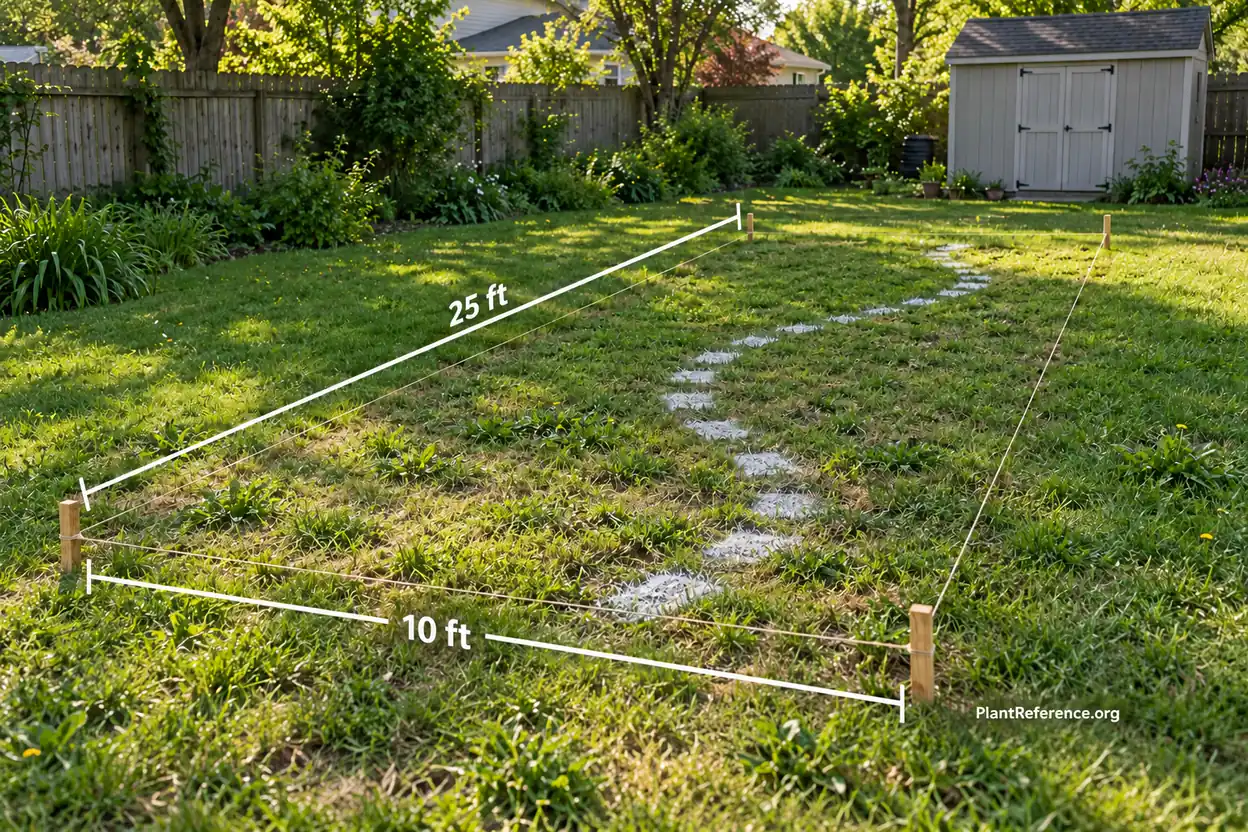
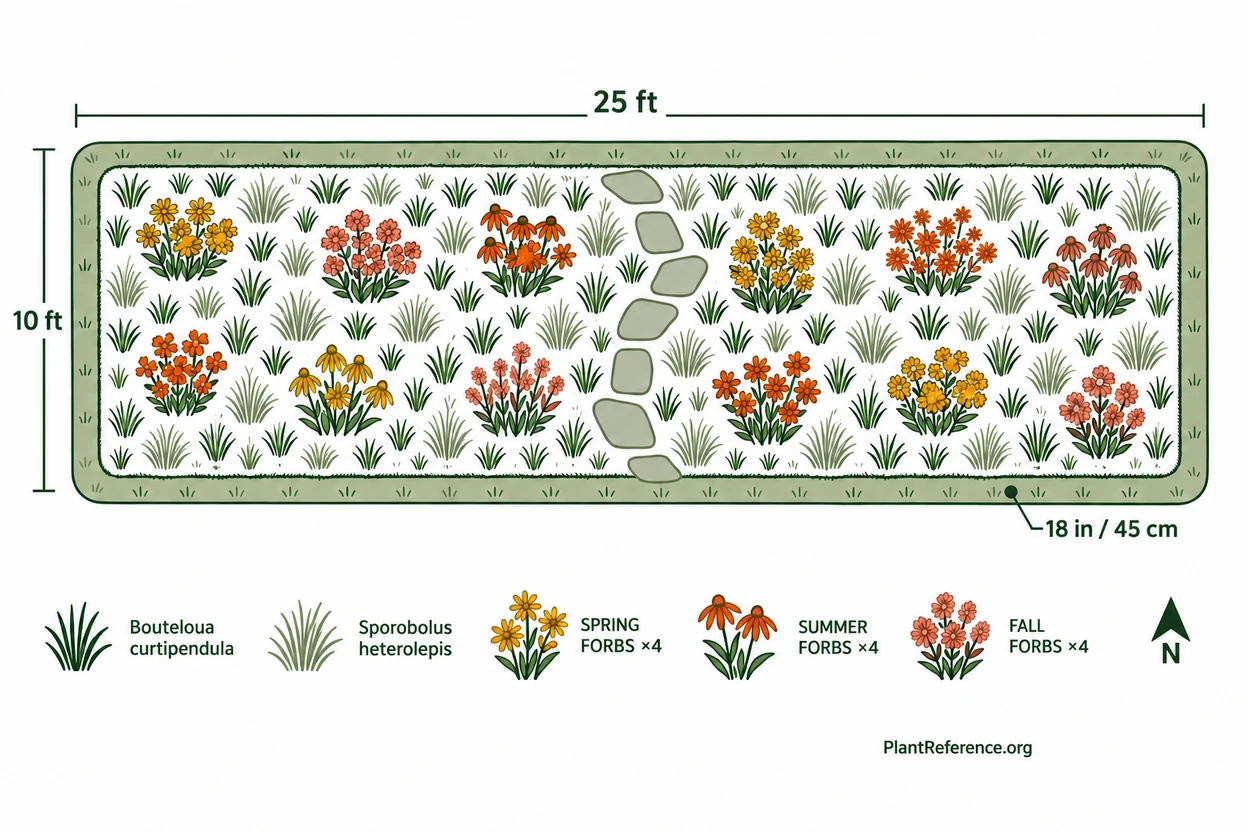
Measure a simple footprint. Ten by 25 feet (3 by 7.6 m) equals 250 square feet (23 m²), but a wider curved bed can use the same area. Keep the shape broad enough for repeated drifts rather than a narrow ribbon. Mark access from the beginning: a stepping path or edge should let you reach the center without trampling crowns.
A small meadow also needs a visual frame. A 12- to 18-inch (30- to 45-cm) mown strip, stone edge, or simple path tells neighbors that the planting is intentional. The conversion ideas in Lawn Alternatives That Actually Work: 5 Options Beyond Grass can help place a pocket prairie within a larger lawn strategy.
Before disturbing soil, identify perennial weeds. Quackgrass, bindweed, Canada thistle, reed canary grass, and other persistent plants can push through a new meadow. If aggressive perennials dominate, plan a full growing season of site preparation rather than digging them into smaller pieces. The patience feels slow, but it is quicker than fighting mature invaders among 250 new plugs.
Confirm 6 or more hours of direct sun during the growing season.
Reject sites with prolonged standing water, deep shade, or active construction compaction.
Map a path or stepping route that reaches the center of the planting.
Identify perennial weeds before choosing a removal method.
Check that the chosen species are native to your region and suited to the soil.
Compare Plugs and Seed for 250 Square Feet
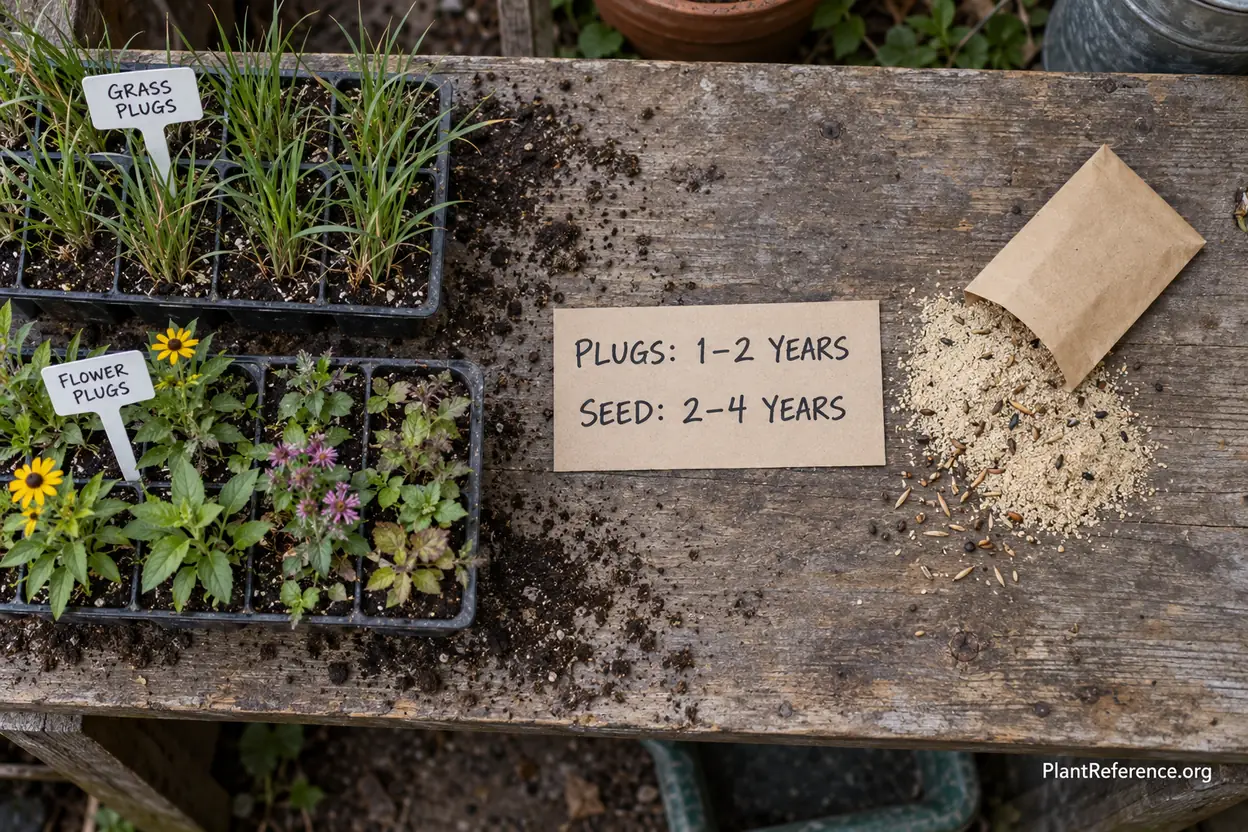
The research comparison is unusually clear at this scale. A seeded 250-square-foot meadow can use about $16 in seed but may need 2-4 years to look abundant. Plug planting can cost about $750 and demands more labor on installation day, yet the roots are already established, the layout is predictable, and coverage can develop in 1-2 years.
Installation method | Approximate plant cost for 250 sq ft | Establishment time | Layout control | Early weed challenge |
|---|---|---|---|---|
Broadcast seed | About $16 | 2-4 years | Low; seedlings emerge randomly | High; native seedlings are difficult to distinguish |
Plugs at roughly 1 per sq ft | About $750 | 1-2 years | High; each species has a planned position | Moderate; established starts are easier to identify |
Those figures describe material cost, not the entire project. Site preparation, delivery, irrigation, edging, and hired labor can change the total. Seed also is not automatically cheaper if repeated preparation or reseeding is required. Plugs are the better fit when the goal is a controlled residential design and the budget can carry the up-front expense.
For a do-it-yourself compromise, buy plugs for the grasses and slow or distinctive forbs, then use a small amount of seed for short-lived fillers. That mixed method still requires seedling identification. Beginners who want a clear plan should stay with plugs for the first 250 square feet, learn the plants, and use collected seed or divisions to expand later. Best Tools for Dividing Perennials: Forks, Knives, Spades is useful once mature clumps are large enough to share.
Use a Short-Grass Matrix With 12 Flowering Species
The grasses are the bones. Side-oats grama 🌿Bouteloua curtipendula (boo-teh-LOO-a kur-ti-PEN-dyoo-la) and prairie dropseed 🌿Sporobolus heterolepis (spor-OB-o-lus het-er-o-LEP-is) form compact clumps instead of a tall wall. Repeat them across the whole bed so flowering plants rise through a coherent structure. Grass vs Sedge vs Rush: How to Tell Them Apart helps distinguish the matrix from grasslike weeds during maintenance.
The 12-forb layer should overlap from spring through fall. This sample palette suits many central and eastern prairie-style gardens, but it is not universal. Confirm local nativity, soil tolerance, and legal availability; then substitute a regional species with the same height and bloom role when needed.
Layer | Native species | Main bloom period | Placement in a small meadow |
|---|---|---|---|
Grass matrix | Summer seed heads | Repeat in loose ribbons throughout | |
Grass matrix | Late summer seed heads | Repeat as fine-textured anchors | |
Forb 1 | Spring | Small groups near a lightly shaded edge | |
Forb 2 | Late spring | Broad low groups near the front | |
Forb 3 | Late spring to early summer | Repeated vertical accents | |
Forb 4 | Early summer | Sunny front and middle drifts | |
Forb 5 | Early to midsummer | Dry sunny clusters with open crowns | |
Forb 6 | Midsummer | Middle drifts with good air movement | |
Forb 7 | Midsummer | Repeated central anchors | |
Forb 8 | Mid- to late summer | Taller loose groups toward the back | |
Forb 9 | Late summer | Narrow vertical repeats | |
Forb 10 | Summer into early fall | Short-lived color in open gaps | |
Forb 11 | Solidago speciosa | Late summer to fall | Controlled clumps, not the whole bed |
Forb 12 | Fall | Small back or center groups |
Do not divide the 250 plants evenly among 14 species. A meadow reads better when the two grasses occupy a large repeating share and the flowers appear in irregular groups of three, five, or seven. Use more plugs of dependable, restrained matrix plants and fewer of tall or strongly spreading forbs. Keep the shortest species at visible edges and the tallest away from paths.
For color sequence, pair spring columbine 🌿Aquilegia canadensis and golden Alexanders 🌿Zizia aurea with early summer foxglove beardtongue 🌿Penstemon digitalis and lanceleaf coreopsis 🌿Coreopsis lanceolata. Summer then passes to butterfly weed 🌿Asclepias tuberosa, wild bergamot 🌿Monarda fistulosa, purple coneflower 🌿Echinacea purpurea, yellow coneflower 🌿Ratibida pinnata, and rough blazing star 🌿Liatris aspera. Black-eyed Susan 🌿Rudbeckia hirta, showy goldenrod Solidago speciosa, and New England aster 🌿Symphyotrichum novae-angliae close late gaps.
The pollinator value comes from both continuity and structure. Best Perennials for Pollinators: Bees & Butterflies explains accessible flower forms, while Plan a Perennial Garden That Blooms Spring to Fall offers another way to audit the calendar.
Prepare and Plant the Meadow
Do not rototill living turf and expect it to disappear. Tilling chops rhizomes, brings buried weed seed to the surface, and leaves a loose seedbed that invites erosion. For a small site, repeated sod removal, careful digging, solarization where appropriate, or a full-season smother can work. Choose the method for the weeds present, then wait long enough to confirm regrowth is controlled.
Avoid enriching the whole site with rich compost. Many prairie plants hold themselves upright in lean to moderate soil and become floppy with excess fertility. Correct only a documented problem. If drainage is poor, solve the physical issue or choose a different plant community rather than building a rich raised island.
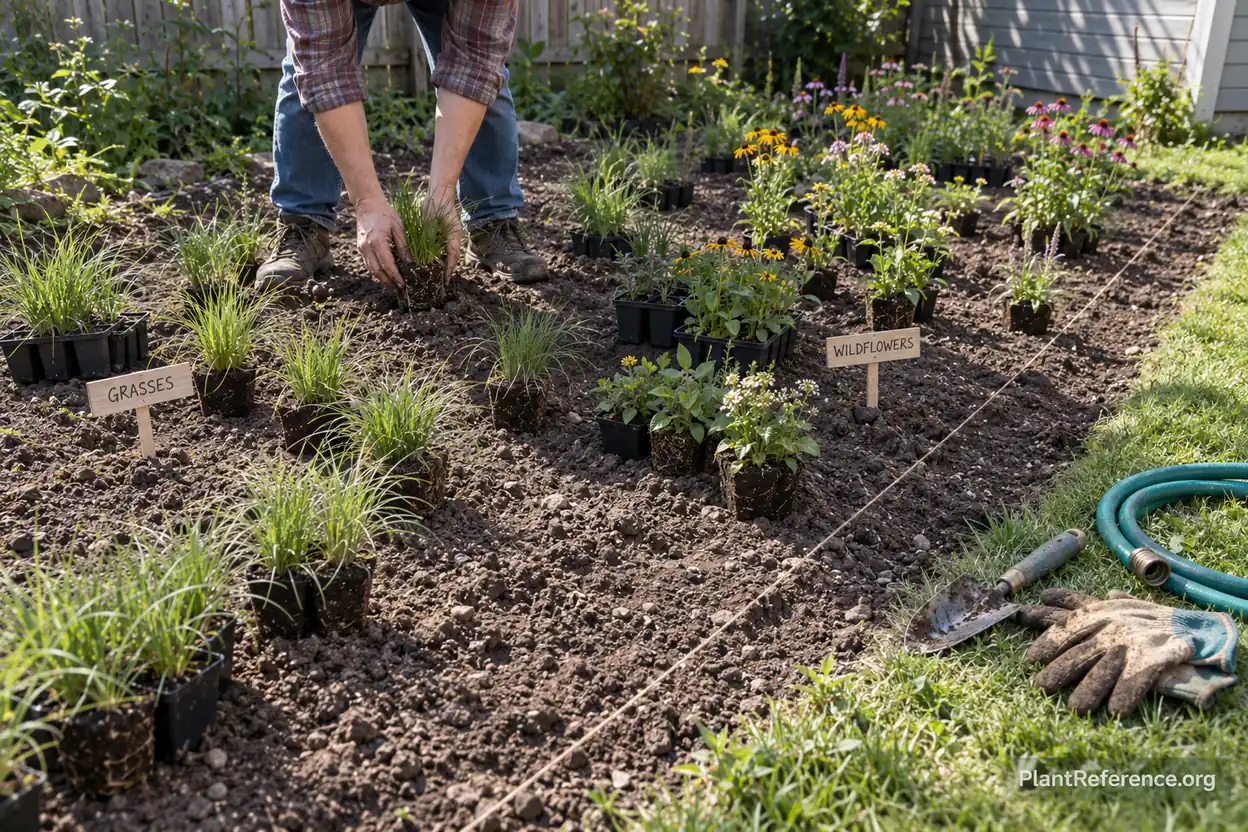
Set out every pot before digging. Place grass plugs first in loose repeating ribbons, then add forb groups by bloom season and height. Stand at the main viewing point and adjust obvious rows. The goal is organized repetition, not a checkerboard. Perennial Combinations That Look Good Together gives useful guidance on repeating form without making a planting rigid.
Remove turf and perennial weeds without mixing live roots through the site.
Wait for regrowth, then remove surviving weeds before planting.
Mark the path, mown edge, and broad matrix-grass ribbons.
Place all plugs on the soil surface and adjust groups from key viewpoints.
Plant crowns level with surrounding soil at roughly 12-inch (30-cm) centers.
Water each plug deeply and label small groups for first-year identification.
Add a thin mulch layer only if needed for erosion and annual-weed suppression.
At one plug per square foot, spacing is about 12 inches (30 cm) on center. Stagger plants rather than making straight ranks. Water immediately, then keep root balls evenly moist during the first growing season without keeping the soil saturated. When to Plant Perennials: Season-by-Season Timing helps choose weather that reduces transplant stress.
Use no more than 1 to 2 inches (2.5 to 5 cm) of fine shredded mulch between plugs if weed pressure is high. Keep crowns clear. Meadow plants should eventually cover soil with foliage and litter, so stop replenishing mulch once the matrix begins closing.
Manage Weeds in Years One Through Three
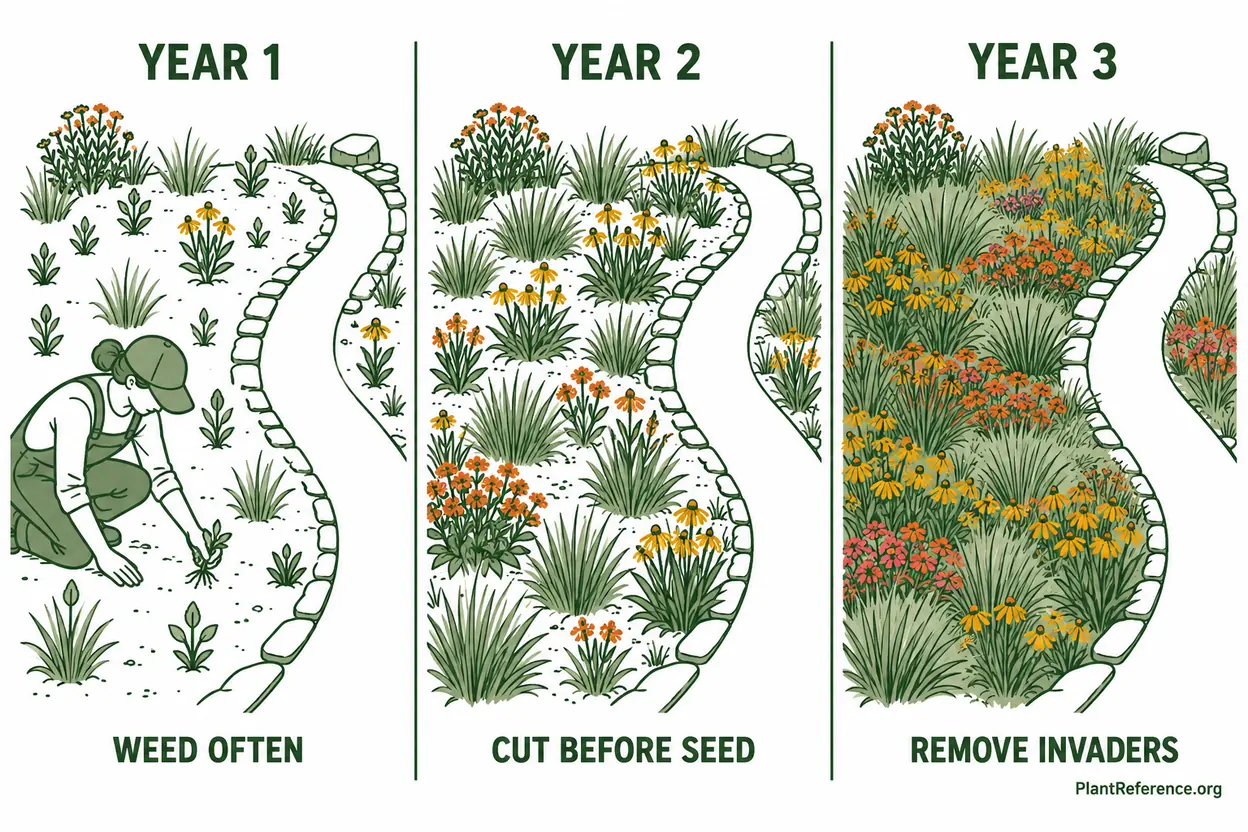
Year one is about identification and root establishment. Walk the path weekly, pull annual weeds before they seed, and dig perennial invaders with as much root as possible. Do not yank an unfamiliar seedling until you check the labels and planting plan. Plugs make this easier because every intended plant began in a known position.
Keep the bed around 6 to 8 inches (15 to 20 cm) tall by selective trimming only if fast annual weeds shade the plugs. Do not repeatedly scalp young native plants. Remove weeds by hand around crowns, water during dry spells, and replace failures after you understand whether moisture, light, or competition caused the loss.
Year two is the sorting year. Grasses and longer-lived forbs expand, while short-lived plants may flower heavily. Continue pulling perennial weeds and cut unwanted seed heads before they mature. Move or thin only plants that clearly violate the plan; the meadow still needs time to knit.
Year three should show a stable matrix, but it is not the end of maintenance. Mark shrinking species, divide an overly dominant clump, and add plugs where bare ground keeps inviting weeds. Use How to Divide Perennials: A Species-by-Species Guide for clean divisions and When to Cut Back Perennials in Fall (And What to Leave) before removing stems that support winter habitat.
Year | Primary goal | Weed work | Expected appearance |
|---|---|---|---|
Year 1 | Root establishment | Weekly identification, hand pulling, no weed seed | Open soil with visible individual plugs |
Year 2 | Canopy expansion | Remove perennial invaders and prevent seed | Stronger clumps with some gaps and uneven bloom |
Year 3 | Matrix balance | Thin dominants, fill persistent gaps, spot weed | Connected grasses and repeating seasonal drifts |
Keep the Meadow Intentional and Resilient
Leave most stems and seed heads through winter. They hold snow, shelter insects, and keep the bed legible when flowers are gone. In early spring, cut the previous year's growth to 8 to 12 inches (20 to 30 cm), carrying away only material that would smother crowns. A clean mown edge can remain crisp while the interior stays ecologically useful.
Watch for one species taking over. Some movement is normal; a meadow should not preserve every plug in its original spot forever. Intervene when a dominant plant erases entire seasonal layers or blocks the path. Add locally native replacements to persistent gaps rather than feeding the whole bed.
Deer and rabbits can reshape a young project quickly. Compare vulnerable choices with Deer-Resistant Perennials: A Zone-by-Zone Planting Guide, then protect small groups during establishment if browsing is heavy. Do not assume any species is completely resistant.
Keep the original diagram and update it each year. Note which species persist, bloom, seed, or disappear. That record turns maintenance into a series of small decisions instead of one large renovation. A pocket prairie is not a lawn you stop mowing; it is a planted community you guide toward balance.
Frequently Asked Questions
Reading about plants and recognising them are different skills. These three build the second.
- Daily PlantIdentify the day’s mystery plant from a close-up photograph.
- Keyed OutWork a dichotomous key, lead by lead, to name a hidden specimen.
- Name That PlantName a specimen from botanical clues dealt hardest first.
Free to play, no account needed
Tagged with
Pat has been gardening in Milwaukee for over thirty years, through every kind of Wisconsin weather. She worked as a school librarian and started gardening seriously when her kids were small—she wanted them to know where food came from. Now retired, she's a certified Master Gardener and runs the plant sale at her local garden club every spring. She specializes in cold-hardy perennials, native wildflower meadows, and the art of getting a vegetable garden producing in Wisconsin's short but intense growing season. Pat is practical and patient—she's seen enough Wisconsin winters to know that gardening here is a long game, and she writes with the steady confidence of someone who's been doing this a long time.