Bouteloua, Genus, curtipendula, Species,
- Genus & species
sideoats grama
North America — from southern Canada south through the Great Plains, Great Basin, and into Mexico; the state grass of Texas
Overview
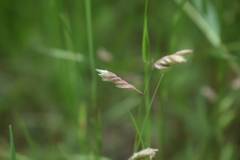
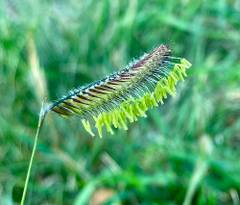
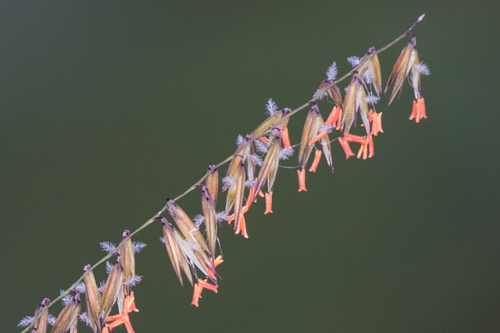
Bouteloua curtipendula is sideoats grama (sideoats grama grass), a warm-season clumping perennial grass growing 18-36 inches (45-90 cm) tall and 12-18 inches (30-45 cm) wide. Blue-green narrow blades 0.1-0.2 inch (2-4 mm) wide and 6-10 inches (15-25 cm) long. Oat-like spikelets arranged in a row along one side of the flowering stem — the 'sideoats' arrangement is the species' defining trait. The spikelets are purplish when fresh, drying to straw-tan. In the grass family (Poaceae). Native to the Great Plains — the state grass of Texas. Warm-season: grows actively at 70-90°F (21-32°C). Goes dormant (turns tan/straw) from October through April — the dormant brown appearance for 6-7 months is the primary limitation for year-round plantings. Tolerates a wide range of soils: clay, rocky, alkaline, poor, and sandy soils with pH 5.5-8.0. Does not tolerate wet or waterlogged sites. Butterfly larval host for several skipper species (Hesperia spp.). Deer-resistant. Drought-tolerant once established. Non-toxic. Zones 3-9. Full sun. Growth rate is moderate. Native to North America.
Native Range
Native to North America — from southern Canada south through the Great Plains, Great Basin, and into Mexico. The state grass of Texas.Suggested Uses
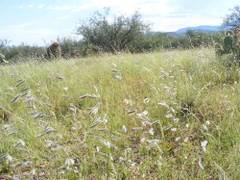
Grown in prairie restorations, native plant gardens, meadows, and dry slopes. Native to the Great Plains. Tolerates poor dry alkaline rocky soils. Butterfly larval host. Deer-resistant. Drought-tolerant. Non-toxic. Zones 3-9.How to Identify
Appearance
Size & Dimensions
Height1'6" - 3'
Width/Spread1' - 1'6"
Colors
Bloom Information
Mid to late summer (July-September). Oat-like spikelets in a one-sided row along the stem. Purplish when fresh, drying to straw-tan. Wind-pollinated. 6 weeks of bloom. Dried seed heads persist through winter.
Detailed Descriptions
Flower Description
Oat-like spikelets arranged in a row along one side of the stem (the 'sideoats' arrangement), purplish at first, drying to straw-tanFoliage Description
Blue-green, narrow blades 0.1-0.2 inch (2-4 mm) wide, 6-10 inches (15-25 cm) long; turns tan to straw in fall dormancyGrowing Conditions
Sun Requirements
Requires 6-12 hours of direct sunlight daily
• Full Sun: 6+ hours of direct sunlight
• Partial Shade: 3-6 hours of direct sunlight
• Full Shade: Less than 3 hours of direct sunlight
Care & Maintenance
Care Guide
Full sun (6+ hours). Well-drained soil pH 5.5-8.0 — tolerates clay, rocky, alkaline, and poor soils. Does not tolerate wet or waterlogged sites. Drought-tolerant once established. Cut back to 3-4 inches (7-10 cm) in late winter. Leave dried stems through winter. Deer-resistant. Non-toxic. Zones 3-9.Pruning
Cut back all foliage and stems to 3-4 inches (7-10 cm) in late winter to early spring (February-March) before new growth emerges. Leave dried stems and seed heads through fall and winter for texture and wildlife habitat. Do not cut or mow in mid-season.Pruning Schedule
Prune: February–March
early spring