Image 1 of 6
1 / 6
Plant Reference
Magnolia, Genus, grandiflora, Species,
- Genus & species
southern magnolia
Southeastern United States — Virginia south to central Florida and west along the Gulf Coast to east Texas; bottomland forests, coastal plains, and river terraces on rich moist acidic soils
Overview
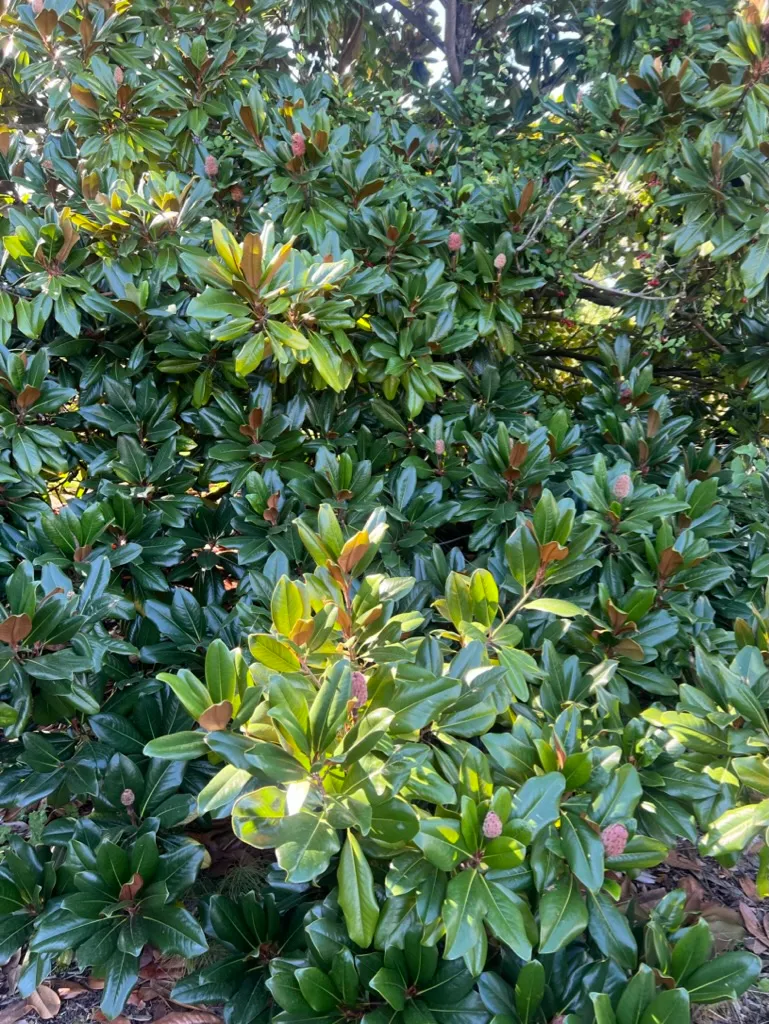
Magnolia grandiflora is a large upright pyramidal broadleaf evergreen tree in the family Magnoliaceae growing 40–80 feet (12–24 m) tall and 30–50 feet (9–15 m) wide from a single trunk that develops smooth gray bark with age and that supports a dense pyramidal canopy reaching to the ground on open-grown specimens. The specific epithet grandiflora is from the Latin grandis meaning large and flora meaning flower, referring to the large 8–12 inch (20–30 cm) cup-shaped flowers that are the signature ornamental feature of the species and that carry a strongly sweet lemony fragrance ranking the species in the highly-scented tier of cultivated flowering trees. The species is the state flower of Mississippi and Louisiana, an honor that reflects the species' deep cultural standing in the Deep South where the white flowers of southern magnolia in the May through July bloom window are a regional landmark of the southeastern North American summer. Leaves are glossy dark green on the upper surface with a thick leathery texture, and the underside carries a rusty-brown to cinnamon-colored tomentum (a felt-like covering of small reddish hairs) — the two-toned upper-and-lower leaf surfaces flash visibly when wind lifts the foliage and are a reliable field character of the species. Leaves are elliptic and 5–10 inches (13–25 cm) long, and the species drops older leaves throughout the year so that the leathery leaf litter accumulates as a year-round mulch under the canopy and as a year-round maintenance task in formal residential plantings. Creamy-white cup-shaped to saucer-shaped flowers 8–12 inches (20–30 cm) across with 6–12 thick waxy tepals arranged in two or three whorls open from May through July across a 6-week bloom period, and the flowers carry the strongly sweet lemony fragrance that is the species' defining olfactory character. The flowers are beetle-pollinated rather than bee-pollinated, and the beetle-pollination biology reflects the antiquity of the family Magnoliaceae which arose in the Cretaceous Period approximately 95 million years ago before the radiation of bees as flower pollinators — the thick waxy tepals of Magnolia flowers evolved as protection against the chewing damage of the beetle pollinators that worked the flowers in the Cretaceous magnolia ancestors. Cone-like aggregate fruit 3–5 inches (7–13 cm) long develops in fall and splits open to reveal bright red seeds attached by silky white threads, and the seeds are dispersed by birds. Limitation: the massive mature size at 40–80 feet (12–24 m) tall and 30–50 feet (9–15 m) wide is the primary spatial limitation of the species and excludes the species from typical residential lots — full-size M. grandiflora calls for a minimum site of approximately 40 by 40 feet (12 by 12 m) of clear ground for the canopy spread. Compact cultivars supply the same flowers and foliage on a smaller frame and are the practical solution for small-site planting: 'Little Gem' reaches 20–25 feet (6–7.5 m), 'Teddy Bear' reaches 15–20 feet (4.5–6 m) with darker brown leaf undersides, and 'Bracken's Brown Beauty' reaches 30–35 feet (9–10.5 m) with extra cold hardiness for zone 6 plantings. Year-round leaf and flower-petal litter is a maintenance consideration in formal residential settings. Native to the southeastern United States. Drought-tolerant once established. Non-toxic. Deer-resistant.
Native Range
Native to the southeastern United States — Virginia south to central Florida and west along the Gulf Coast to east Texas — growing in bottomland forests, coastal plains, and river terraces on rich moist acidic soils. The species is the state flower of Mississippi and Louisiana and a regional landmark of the southeastern summer where the white flowers in the May through July bloom window are a defining visual feature of Deep South gardens, plantation landscapes, and historic urban plantings in cities such as Charleston, Savannah, and New Orleans.Suggested Uses
Used as a large evergreen specimen tree, shade tree, screen, allée tree along driveways and entrance avenues, and historic landscape feature on large properties, parks, plantation landscapes, and urban plazas with sufficient root space at 30–50 foot (9–15 m) spacing on full-size plantings in USDA zones 6 through 10. The very large fragrant white flowers in the May through July bloom window, the year-round two-toned glossy evergreen foliage, and the species' standing as the state flower of Mississippi and Louisiana combine for a high-value southern landscape tree on properties that can accommodate the 40–80 foot mature height. Compact cultivars ('Little Gem' at 20–25 feet, 'Teddy Bear' at 15–20 feet, 'Bracken's Brown Beauty' at 30–35 feet) supply the same flowers and foliage on a smaller frame and are the practical solution for small residential lots. Sites smaller than approximately 40 by 40 feet (12 by 12 m) are unsuitable for full-size plantings without choosing a compact cultivar instead. Year-round leaf and flower-petal litter is a maintenance consideration in formal residential settings.How to Identify
Appearance
Size & Dimensions
Height40' - 80'
Width/Spread30' - 50'
Bloom Information
Creamy-white cup-shaped to saucer-shaped flowers 8–12 inches (20–30 cm) across with 6–12 thick waxy tepals arranged in two or three whorls open from May through July across a 6-week bloom period, and the flowers carry a strongly sweet lemony fragrance that carries across a wide radius around the tree. The flowers are beetle-pollinated rather than bee-pollinated, and the beetle-pollination biology reflects the antiquity of the family Magnoliaceae which arose in the Cretaceous Period approximately 95 million years ago before the radiation of bees as flower pollinators — the thick waxy tepals evolved as protection against the chewing damage of beetle pollinators. Cone-like aggregate fruit 3–5 inches (7–13 cm) long develops in fall and splits open to reveal bright red seeds attached by silky white threads, and the seeds are dispersed by birds.
Detailed Descriptions
Flower Description
creamy-white cup-shaped to saucer-shaped flowers 8-12 inches (20-30 cm) across with 6-12 thick waxy tepals arranged in two or three whorls; strongly fragrant with a sweet lemony scent that carries across a wide radius around the tree; May through July bloom window; the flowers are beetle-pollinated rather than bee-pollinated, and the beetle-pollination biology reflects the antiquity of the family Magnoliaceae which arose in the Cretaceous Period approximately 95 million years ago before the radiation of bees as flower pollinatorsFoliage Description
glossy dark green on the upper surface with a thick leathery texture; rusty-brown to cinnamon-colored tomentum (a felt-like covering of small reddish hairs) on the underside; elliptic leaves 5-10 inches (13-25 cm) long; the two-toned green-above and rusty-brown-below leaf surfaces flash visibly when wind lifts the foliage and are a reliable field character of the species; evergreen — the species drops older leaves throughout the year, and the year-round leathery leaf litter is a maintenance consideration in residential plantingsGrowing Conditions
Sun Requirements
Requires 4-10 hours of direct sunlight daily
• Full Sun: 6+ hours of direct sunlight
• Partial Shade: 3-6 hours of direct sunlight
• Full Shade: Less than 3 hours of direct sunlight
Care & Maintenance
Care Guide
Site in full sun to partial shade with 4–10 hours of direct sun per day in well-drained loam, clay, or sand soil with a pH of 5.0–7.0. The species adapts to a range of soil conditions but performs strongest on rich moist acidic soils similar to the bottomland forest and river terrace soils of the southeastern North American native range. Drought tolerance develops once the root system is established, though the species performs more strongly with consistent moisture during the May through July bloom window. The massive mature size at 40–80 feet (12–24 m) tall and 30–50 feet (9–15 m) wide calls for a minimum site of approximately 40 by 40 feet (12 by 12 m) of clear ground for the canopy spread on full-size plantings — small residential sites should select compact cultivars such as 'Little Gem' (20–25 feet), 'Teddy Bear' (15–20 feet), or 'Bracken's Brown Beauty' (30–35 feet, extra cold hardiness for zone 6). Year-round leathery leaf litter and post-bloom flower-petal litter accumulate under the tree and call for periodic raking in formal residential settings; informal plantings can leave the litter as a self-mulch under the canopy. Non-toxic and deer-resistant. Hardy in USDA zones 6–10.Pruning
Pruning is done in late spring (May or June) after the first wave of bloom to remove dead, damaged, or crossing branches and to limb up the lower trunk for ground clearance under the canopy. The species tolerates pruning but heals slowly because the dense leathery wood is slow to compartmentalize cuts, so pruning cuts are kept to the smallest size practical for the work and large cuts are avoided unless dead-wood removal calls for them. The natural pyramidal canopy form requires minimal shaping on open-grown specimens in large sites, and the species reaches its strongest ornamental expression when allowed to grow to the ground on an unrestricted site rather than limbed up.Pruning Schedule
Prune: May–June
late spring