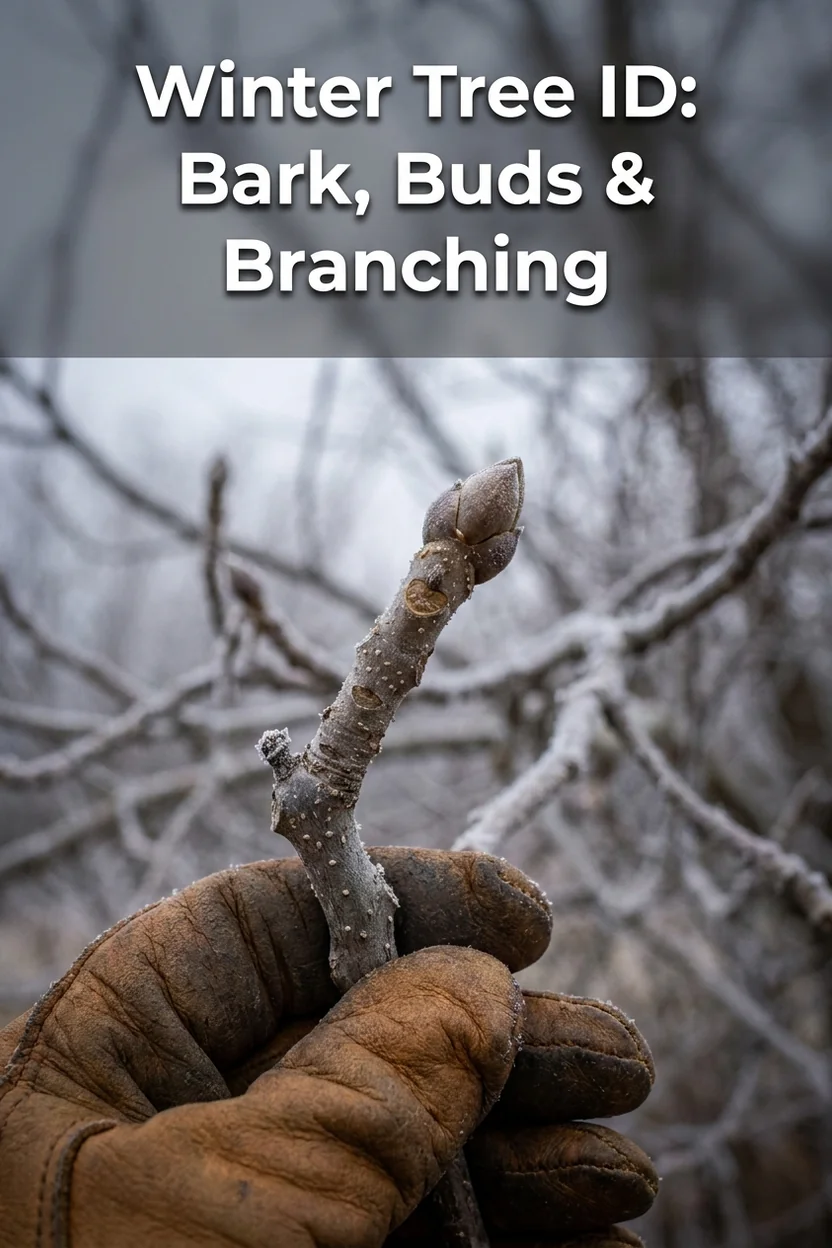
Winter Tree Identification: Bark, Buds & Branching
Pets & Toxicity
Recorded toxicity for plants linked in this guide. An unknown status is not a safety assessment.
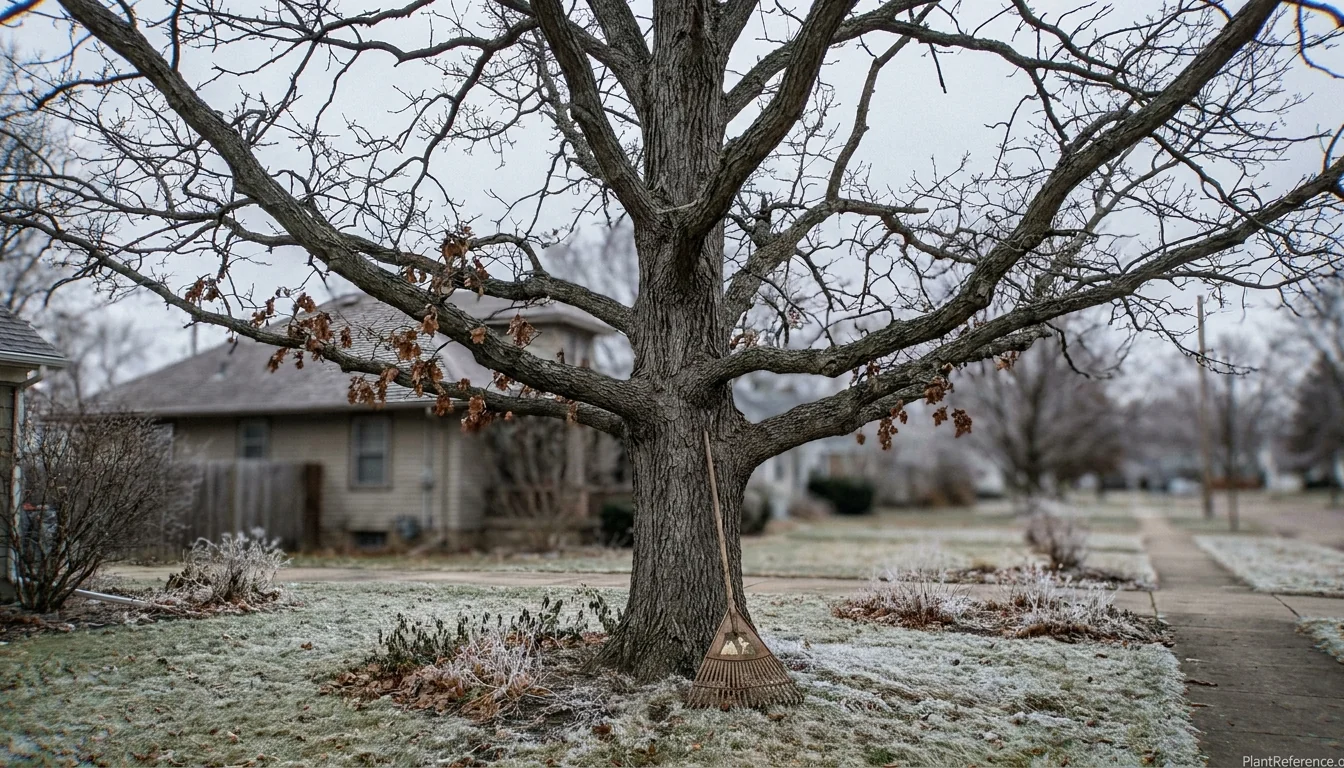
— Image © Plant Reference 2026
Most people assume tree identification stops when the leaves fall. It doesn't. Winter tree identification is a skill any homeowner can learn, and frankly, a bare tree often tells you more than a leafy one. With the canopy gone, you can finally see the architecture—how the branches divide, where the buds sit, and the full texture of the bark from root flare to crown. I teach identification walks through parks here in Nashville, and I run them in January on purpose. People are always surprised how fast it clicks.
Why Winter Is a Great Time to Learn Trees
Summer hides the structure of a tree. A full canopy of leaves is beautiful, but it buries the very features professional botanists rely on. Strip those leaves away and the tree shows its bones. The branching pattern is exposed. The buds—next year's growth, already formed and waiting—sit right at eye level on the lower twigs. The bark stands uninterrupted from the base to the upper limbs.
There's a practical reason arborists like me work comfortably in winter, too. Diagnosis is easier when we can see the whole frame. The same logic applies to identification. If you've read How to Identify Trees by Their Leaves: Shapes, Margins, and Venation Explained, you already know summer ID leans hard on leaf shape and venation. Winter swaps those clues for a different but equally reliable set.
Foresters summarize the winter approach with a simple phrase: the Three Bs—Branching, Buds, and Bark. Work through them in that order and you'll narrow almost any North American tree down to its genus, and often to its species. Add a fourth clue, persistent fruits and seeds, and the picture usually becomes conclusive.
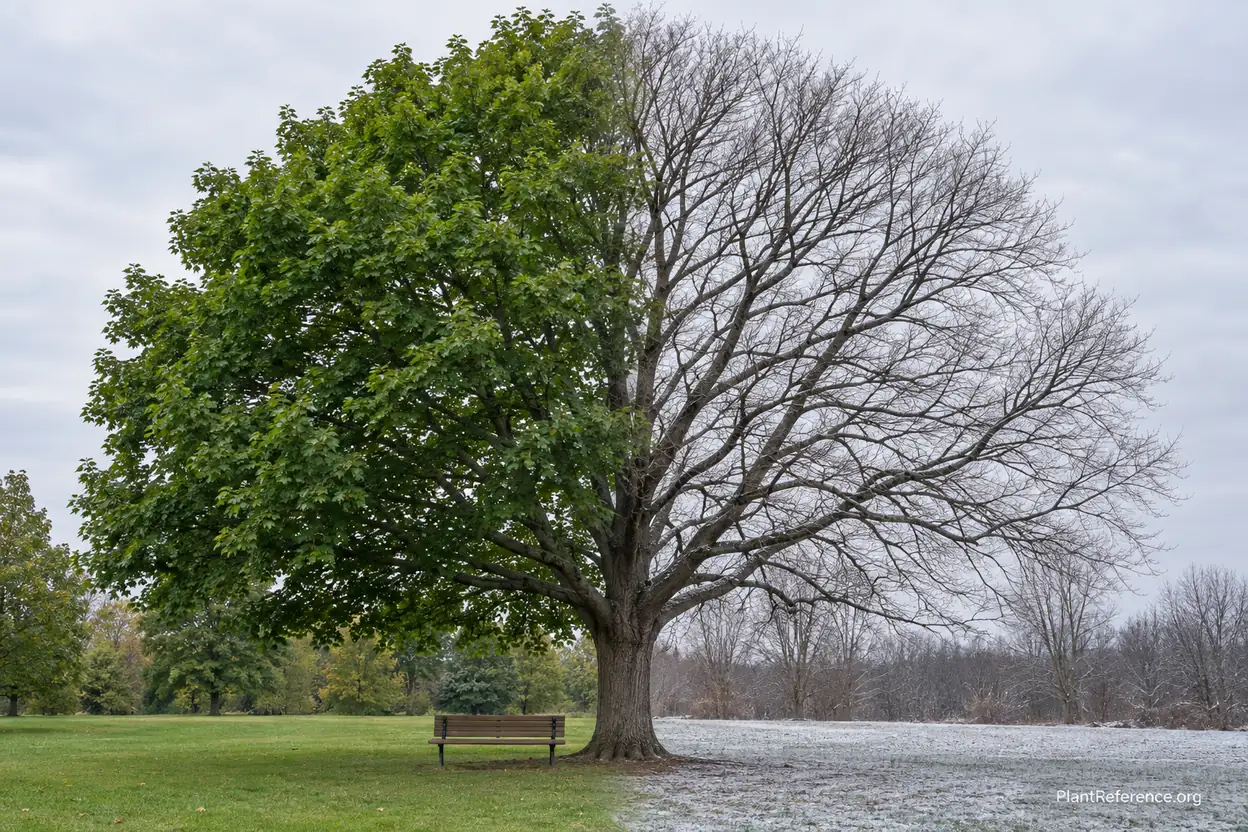
Start With Branching: Alternate vs Opposite
Before you look at anything else, look at how the twigs and branches attach to one another. This single observation eliminates more possibilities than any other winter clue, which is why I always start here.
Branches grow in one of two arrangements. In alternate branching, twigs emerge one at a time, staggered along the stem in a zigzag or spiral pattern. In opposite branching, twigs emerge in matched pairs directly across from each other at the same point on the stem. The overwhelming majority of North American trees branch alternately—oaks, hickories, birches, beeches, cherries, elms, sycamores, and most others. That's the key to why this works: only a short list of trees branches oppositely.
That short list has a mnemonic that every botany student learns: MADCapHorse.
MA — Maples (Acer (AY-ser))
D — Dogwoods (Cornus (KOR-nus))
Cap — Caprifoliaceae, the honeysuckle and viburnum family
Horse — Horsechestnuts and buckeyes (Aesculus (ESS-kew-lus))
And one more worth adding: Ashes (Fraxinus (FRAK-sin-us))
If a tree shows clean opposite branching, you're almost certainly looking at a maple, ash, dogwood, viburnum, or buckeye. That's a handful of options instead of hundreds. If the branching is alternate, you've ruled that whole group out and moved on. I cover this trick in more depth in Alternate vs Opposite Leaf Arrangement: The MADCapHorse Mnemonic Explained, because it works the same way whether you're reading leaves or bare twigs.
One caution: check the smallest twigs, not the big structural limbs. Storms, pruning, and dieback can break the symmetry on large branches, so a paired arrangement is most reliable out near the tips where this year's growth happened. If you see consistent pairs on the youngest twigs, trust it.
Reading Buds: Your Best Winter Clue
Once you've sorted branching, the buds tell the next part of the story. A winter bud is a tightly packed, dormant shoot wrapped in protective scales, holding next spring's leaves or flowers. Buds are remarkably consistent within a species, which makes them one of the most dependable winter field marks. You'll want a hand lens for the fine detail—a 10x loupe turns a blurry bump into a structure you can actually read.
Start with the terminal bud, the one at the very tip of the twig. Its size, shape, and color often point straight to a genus. Then look at the lateral buds running down the sides and note how they're arranged—alternate or opposite, matching what you saw in the branching.
A few classic examples make this concrete. Oaks (Quercus (KWER-kus)) carry a distinctive cluster of buds at the tip of each twig rather than a single terminal bud—once you've seen it, you'll spot a Quercus from across the yard. Beech (🌿Fagus grandifolia (FAY-gus gran-dih-FOH-lee-uh)) produces long, slender, sharply pointed buds that look like tiny copper cigars, unlike anything else in the eastern woods. Acer buds sit in opposite pairs and, in red maple (🌿Acer rubrum), turn a reddish color through winter. Ash (🌿Fraxinus americana (frak-SIN-us a-mer-ih-KAH-nuh)) shows chunky, dark, opposite buds set above a distinctive C-shaped or smiley-face leaf scar.
Bud arrangement — alternate, opposite, or clustered at the tip
Bud scales — count them and note whether they overlap; some buds are "naked" with no scales at all
Color and texture — reddish, black, gray, hairy, sticky, or glossy
Leaf scars — the mark left where last year's leaf detached, often shaped like a crescent, shield, or face
Bundle scars — tiny dots inside the leaf scar showing where the leaf's veins connected
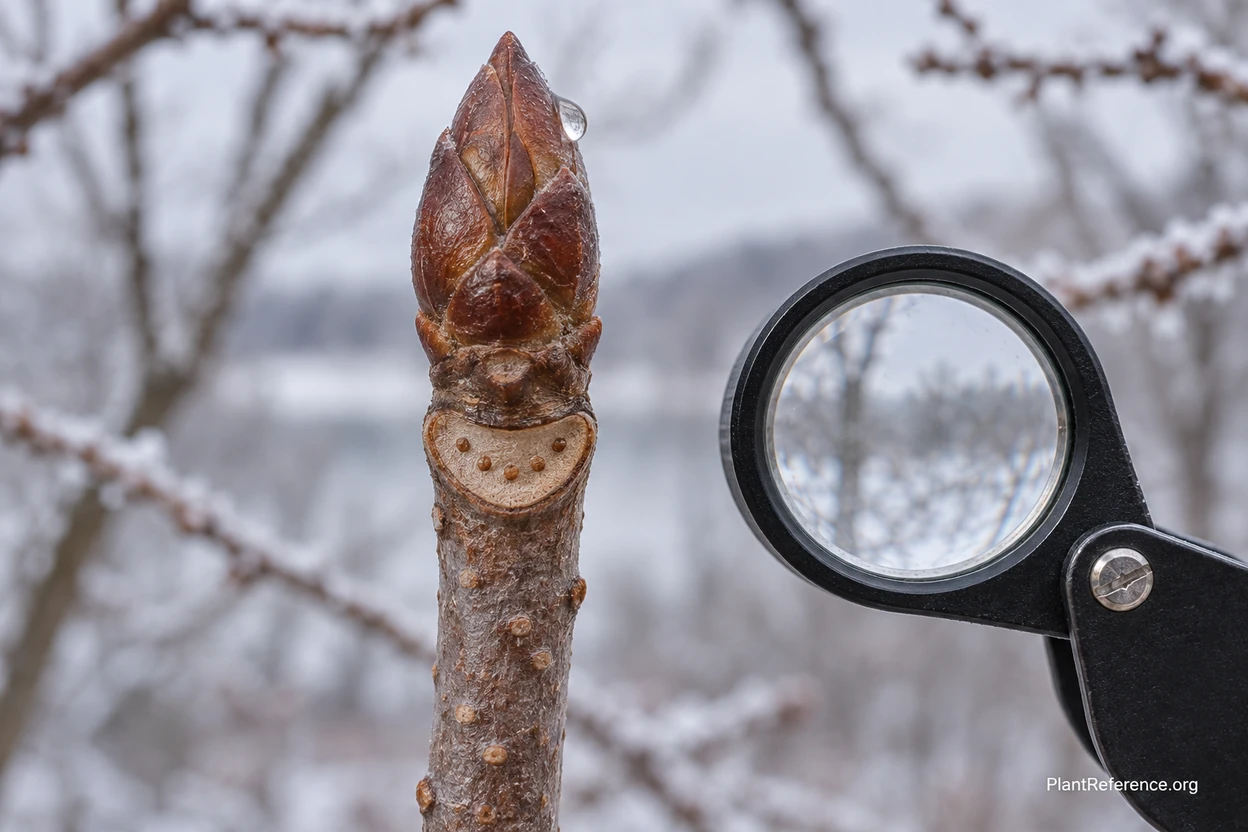
Don't overlook the leaf scar. When a leaf falls, it leaves a healed mark on the twig, and that scar's shape is surprisingly diagnostic. The inner dots—bundle scars—mark where the leaf's plumbing connected to the twig. Walnut (🌿Juglans nigra (JOO-glanz NY-gruh)) is famous here: its large leaf scar resembles a monkey or cat face, with the bundle scars forming the eyes and the notched upper edge forming a furry brow. Once a homeowner sees that on their own tree, they never forget it.
Bark: Texture, Color, and Pattern
Bark is the clue people reach for first, and it's genuinely useful—just not always sufficient on its own, because bark changes dramatically as a tree ages. A young, smooth-barked tree can become deeply furrowed in maturity, so I treat bark as confirmation rather than a starting point. Read it alongside branching and buds, not instead of them.
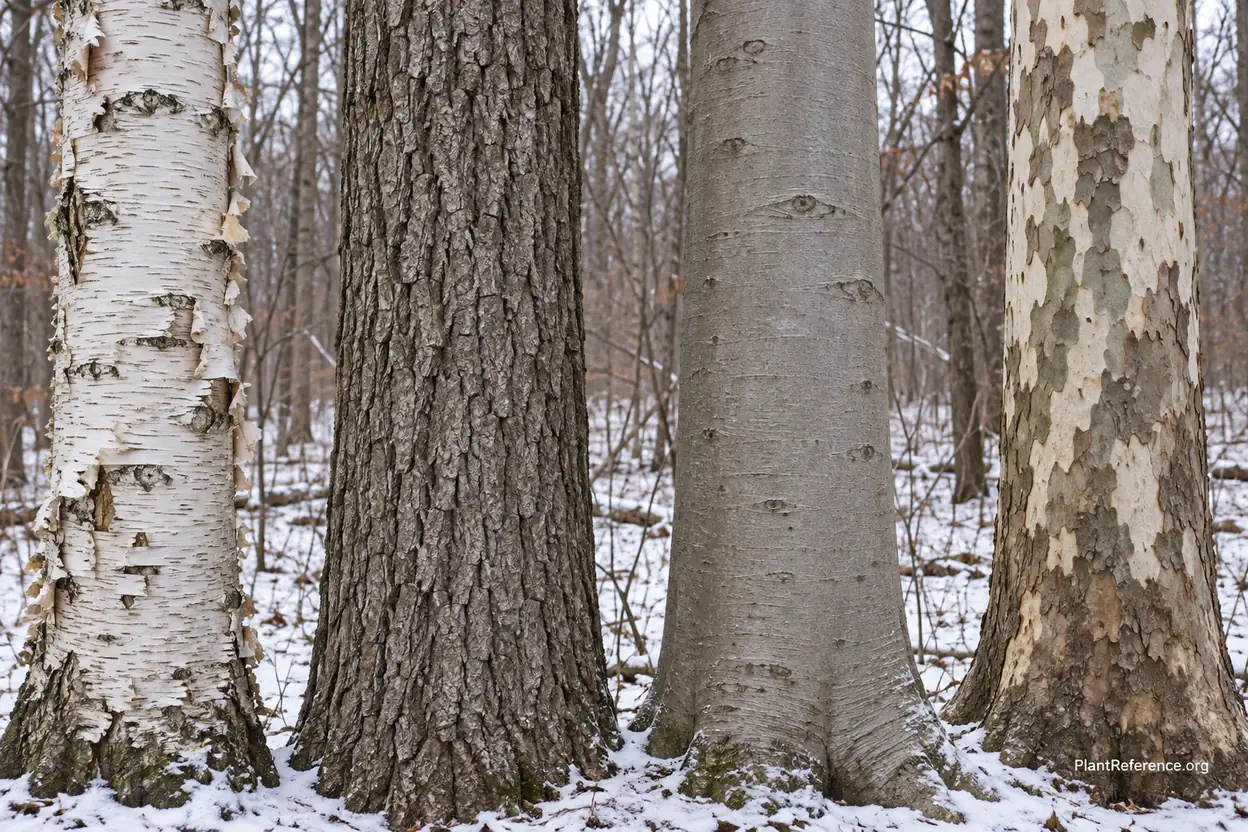
Still, several bark types are distinctive enough to call a genus on their own. Birches (Betula (BET-yoo-luh)) peel in thin, papery horizontal sheets, often bright white or coppery. Cherries and other members of Prunus (PROO-nus) show horizontal rows of lenticels—small corky pores for gas exchange—that give the bark a banded, shiny look. American beech stays famously smooth and gray its whole life, which is why people carve initials into it. Black walnut and many oaks develop deep, blocky furrows. Sycamore (🌿Platanus occidentalis (PLAT-uh-nus ok-sih-den-TAH-lis)) sheds its outer bark in patches to reveal a creamy white camouflage pattern that's unmistakable from a distance.
Bark Type | What to Look For | Common Trees |
|---|---|---|
Peeling horizontal sheets | Thin papery curls, white or copper | Birch (Betula) |
Horizontal lenticel bands | Shiny, banded, raised pores | Cherry (Prunus) |
Smooth gray | Tight, unbroken, elephant-skin | Beech (🌿Fagus grandifolia) |
Deep blocky furrows | Thick ridges and valleys | Black walnut (🌿Juglans nigra), many oaks |
Patchy camouflage | Flaking to creamy white underbark | Sycamore (🌿Platanus occidentalis) |
Shaggy vertical strips | Long plates peeling at both ends | Shagbark hickory (🌿Carya ovata) |
Color matters too, and it's easiest to judge on an overcast day when there's no harsh glare. Run your hand over the surface. Is it tight and smooth, or ridged and rough? Does the outer layer flake, peel, or stay put? Shagbark hickory (🌿Carya ovata (KAIR-ee-uh oh-VAH-tuh)) earns its name with long vertical plates that curl away from the trunk at top and bottom—a feature so obvious you can name the tree at highway speed.
Persistent Fruits, Seeds, and Leaves
Many trees hold onto their fruits, seeds, or even dead leaves through winter, and these leftovers are some of the most conclusive clues you'll find. They're worth scanning for on the tree and on the ground beneath it.
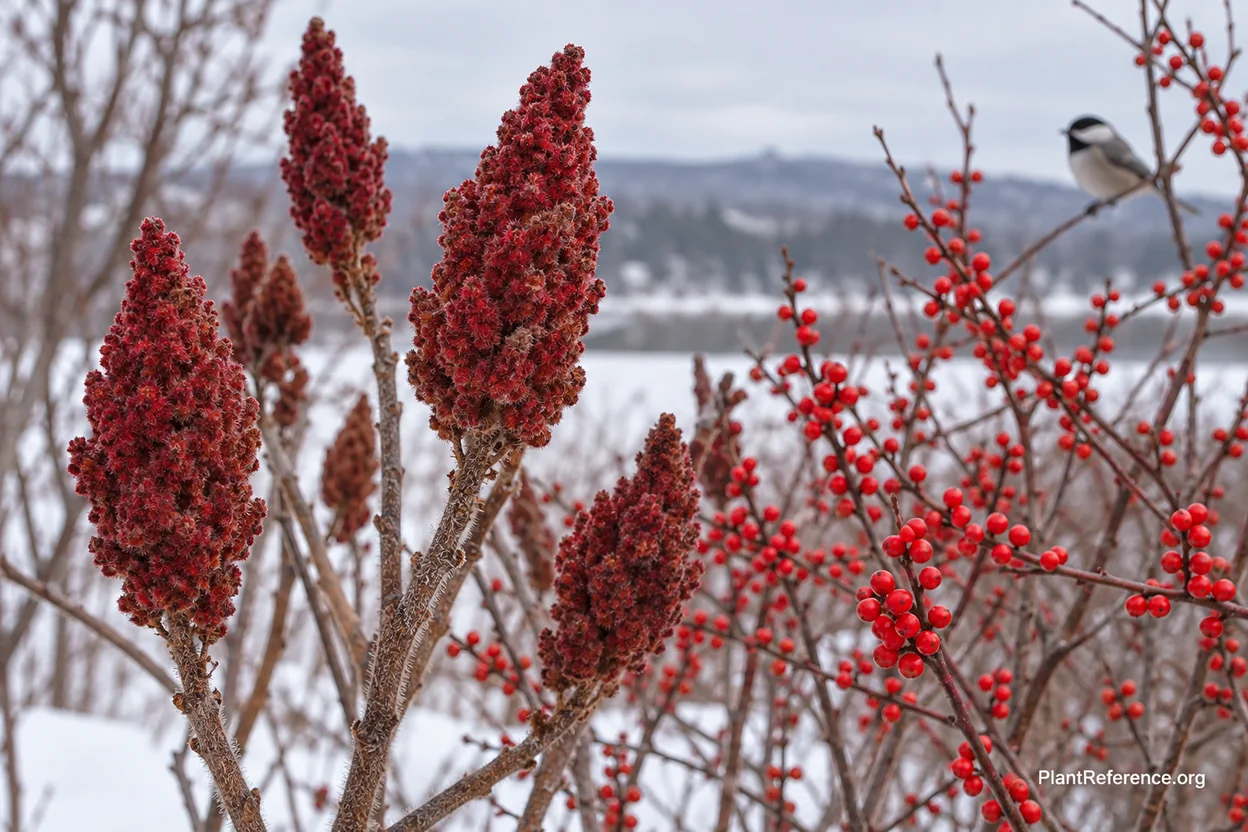
Honey locust (🌿Gleditsia triacanthos (gleh-DIT-see-uh try-uh-KAN-thos)) dangles long, dark, curling seed pods that rattle in the wind and litter the ground below. Sycamore holds its round, ball-like seed clusters on long stalks well into midwinter. Staghorn sumac (🌿Rhus typhina (roos ty-FEE-nuh)) raises fuzzy, deep-red cone-shaped fruit clusters that stand out against snow and feed birds through the cold months. Winterberry holly (🌿Ilex verticillata (EYE-leks ver-tih-sih-LAH-tuh)) studs its bare branches with bright crimson berries, one of the showiest winter ID marks in any wetland edge.
American beech — spiky husks holding triangular nuts, often with tan leaves still clinging
Honey locust — long, twisting, dark-brown seed pods
Staghorn sumac — upright, fuzzy, red fruit cones at branch tips
Sycamore — single round seed balls on long pendant stalks
Winterberry holly — dense bright-red berries on leafless twigs
Hackberry (🌿Celtis occidentalis) — small dark pea-sized fruits favored by waxwings
Then there's marcescence—the technical word for leaves that turn brown but refuse to drop. Young oaks and beeches are notorious for it, hanging onto papery tan leaves all winter. It looks untidy, but it's a gift for identification. A medium tree clinging to brown leaves in January is very likely a Quercus or 🌿Fagus grandifolia, and the leaf shape still readable on those holdouts can carry you to species. Hackberry (🌿Celtis occidentalis (SEL-tis ok-sih-den-TAH-lis)) leaves drop cleanly, but its warty, corky bark ridges fill the same diagnostic role. If you can still make out a leaf outline, pair it with Flower Identification Guide: Petals, Shape & Color Explained thinking and the species usually falls into place.
Conifers Make Winter ID Easy
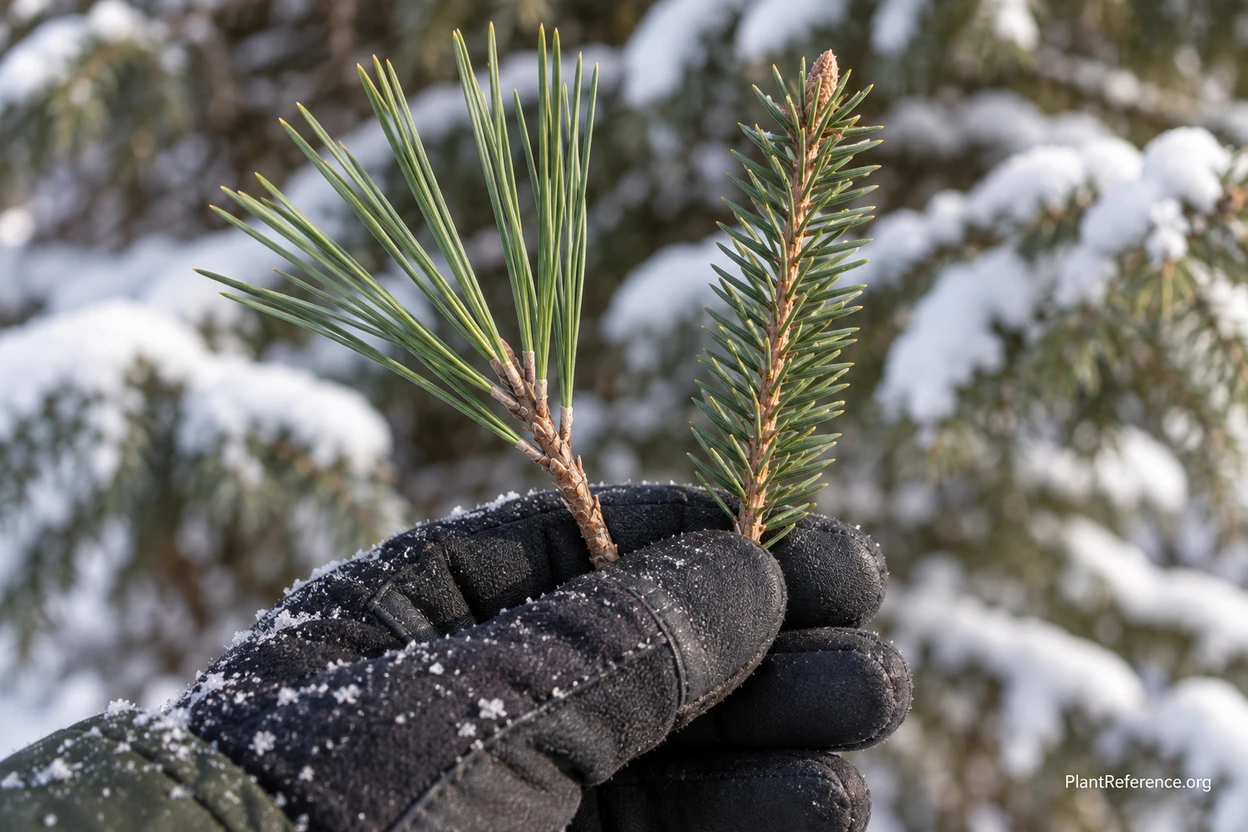
Here's the good news: evergreen conifers keep their foliage all winter, so the leaf-based clues never disappear. If your tree has needles or scales in January, you're working with a conifer, and the same rules apply year-round. I won't go deep here since How to Identify Conifers: Pines, Spruces, and Firs Simplified covers it thoroughly, but the quick keys are worth repeating.
Pines (Pinus) — needles bundled in groups of 2, 3, or 5, held together at the base in a papery sheath
Spruces (Picea) — single, stiff, four-sided needles you can roll between your fingers, attached to small woody pegs
Firs (Abies) — single, flat needles that won't roll, leaving a smooth round scar when pulled
Cedars and junipers — tiny scale-like leaves pressed flat against the twig
The classic memory aid: spruce needles are square and roll, fir needles are flat and friendly (they don't prick as hard). Count a pine's needle bundle and you've already narrowed the species considerably. Pinus (PY-nus), Picea (py-SEE-uh), and Abies (AY-bee-eez) each have a consistent needle habit that makes them straightforward once you know what to feel for.
A Simple Winter Identification Workflow
When I hand homeowners a routine to follow, identification stops feeling like guesswork. Walk through these steps in order and you'll arrive at a confident answer most of the time. A systematic approach beats random matching every time, which is the same logic behind How to Identify Any Plant: A Beginner's Guide to Leaves, Flowers, and Stems.
Step 1 — Check branching. Alternate or opposite? Opposite points to the MADCapHorse group; alternate rules it out.
Step 2 — Read the buds. Note arrangement, terminal-bud size and color, scale count, and the shape of the leaf scar.
Step 3 — Examine the bark. Texture, color, and whether it peels, furrows, or stays smooth—use it to confirm, not to start.
Step 4 — Scan for fruits and leaves. Look up for persistent pods, berries, or clinging brown leaves, and down at what's fallen below.
Step 5 — Confirm with a key or reference. Match your notes against a field guide or a dichotomous key to lock in the species.
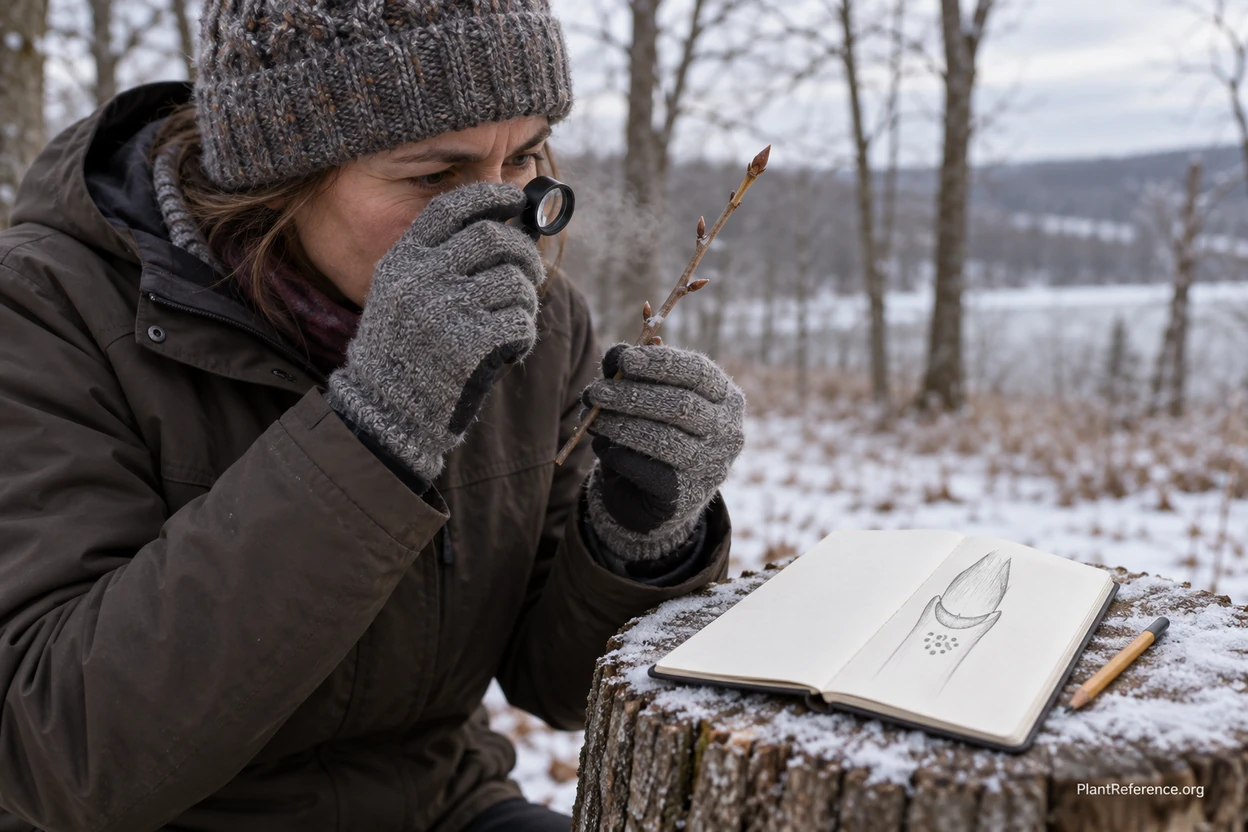
Two tools make this dramatically easier. A 10x hand lens brings bud scales and bark detail into focus, and a weatherproof field notebook lets you sketch a twig or jot bundle-scar counts that you'll compare later. Sketching is underrated—drawing a leaf scar for two minutes builds recognition faster than any amount of passive scrolling. I also keep a good tree guide in the truck for the cases that fight me.
A quick word on apps, since everyone asks. Image-recognition apps struggle in winter because they're trained mostly on leaves and flowers. Point one at a bare twig and you'll often get a shrug or a wrong guess. They're a fine starting hint, but they don't teach you the underlying skill. This is exactly where learning to read the tree yourself pays off: apps identify a plant for you, while building real recognition lets you identify it yourself—in any season, with no signal required. If you want to practice, PlantReference's flashcard system shows multiple images per species across seasons and uses spaced repetition to make winter twigs, buds, and bark stick in long-term memory.
Winter identification rewards patience and a little structure. The trees aren't hiding anything from you—they've actually revealed more than they do all summer. Spend a few cold afternoons working the Three Bs on your own street, and by spring you'll recognize your neighborhood trees before their leaves are even out. If you're thinking about what to plant next, it's also worth reading Choosing Climate-Ready Trees: Species Selection for 2050 and Beyond and, for the trees you already have, Is My Tree Dangerous? 10 Warning Signs Every Homeowner Should Know. Once you can name what's in your yard, mapping out a simple How to Write a Tree Care Plan: The Complete 2026 Guide is a natural next step, and understanding How Much Soil Do Urban Trees Actually Need? The Root Volume Guide will help those trees thrive. Before any removal, always check Do I Need a Permit to Remove a Tree? A State-by-State Guide.
Frequently Asked Questions
Three daily games
Can you name a plant on sight?
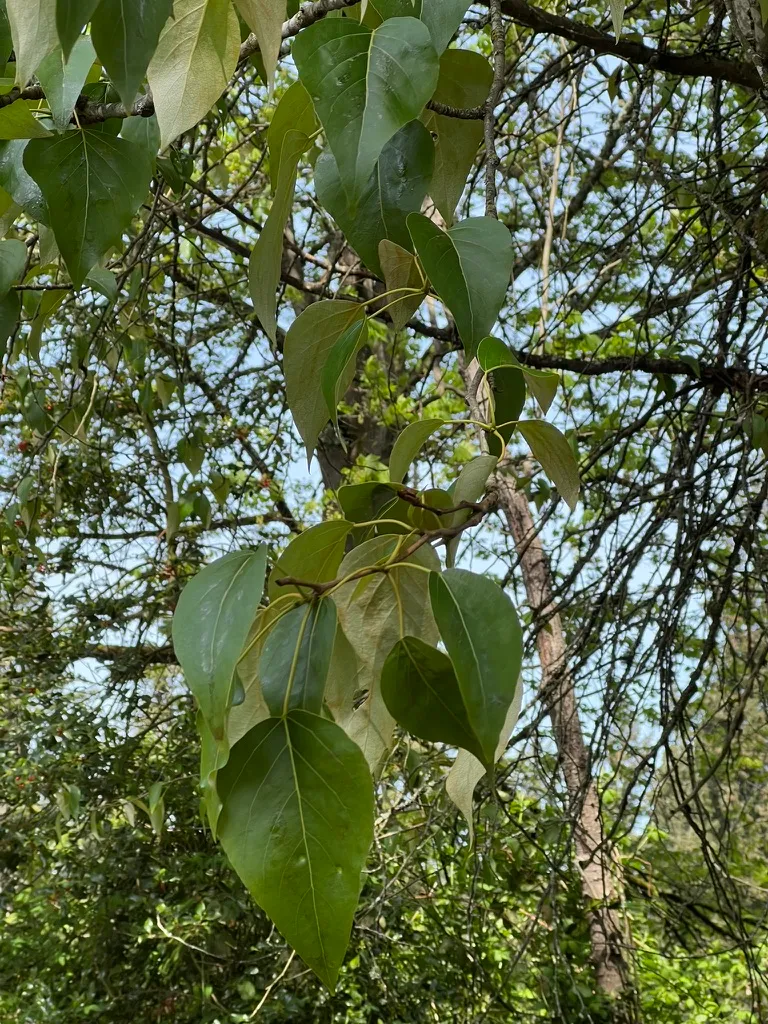
Friday’s specimenPopulus balsamifera ssp. trichocarpaReading about plants and recognising them are different skills. These three build the second.
- Daily PlantIdentify the day’s mystery plant from a close-up photograph.
- Keyed OutWork a dichotomous key, lead by lead, to name a hidden specimen.
- Name That PlantName a specimen from botanical clues dealt hardest first.
Free to play, no account needed
Tagged with
Derek is an arborist and tree care specialist based in Nashville. He spent a decade working for a commercial tree service before starting his own consulting practice focused on residential tree health. His background is in forest management, and he brings that perspective to urban tree care. He's particularly interested in the intersection of native trees and suburban landscapes, helping homeowners understand what's growing in their yards and how to care for it properly. Derek also teaches tree identification walks through local parks. He's straightforward about tree care: most homeowners either ignore their trees completely or prune them incorrectly, and both cost money in the long run.