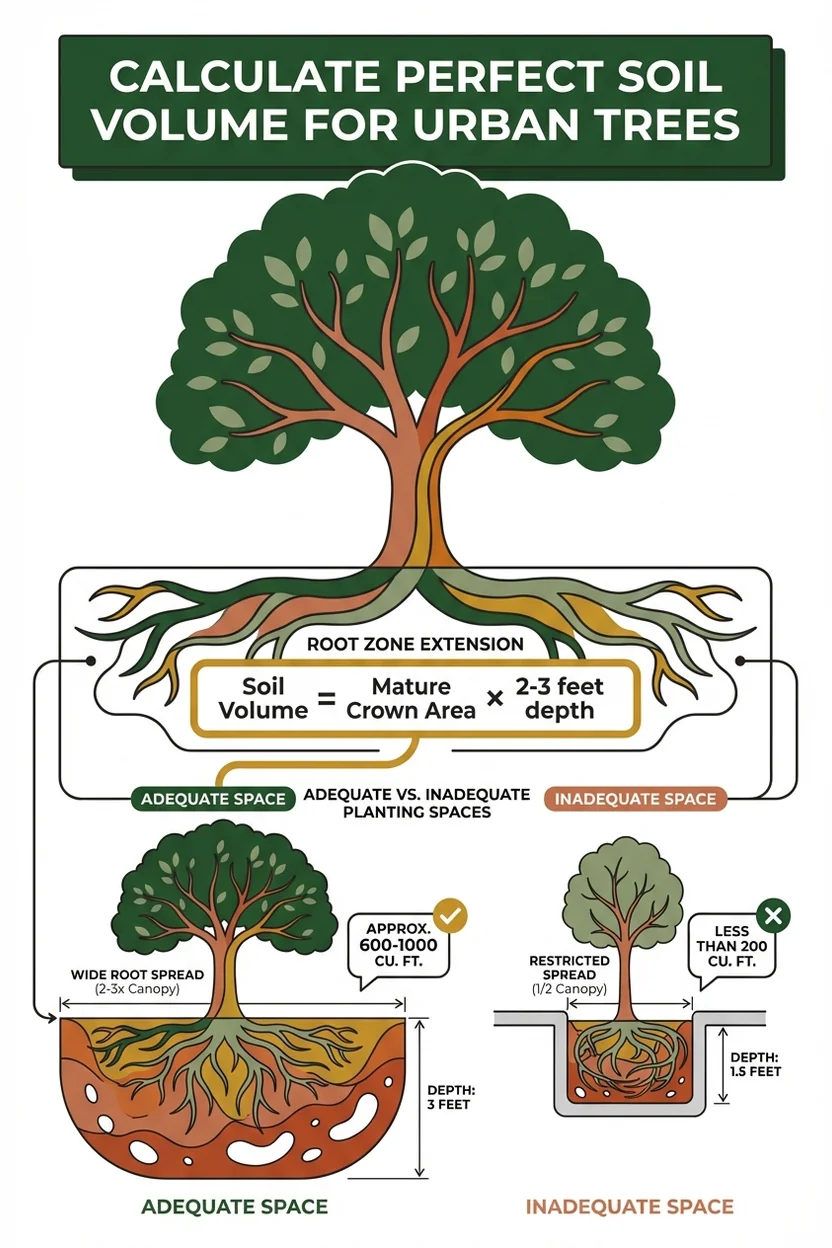
How Much Soil Do Urban Trees Actually Need? The Root Volume Guide
Pets & Toxicity
Recorded toxicity for plants linked in this guide. An unknown status is not a safety assessment.
Toxic to pets: red oakDetailsHide
Quercus rubra — Toxicity Warning
Toxic when leaves or acorns are eaten in quantity, especially by horses and grazing livestock; human ingestion toxicity is generally low.View Quercus rubra plant profile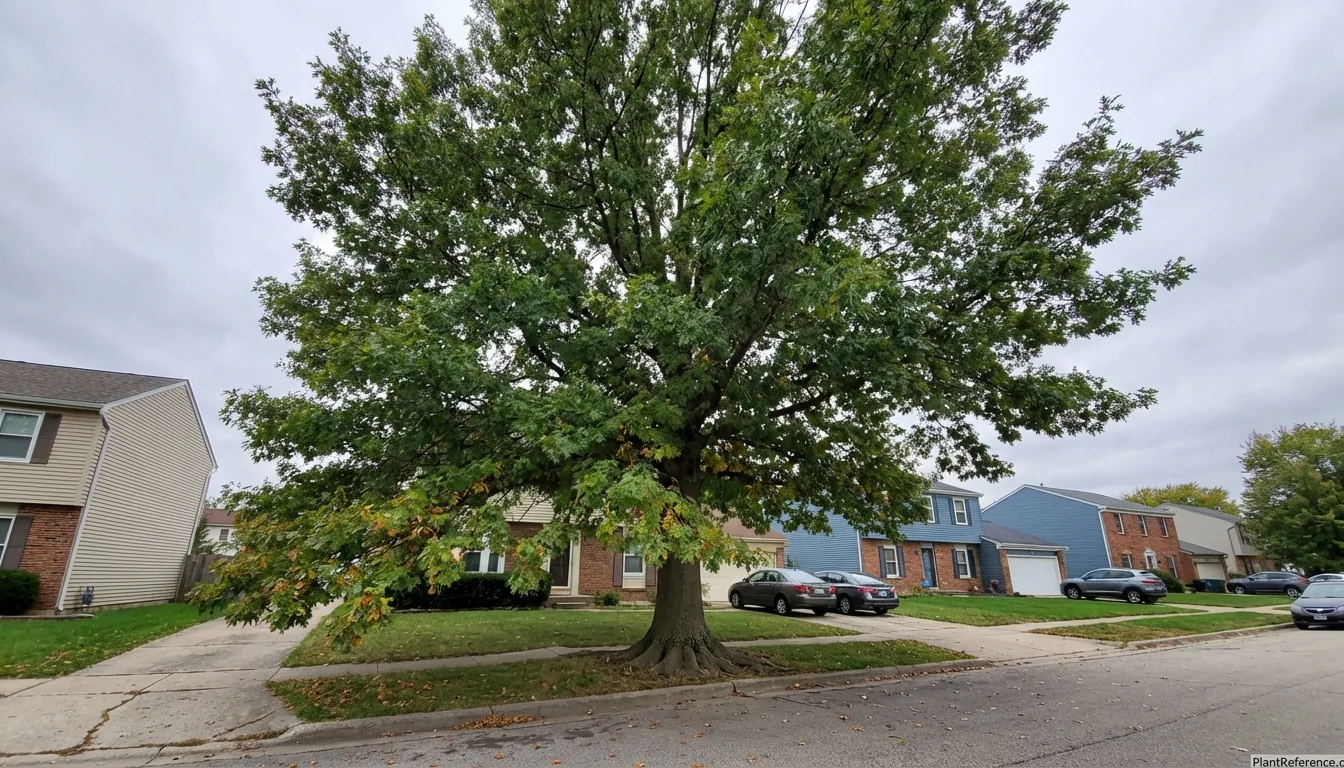
— Image © Plant Reference 2026
Urban tree failures aren't usually from disease or insects—they're from something much more basic. Most trees die slowly from insufficient soil volume for trees, spending years in decline before property owners realize the fundamental problem was underground all along.
Why Most Urban Trees Get Inadequate Soil Volume
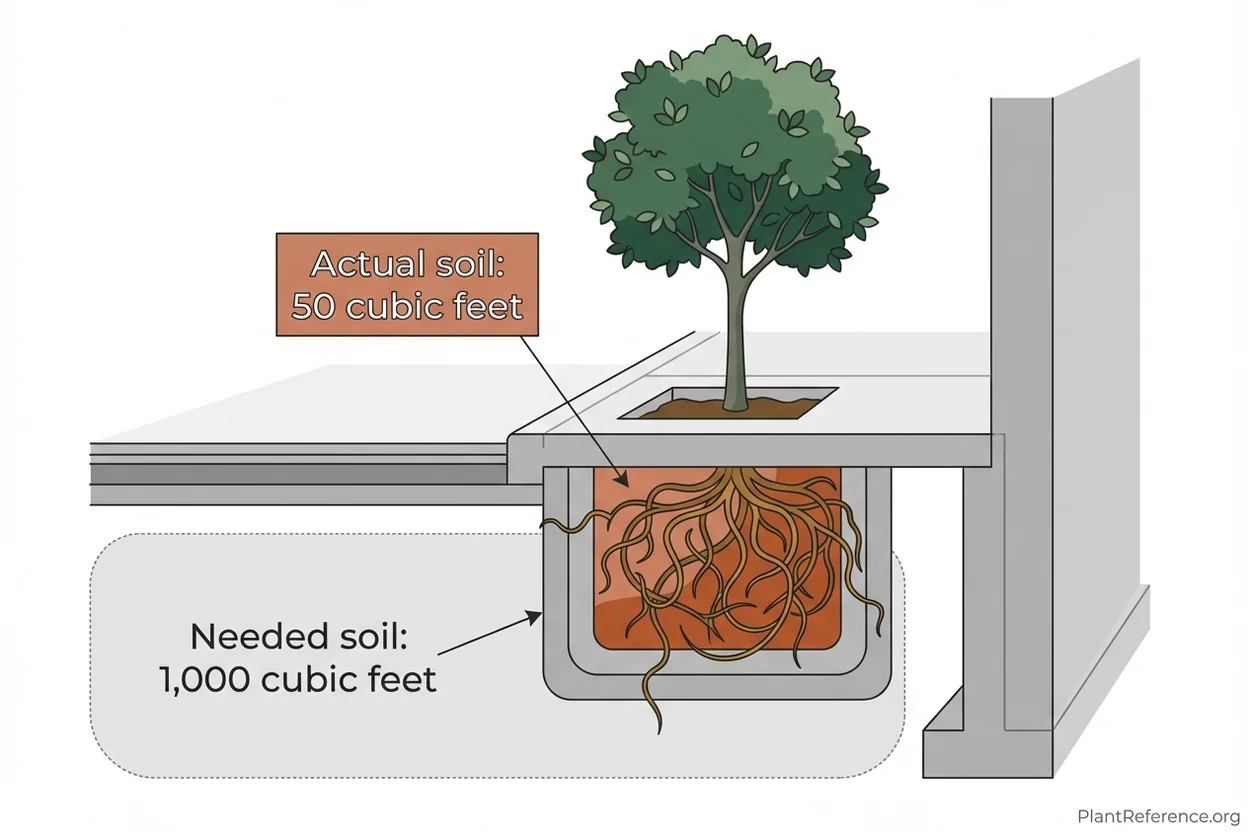
I've seen hundreds of tree installations over the years, and the pattern is always the same: someone plants a tree in whatever space is available, not what the tree actually needs to survive long-term. A typical street tree gets a 4×4 foot (1.2×1.2 meter) opening in concrete—16 square feet (1.5 square meters). That same tree, if it's going to reach maturity, might need 800-1,000 square feet (74-93 square meters) of canopy spread. The math doesn't work.
The fundamental disconnect happens because we think about trees as decoration rather than infrastructure. You wouldn't install a water main in a pipe that's too small and expect it to work properly. Trees are the same—they need adequate soil volume to function.
Urban soils present three main challenges:
Compaction from foot and vehicle traffic: Reduces pore space, preventing root penetration and water infiltration. Compacted soil can have bulk density exceeding 1.6 g/cm³, while trees need soil below 1.4 g/cm³ for healthy root growth.
Restricted rooting area: Surrounded by concrete, asphalt, and building foundations, most urban trees have access to a fraction of the soil volume they'd naturally claim.
Poor soil quality: Construction debris, contamination, and depleted organic matter create hostile growing conditions even where soil volume appears adequate.
The result? Trees that struggle to establish, show chronic stress symptoms (sparse foliage, early fall color, branch dieback), and fail to reach their mature size and lifespan potential.
The Science: How Much Soil Trees Actually Need
The research is clear: healthy urban trees require 1.5 to 2 cubic feet of uncompacted, well-draining soil per square foot of mature canopy coverage. This isn't a rough estimate—it's based on decades of studying successful vs failing urban plantings.
Here's why this ratio matters: tree roots extend roughly 1.5 to 3 times the canopy diameter, but in urban settings, we assume most functional roots will be concentrated within the canopy drip line. The effective rooting depth in urban soils rarely exceeds 2-3 feet (60-90 centimeters) due to compaction, utility lines, and hardpan layers.
For a large mature tree like a red oak 🌿Quercus rubra (KWER-kus ROO-bruh) with a 40-foot (12-meter) canopy diameter:
Canopy area: π × 20² = 1,256 square feet (117 square meters)
Soil volume needed: 1,256 × 1.5 = 1,884 cubic feet minimum (53 cubic meters)
Soil volume typically provided: 4×4 foot (1.2×1.2 meter) opening = 32 cubic feet (0.9 cubic meters)
The tree gets less than 2% of what it needs. No wonder urban trees show stress.
Research by Dr. Nina Bassuk at Cornell University demonstrates that trees provided with adequate soil volume:
Reach 85-95% of their genetic potential for trunk diameter growth
Maintain dense, healthy canopy coverage throughout their lifespan
Show significantly lower mortality rates in the first 10 years after planting
Require 40-60% less irrigation once established
Provide substantially higher ecosystem services (carbon storage, stormwater management, cooling)
Trees in inadequate soil volume rarely exceed 50% of their potential trunk diameter and show chronic decline symptoms within 5-7 years of planting.
Calculating Soil Volume Requirements
The formula for soil volume for trees is straightforward, but you need accurate information about the tree's mature size:
Soil Volume = Mature Crown Area × Effective Rooting Depth
Step 1: Determine mature canopy diameter for your species. Don't guess—look this up in reliable references. A Tree Identification Guide can help with species-specific growth data.
Step 2: Calculate canopy area using the circle formula: Area = π × (radius)²
Step 3: Multiply by effective rooting depth. Use 2 feet (60 centimeters) for restricted urban sites, 3 feet (90 centimeters) for more open areas.
Practical examples:
**Honey Locust 🌿Gleditsia triacanthos (glee-DIT-see-uh try-ak-AN-thos)**: 35-foot (10.5-meter) mature spread
Canopy area: π × 17.5² = 962 square feet (89 square meters)
Soil volume needed: 962 × 2 = 1,924 cubic feet (54 cubic meters)
**Japanese Zelkova 🌿Zelkova serrata (zel-KOH-vuh ser-RAH-tuh)**: 25-foot (7.5-meter) mature spread
Canopy area: π × 12.5² = 491 square feet (46 square meters)
Soil volume needed: 491 × 2 = 982 cubic feet (28 cubic meters)
**Ornamental Pear 🌿Pyrus calleryana (PIE-rus kal-ler-ee-AH-nuh)**: 20-foot (6-meter) mature spread
Canopy area: π × 10² = 314 square feet (29 square meters)
Soil volume needed: 314 × 2 = 628 cubic feet (18 cubic meters)
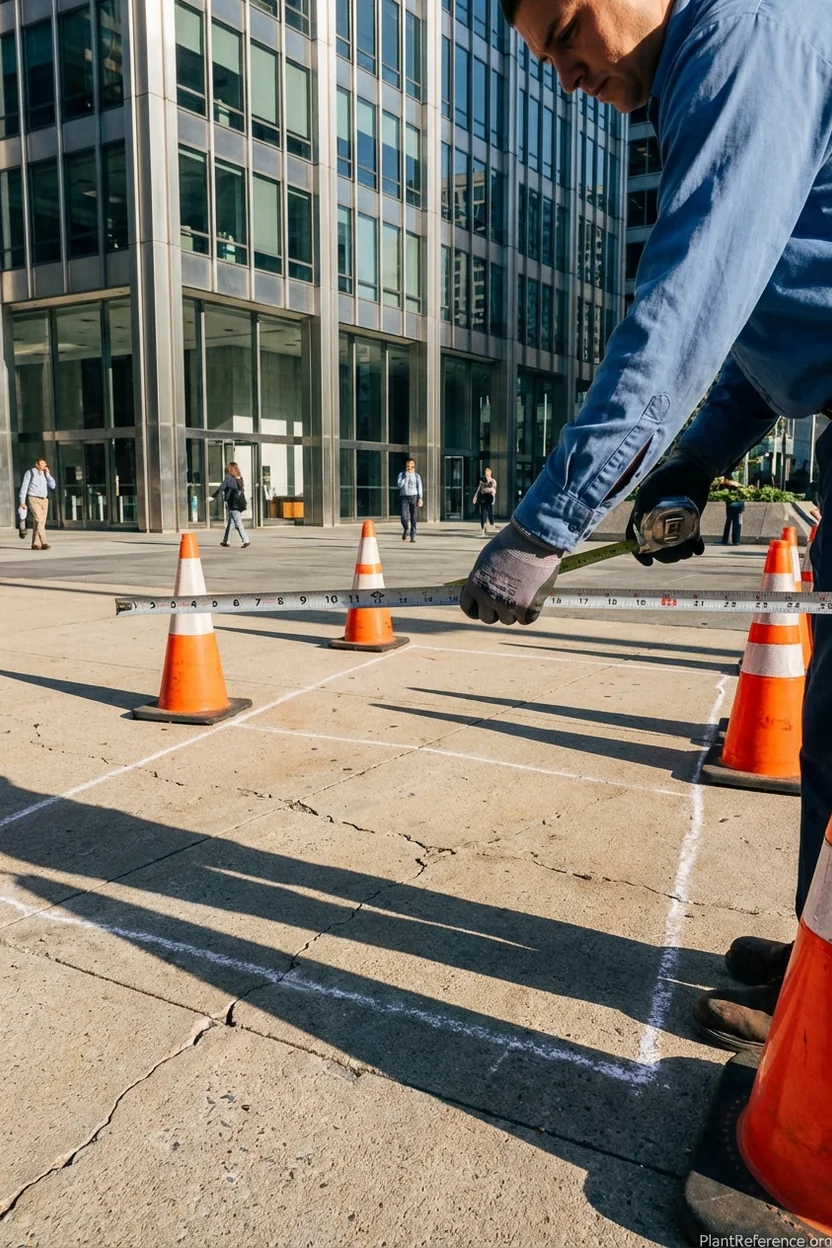
Remember: these calculations assume uncompacted soil. Compacted soil has reduced pore space and restricted root penetration, so you may need 25-50% more volume to achieve the same functional capacity.
Structural Solutions for Restricted Spaces
When you can't provide adequate surface soil area, you need to think three-dimensionally. Modern urban forestry uses several proven systems to provide soil volume for trees under pavement and hardscaping.
Silva Cell and Stratavault Systems: Modular plastic or concrete structures that support pavement loads while creating soil-filled chambers for root growth. Silva Cells can support H-20 loading (truck traffic) while providing 28.6 cubic feet of soil per module. A typical installation uses 15-20 modules, providing 400-600 cubic feet of soil under a sidewalk or plaza.
CU-Structural Soil: Developed at Cornell University, this engineered growing medium consists of crushed stone mixed with small amounts of clay loam and hydrogel. The stone matrix supports pavement loads while the soil component provides nutrients and water-holding capacity. Typical mix: 80% crushed stone, 15-20% soil, with controlled compaction allowing root penetration.
Suspended Pavement Systems: Concrete or composite decking systems that span between structural supports, creating uncompacted soil chambers underneath. More expensive than structural soil but provides the closest approximation to natural growing conditions.
Tree Grates: Avoid Them: Metal tree grates look professional but cause more problems than they solve. They create heat islands around the trunk, provide tripping hazards, and most critically, they're fixed-diameter systems that eventually girdle growing trunks. Use flexible materials like mulch, rubber mulch, or permeable resin-bound aggregates instead.
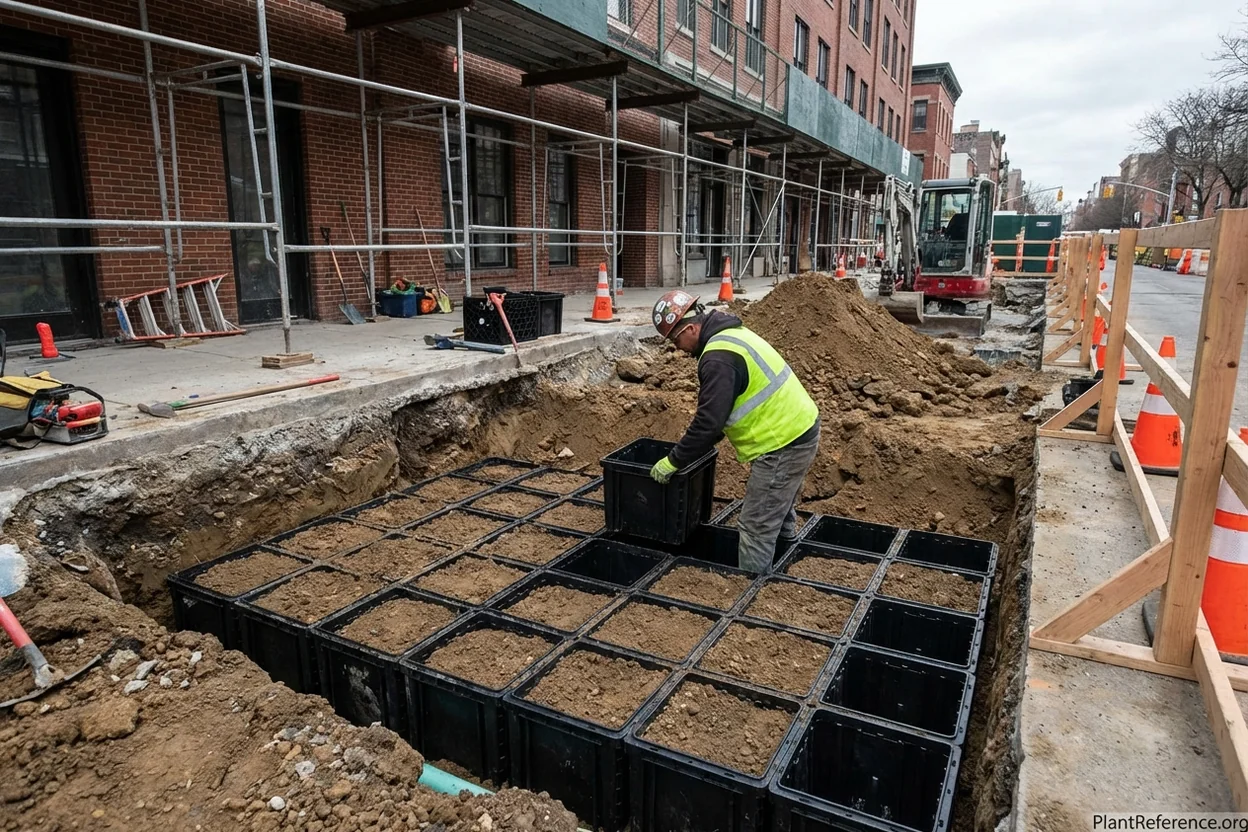
Cost considerations: Structural soil systems add $15-25 per cubic foot compared to $3-5 per cubic foot for conventional soil. However, the long-term tree health and reduced replacement costs typically justify the investment within 10-15 years.
Soil Quality vs Quantity: What Type of Soil Works
Having adequate volume doesn't help if the soil quality is poor. Urban trees need soil that balances three critical functions: structural support, water management, and nutrient availability.
Soil composition for urban trees:
40-60% mineral component (sand, silt, clay mix with good drainage)
25-35% organic matter (compost, aged leaf mold, biochar)
5-15% coarse aggregate (perlite, pumice, or fine gravel for drainage)
pH between 6.0-7.5 (slightly acidic to neutral)
Bulk density below 1.4 g/cm³ (achievable only with uncompacted installation)
Drainage is critical: Urban soils must drain excess water within 24-48 hours while retaining enough moisture for drought periods. Poor drainage kills more urban trees than drought. Install drainage tiles or French drains if your site has clay subsoils or poor natural drainage.
Organic matter: Fresh organic matter decomposes and settles, creating depressions and changing soil structure. Use well-composted materials aged at least 12 months (1 year). Biochar (stable carbon from pyrolysis) provides long-term soil structure improvement and habitat for beneficial microorganisms.
Mycorrhizal inoculation: Beneficial fungi form symbiotic relationships with tree roots, extending the effective root network and improving nutrient uptake. Commercial mycorrhizal inoculant products can improve establishment success, particularly in sterile urban soils.
Soil Component | Function | Recommended % | Problems if Wrong |
|---|---|---|---|
Sand/Silt | Drainage, root penetration | 40-50% | Too much = drought stress; too little = waterlogging |
Clay | Nutrient retention, structure | 10-20% | Too much = poor drainage; too little = nutrient leaching |
Organic Matter | Water retention, nutrients | 25-35% | Too much = settling, nitrogen tie-up; too little = poor fertility |
Coarse Aggregate | Drainage, aeration | 5-15% | Too much = drought stress; too little = compaction |
Retrofitting Existing Problem Plantings
Many urban trees were planted before we understood soil volume requirements. These trees show predictable symptoms: sparse canopy, early fall color, branch dieback, and failure to reach mature size. Retrofitting can extend their lifespan significantly.
Pneumatic soil excavation (Air-Spading): Uses compressed air to excavate compacted soil around existing root systems without damaging roots. This allows decompaction and soil amendment in the critical root zone. Typical cost: $8-15 per square foot, but can add 10-15 years to a declining tree's lifespan.
Soil volume expansion: Where possible, remove pavement or expand planting areas to increase available soil volume. Even increasing from 100 to 300 cubic feet (2.8-8.5 cubic meters) can dramatically improve tree health.
Vertical mulching: Drilling 2-3 inch (5-8 centimeter) diameter holes through compacted soil layers and backfilling with organic matter and coarse aggregate. Creates aeration channels and improves water infiltration. Space holes 3-4 feet (90-120 centimeters) apart throughout the root zone.
Root invigoration treatments: Combination of mycorrhizal inoculation, slow-release fertilizer, and soil conditioning agents applied through deep-root injection or vertical mulching. Most effective on trees showing early decline symptoms.
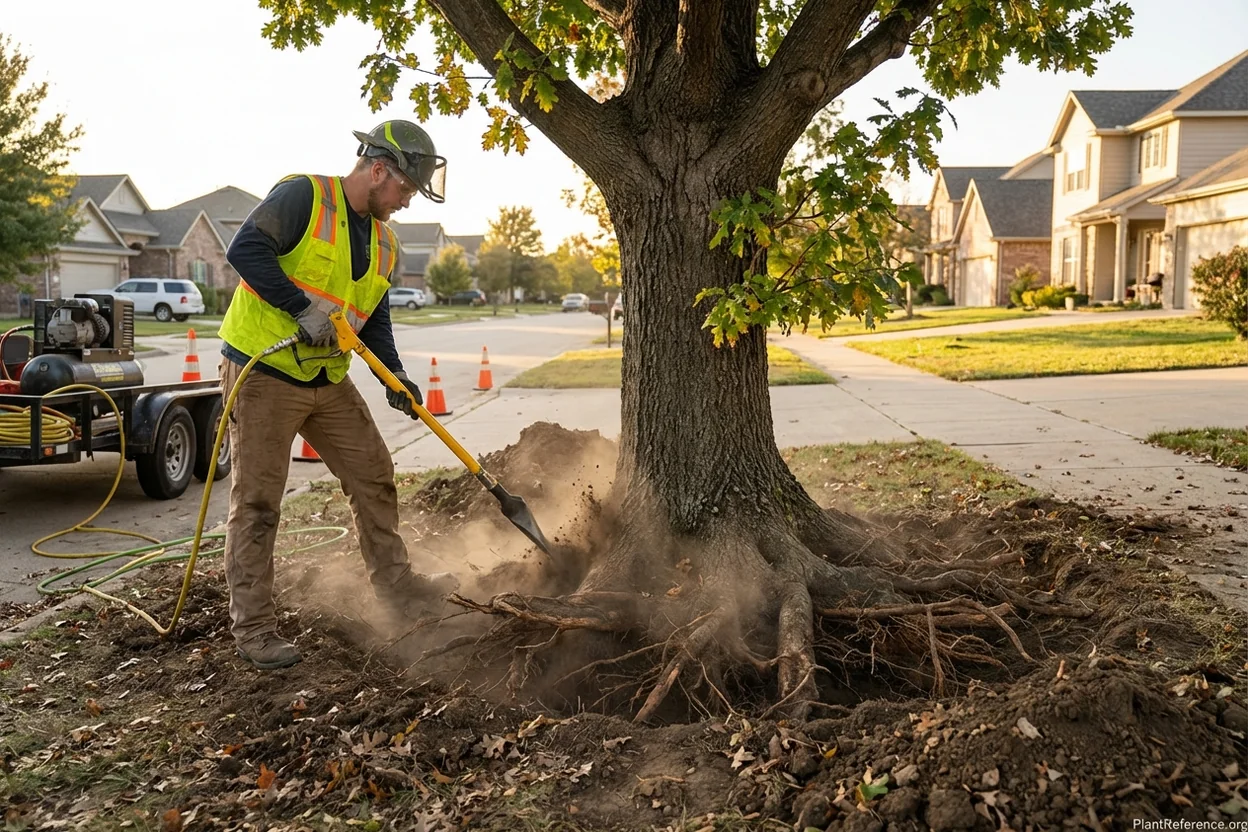
Success indicators: Retrofitted trees typically show improvement within 1-2 growing seasons. Look for increased leaf size, better color retention in late summer, new terminal growth on branch tips, and reduced branch dieback.
Common Urban Planting Mistakes to Avoid
After decades in construction and sustainable design, I've seen these soil volume mistakes repeated constantly:
Planting in construction debris: Contractors often backfill planting holes with rubble, broken concrete, and subsoil excavated during construction. This material has zero nutritional value and creates drainage problems. Always specify virgin topsoil or engineered growing media.
Overestimating existing soil quality: That black dirt around your building site probably isn't topsoil—it's often construction fill, contaminated material, or severely compacted subsoil. Get a soil test before assuming existing material is suitable.
Ignoring mature size: Planting a species that will grow 50 feet (15 meters) wide in a 10-foot (3-meter) strip between buildings. The tree will never thrive, and eventual removal costs far exceed proper initial planning.
Volume vs area confusion: Assuming that surface area equals soil volume. A 10×10 foot (3×3 meter) planting area only provides 100-300 cubic feet (2.8-8.5 cubic meters) of soil if there's a hardpan layer at 12-36 inches (30-90 centimeters) deep. You need to know what's below ground.
Inadequate drainage planning: Installing trees in low spots where water accumulates, or in areas with impervious clay subsoils without drainage improvements. Waterlogged roots are dead roots.
The most expensive mistake is not planning for soil volume for trees at all. You'll spend more money replacing failed plantings than doing it right the first time. Good construction practices save money long-term, and tree planting is no different.
Frequently Asked Questions
Reading about plants and recognising them are different skills. These three build the second.
- Daily PlantIdentify the day’s mystery plant from a close-up photograph.
- Keyed OutWork a dichotomous key, lead by lead, to name a hidden specimen.
- Name That PlantName a specimen from botanical clues dealt hardest first.
Free to play, no account needed
Aisha manages a small tropical nursery on the east side of Houston, specializing in plants that can handle the Gulf Coast's humidity, heat, and unpredictable flooding. She studied horticulture in college and worked at a wholesale grower before opening her own operation. Growing up, her parents kept a kitchen garden with okra, bitter gourd, and curry leaf plants—a tradition she's continued. Houston's subtropical climate lets her grow things most of the country can't, but it also means dealing with fungal issues, standing water, and summers where it's too hot for even tomatoes. Aisha writes about tropical and subtropical plant care, humidity management, and working with heavy clay soils.