Pyrus, Genus, calleryana, Species,
- Genus & species
Callery flowering pear
China, Korea, Japan, and Vietnam; listed as invasive across 28 U.S. states; sale and planting are prohibited under invasive species regulations in Ohio, Pennsylvania, and South Carolina as of 2023-2024
Overview
Pyrus calleryana is a medium-sized deciduous tree in the family Rosaceae reaching 30–50 feet (9–15 m) tall and 20–35 feet (6–10.7 m) wide with a pyramidal to broadly oval crown on most cultivars. Bark is smooth and gray-brown on young trees and develops shallow furrows and scaly plates with age. Leaves are alternate, simple, broadly ovate to round, 1.5–3 inches (4–8 cm) long, with scalloped to finely crenate margins and a glossy dark green leathery upper surface; fall color is variable across a single tree and ranges from crimson and scarlet through purple, orange, and bronze over a 2–3 week transition period in October and November. White 5-petaled flowers 0.75–1 inch (2–2.5 cm) across open in profuse corymb-like clusters before or concurrent with leaf emergence in March and April, and the flowers carry a strong unpleasant odor from trimethylamine that is variously described as fishy. Small hard round brown pomes 0.3–0.5 inch (8–13 mm) across develop through summer and persist into winter. Growth is rapid at 12–24 inches (30–61 cm) per year. P. calleryana was introduced to the United States in 1908 by USDA plant explorer Frank Meyer for fire blight resistance breeding and was later developed into street-tree cultivars including 'Bradford', 'Chanticleer', 'Cleveland Select', 'Aristocrat', 'Autumn Blaze', and 'Redspire'. Limitation: individual cultivars are self-incompatible but cross-pollination between different cultivars planted within bee flight range produces viable seed, birds disperse the seeds across long distances, and the species is listed as invasive across 28 U.S. states where naturalized populations form dense thickets in old fields, roadsides, and forest margins; sale and planting are prohibited under invasive plant regulations in Ohio, Pennsylvania, and South Carolina as of 2023–2024, and additional states including Indiana and Missouri are progressively restricting the species. Earlier cultivars such as 'Bradford' develop narrow co-dominant crotch angles with included bark that split in wind and ice storms at 15–25 years; improved cultivars including 'Chanticleer' carry stronger branch structure but do not resolve the seed escape issue when planted near other Pyrus calleryana cultivars. Fire blight (Erwinia amylovora) causes tip dieback and branch death.
Native Range
Native to China, Korea, Japan, and Vietnam, growing in open woodlands, forest margins, and disturbed ground from sea level to 6,500 feet (2,000 m) elevation. Introduced to the United States in 1908 by USDA plant explorer Frank Meyer primarily for fire blight resistance breeding. Now naturalized and listed as invasive across 28 U.S. states in the eastern and southeastern regions where bird-dispersed seeds establish in old fields, roadsides, and forest margins.Suggested Uses
Historically used as a street tree, urban parking lot tree, and residential specimen because of the rapid growth, pollution tolerance, profuse white spring bloom, and multicolor fall foliage. Planting is now prohibited under invasive plant regulations in Ohio, Pennsylvania, and South Carolina and is restricted across 28 U.S. states where bird-dispersed seeds establish naturalized populations in old fields and forest margins. Native alternatives for similar urban tree functions include Amelanchier species (serviceberry), Nyssa sylvatica (black tupelo), and Cercis canadensis (eastern redbud); western native alternatives include Acer circinatum (vine maple) and Cornus nuttallii (Pacific dogwood).How to Identify
Appearance
Size & Dimensions
Height30' - 50'
Width/Spread20' - 35'
Bloom Information
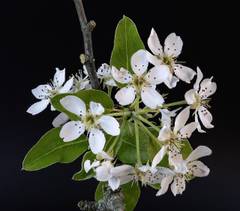
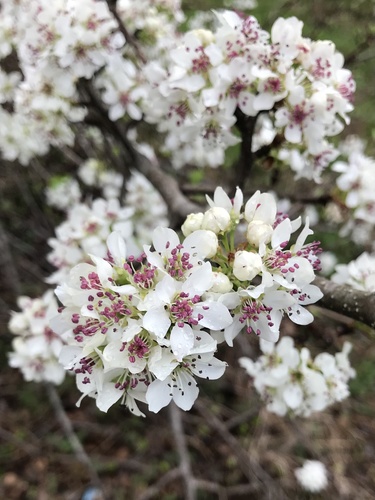
White 5-petaled flowers 0.75–1 inch (2–2.5 cm) across open in profuse corymb-like clusters before or concurrent with leaf emergence from March through April, lasting 1–2 weeks. The flowers carry a strong unpleasant odor from trimethylamine that is variously described as fishy or reminiscent of decaying flesh. Cross-pollination between different cultivars planted within bee flight range produces viable seed that birds disperse into surrounding landscapes and natural areas. Small hard round brown pomes 0.3–0.5 inch (8–13 mm) across develop through summer and persist into winter.
Detailed Descriptions
Flower Description
white 5-petaled flowers 0.75-1 inch (2-2.5 cm) across in profuse corymb-like clusters before or with leaf emergence in early spring; the flowers carry a strong unpleasant odor from trimethylamine that is variously described as fishyFoliage Description
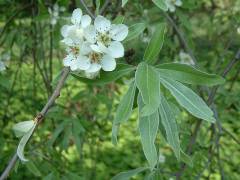
glossy dark green with a leathery texture; alternate, simple, broadly ovate to round, 1.5-3 inches (4-8 cm) long, with scalloped to finely crenate margins; turns crimson, scarlet, purple, orange, and bronze in fall with multiple colors on the same treeGrowing Conditions
Sun Requirements
Requires 6-12 hours of direct sunlight daily
• Full Sun: 6+ hours of direct sunlight
• Partial Shade: 3-6 hours of direct sunlight
• Full Shade: Less than 3 hours of direct sunlight
Care & Maintenance
Care Guide
Site in full sun with 6–12 hours of direct sun per day in well-drained soil with a pH of 5.0–8.0. The species tolerates loam, clay, sand, silt, and chalk and is drought-tolerant once established. The species is listed as invasive across 28 U.S. states, and sale and planting are prohibited under invasive plant regulations in Ohio, Pennsylvania, and South Carolina as of 2023–2024, with additional restrictions progressively in place across other eastern and midwestern states. Where planting is still permitted, improved cultivars including 'Chanticleer' and 'Cleveland Select' carry stronger branch structure than the older 'Bradford' cultivar, which typically splits at 15–25 years from narrow co-dominant crotch angles. Fire blight (Erwinia amylovora) produces shepherd's-crook tip wilting and branch death; infected branches are cut 12 inches (30 cm) below visible infection during dry weather, and pruning tools are disinfected between cuts to prevent spreading the bacterium. Hardy in USDA zones 5–9.Pruning
Pruning is done in late winter (January and February) while the tree is dormant. Young trees are trained to a strong central leader with well-spaced scaffold branches at wide angles; co-dominant leaders and branches with included bark are reduced in the first 10 years to reduce storm splitting, which is the primary structural failure mode of older 'Bradford' plantings. Canopy thinning in mature trees reduces wind resistance. Fire blight infections call for cuts 12 inches (30 cm) below visibly affected tissue during dry weather, and tools should be disinfected between cuts.Pruning Schedule
Prune: January–February
winter