When to Plant Green Beans in Los Angeles: Complete Guide + Best Varieties for Zone 10b
Pets & Toxicity
Recorded toxicity for plants linked in this guide. An unknown status is not a safety assessment.
No linked plant is recorded as toxic (6 linked plants checked)DetailsHide
Phaseolus vulgaris 'Blue Lake' — Toxicity
Non-toxic when cooked. Raw pods carry lectins (phytohemagglutinin) that cause digestive upset on raw consumption — pods are cooked before eatingView Phaseolus vulgaris 'Blue Lake' plant profilePhaseolus vulgaris 'Purple Queen' — Toxicity
Non-toxicView Phaseolus vulgaris 'Purple Queen' plant profilePhaseolus vulgaris 'Dragon Tongue' — Toxicity
Non-toxicView Phaseolus vulgaris 'Dragon Tongue' plant profilePhaseolus vulgaris 'Kentucky Wonder' — Toxicity
Non-toxicView Phaseolus vulgaris 'Kentucky Wonder' plant profile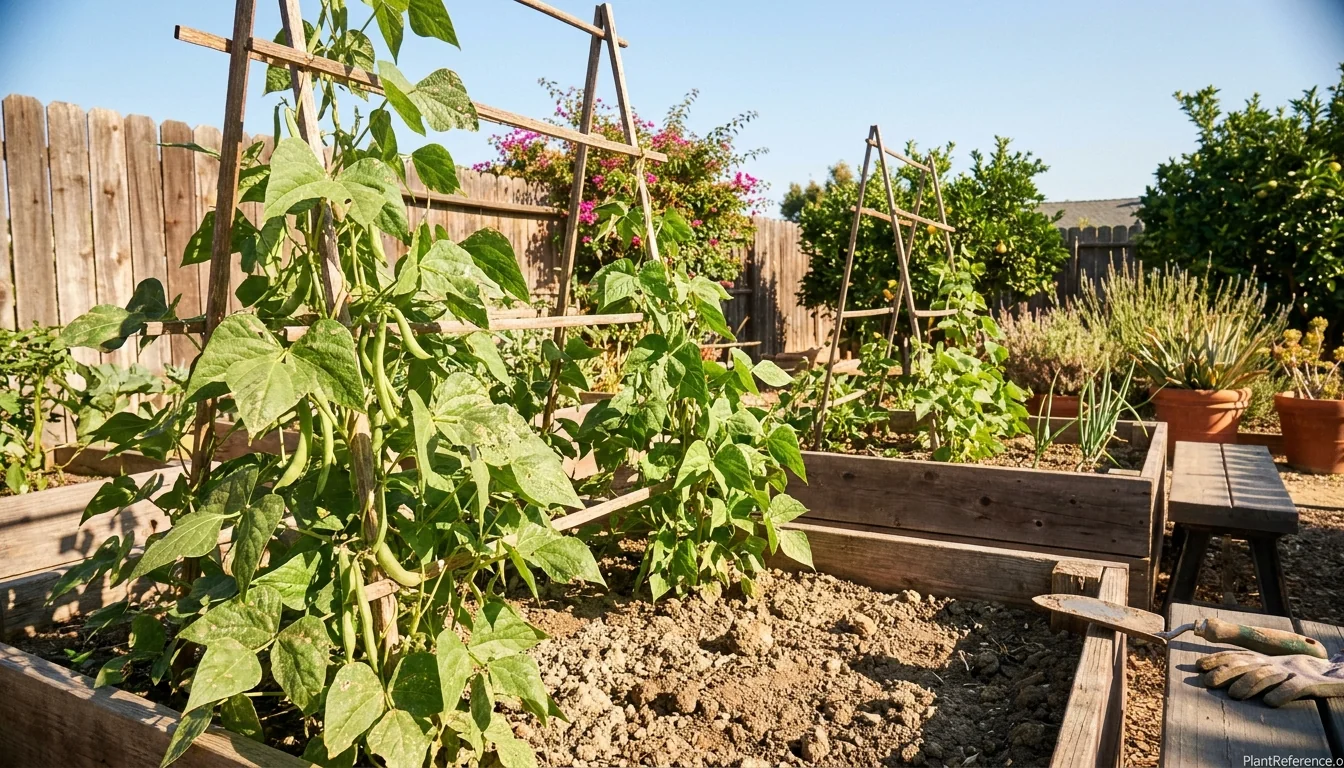
— Image © PlantReference.org 2026
Los Angeles gives green beans the longest growing window of almost any major American city—303 frost-free days between our February 15 last frost and December 15 first frost. That means seven or eight succession plantings are possible, and with careful variety selection you can harvest fresh beans from May through November. But LA gardening is never as simple as the zone number suggests. The microclimates across the basin vary wildly: inland valleys like the San Fernando hit 110°F in August while coastal neighborhoods in Santa Monica sit under cool marine layer fog through June. I've been growing beans across Southern California for years, and the key insight is that your specific microclimate determines your variety rotation and planting calendar more than the zone designation. Every bean garden in LA needs irrigation—we average 15 inches of rain, almost none between May and October. The Complete Guide to Raised Bed Gardening for Beginners (2025)
Best Green Bean Varieties for Los Angeles's Zone 10b Climate
Los Angeles soil varies dramatically across the basin. Coastal areas have sandy loam that drains fast—sometimes too fast. Inland valleys have heavier clay. The hillside neighborhoods contend with decomposed granite and thin rocky soil. Raised beds with imported soil mix normalize these differences and are the standard approach for serious vegetable growing in LA. The Mediterranean climate means low humidity through the growing season, which virtually eliminates the fungal diseases that plague green beans in the eastern US. Your primary challenges are irrigation, heat management in inland areas, and cool-marine-layer delays in coastal areas. Best Soil Mix for Raised Beds: Creating the Perfect Growing Medium
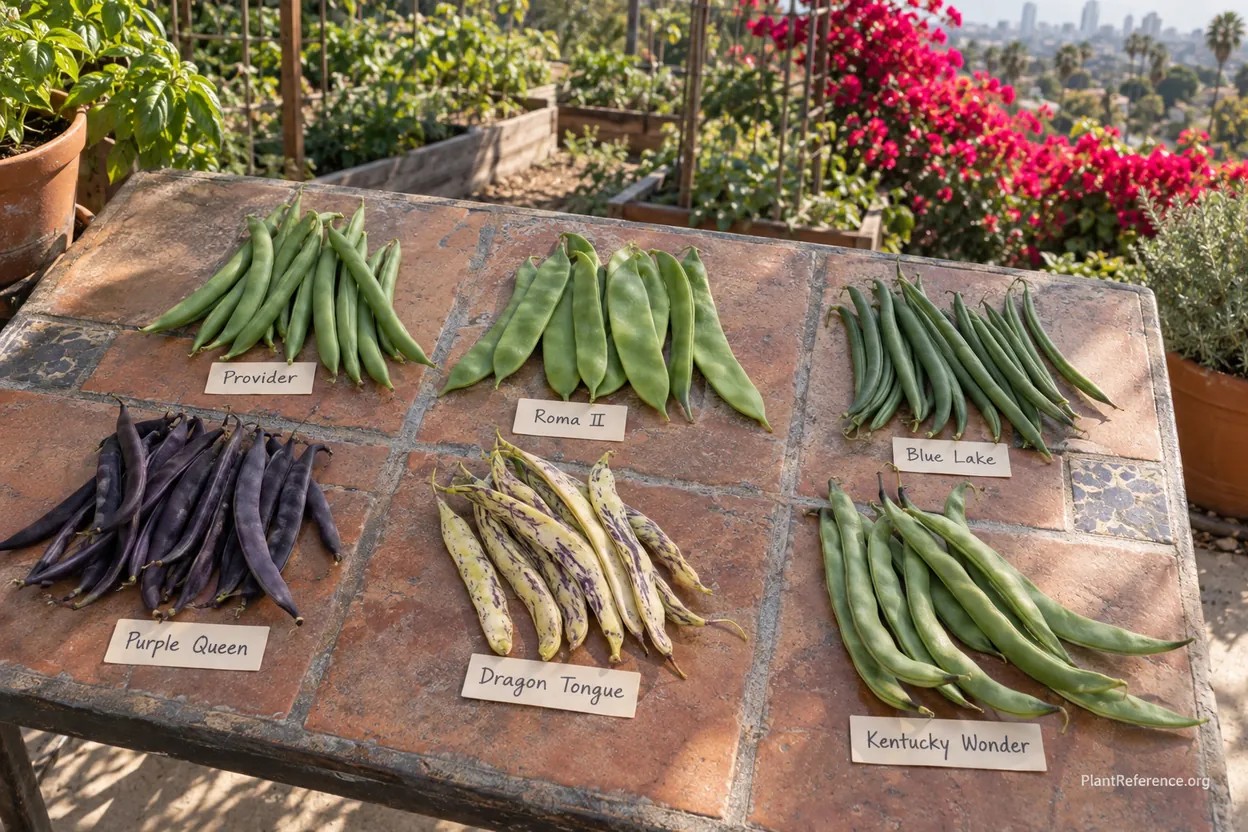
🌿Phaseolus vulgaris 'Provider' launches the LA season at 50-55 days. 🌿Phaseolus vulgaris 'Provider' germinates in cooler soil than other varieties, making it ideal for early March sowings when soil has just reached 60°F. The fast maturity means harvest by late April or early May—the earliest fresh beans of the season. Space 🌿Phaseolus vulgaris 'Provider' at 4 inches (10 cm). The compact bush habit works well in the smaller raised beds common in LA's tight urban lots.
🌿Phaseolus vulgaris 'Roma II' is the reliable workhorse at 53-60 days. 🌿Phaseolus vulgaris 'Roma II' produces broad flat Italian pods that hold quality on the plant—useful in LA's benign climate where you're not racing against disease pressure. The mosaic virus resistance is less critical here than in humid climates, but 🌿Phaseolus vulgaris 'Roma II' remains a solid performer from spring through fall.
🌿Phaseolus vulgaris 'Blue Lake' is the main-season standard at 55-65 days. 🌿Phaseolus vulgaris 'Blue Lake' produces the classic round pods ideal for canning and freezing. The vigorous bush habit needs 6-inch (15 cm) spacing. In LA's long season, 🌿Phaseolus vulgaris 'Blue Lake' can be planted from April through August for continuous production—the backbone of any succession rotation.
🌿Phaseolus vulgaris 'Purple Queen' handles inland valley heat at 55-60 days. If you garden in the San Fernando Valley, Pasadena foothills, or any inland location that exceeds 100°F in summer, 🌿Phaseolus vulgaris 'Purple Queen' is your July and August variety. Coastal gardeners rarely need its heat tolerance but may appreciate the purple pods for visual interest.
🌿Phaseolus vulgaris 'Dragon Tongue' offers a specialty option at 55-60 days. 🌿Phaseolus vulgaris 'Dragon Tongue' thrives in LA's Mediterranean climate—the dry air allows shell beans to dry perfectly on the vine through fall. Harvest young for snap beans from spring plantings or let fall plantings mature for dried beans through October and November.
🌿Phaseolus vulgaris 'Kentucky Wonder' is the pole bean at 60-70 days. 🌿Phaseolus vulgaris 'Kentucky Wonder' produces continuously for 6-8 weeks from a single planting, and LA's long season means you can plant it from April through July and still get full production. Vines reach 8-10 feet (2.4-3 m) on a trellis. The continuous harvest habit is efficient for smaller LA garden spaces where every square foot matters. Raised Bed Vegetable Garden Layout: Planning for Maximum Production
Variety | Days to Maturity | Type | Best For LA | Notes for Zone 10b |
|---|---|---|---|---|
50-55 days | Bush | Earliest spring crop | Cool-soil tolerance; March start; fast turnaround | |
53-60 days | Bush | Spring through fall | Flat Italian pod; holds quality; reliable all-season | |
55-65 days | Vigorous bush | Main season backbone | Gold standard canning and freezing; April-August | |
55-60 days | Bush | Inland valley heat | Heat-tolerant for 100°F+ areas; purple pods | |
55-60 days | Vigorous bush | Dry bean harvest | Dual-purpose; LA dry air ideal for on-vine drying | |
60-70 days | Pole | Continuous harvest | 6-8 weeks from one planting; space-efficient for small lots |
Specific Planting Dates for Los Angeles
Los Angeles averages a February 15 last frost and December 15 first frost, giving you 303 frost-free days. The practical bean window opens in early March when soil crosses 60°F and extends through September—potentially seven or eight succession plantings. Your specific microclimate shifts this calendar: coastal gardens run 2-3 weeks behind inland areas in spring because of cool marine layer, while inland valleys may need to skip July-August due to extreme heat.
Early Spring: March through April
Direct sow 🌿Phaseolus vulgaris 'Provider' starting early March (inland) or mid-March (coastal) once soil reaches 60°F. Coastal gardens under marine layer influence may need to wait until soil genuinely warms—the fog keeps mornings cool even when afternoon sun is strong. By April, all varieties are fair game across the basin. Best Raised Bed Vegetables for Beginners: Top 10 Easy-Growing Crops
Main Season: May through July
This is LA's peak bean production window. Plant 🌿Phaseolus vulgaris 'Blue Lake' and 🌿Phaseolus vulgaris 'Roma II' every 3-4 weeks. The longer interval between sowings (compared to the 2-3 weeks recommended for shorter-season cities) works because LA's consistent warm temperatures mean each planting produces over a longer harvest window. Coastal gardens can plant straight through this period. Inland valleys should switch to 🌿Phaseolus vulgaris 'Purple Queen' for July sowings.
Late Season: August through September
Continue succession planting through September. These late sowings mature during the ideal October and November harvest window—warm enough for production but past the extreme inland heat. Your last sowing in late September gives fast-maturing varieties enough time before the December 15 first frost, though in many LA microclimates frost never actually arrives.
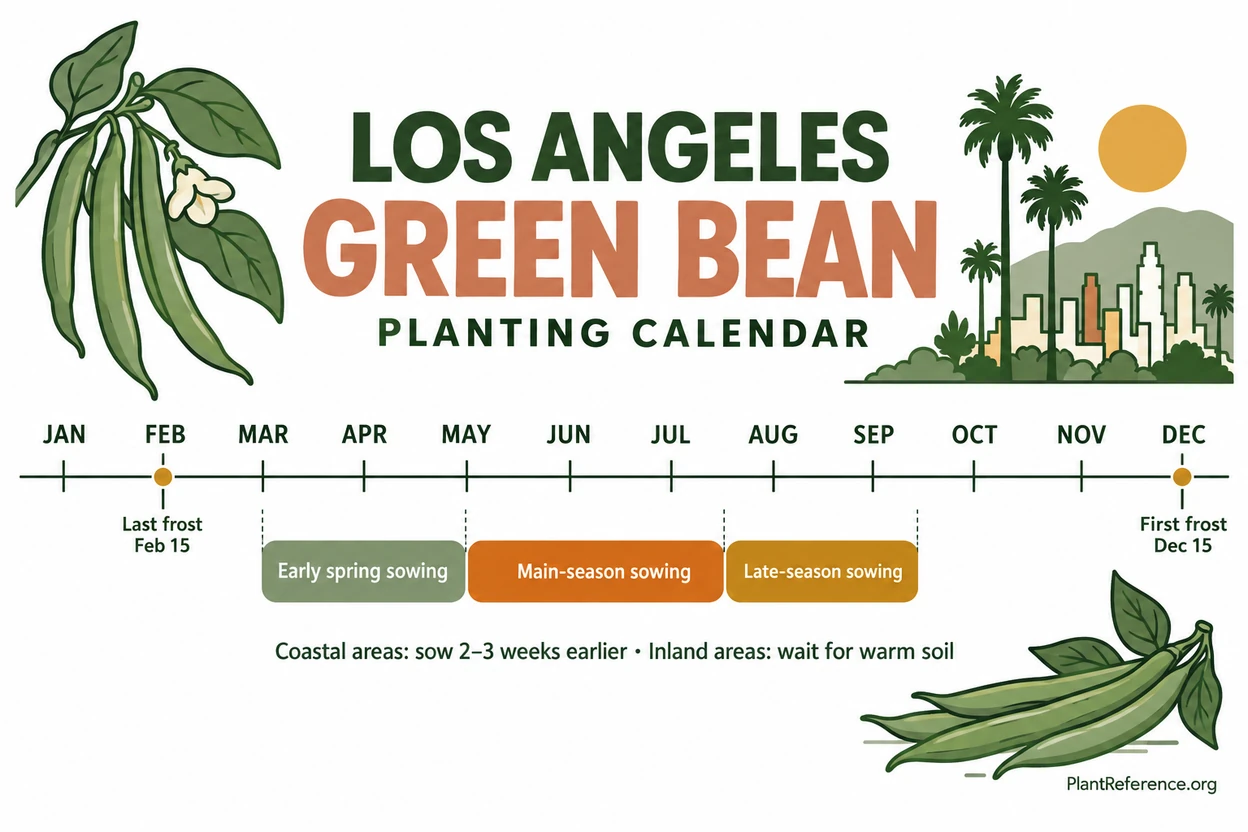
Early spring: March through April (Provider first, all varieties by April)
Main season: May through July (Blue Lake and Roma II backbone; every 3-4 weeks)
Inland summer: July-August use Purple Queen for heat tolerance
Late season: August through September (harvest October-November)
Pole bean window: April through July (Kentucky Wonder, single planting)
Season end: December 15 first frost (if it arrives at all in your microclimate)
Complete Growing Guide for Los Angeles
Soil Preparation
LA's diverse soil types—coastal sand, inland clay, hillside decomposed granite—all benefit from the raised bed approach. Mix 60% quality topsoil with 30% compost and 10% perlite for a mix that drains well in our dry climate while retaining enough moisture between irrigations. LA soil pH typically runs 6.5-7.5, close to the 6.0-6.8 range Phaseolus vulgaris prefers. In-ground gardens on the coastal side need organic matter for moisture retention in sandy soil. Inland clay needs it for drainage. Best Soil for Raised Beds: 6 Commercial Mixes Tested and Compared
Phaseolus vulgaris fixes its own nitrogen through Rhizobium root nodule bacteria. In LA's year-round gardening cycle, beans serve a valuable rotation role—the nitrogen they leave behind feeds the heavy-feeding crops like tomatoes that follow them.
Planting Method
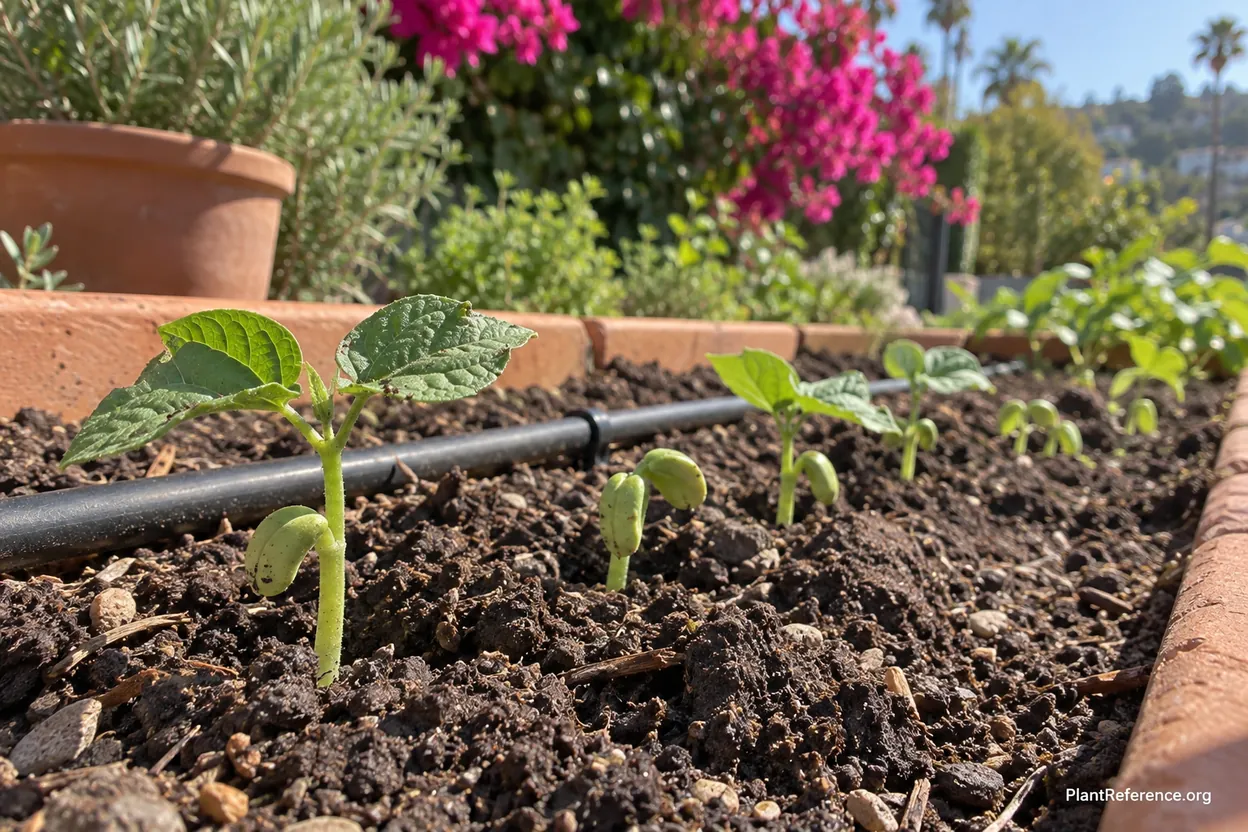
Direct sow all varieties 1 inch (2.5 cm) deep. Space bush types at 4 inches (10 cm) and vigorous varieties at 6 inches (15 cm) in rows 18-24 inches (45-60 cm) apart. Water immediately after planting. In LA's dry climate, pre-soak seeds for 4-8 hours before planting to speed germination—the dry air and fast-draining soil can dehydrate seeds before they sprout. Keep soil consistently moist until germination. How to Build a Raised Garden Bed: Step-by-Step Construction Guide
Watering
LA averages 15 inches of rain annually—and virtually none falls between May and October. Irrigation is not supplemental; it is the complete water supply during the entire main growing season. Green beans need 1-1.5 inches (2.5-4 cm) per week. Drip irrigation is the standard LA approach: it conserves water (critical in drought-prone Southern California), minimizes evaporation, and keeps foliage dry. Water 3-4 times per week in summer with short cycles that soak without runoff. Early morning watering reduces evaporation losses. Raised Bed Irrigation Systems: Watering Solutions for Consistent Growth
Fertilizing
Apply low-nitrogen fertilizer (5-10-10) at planting. Phaseolus vulgaris fixes its own nitrogen, so avoid the nitrogen-heavy formulas that push foliage over pods. Side-dress with compost at flowering. LA's year-round growing means soil nutrients deplete faster than in seasonal climates—refresh compost between each succession planting rather than just annually. Nutrient Deficiencies in Raised Beds: Visual Diagnosis and Treatment
Mulching
Apply 2-3 inches (5-8 cm) of straw or wood chip mulch to conserve moisture in LA's dry air. Mulch also moderates soil temperature during inland heat waves and suppresses the aggressive weeds that thrive year-round in our frost-free climate. In LA's low humidity, mulch doesn't create the disease-promoting moisture that it can in humid climates. Replace mulch between succession plantings as it breaks down in the warm climate. Raised Bed Weeds: Prevention Strategies and Control Methods
Trellising Pole Beans
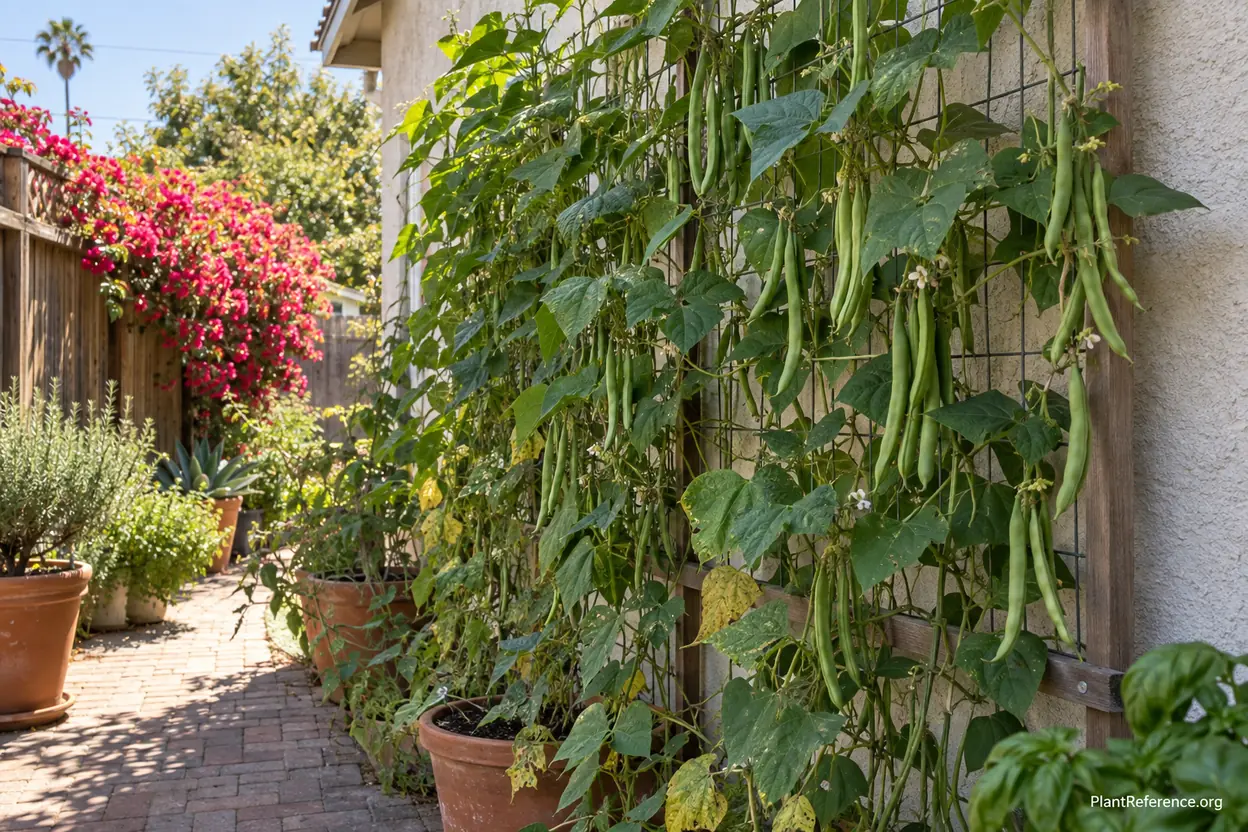
🌿Phaseolus vulgaris 'Kentucky Wonder' vines reach 8-10 feet (2.4-3 m). In LA's smaller urban lots, pole beans on a vertical trellis produce far more per square foot than bush varieties in a bed. Use sturdy bamboo teepees or wall-mounted trellises to maximize vertical space. The dry climate means you can plant pole beans closer together than in humid areas without disease problems.
Troubleshooting Los Angeles-Specific Problems
Marine Layer and Slow Starts (Coastal)
Coastal LA neighborhoods under "June gloom" marine layer influence may find green beans slow to germinate and produce through late spring. Cool foggy mornings keep soil temperatures lower than inland. Start coastal plantings 2-3 weeks later than inland schedules. Use black plastic mulch or row cover to warm soil in early spring. Once June gloom lifts in July, coastal bean production catches up quickly and often continues later into fall than inland locations. Raised Bed Too Hot in Summer: Protecting Plants from Heat Stress
Inland Heat and Blossom Drop
San Fernando Valley, Pasadena foothills, and other inland LA areas regularly exceed 100°F in July and August—sometimes reaching 110°F during Santa Ana wind events. Bean blossoms drop above 90°F sustained heat. Use 🌿Phaseolus vulgaris 'Purple Queen' for midsummer inland plantings. Shade cloth at 30-40% density helps during extreme heat events. Time succession plantings so your July sowing matures in September after the worst heat breaks. Coastal gardens rarely face this problem.
Water Conservation and Drought
Southern California's perpetual water concerns make efficient irrigation non-negotiable. Drip irrigation on a timer is the responsible approach—overhead sprinklers waste 30-50% to evaporation and overspray. Mulch heavily to reduce water demand. Consider greywater systems for garden irrigation where local codes permit. Green beans are moderately water-efficient compared to other vegetables, making them a reasonable choice for water-conscious LA gardens. Raised Bed Pest Problems: Identification and Organic Control Methods
Whiteflies and Aphids
LA's warm year-round climate supports persistent whitefly and aphid populations that plague green beans. Strong water spray dislodges both pests from leaf undersides. For heavier infestations, apply neem oil or insecticidal soap in early morning or evening. The warm winter means pest populations never crash the way they do in freezing climates—monitor beans year-round and address infestations early before populations explode. Ladybugs and lacewings are effective biological controls in LA gardens. Poor Drainage in Raised Beds: Causes and Fixes for Waterlogged Soil
Harvest & Storage
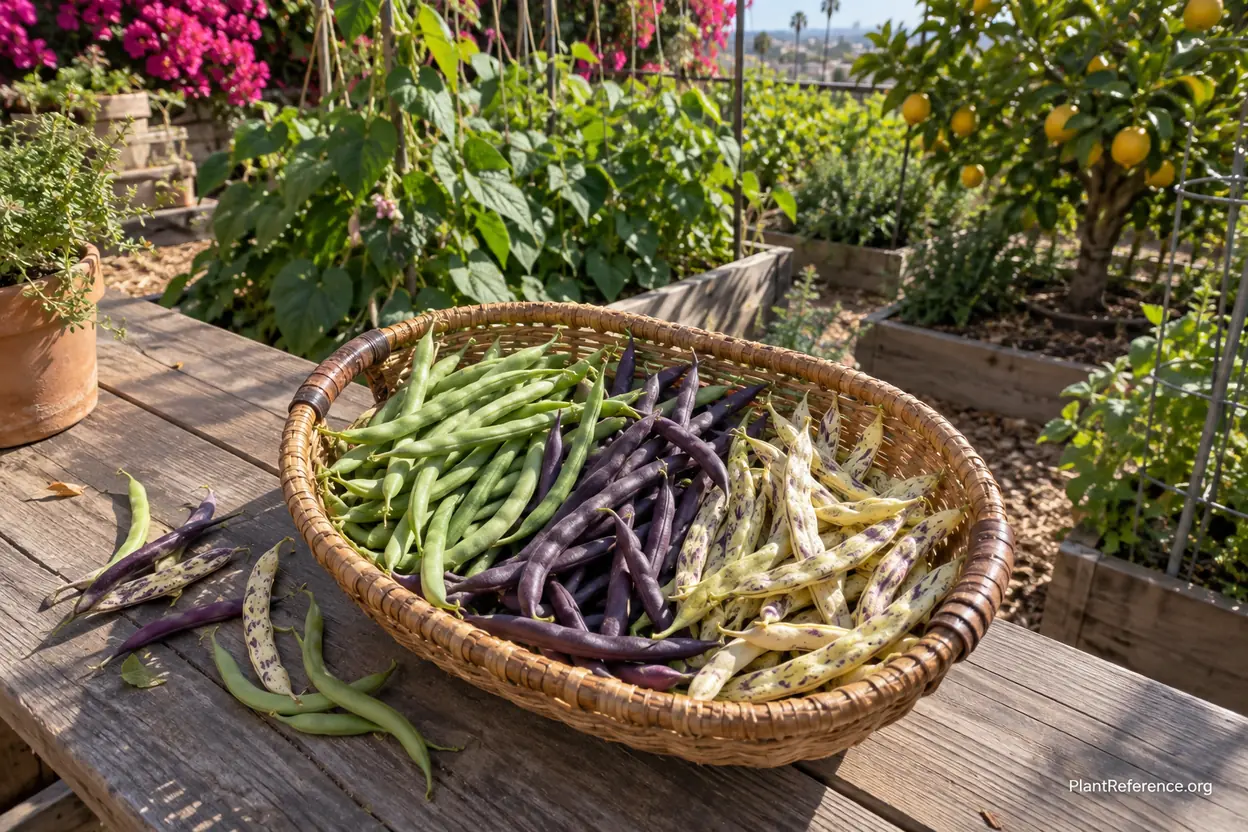
Harvest bush beans when pods are 4-6 inches (10-15 cm) long and snap crisply when bent. LA's warm consistent temperatures keep beans producing longer per planting than cooler climates—a single bush bean sowing may produce for 3-4 weeks before exhausting. Pick every 2-3 days during peak production. Leaving over-mature pods signals Phaseolus vulgaris to slow flower production. Harvest in morning before afternoon heat wilts pods.
🌿Phaseolus vulgaris 'Kentucky Wonder' pole beans need harvest every 1-2 days during peak. The continuous production from a single planting can last 6-8 weeks in LA's ideal temperatures.
Fresh beans store 5-7 days refrigerated. For freezing, blanch 3 minutes, ice bath, drain, and freeze flat before bagging. LA's seven or eight succession plantings produce more fresh beans than most families can eat—freezing ensures nothing goes to waste. 🌿Phaseolus vulgaris 'Blue Lake' is the freezing standard. 🌿Phaseolus vulgaris 'Dragon Tongue' dries beautifully on the vine in LA's arid fall air—let pods brown completely, shell, and store dried beans in jars for winter cooking.
Frequently Asked Questions
Reading about plants and recognising them are different skills. These three build the second.
- Daily PlantIdentify the day’s mystery plant from a close-up photograph.
- Keyed OutWork a dichotomous key, lead by lead, to name a hidden specimen.
- Name That PlantName a specimen from botanical clues dealt hardest first.
Free to play, no account needed
Tagged with
Emma runs a small succulent propagation business from her home in San Diego, shipping starter plants and cuttings across the country. She fell into succulents after college when she realized they were the only plants that survived her travel schedule—she was working as a travel nurse at the time. San Diego's mild, dry climate is ideal for outdoor succulent gardens, and Emma's front yard is a living catalog of over 200 varieties. She completed a certificate program in ornamental horticulture and writes about succulent care, propagation techniques, and drought-tolerant garden design. Her writing is calm and reassuring—she knows people feel bad about killing plants, and she wants them to stop worrying so much.