When to Plant Onions in Denver: Zone 5a Dates + Best Varieties
Pets & Toxicity
Recorded toxicity for plants linked in this guide. An unknown status is not a safety assessment.
Allium cepa 'Walla Walla' — Toxicity Warning
Toxic to petsView Allium cepa 'Walla Walla' plant profileAllium cepa 'Yellow Sweet Spanish' — Toxicity Warning
Toxic to petsView Allium cepa 'Yellow Sweet Spanish' plant profileAllium sativum 'California Early' — Toxicity Warning
Toxic to petsView Allium sativum 'California Early' plant profile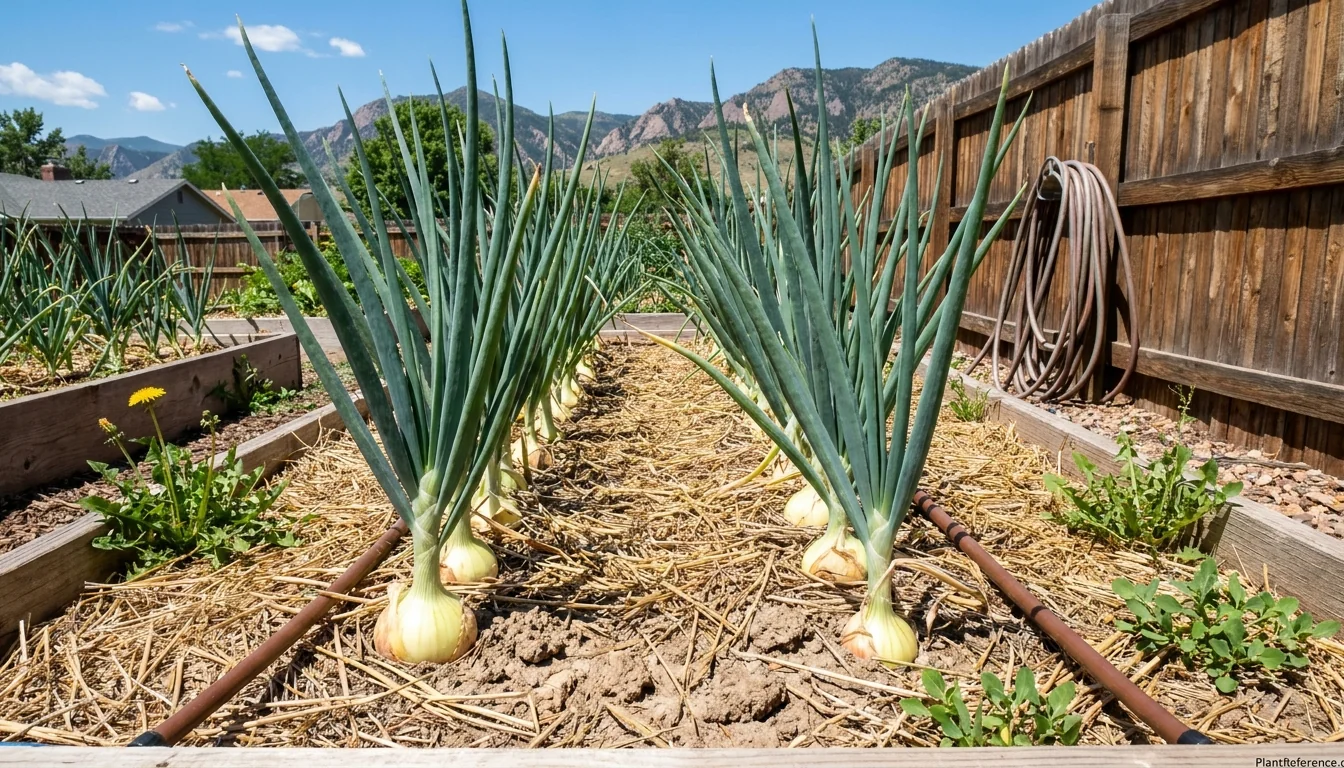
— Image © Plant Reference 2026
Denver's Front Range gives onions a strange mix of conditions: alkaline clay soil, 15 inches of annual precipitation, intense UV at 5,280 feet, and temperature swings that can drop you from 70°F to snow in a single afternoon. The good news is that onions are tougher than most spring crops, and Denver's 40°N latitude puts you firmly in long-day onion territory—the type bred to bulb when daylight stretches past 14 hours in late June. Time your planting correctly and onions will give you one of the most reliable harvests in the Colorado vegetable garden.
Best Onion Varieties for Denver's Zone 5a Climate
Denver sits at roughly 40°N latitude, which puts the Front Range on the southern edge of true long-day onion country. Long-day varieties need 14-16 hours of daylight to switch from leaf growth into bulb formation, and Denver hits that threshold from late June through early August. Plant the wrong day-length type—say, a short-day variety meant for Texas—and your bulbs will stay small no matter how perfectly you grow them. Stick with long-day cultivars and you set yourself up for success before you ever pick up a trowel.
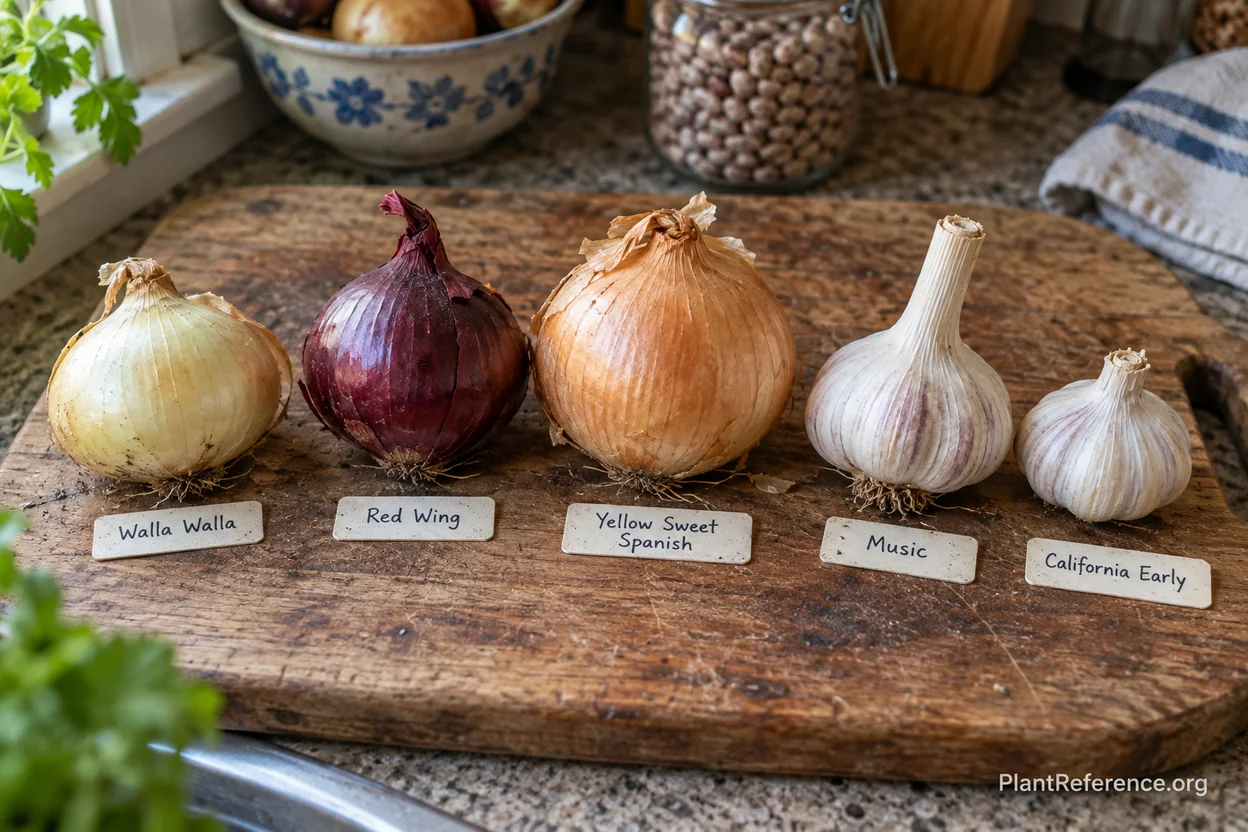
🌿Allium cepa 'Walla Walla' (AL-ee-um SEE-pa) is the sweet onion most Denver gardeners ask for by name. It is a long-day variety bred in the Pacific Northwest at a similar latitude, and its mild flavor and large bulbs make it a favorite for fresh eating and burgers. The trade-off is short storage—🌿Allium cepa 'Walla Walla' holds for 4-6 weeks once cured. Grow it for summer kitchen use, not the root cellar.
🌿Allium cepa 'Red Wing' is the long-day storage onion to anchor your patch with. The bulbs hold their red-purple skin and firm white flesh for 6-9 months in cool storage, which matters when Denver winters keep you out of the garden. It tolerates the Front Range's sudden temperature swings better than many sweet onions and resists pink root, a soil-borne disease that can show up in older Denver garden beds.
🌿Allium cepa 'Yellow Sweet Spanish' bridges the gap between fresh eating and storage. It is technically a long-day to intermediate-day variety, which means it performs well at Denver's borderline latitude. Large, mild, golden bulbs cure decently and store for 3-4 months. It is the workhorse onion for slicing, sautéing, and tossing into anything that needs cooking down.
For garlic, Denver's cold winters and dry summers favor hardneck types. 🌿Allium sativum 'Music' (AL-ee-um sa-TY-vum) is a Porcelain-class hardneck that has become the standard recommendation across the Mountain West. The cloves are large, the flavor is full, and the bulbs hold for 4-6 months in cool storage. You also get to harvest scapes in June—the curly flower stalks that taste like mild garlic and are worth the planting on their own.
If you want a backup or a softneck for braiding, 🌿Allium sativum 'California Early' works in Denver despite being bred for warmer climates. Plant it deeper (3-4 inches/7.5-10 cm) and mulch heavily for winter survival. The smaller cloves are milder, and the bulbs braid well and store 8-10 months.
For year-round green onion supply, 🌿Allium fistulosum (AL-ee-um fih-stoo-LO-sum)—true bunching onions, sometimes called scallions—handle Denver's spring frosts and summer heat with little fuss. Plant in succession every 3 weeks from April through August.
Variety | Type | Days to Maturity | Best For | Notes for Denver |
|---|---|---|---|---|
Long-day sweet | 110-125 days | Fresh eating, summer kitchen | Sweet & mild but stores only 4-6 weeks | |
Long-day storage | 105-120 days | Long-term storage | Best storage life; resists pink root | |
Long/intermediate | 110-120 days | All-purpose cooking | Reliable at Denver's borderline 40°N latitude | |
Hardneck garlic | 240-270 days | Cold-climate planting | Big cloves, scapes in June, fall plant only | |
Softneck garlic | 240-270 days | Braiding & long storage | Plant deeper & mulch heavy for Denver winters | |
Bunching/scallion | 60-70 days | Continuous green onions | Plant every 3 weeks April-August |
Specific Planting Dates for Denver
Denver's May 10 average last frost date does not anchor onion planting the way it does tomatoes or peppers. Onions and garlic are cold-hardy and need to go in the ground much earlier so they can build leaf mass before the long days of late June flip them into bulbing mode. Every date below assumes a typical Front Range spring—if a particular year runs warmer or colder, adjust by a week.
Onion Sets and Transplants (Spring Planting)
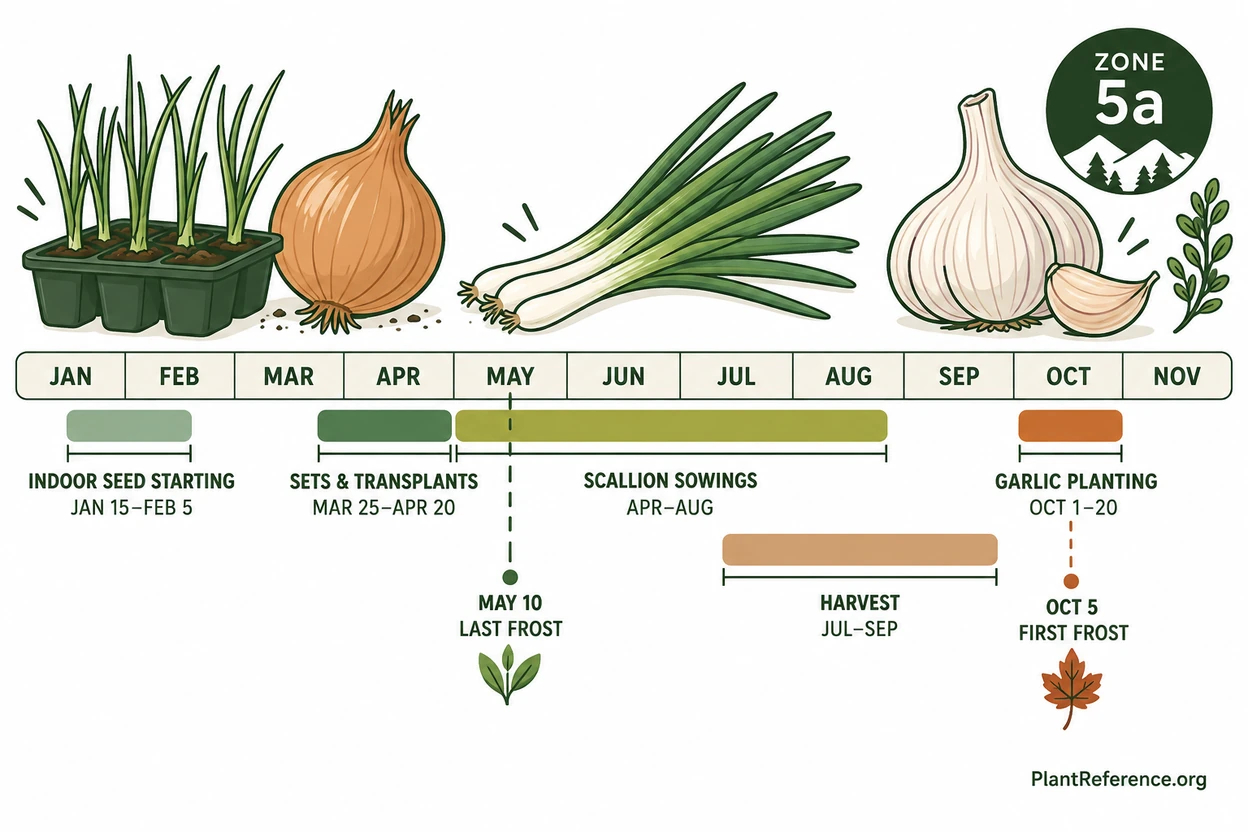
Plant onion sets and transplants outdoors March 25 through April 20, as soon as the soil can be worked. Onions tolerate light frost down to 20°F (-7°C), so the May 10 last frost date is not a constraint—it is a milestone you plant well before. The earlier you get them in the ground, the more leaves they will grow before bulbing is triggered. Every leaf becomes a ring in the bulb, so more leaves means a bigger onion.
Push sets into prepared soil 1 inch (2.5 cm) deep, pointed end up, 4 inches (10 cm) apart. For transplants, trim the roots back to 2 inches (5 cm) and the tops to 4 inches (10 cm)—this reduces transplant shock and triggers vigorous new root growth. Set transplants 1 inch (2.5 cm) deep at the same 4-inch (10 cm) spacing.
Onion Seeds (Indoor Start)
If you want varieties you cannot find as sets, start onion seeds indoors January 15 through February 5, roughly 10-12 weeks before transplanting. That seems early because it is—onion seedlings are slow, and they need time to reach pencil thickness before going outside. Use a heat mat to hit 70°F (21°C) for germination, then drop to 60-65°F (16-18°C) under lights once seedlings emerge. Trim tops to 4 inches (10 cm) every couple of weeks to encourage thicker stems.
Garlic (Fall Planting)
Plant garlic cloves October 1 through October 20, about 4-6 weeks before the ground freezes hard. The window matters because garlic needs to grow roots before winter without sending up tops that will freeze back. October planting in Denver gives the cloves 4-6 weeks of root establishment before the soil drops below 40°F (4°C). Push individual cloves 2-3 inches (5-7.5 cm) deep, pointed end up, 6 inches (15 cm) apart. Mulch 3-4 inches (7.5-10 cm) deep with straw or shredded leaves immediately after planting—this keeps soil temperatures steady through Denver's freeze-thaw cycles, which are far more damaging than steady cold.
Scallions and Bunching Onions
Sow 🌿Allium fistulosum seed directly April 1 through August 15 in successive 3-week intervals for continuous harvest. Direct seed 1/4 inch (0.6 cm) deep, 2 inches (5 cm) apart in rows 6 inches (15 cm) apart. The fall planting from late July gives you scallions through November under row cover.
Key Date Summary
Indoor onion seed start: January 15 - February 5
Outdoor onion sets & transplants: March 25 - April 20
First scallion sowing: April 1 (succession every 3 weeks)
Onion harvest window: late July - early September
Garlic fall planting: October 1 - October 20
Garlic harvest: late June - mid July (following year)
Season ends: October 5 (first frost)
Complete Growing Guide for Denver
Site Selection and Soil Preparation
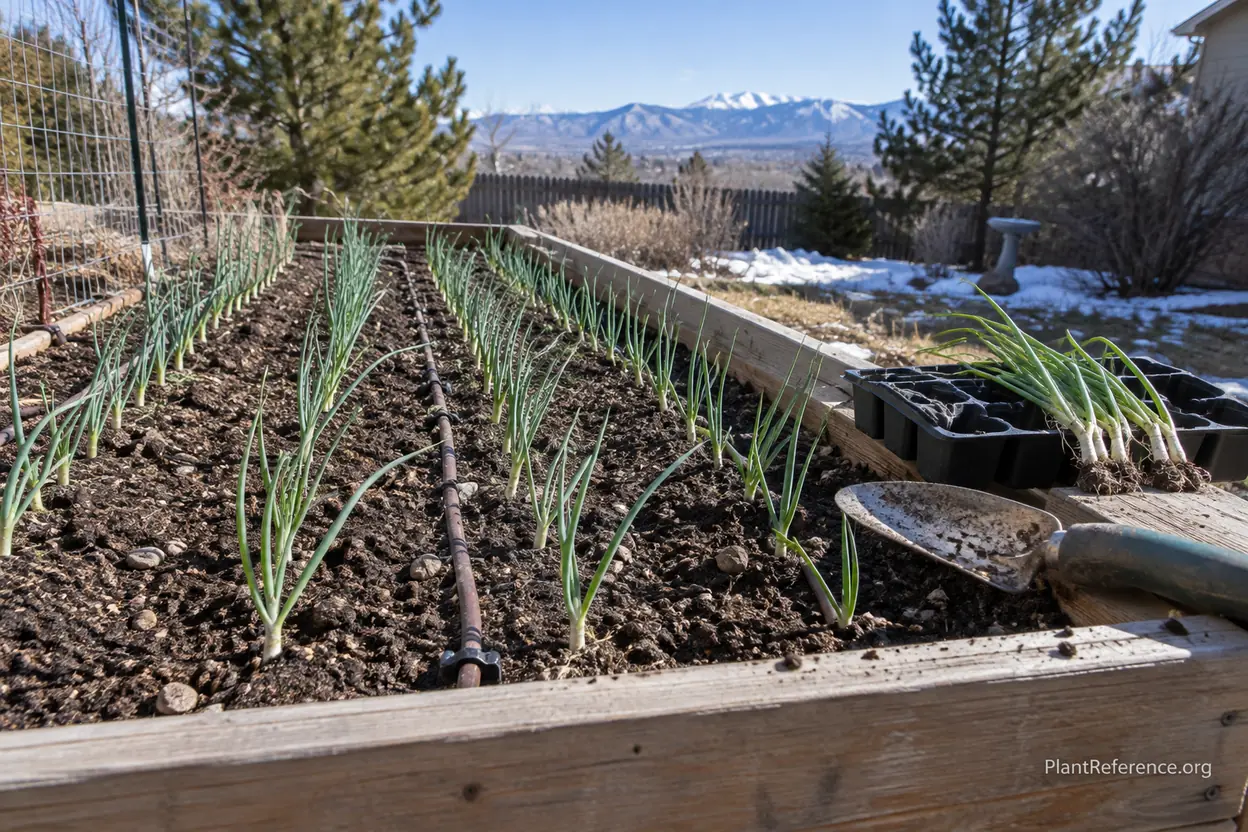
Onions and garlic need full sun—at least 8 hours daily—and they want a loose, fertile, well-drained bed. That is a tall order in Denver's native clay, which packs hard, drains poorly, and runs alkaline at pH 7.5-8.5. The fix is the same fix for most Front Range vegetable growing: build up, do not dig down. Raised beds filled with a mix of topsoil and compost give onions the loose root run they need without fighting clay. Raised Bed Soil Settling and Compaction: Prevention and Solutions
Work 3-4 inches (7.5-10 cm) of finished compost into the bed in fall or very early spring, along with a balanced organic fertilizer (5-5-5 or similar) at the rate listed on the bag. Best Soil for Raised Beds: 6 Commercial Mixes Tested and Compared If a soil test shows pH above 7.5, work in elemental sulfur the previous fall to nudge it toward 6.5-6.8, where alliums take up nutrients best. Raised Bed Soil pH Problems: Testing, Adjusting, and Maintaining Balance
Watering on the Front Range
Onions are shallow-rooted. The bulk of their roots live in the top 6 inches (15 cm) of soil, which is the layer that dries out fastest in Denver's low humidity. Aim for 1 inch (2.5 cm) of water per week from rainfall and irrigation combined, delivered evenly. Drip irrigation works far better than overhead watering—it puts water directly at the root zone instead of evaporating in Denver's dry air, and it keeps the foliage dry, which helps prevent fungal problems later.
Cut watering by half once tops begin to yellow and fall over in midsummer. Excess water at that stage rots necks and gives you onions that will not store. Stop watering entirely once half the tops have fallen over—that is the signal to start curing.
Mulching for Temperature Moderation
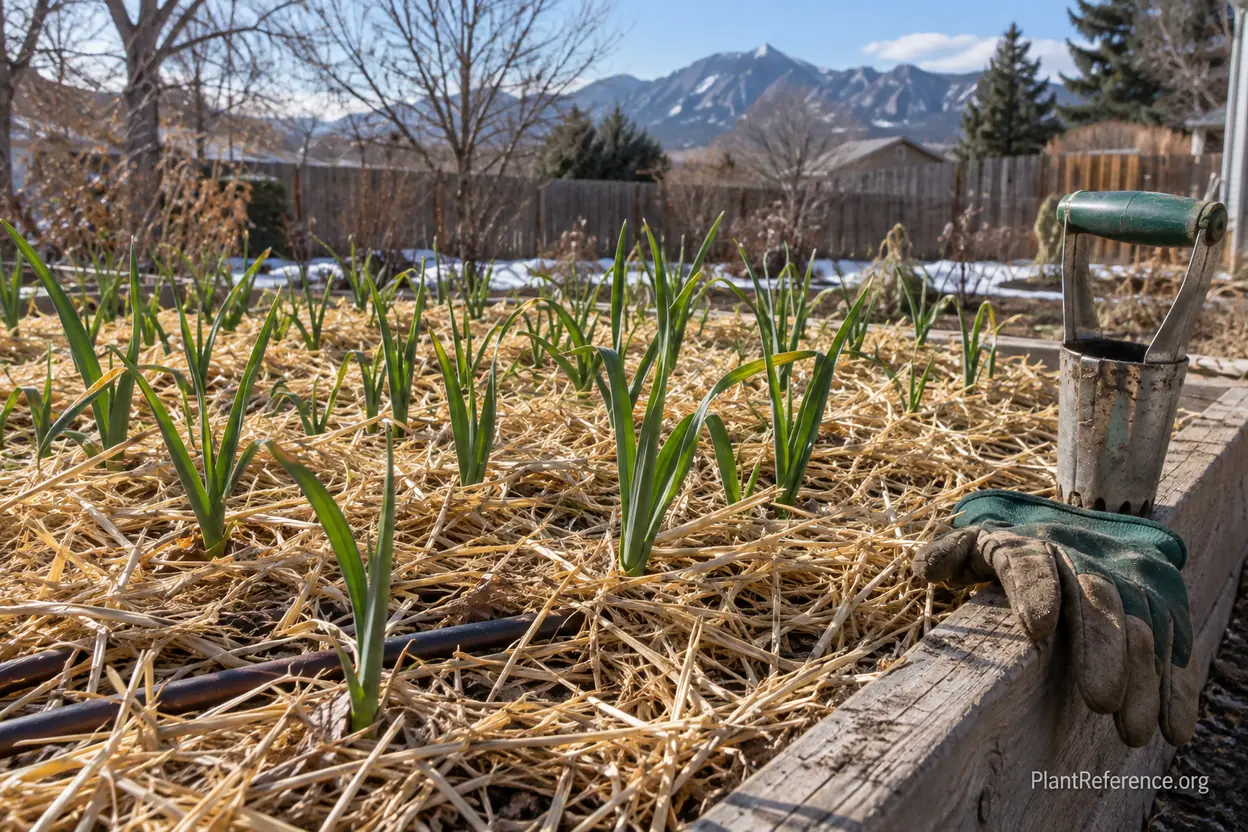
Denver's combination of intense UV and dry air punishes bare soil. A 2-3 inch (5-7.5 cm) layer of straw or shredded leaf mulch around onions after they reach 6 inches (15 cm) tall does three things at once: it moderates soil temperature during 90°F (32°C) summer afternoons, it conserves moisture between waterings, and it suppresses weeds that would otherwise compete for water in a dry climate. Keep the mulch pulled back 1 inch (2.5 cm) from the onion necks so air can move and the bulbs can size up properly.
For fall-planted garlic, mulching is non-negotiable. Apply 3-4 inches (7.5-10 cm) of straw immediately after planting in October. This insulating layer prevents the freeze-thaw heaving that pushes cloves out of the ground during Denver's bipolar winters, where a 60°F afternoon can be followed by 5°F overnight.
Fertilizing
Side-dress onions with a high-nitrogen organic fertilizer (blood meal, fish meal, or 12-0-0) every 3-4 weeks from emergence until the tops are about pencil-thick at the base. Nitrogen during leaf growth means more leaves, which means more rings, which means bigger bulbs. Stop nitrogen completely once the bulbs begin to swell at soil level—late nitrogen produces thick necks that resist curing and rot in storage.
For garlic, side-dress in late March or early April when tops begin to push hard, then once more in mid-May. Stop feeding by June 1 to let the bulbs cure cleanly. When to Plant Peppers in Denver: Complete Guide + Best Varieties for Zone 5a
Troubleshooting Denver-Specific Problems
Bolting (Premature Flowering)
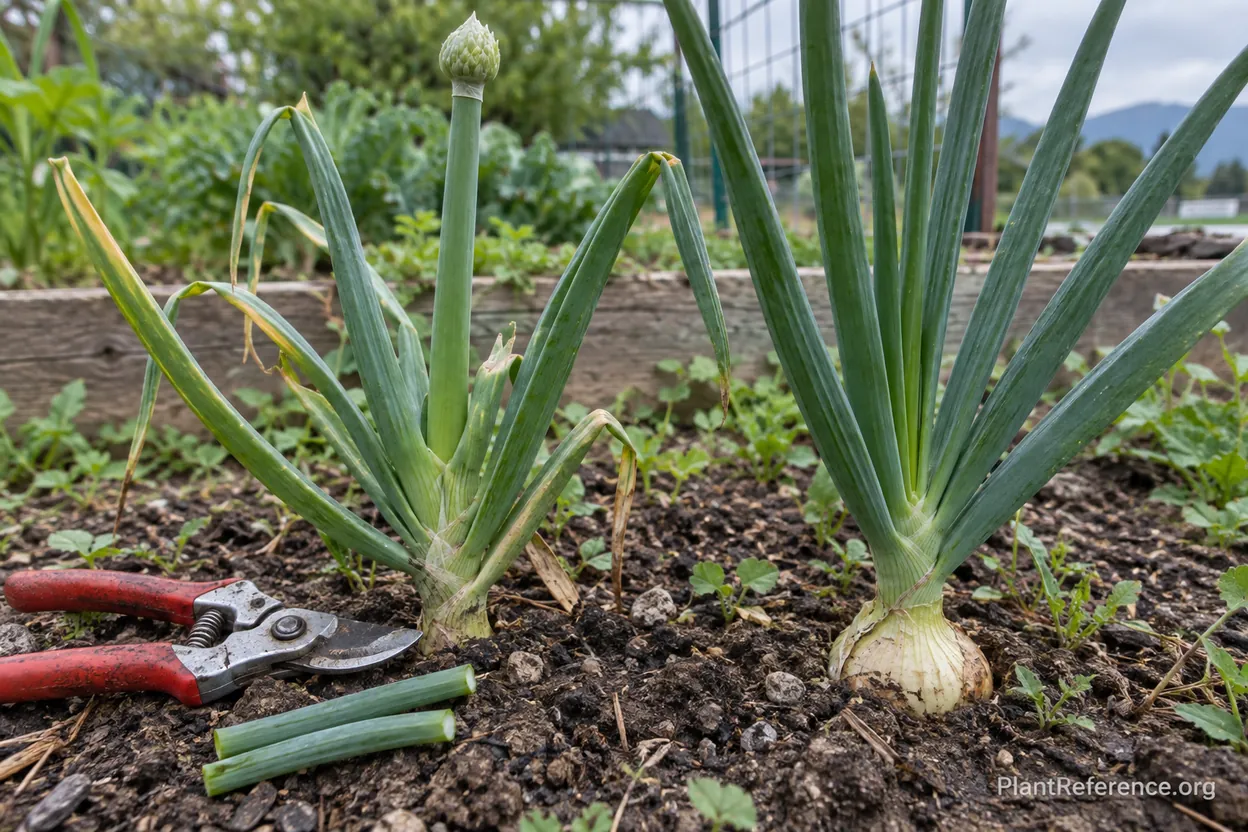
Bolting—where the plant sends up a flower stalk instead of forming a proper bulb—is the most frustrating onion failure in Denver. The usual causes here are oversized sets (anything larger than a dime tends to bolt) and the wild temperature swings of Front Range springs. A run of warm days followed by a cold snap below 40°F (4°C) can convince the plant it has been through two seasons and trigger flowering.
You cannot stop a flower stalk once it starts, but you can prevent the next round. Buy small sets, plant on the early end of the window so plants are well-rooted before any cold snaps, and snap off any flower stalks immediately if they appear—this redirects energy back to the bulb, though the bulb will not store well. 🌿Allium cepa 'Red Wing' resists bolting better than 🌿Allium cepa 'Walla Walla'.
Onion Maggots
Onion maggot flies lay eggs at the base of plants in mid-May to mid-June along the Front Range, and the larvae tunnel into bulbs and stems. Affected plants wilt, yellow, and pull out of the ground without resistance. Floating row covers from planting through mid-June break the egg-laying cycle and are the single most effective prevention. Avoid composted manure in onion beds during the planting year—it can attract egg-laying flies. When to Plant Squash in Denver: Complete Guide + Best Varieties for Zone 5a
Pink Root
Pink root is a soil-borne fungal disease that turns roots pink, then brown, then mushy. Bulbs stay small and never reach full size. Prevention is everything—rotate alliums on a 3-4 year cycle so they do not return to the same bed, and plant resistant varieties like 🌿Allium cepa 'Red Wing' in beds with any history of the disease. Once pink root is established in soil, there is no organic cure.
Thick Necks and Poor Curing
Onions in Denver sometimes refuse to cure because the necks stay too thick to dry down. The cause is almost always late-season nitrogen or excess water close to harvest. Stop fertilizing by mid-June for onions, stop watering when tops begin to fall, and resist the urge to feed plants that look stalled in July—they are not stalled, they are bulbing. When to Plant Cucumbers in Denver: Complete Guide + Best Varieties for Zone 5a
Sunscald
Denver's UV is intense. Bulbs that get exposed to direct sun during the last few weeks before harvest can scald—the outer layers turn yellow and papery, then crack and rot in storage. The solution is to leave the dying tops loosely covering the bulb shoulders until harvest, and to cure the onions out of direct sun. When to Plant Green Beans in Denver: Complete Guide + Best Varieties for Zone 5a
Harvest & Storage
Pull onions when about half of the tops have flopped over naturally and the necks at the base of the leaves have started to soften—usually late July through early September in Denver depending on variety and planting date. Pulling too early gives you bulbs that have not finished sizing; pulling too late risks split skins and rot in storage. Lift bulbs by the tops gently—if a top breaks off, the bulb is a fresh-eating onion, not a storage onion.
Cure onions for 2-3 weeks in a shaded, well-ventilated spot—a covered porch, a garage with the door open, or a screened shed all work. Lay the bulbs out in a single layer or hang in mesh bags. Denver's low humidity and warm late-summer days are nearly ideal for curing. The onions are cured when the necks are tight and dry to the touch and the outer skins are papery. Trim tops 1 inch (2.5 cm) above the bulb and trim roots flush. Store in mesh bags at 32-40°F (0-4°C) and 60-70% humidity—a cool basement or a refrigerator in extreme cases. When to Plant Lettuce in Denver: Complete Guide + Best Varieties for Zone 5a
For garlic, harvest when the bottom 3-4 leaves have browned but the top 4-5 are still green—usually late June through mid-July from October-planted cloves. Lift carefully with a digging fork to avoid bruising the wrapper leaves, then cure for 3-4 weeks before trimming and storing. Hardneck garlic stores 4-6 months at 50-60°F (10-16°C); softneck stores 8-10 months under the same conditions. When to Plant Onions in Salt Lake City: Complete Guide + Best Varieties for Zone 7a
Frequently Asked Questions
Reading about plants and recognising them are different skills. These three build the second.
- Daily PlantIdentify the day’s mystery plant from a close-up photograph.
- Keyed OutWork a dichotomous key, lead by lead, to name a hidden specimen.
- Name That PlantName a specimen from botanical clues dealt hardest first.
Free to play, no account needed
Tagged with
Nathan is a garden designer in Denver who focuses on water-wise plantings adapted to Colorado's Front Range climate. He grew up in Nebraska, studied environmental science in college, and fell into garden design after spending summers working at a native plant nursery in Fort Collins. Denver's climate is genuinely challenging—low humidity, intense UV, alkaline clay soil, and wild temperature swings that can go from 70°F to snow in 24 hours. Nathan designs gardens that handle all of that without supplemental irrigation once established. He writes about xeric gardening, native plant selection for the Front Range, and the practical realities of high-altitude growing.