When to Plant Onions in Boston: Zone 6b Dates + Varieties
Pets & Toxicity
Recorded toxicity for plants linked in this guide. An unknown status is not a safety assessment.
Toxic to pets: Walla Walla sweet onion, red wing storage onion, yellow sweet Spanish onion and 3 moreDetailsHide
Allium cepa 'Walla Walla' — Toxicity Warning
Toxic to cats and dogs if eaten; cats are especially susceptible, and raw, cooked or concentrated plant material can damage red blood cells and cause anaemia.View Allium cepa 'Walla Walla' plant profileAllium cepa 'Red Wing' — Toxicity Warning
Toxic to cats and dogs if eaten; cats are especially susceptible, and raw, cooked or concentrated plant material can damage red blood cells and cause anaemia.View Allium cepa 'Red Wing' plant profileAllium cepa 'Yellow Sweet Spanish' — Toxicity Warning
Toxic to cats and dogs if eaten; cats are especially susceptible, and raw, cooked or concentrated plant material can damage red blood cells and cause anaemia.View Allium cepa 'Yellow Sweet Spanish' plant profileAllium fistulosum — Toxicity Warning
Toxic to cats and dogs if eaten; cats are especially susceptible, and raw, cooked or concentrated plant material can damage red blood cells and cause anaemia.View Allium fistulosum plant profileAllium sativum 'Music' — Toxicity Warning
Toxic to cats and dogs if eaten; cats are especially susceptible, and raw, cooked or concentrated plant material can damage red blood cells and cause anaemia.View Allium sativum 'Music' plant profileAllium sativum 'California Early' — Toxicity Warning
Toxic to cats and dogs if eaten; cats are especially susceptible, and raw, cooked or concentrated plant material can damage red blood cells and cause anaemia.View Allium sativum 'California Early' plant profile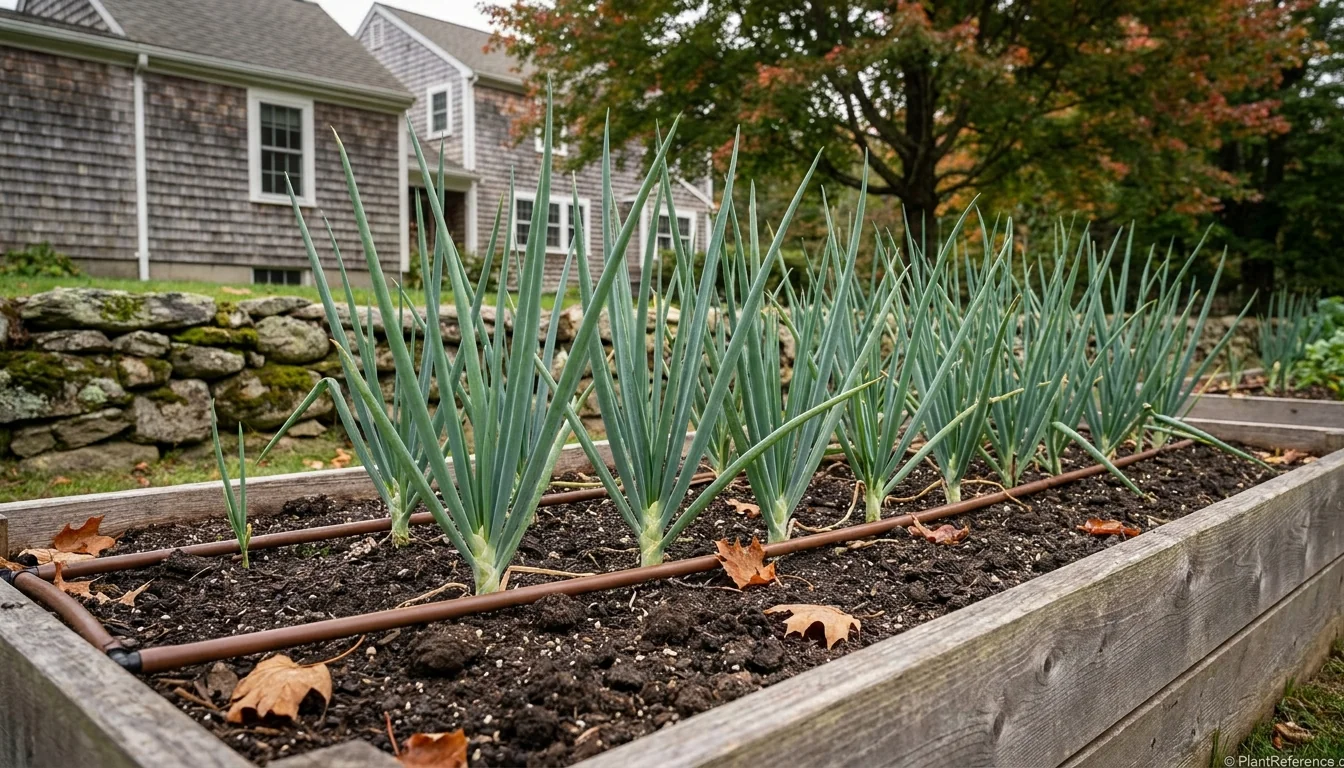
— Image © PlantReference.org 2026
Knowing when to plant onions in Boston starts with a fact that trips up a lot of New England gardeners: onions don't bulb on a calendar, they bulb on day length. At our latitude in Zone 6b, that means long-day varieties, planted early while the weather is still cool. I think about alliums the way I think about garden structure—they're the dependable bones of the spring vegetable bed, in the ground before almost anything else and quietly working all season. Get the timing and the variety right and onions and garlic are about as low-maintenance as edible crops get around here.
Best Onion Varieties for Boston's Zone 6b Climate
Before variety, understand the mechanism. Onions are triggered into forming bulbs by day length—the hours of daylight—not by temperature or plant size. Boston sits near 42°N latitude, firmly in long-day country. Long-day onions need 14-16 hours of daylight to switch from growing leaves to building a bulb, and our June days deliver exactly that. Plant short-day onions meant for the South and they'll try to bulb far too early on small plants, leaving you with marbles. Choosing for latitude is the whole game.
Start with Allium cepa (AL-ee-um SEE-puh) varieties bred for northern day lengths. 🌿Allium cepa 'Walla Walla' is a New England favorite—a sweet, mild, long-day onion that matures in 110-125 days and produces big, flattened bulbs perfect for grilling and fresh eating. The trade-off is storage: 🌿Allium cepa 'Walla Walla' keeps only a few weeks, so treat it as a summer eating onion rather than a winter keeper.
For storage, 🌿Allium cepa 'Red Wing' is the one I'd build the bed around. This long-day red matures in 105-120 days into firm, deep-red bulbs with tight skins that hold for months in a cool basement—exactly what you want for cooking through a long Massachusetts winter. The flavor is sharper and more assertive than a sweet onion.
🌿Allium cepa 'Yellow Sweet Spanish' is the reliable all-purpose yellow, a long-day to intermediate type maturing in 110-120 days. It gives you big globe-shaped bulbs that work for fresh eating and medium-term storage both. If you want one onion that does everything, this is it.
And don't skip scallions. 🌿Allium fistulosum (al-EE-um fis-tew-LOH-sum), the bunching onion, never forms a bulb, so day length doesn't matter. You harvest green stalks in 60-70 days and can sow them every couple of weeks from spring into late summer for a steady supply. They're the easiest allium in the bed.
Variety | Type | Days to Maturity | Best For | Notes for Boston |
|---|---|---|---|---|
Long-day | 110-125 days | Fresh eating | Sweet and large; poor storage, eat by early fall | |
Long-day | 105-120 days | Long storage | Firm red bulbs; holds for months in a cool basement | |
Long/intermediate | 110-120 days | All-purpose | Big yellow globes; the dependable first choice | |
🌿Allium fistulosum (scallions) | Day-neutral | 60-70 days | Continuous greens | No bulbing; succession sow every 2-3 weeks |
For garlic, Boston's real winters favor hardneck types built for cold. 🌿Allium sativum 'Music' (AL-ee-um sa-TY-vum) is a porcelain hardneck rated for Zones 3-8, with large, easy-to-peel cloves, complex flavor, and the bonus of edible scapes in early summer. If you'd rather have garlic that braids and stores closer to a year, the softneck 🌿Allium sativum 'California Early' is a milder alternative, though hardnecks generally come through New England winters more reliably.
Specific Planting Dates for Boston
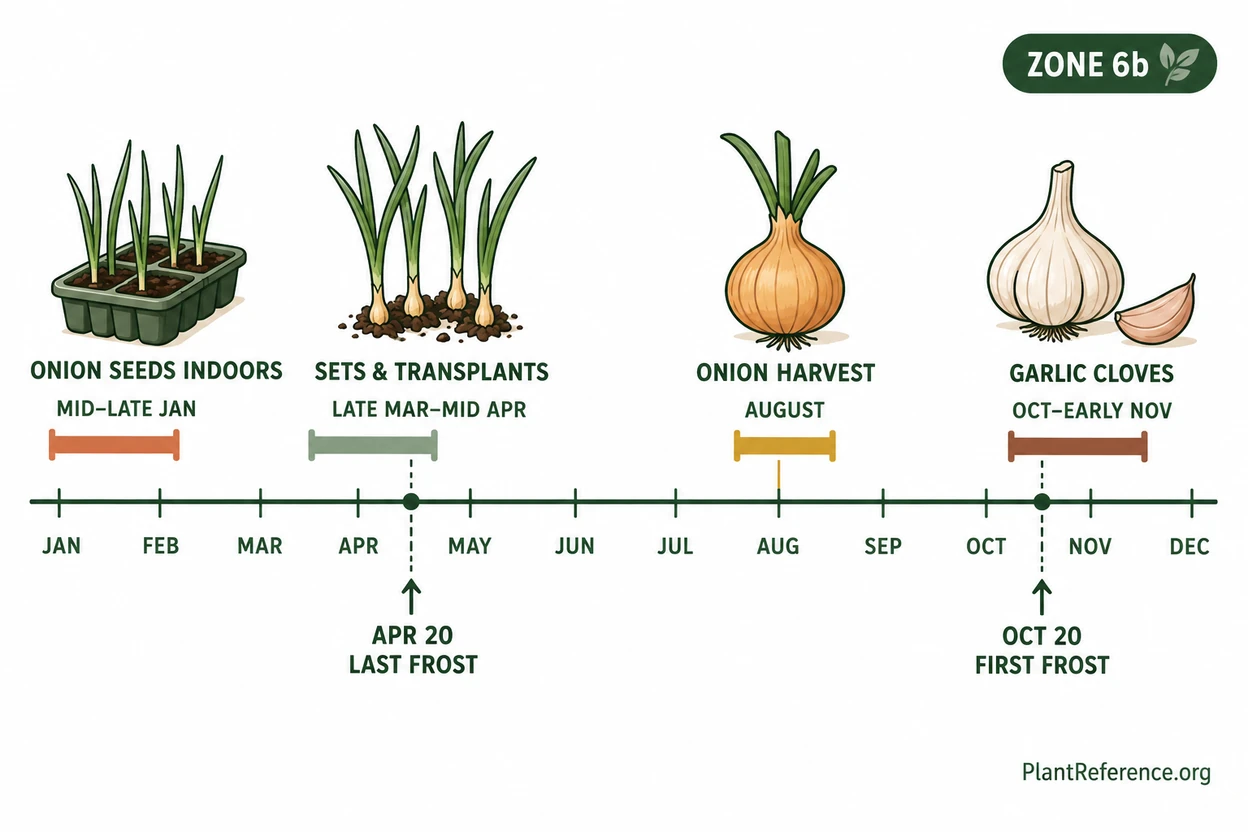
Boston's average last frost lands around April 20, and the first fall frost holds off until about October 20, giving us a long 183-day growing season—genuinely excellent for alliums. The thing to internalize: onions are cold-hardy and don't wait for the last frost. They want a cool start so they can build a large leafy plant before the bulbing trigger arrives in June.
Starting Onion Seeds Indoors
Growing from seed gives you the widest variety selection, but it's the slow road—start indoors 8-10 weeks before transplanting. For Boston that means sowing flats in mid-to-late January. The seedlings look like thin blades of grass for weeks; keep them under lights 12-14 hours a day and trim the tops to about 3 inches (7.5 cm) when they flop to push stronger roots. Plan to transplant them out on the same spring schedule as sets.
Planting Sets and Transplants Outdoors
For most Boston gardeners, sets or purchased transplants are the practical choice. Plant them outdoors from late March through mid-April, as soon as the soil is workable and not waterlogged from snowmelt—a few weeks ahead of our April 20 last frost. Onions tolerate light frost down to around 28°F (-2°C), and the earlier they go in, the more leaves they build before midsummer. More leaves means bigger bulbs. Push sets about 1 inch (2.5 cm) deep and space them 4 inches (10 cm) apart.
One detail that matters: pick sets smaller than a dime. Oversized sets are far more likely to bolt—to throw a flower stalk instead of forming a bulb—after a cold snap.
Planting Garlic in Fall
Garlic is the exception to everything above—it goes in the ground in autumn. Plant cloves in mid-to-late October, roughly 4-6 weeks before the ground freezes hard, which in the Boston area usually means planting through late October into early November. The cold period, called vernalization, is what tells each clove to divide into a full head. Set cloves pointy-end up, 2 inches (5 cm) deep and 6 inches (15 cm) apart, then mulch heavily. Roots establish in fall, tops emerge in spring, and you harvest the following July.
Boston Planting Date Summary
Onion seeds indoors: mid-to-late January
Onion sets and transplants outdoors: late March through mid-April
Scallions (succession): April through early August, every 2-3 weeks
Garlic cloves: mid-to-late October into early November
Onion harvest: August
Garlic harvest: the following July
Complete Growing Guide for Boston
Building the Bed
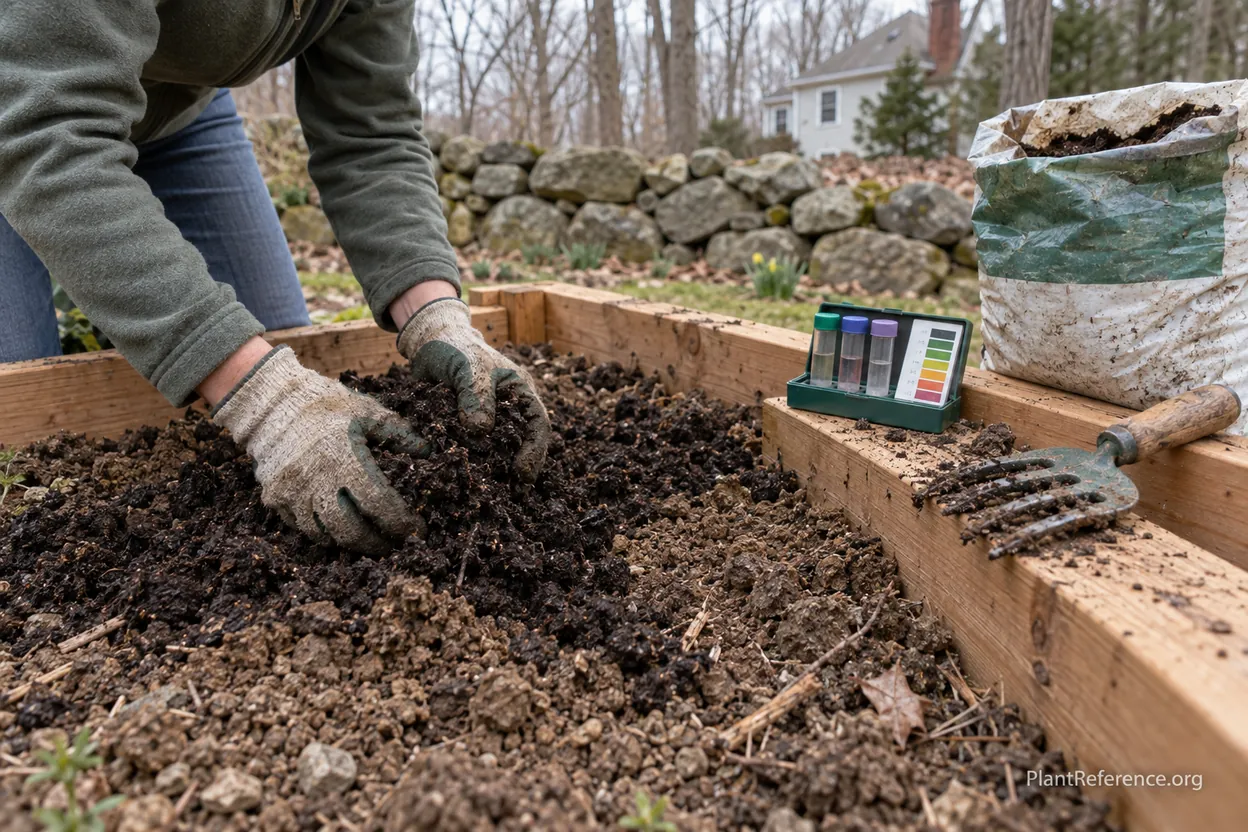
Onions reward a well-built bed more than almost any vegetable. They have shallow, sparse roots and can't fight through compaction or chase nutrients, so they want loose, fertile, well-drained soil with a pH around 6.0 to 7.0. Work 2-3 inches (5-7.5 cm) of finished compost into the top 8 inches (20 cm) before planting. New England's heavier, often acidic soils can run a touch low on pH; a soil test tells you whether a little lime is warranted. Best Soil Mix for Raised Beds: Creating the Perfect Growing Medium
I build most of my clients' vegetable beds raised for exactly this reason—a raised bed drains faster after a wet New England spring, warms sooner, and lets you control the soil from the start. The Complete Guide to Raised Bed Gardening for Beginners (2025) If you're sourcing soil, it's worth getting the mix right the first time. Best Soil for Raised Beds: 6 Commercial Mixes Tested and Compared
Sun, Spacing, and Water
Onions need full sun—8 hours minimum—so site the bed where it isn't shaded by the house or a maple coming into leaf. Space bulbing onions 4 inches (10 cm) apart in rows 12-16 inches (30-40 cm) apart, or grid them tighter in a raised bed. Give garlic a bit more room at 6 inches (15 cm).
Water is where people quietly lose onion size. Those shallow roots need consistent moisture—about 1 inch (2.5 cm) per week—especially through the leafy growth of late spring. Drip irrigation or a soaker hose beats overhead watering: it keeps water at the roots and the foliage dry, which matters in our humid summers. Erratic watering is a leading cause of small, split, or double bulbs. Too Much Water in Raised Beds: Signs and Solutions for Overwatering
Feeding for Big Bulbs
Onions feed hard early. Mix a balanced fertilizer into the bed at planting, then side-dress with nitrogen every few weeks while the plant is building foliage—each leaf becomes a ring in the finished bulb, so leaf growth before midsummer directly sets your onion size. Then stop. Once bulbs begin to swell, cut the nitrogen entirely; late feeding produces thick, soft necks that won't cure or store. Taper feeding off by early summer and let the plant pour everything into the bulb.
Mulch and Winter Protection
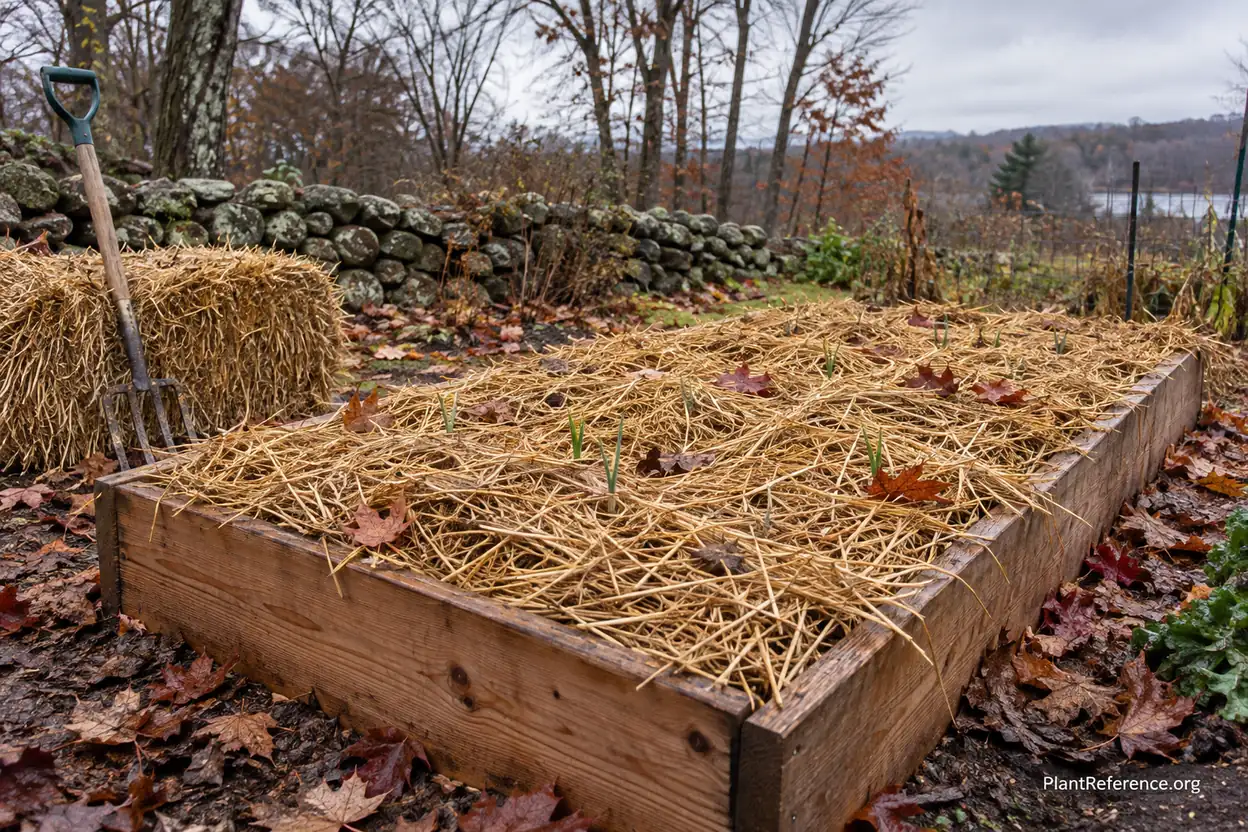
Mulch does two different jobs here. Around spring onions, a light mulch holds moisture and suppresses weeds—and onions are poor competitors, since their narrow upright leaves cast almost no shade. For fall garlic, mulch is winter armor: lay 3-4 inches (7.5-10 cm) of straw or shredded leaves over the bed after planting. This is the part New England gardeners can't skip. Our freeze-thaw cycles—soil freezing, thawing, and refreezing through winter—physically heave shallow cloves up out of the ground if they're left bare. A heavy mulch keeps the soil temperature steady and the cloves where you planted them. Raised Bed Soil Settling and Compaction: Prevention and Solutions
Fitting Alliums Into the Plan
Because onions hold a bed most of the season, plan their place early. They make excellent neighbors for carrots—the onion scent helps throw off carrot root flies—and they share cool-season timing with early greens and roots. When to Plant Carrots in Boston: Complete Guide + Best Varieties for Zone 6b When I lay out a four-season edible bed, I sketch where the long-season alliums and the warm-season crops will sit before anything goes in. When to Plant Peppers in Boston: Complete Guide + Best Varieties for Zone 6b Onions and garlic also slot in cleanly around the spring lettuce and bean plantings most Boston gardeners are already running. When to Plant Lettuce in Boston: Complete Guide + Best Varieties for Zone 6b
Troubleshooting Boston-Specific Problems
Small Bulbs
The most common letdown, and it usually traces to one of three causes. First, the wrong day-length type—short-day onions simply will not size up at Boston's latitude, so stick with long-day varieties like 🌿Allium cepa 'Red Wing'. Second, planting too late; onions set out in May instead of late March don't build enough leaves before bulbing begins. Third, weeds and uneven water starving the plant during leaf growth. Plant early, plant long-day, weed diligently, and water steadily.
Bolting After a Cold Snap
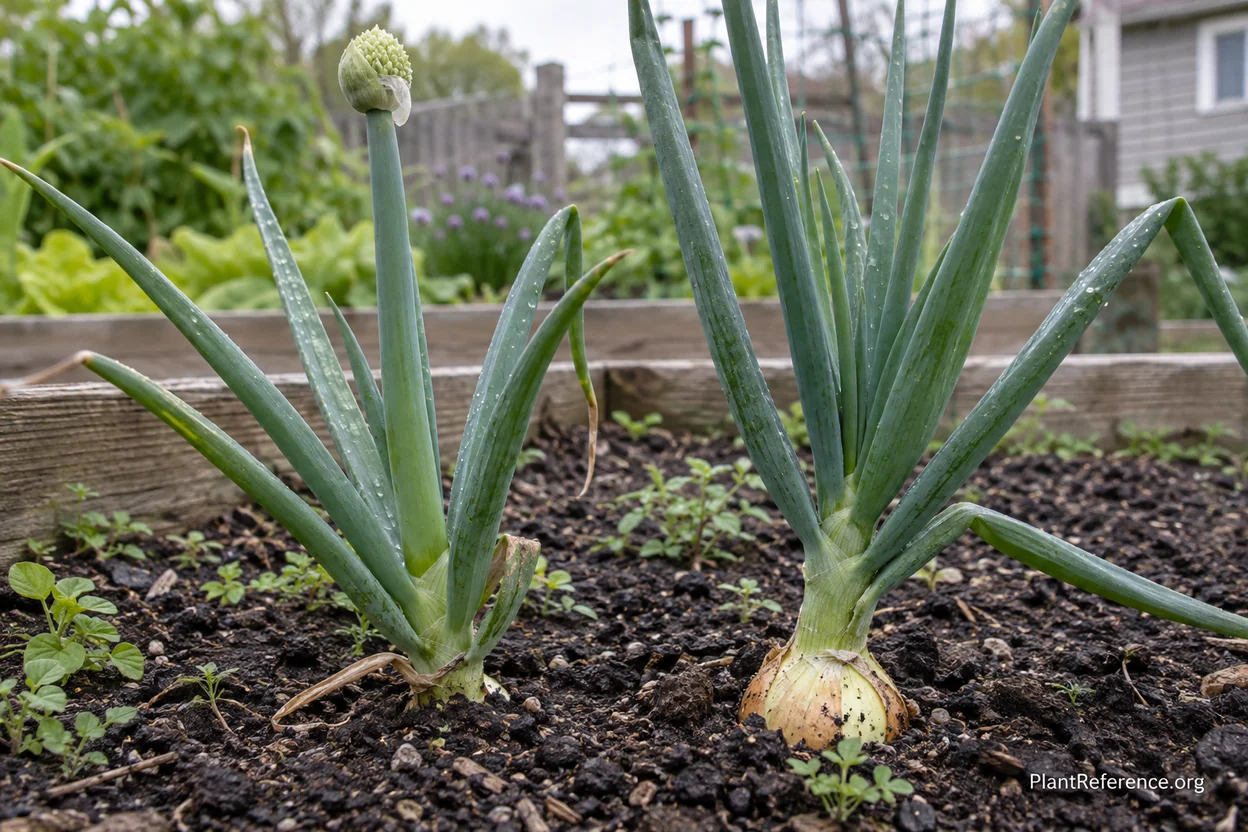
New England springs love to tease you with a warm week followed by a hard freeze, and that swing can trigger bolting—a flower stalk that stops the bulb from sizing and leaves a woody core. Oversized sets make it worse. Use sets smaller than a dime, favor transplants when you can, and resist planting during a freak early-warm spell only to get caught by a return freeze. Onions that bolt won't store, so harvest and eat them fresh.
Thick Necks That Won't Cure
If onions finish with fat, soft necks that stay green, the cause is almost always late-season nitrogen or too much water near harvest. Stop fertilizing once bulbs swell, and ease off watering as the tops start to yellow and fall. Thick-necked onions rot in storage—eat those first.
Garlic Heaving Over Winter
This is the quintessential New England garlic problem. Freeze-thaw cycles push fall-planted cloves up out of the soil, exposing them to cold and drying wind. The prevention is straightforward: plant a full 2 inches (5 cm) deep and mulch heavily right after planting. If you spot heaved cloves during a winter thaw, press them gently back down and re-cover with mulch. When to Plant Green Beans in Boston: Complete Guide + Best Varieties
Harvest & Storage
Onions signal harvest themselves: the tops yellow and bend over at the neck, usually in August around Boston. Once roughly half the tops have flopped, stop watering and let the bulbs firm up for about a week. Then lift them on a dry day, handling gently—bruised onions rot fast and won't keep.
Curing is what makes the difference between onions that store and onions that don't. Spread the lifted bulbs in a single layer in a warm, dry, airy, shaded spot—a covered porch, a garage, or a shed works well. Cure for 2-4 weeks until the outer skins are papery and the necks are fully dry and tight. Trim the tops to about 1 inch (2.5 cm), brush off loose soil, and store. When to Plant Cucumbers in Boston: Complete Guide + Best Varieties for Zone 6b
Keep cured onions somewhere cool (32-40°F / 0-4°C), dark, and dry, with airflow around the bulbs—mesh bags or open crates are ideal in a basement or garage. 🌿Allium cepa 'Red Wing' and well-cured 🌿Allium cepa 'Yellow Sweet Spanish' hold for months; sweet 🌿Allium cepa 'Walla Walla' should be eaten within a few weeks. Store onions away from potatoes, whose moisture shortens onion storage life.
Garlic comes out the following July, when the lower leaves brown while five or six green leaves remain up top. Cure it the same way, and set aside your largest, healthiest cloves to replant in October—do that for a few seasons and you'll have a strain adapted to your own Boston garden. When to Plant Onions in New York: Complete Guide + Best Varieties for Zone 7a
Frequently Asked Questions
Reading about plants and recognising them are different skills. These three build the second.
- Daily PlantIdentify the day’s mystery plant from a close-up photograph.
- Keyed OutWork a dichotomous key, lead by lead, to name a hidden specimen.
- Name That PlantName a specimen from botanical clues dealt hardest first.
Free to play, no account needed
Tagged with
Kevin is a landscape contractor in the Boston area who specializes in cold-climate perennial gardens and hardscaping. He studied landscape design and worked at a prominent nursery on the North Shore before starting his own design-build firm. Kevin's gardens are built to handle New England weather—freeze-thaw cycles, nor'easters, late springs, and heavy snow loads. He's particularly interested in native perennials and shrubs that provide four-season interest without constant maintenance. Kevin writes about cold-hardy plant selection, winter garden structure, and building landscapes that look good even in February.