When to Plant Onions in Anchorage: Zone 4b Dates + Best Varieties
Pets & Toxicity
Recorded toxicity for plants linked in this guide. An unknown status is not a safety assessment.
Allium cepa 'Walla Walla' — Toxicity Warning
Toxic to petsView Allium cepa 'Walla Walla' plant profileAllium cepa 'Yellow Sweet Spanish' — Toxicity Warning
Toxic to petsView Allium cepa 'Yellow Sweet Spanish' plant profileAllium sativum 'California Early' — Toxicity Warning
Toxic to petsView Allium sativum 'California Early' plant profile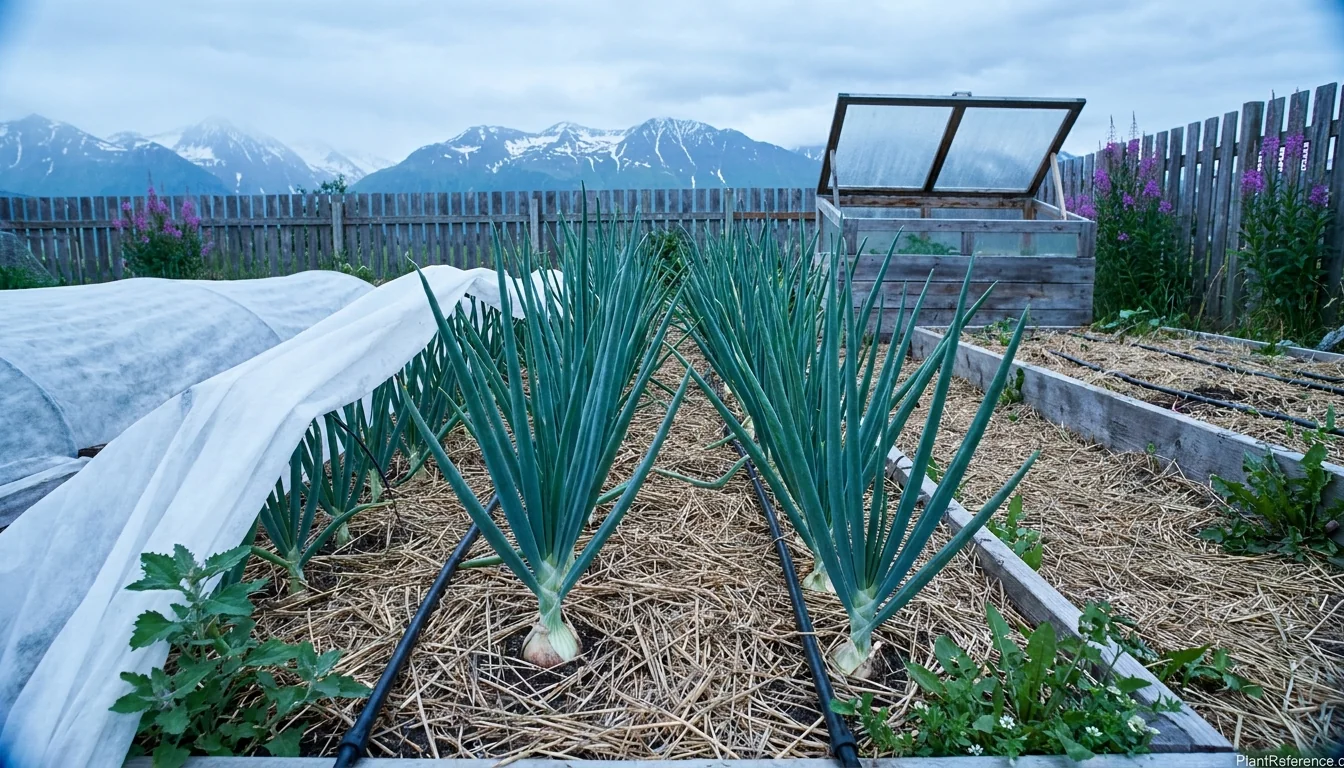
— Image © Plant Reference 2026
Anchorage onion growing is a different game from anywhere in the Lower 48. Our frost-free season runs roughly 118 days, our soil takes its sweet time warming up in May, and we sit at 61°N where June gives us 19 hours of daylight. That last part is what makes onions work up here at all. The long days drive remarkable growth in plants that can use them—a cabbage might be ready in 65 days instead of 80, and onions bulb up beautifully if you choose the right variety and start them early enough.
Best Onion Varieties for Anchorage's Zone 4b Climate
Anchorage sits at roughly 61°N latitude, which puts us deeper into long-day territory than almost any gardening location in the country. Long-day onions need 14-16 hours of daylight to switch from leaf growth into bulb formation, and we blow past that threshold in mid-May and stay there into August. That sounds like a problem until you understand the upside: those long days drive faster leaf production than anywhere south of us, so a well-grown subarctic onion can match the size of one grown in Iowa. Just stick to varieties that can handle our short season—anything needing more than 110 days from transplant is a gamble.
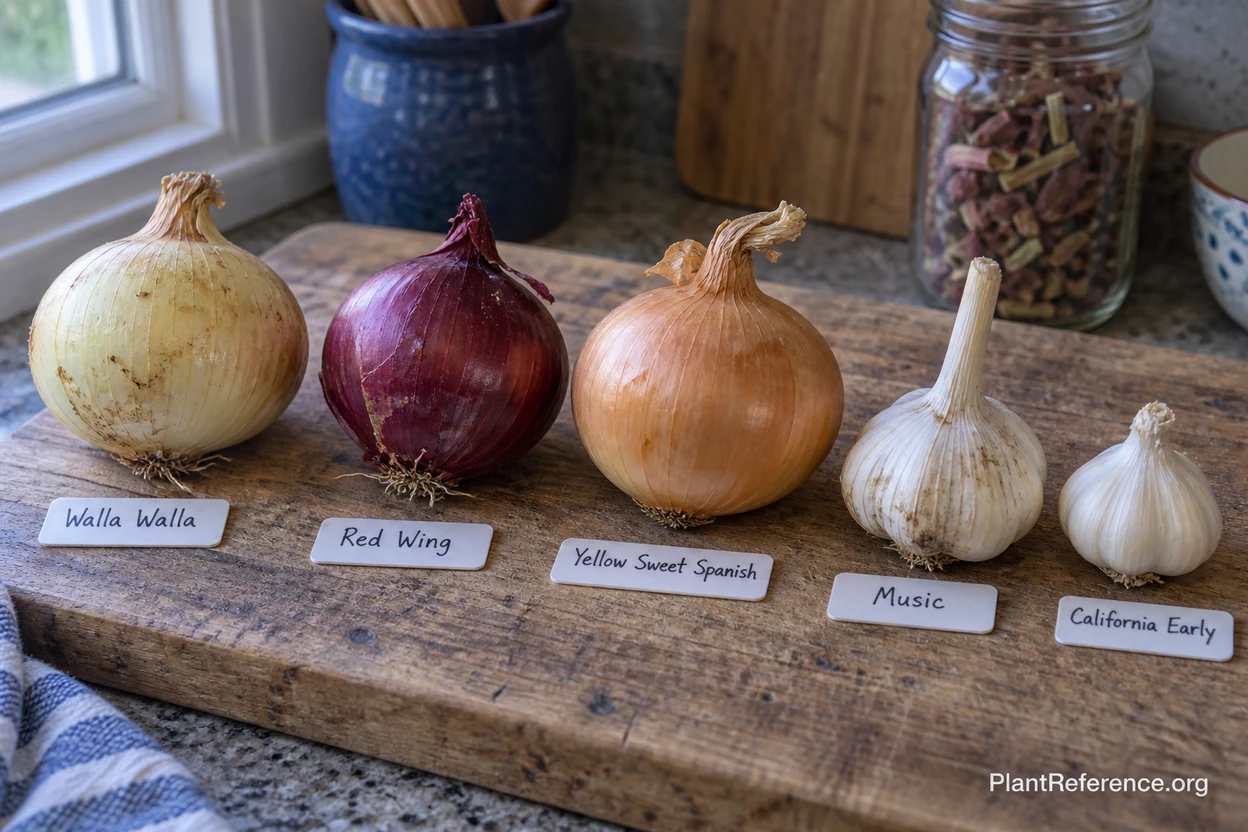
🌿Allium cepa 'Walla Walla' (AL-ee-um SEE-pa) is the sweet onion that has earned its place in Anchorage gardens. It is a long-day variety bred in the Pacific Northwest, and while we are well north of where it was developed, our daylight more than makes up for the cooler average temperatures. The bulbs come in mild and large, perfect for fresh eating through the late summer. The trade-off is short storage—🌿Allium cepa 'Walla Walla' holds for 4-6 weeks once cured, so plan to eat your crop within a couple of months of harvest.
🌿Allium cepa 'Red Wing' is the long-day storage onion to lean on. The bulbs hold their red-purple skin and firm white flesh for 6-9 months in cool storage, which matters more in Anchorage than almost anywhere else—our growing season is so short that what you store carries you through long stretches when fresh local food is hard to come by. It tolerates the cool soil and cool nights better than most sweet onions and resists pink root, a soil-borne disease that can build up in beds reused too often.
🌿Allium cepa 'Yellow Sweet Spanish' works in Anchorage at the edge of its range. It is a long-day to intermediate-day variety that can size up well in our 19-hour June days, though it needs the full season—do not plant it expecting bulbs in 90 days. Plan on a full 110-120 days from transplant, which means February seed starts and a late May transplant.
For garlic, our deep cold winters and reliable snow cover favor hardneck types. 🌿Allium sativum 'Music' (AL-ee-um sa-TY-vum) is a Porcelain-class hardneck that handles Anchorage's winters better than just about anything else I have grown. The cloves are large, the flavor is strong without being harsh, and the bulbs hold for 4-6 months in cool storage. The scapes in June are a bonus crop you can pickle, sauté, or chop into pesto.
🌿Allium sativum 'California Early' is a softneck I plant alongside the hardneck for variety, though it needs heavy mulch and ideally a snowbank to survive a typical Anchorage winter. The bulbs are smaller but the cloves are milder and the storage life is closer to 8-10 months.
For continuous green onions, 🌿Allium fistulosum (AL-ee-um fih-stoo-LO-sum)—true bunching onions, sometimes called scallions—do not bulb up and handle our cool summers fine. Sow in succession every 3 weeks from late May through early July under row cover for a steady supply all summer.
Variety | Type | Days to Maturity | Best For | Notes for Anchorage |
|---|---|---|---|---|
Long-day sweet | 110-125 days | Fresh eating, summer kitchen | Sweet & mild; eat within 4-6 weeks of harvest | |
Long-day storage | 105-120 days | Long-term winter storage | Best storage life; resists pink root in cool soil | |
Long/intermediate | 110-120 days | All-purpose cooking | Needs full season; start indoors mid-February | |
Hardneck garlic | 240-270 days | Cold-climate planting | Most reliable garlic for Anchorage winters | |
Softneck garlic | 240-270 days | Braiding & long storage | Plant deep & mulch heavy or it will winter-kill | |
Bunching/scallion | 60-70 days | Continuous green onions | Plant every 3 weeks late May-early July |
Specific Planting Dates for Anchorage
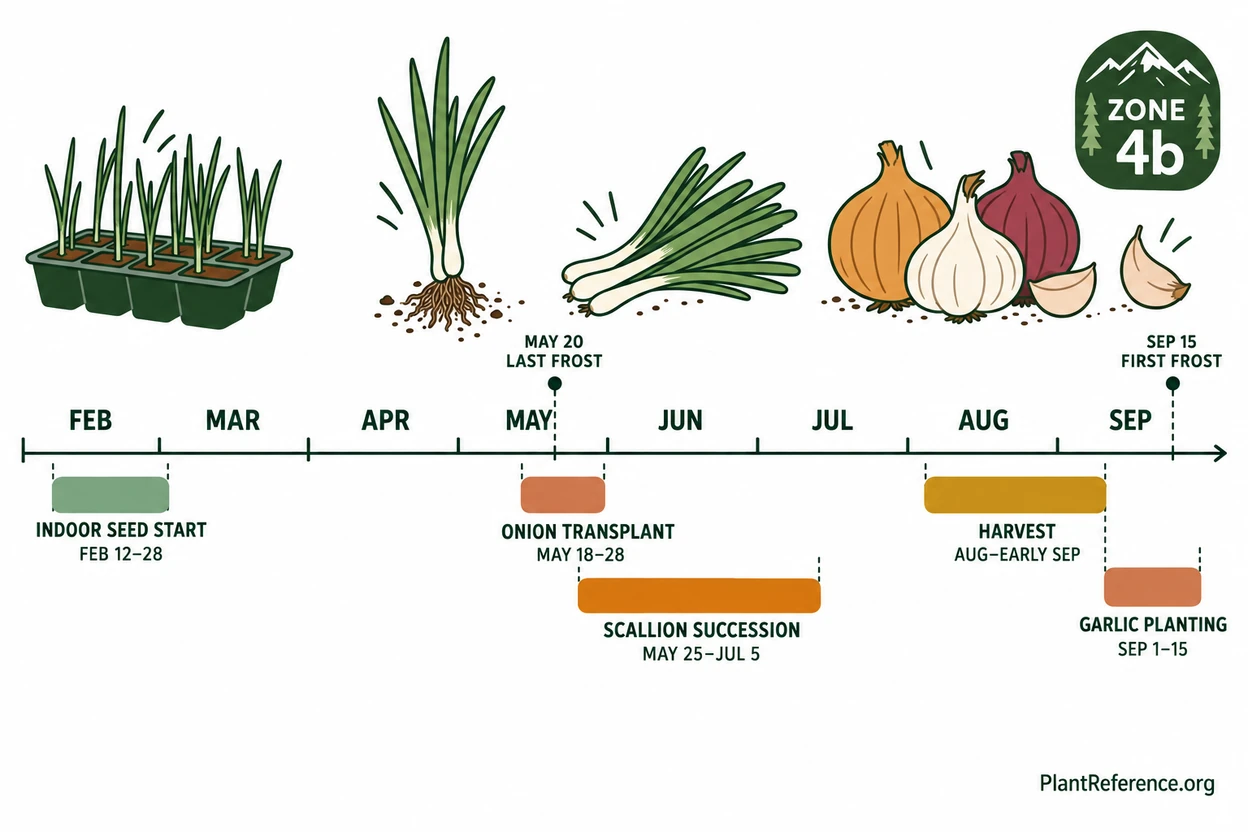
Anchorage's May 20 average last frost date is the gate that controls outdoor onion planting. We get hard frosts well into the second week of May most years, and a single cold night around 25°F (-4°C) will set young transplants back two weeks even if it does not kill them. Plan around the dates below and you will give your onions and garlic the best shot at sizing up before our short season ends in mid-September.
Onion Seeds (Indoor Start)
Start onion seeds indoors February 12 through February 28, roughly 12-14 weeks before transplanting. That is earlier than most of the country and it has to be—onion seedlings grow slowly, and we want them at pencil thickness by late May to take full advantage of the long-day surge. Use a heat mat to hit 70°F (21°C) for germination, then drop to 60-65°F (16-18°C) under lights once seedlings emerge. Keep tops trimmed to 4 inches (10 cm) every two weeks to encourage thicker stems and a deeper root mass.
Outdoor Transplants
Move hardened-off transplants outside May 18 through May 28, after soil temperature at 4 inches (10 cm) deep has reached 50°F (10°C) for three consecutive days. Air temperature here can lie to you—it might be 60°F (16°C) at noon while the soil is still in the low 40s. A soil thermometer is not optional in Anchorage. Trim transplant roots back to 2 inches (5 cm) and tops to 4 inches (10 cm) before setting them out 1 inch (2.5 cm) deep, 4 inches (10 cm) apart. Cover with row cover for the first two weeks to buffer cool nights.
Onion Sets
Sets work in Anchorage but only if you can find them locally—mail-order sets often arrive in poor condition after the long trip north. If you do find good sets, plant them outdoors May 18 through May 28 on the same schedule as transplants. Use sets smaller than a dime in diameter to avoid bolting, which is a real risk when our spring temperatures bounce between warm afternoons and cold nights.
Garlic (Fall Planting)
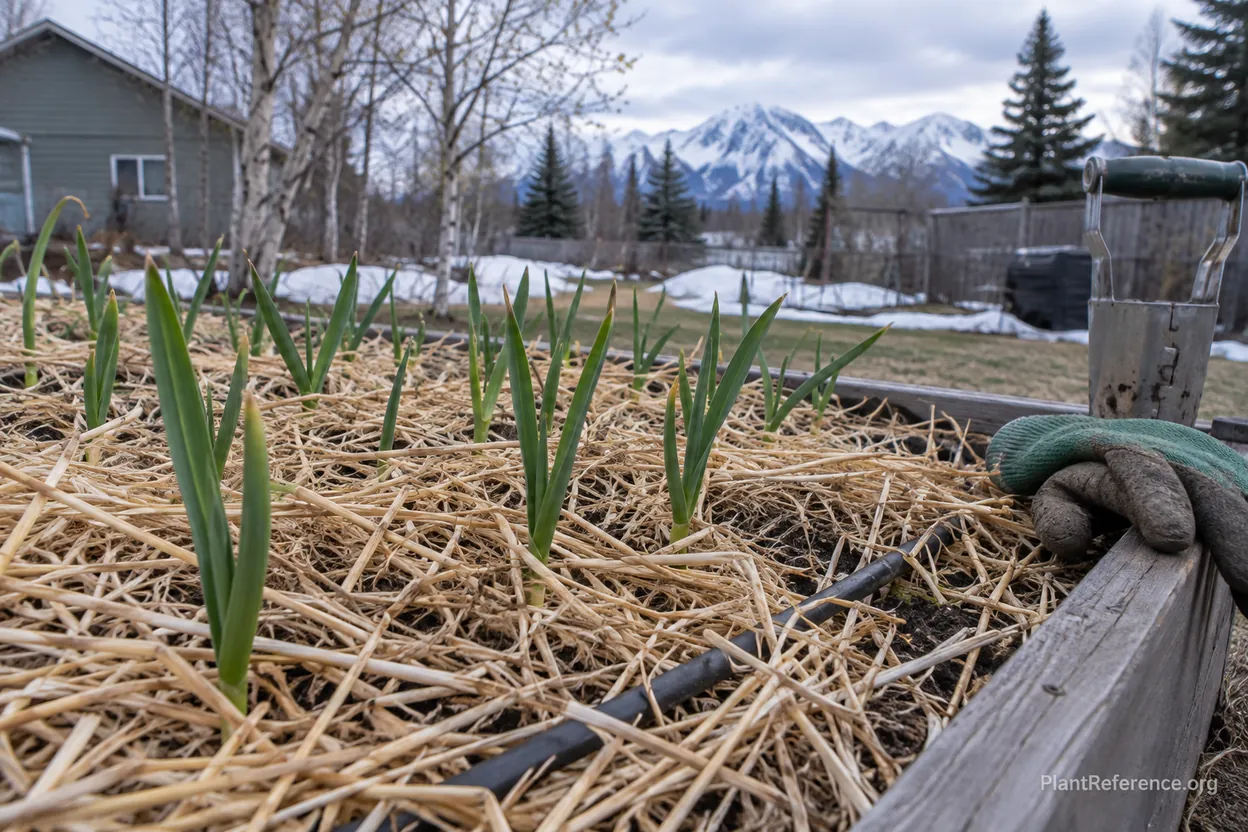
Plant garlic cloves September 1 through September 15, about 4-6 weeks before the ground freezes hard. Our window is tight—plant too early and the cloves push tops that winter-kill; plant too late and roots do not establish before the soil locks up. Push individual cloves 3-4 inches (7.5-10 cm) deep, pointed end up, 6 inches (15 cm) apart. The extra planting depth compared to Lower 48 recommendations gives an additional buffer of insulation. Mulch immediately with 6 inches (15 cm) of straw, hay, or shredded leaves to push that insulation even further—our snow cover is reliable but the few weeks before it arrives can hammer unprotected cloves.
Scallions and Bunching Onions
Sow 🌿Allium fistulosum seed directly outdoors May 25 through July 5 in successive 3-week intervals for continuous harvest. Direct seed 1/4 inch (0.6 cm) deep, 2 inches (5 cm) apart in rows 6 inches (15 cm) apart. Floating row cover speeds germination by warming the soil and protects seedlings from root maggot flies, which arrive in late May.
Key Date Summary
Indoor onion seed start: February 12 - February 28
Outdoor onion transplants & sets: May 18 - May 28
First scallion sowing: May 25 (succession every 3 weeks until early July)
Onion harvest window: late August - early September
Garlic fall planting: September 1 - September 15
Garlic harvest: late July - mid August (following year)
Season ends: September 15 (first frost)
Complete Growing Guide for Anchorage
Site Selection and Soil Preparation
Onions and garlic want full sun—at least 8 hours a day—and in Anchorage that means our long summer days do most of the work for us. Pick the sunniest spot you have, ideally with southern exposure and shelter from north winds. Our native silty soils warm up slowly and can stay cool well into June, which is the biggest brake on onion success up here. The fix is the same fix for nearly every vegetable in Anchorage: build raised beds and amend heavily with organic matter. Raised Bed Soil Settling and Compaction: Prevention and Solutions
Work 3-4 inches (7.5-10 cm) of finished compost into the bed the previous fall or as soon as the soil thaws in spring. Add a balanced organic fertilizer (5-5-5 or similar) at the rate listed on the bag. Best Soil for Raised Beds: 6 Commercial Mixes Tested and Compared Our soils tend to run slightly acidic, especially in beds where you have grown a lot of cover crops or compost-heavy mixes—aim for pH 6.5-6.8, where alliums take up nutrients best. Raised Bed Vegetable Garden Layout: Planning for Maximum Production
Black Plastic and Row Cover
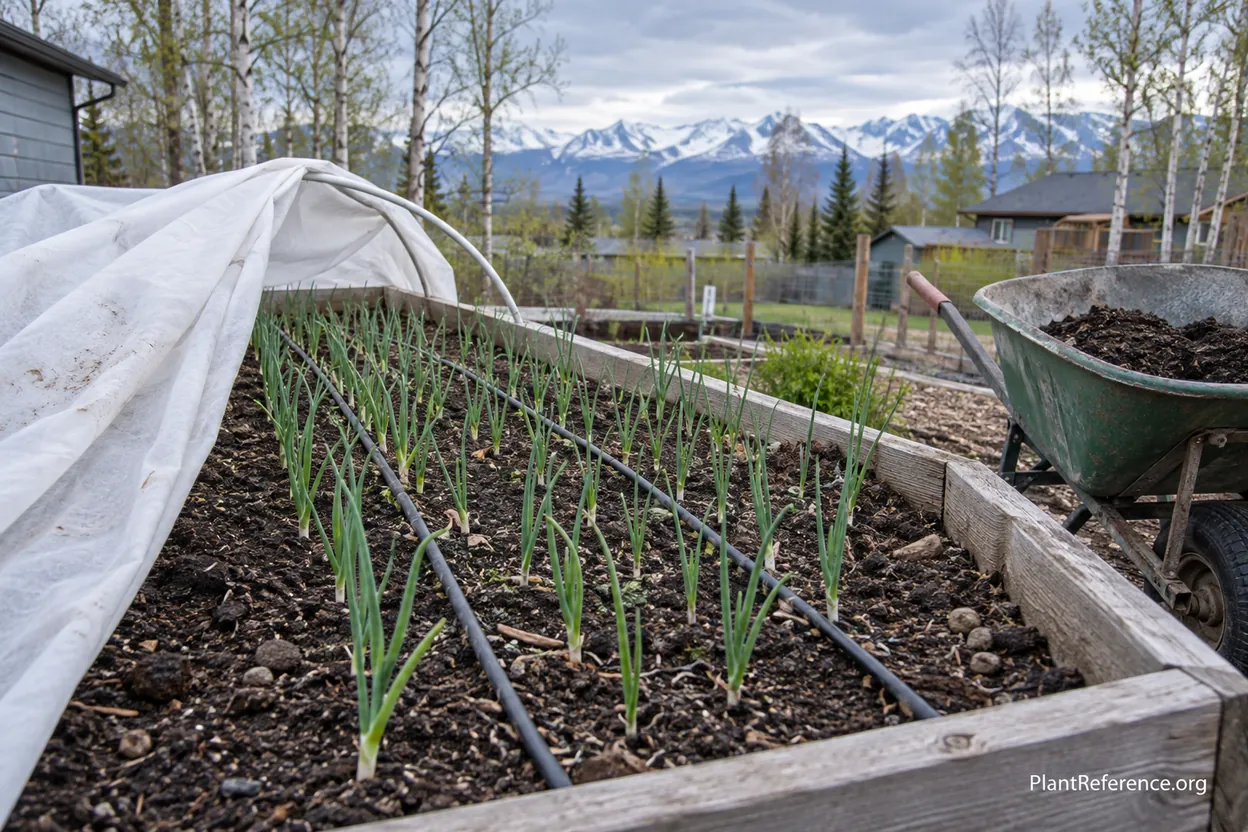
Black plastic mulch over the bed for two weeks before transplanting is one of the most effective things you can do for Anchorage onions. It raises soil temperature 8-10°F (4-5°C) above ambient, which gets us into that 50°F (10°C) sweet spot weeks earlier than bare soil. Cut X-shaped slits for transplants and run drip irrigation underneath. The plastic also suppresses weeds and keeps splashing rain off foliage during our wet spells.
Floating row cover over the top of newly planted onions does two things: it buffers cool nights for the first two to three weeks and excludes root maggot flies, which are our most damaging onion pest. Pull the cover back once daytime temperatures consistently sit above 60°F (16°C), usually mid to late June.
Watering
Anchorage gets about 16 inches of precipitation a year, and onions need about 1 inch (2.5 cm) of water per week from rainfall and irrigation combined. Drip irrigation works better than overhead watering—it keeps the foliage dry and reduces fungal problems in our cool, often damp summer weather. Water in the morning so any splashed leaves dry quickly.
Cut watering by half once tops begin to yellow and fall over in late August. Stop watering entirely once half the tops have fallen over. Excess water at the bulbing stage produces thick necks and onions that will not cure properly.
Mulching
A 2-3 inch (5-7.5 cm) layer of straw or shredded leaf mulch around onions after they reach 6 inches (15 cm) tall conserves soil moisture and suppresses weeds. Keep mulch pulled back 1 inch (2.5 cm) from the onion necks so the bulbs can size up freely and air can move through.
For fall-planted garlic, mulch is your most important winter insurance. Apply 6 inches (15 cm) of straw, hay, or shredded leaves immediately after planting in September. Our snow cover is reliable but does not always arrive on time—those first weeks of bare frozen ground before the snow flies are when unmulched cloves fail. When to Plant Tomatoes in Anchorage: Complete Guide + Best Varieties for Zone 4b
Fertilizing
Side-dress onions with a high-nitrogen organic fertilizer (blood meal, fish meal, or 12-0-0) every 3-4 weeks from emergence until the tops are about pencil-thick at the base. Nitrogen during leaf growth means more leaves, which means more rings, which means bigger bulbs. Stop nitrogen completely once the bulbs begin to swell at soil level—late nitrogen produces thick necks that resist curing.
For garlic, side-dress in early May when tops push hard through the mulch, then once more in mid-June. Stop feeding by late June to let the bulbs cure cleanly. When to Plant Carrots in Anchorage: Complete Guide + Best Varieties for Zone 4b
Troubleshooting Anchorage-Specific Problems
Cold, Slow Soil
The biggest single brake on Anchorage onion success is soil that stays too cold for too long. Transplants set into 45°F (7°C) soil sit and sulk for two weeks before doing much of anything, and those are weeks we cannot afford in a 118-day season. Black plastic mulch laid down two weeks before transplanting, raised beds rather than ground beds, and a soil thermometer to confirm 50°F (10°C) at the 4-inch (10 cm) depth before planting all combine to fix this. Do not let warm air convince you the soil is ready.
Onion Root Maggots
Onion root maggot flies are our most damaging onion pest. They lay eggs at the base of plants from late May through July, and the larvae tunnel into bulbs and stems. Affected plants wilt, yellow, and pull out of the ground without resistance. Floating row covers from transplanting through late July break the egg-laying cycle and are the single most effective prevention. Avoid composted manure in onion beds during the planting year—it draws egg-laying flies. When to Plant Cucumbers in Anchorage: Complete Guide + Best Varieties for Zone 4b
Bolting from Cold Nights
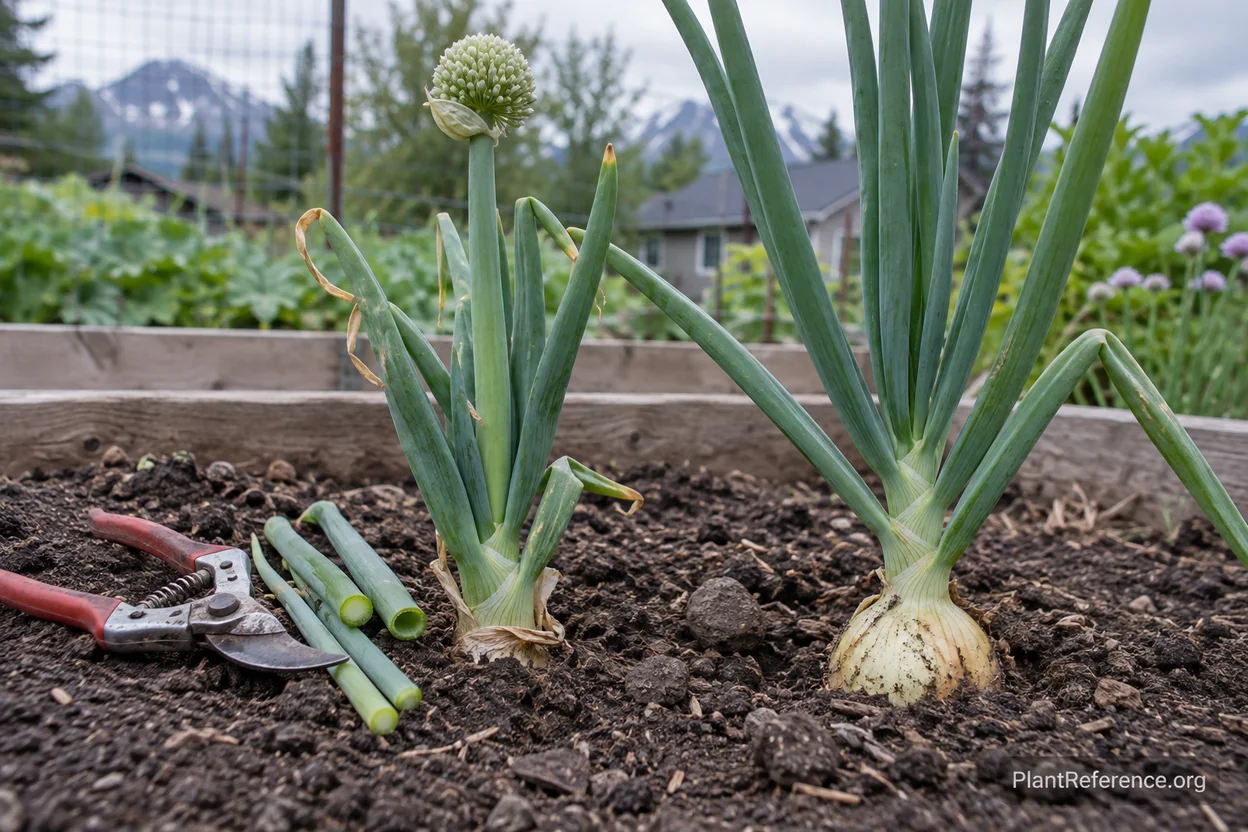
Onions can bolt—send up a flower stalk instead of bulbing—when they get a stretch of cold nights below 40°F (4°C) after they have made significant growth. This happens often enough in Anchorage springs that variety choice matters. 🌿Allium cepa 'Red Wing' resists bolting better than 🌿Allium cepa 'Walla Walla'. If a plant does bolt, snap off the flower stalk immediately to redirect energy back to the bulb. The bulb will not store but you can still eat it fresh within a few weeks.
Pink Root
Pink root is a soil-borne fungal disease that turns roots pink, then brown, then mushy. Bulbs stay small. Once established in soil, there is no organic cure. Rotate alliums on a 4-year cycle so they do not return to the same bed, and plant resistant varieties like 🌿Allium cepa 'Red Wing' in beds with any history of the disease. When to Plant Peppers in Anchorage: Complete Guide + Best Varieties for Zone 4b
Garlic Winter-Kill
Hardneck garlic generally rides out an Anchorage winter fine with 6 inches (15 cm) of mulch and a good snow pack. Softneck varieties are riskier—they can winter-kill in years with little snow or sudden hard freezes before snow falls. If you lose garlic over winter, the cause is almost always insufficient mulch in the gap between fall planting and consistent snow cover. Apply a deeper mulch layer the next year and you will rarely lose another bulb. When to Plant Squash in Anchorage: Complete Guide + Best Varieties for Zone 4b
Harvest & Storage
Pull onions when about half the tops have flopped over naturally and the necks have started to soften—usually late August through early September in Anchorage. Pulling too early gives bulbs that have not finished sizing; pulling too late risks split skins and rot in storage. Lift bulbs gently by the tops. If a top breaks off the bulb, treat that one as a fresh-eating onion rather than a storage onion.
Curing in Anchorage takes a little more attention than in drier climates. Lay bulbs out in a single layer on screens or wire racks in a covered, well-ventilated spot—a garage with the door open, a screened porch, a covered woodshed. A small fan helps move air through the pile when humidity is high. Onions are cured when the necks are tight and dry to the touch and the outer skins are papery, usually 3-4 weeks. Trim tops 1 inch (2.5 cm) above the bulb and trim roots flush. Store in mesh bags at 32-40°F (0-4°C) and 60-70% humidity. A cold corner of an unheated garage or a dedicated root cellar works well; an extra refrigerator is the most reliable option. When to Plant Lettuce in Anchorage: Complete Guide + Best Varieties for Zone 4b
For garlic, harvest when the bottom 3-4 leaves have browned but the top 4-5 are still green—usually late July through mid August from September-planted cloves. Lift carefully with a digging fork to avoid bruising the wrapper leaves. Cure for 3-4 weeks in the same conditions as onions. Hardneck garlic stores 4-6 months at 50-60°F (10-16°C); softneck stores 8-10 months in the same conditions. When to Plant Basil in Anchorage: Complete Guide + Best Varieties for Zone 4b
Frequently Asked Questions
Reading about plants and recognising them are different skills. These three build the second.
- Daily PlantIdentify the day’s mystery plant from a close-up photograph.
- Keyed OutWork a dichotomous key, lead by lead, to name a hidden specimen.
- Name That PlantName a specimen from botanical clues dealt hardest first.
Free to play, no account needed
Tagged with
Tom is a lifelong Alaskan who gardens in Anchorage, where the growing season is short but intense. He works for the state cooperative extension service and has spent years figuring out what works in a climate where the ground freezes deep, the growing season starts in late May, and you get 19 hours of daylight in June. Tom grows cold-hardy vegetables, maintains a collection of boreal-adapted perennials, and experiments with season extension using cold frames and row covers. He writes about the realities of northern gardening—the unique advantages (those long summer days produce remarkable growth) and the genuine limitations. Tom's tone is calm and practical, with the quiet humor of someone who's gardened through Alaskan winters for decades.