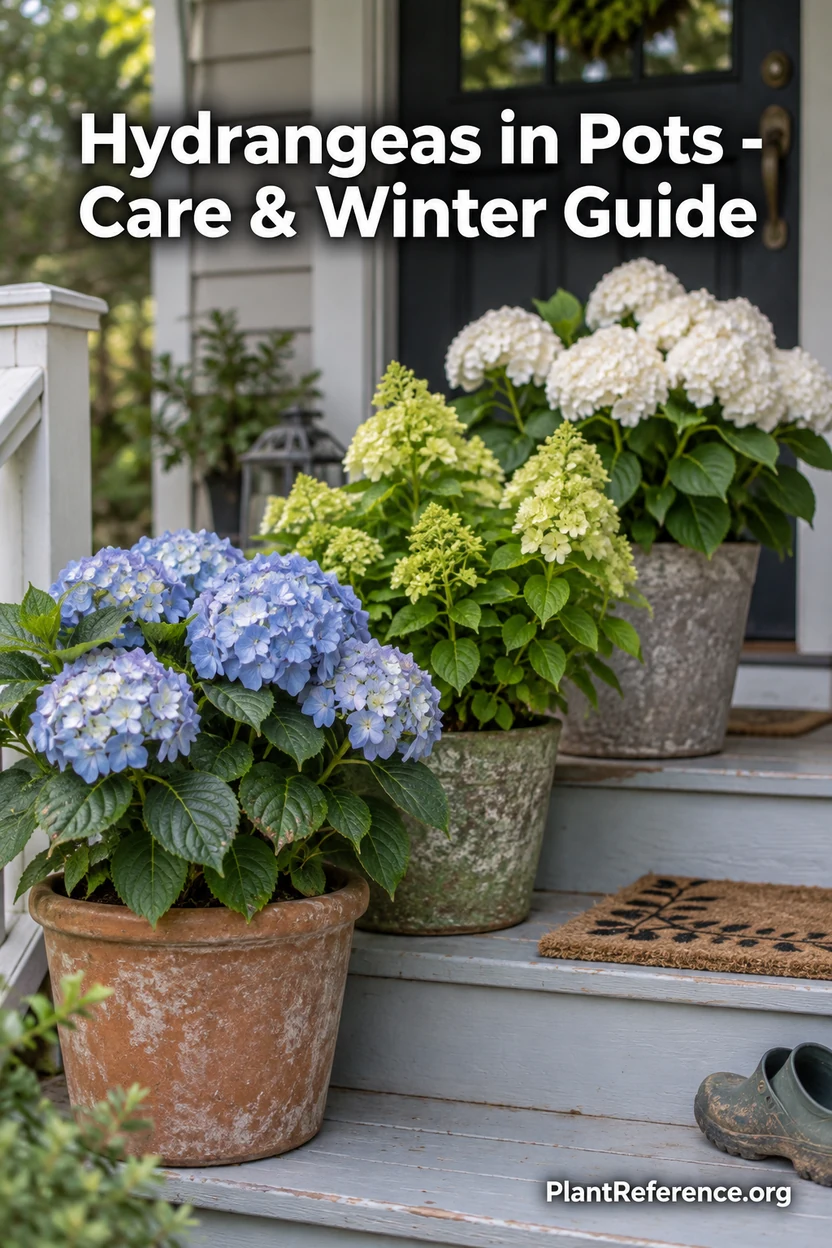
Hydrangeas in Pots: Container Care & Winter Protection
Pets & Toxicity
Recorded toxicity for plants linked in this guide. An unknown status is not a safety assessment.
Toxic to pets: Limelight PeeGee hydrangea, Panicle hydrangea, bigleaf hydrangea and 3 moreDetailsHide
Hydrangea paniculata 'Limelight' — Toxicity Warning
Toxic to petsView Hydrangea paniculata 'Limelight' plant profileHydrangea paniculata — Toxicity Warning
Toxic to pets and humansView Hydrangea paniculata plant profileHydrangea macrophylla — Toxicity Warning
Toxic to pets and humansView Hydrangea macrophylla plant profileHydrangea macrophylla 'BloomStruck' — Toxicity Warning
Toxic to pets and humansView Hydrangea macrophylla 'BloomStruck' plant profileHydrangea quercifolia — Toxicity Warning
Toxic to pets and humansView Hydrangea quercifolia plant profileHydrangea quercifolia 'Pee Wee' — Toxicity
Non-toxicView Hydrangea quercifolia 'Pee Wee' plant profile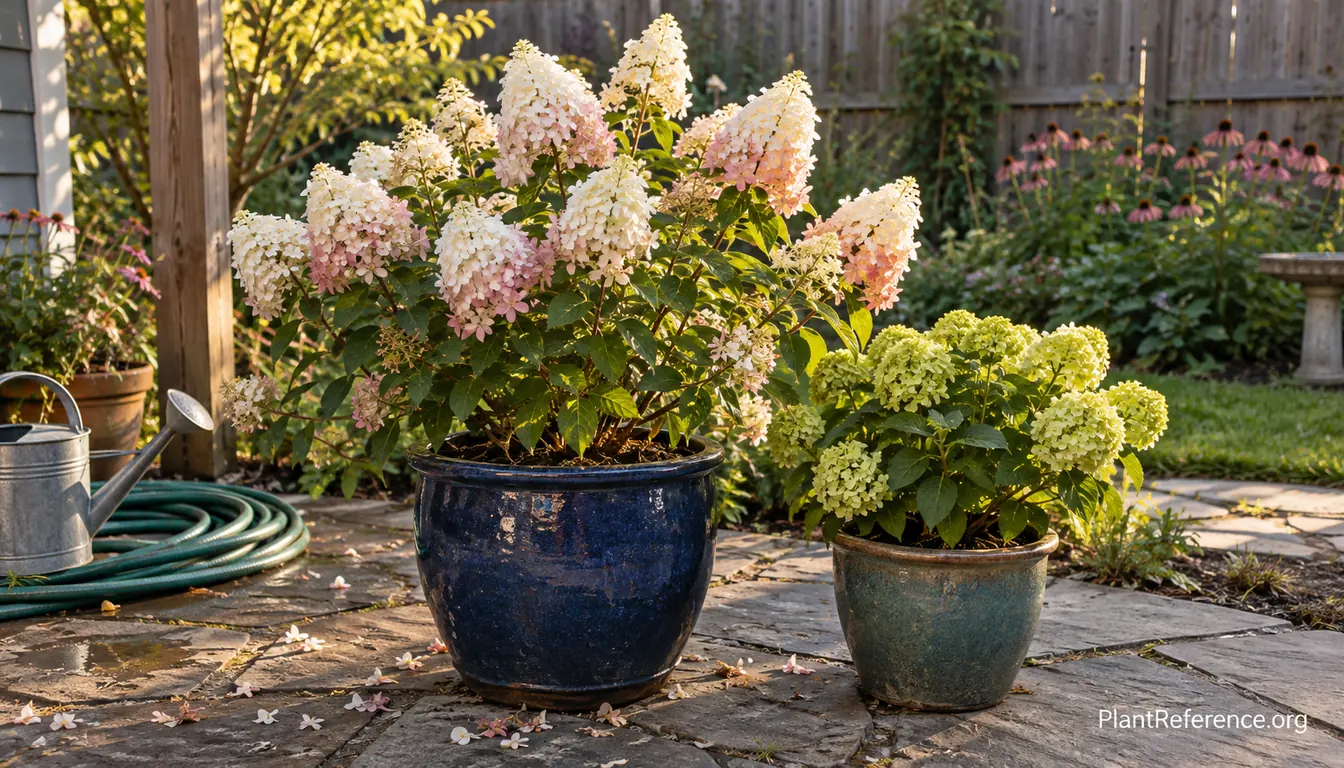
— Image © PlantReference.org 2026
Growing a hydrangea in a pot lets you enjoy these shrubs on a balcony, a shady deck, or a patio with no open soil at all. But hydrangeas in pots live in a very different physical environment than their in-ground relatives, and the rules for water, feeding, and especially winter survival change accordingly. Once you understand why, container hydrangeas become one of the most rewarding shrubs you can grow.
Why Hydrangeas in Pots Behave Differently
The genus hydrangea Hydrangea (hy-DRAIN-juh) evolved as woodland-edge shrubs with broad, shallow, fibrous root systems that spread well beyond the canopy. In the ground, those roots draw on a large reservoir of moisture and are buffered from temperature swings by the surrounding soil mass. A container removes both advantages.
Three physical realities shape everything else in this guide:
Limited water reserve. A 15-gallon (57 L) pot holds a small fraction of the water available to an in-ground root system, and hydrangea leaves transpire heavily. On a hot, windy day, a potted plant can use most of that reserve by mid-afternoon.
Rapid nutrient loss. Frequent watering leaches soluble nutrients out of the drainage hole, so container plants need more regular, lighter feeding than garden shrubs.
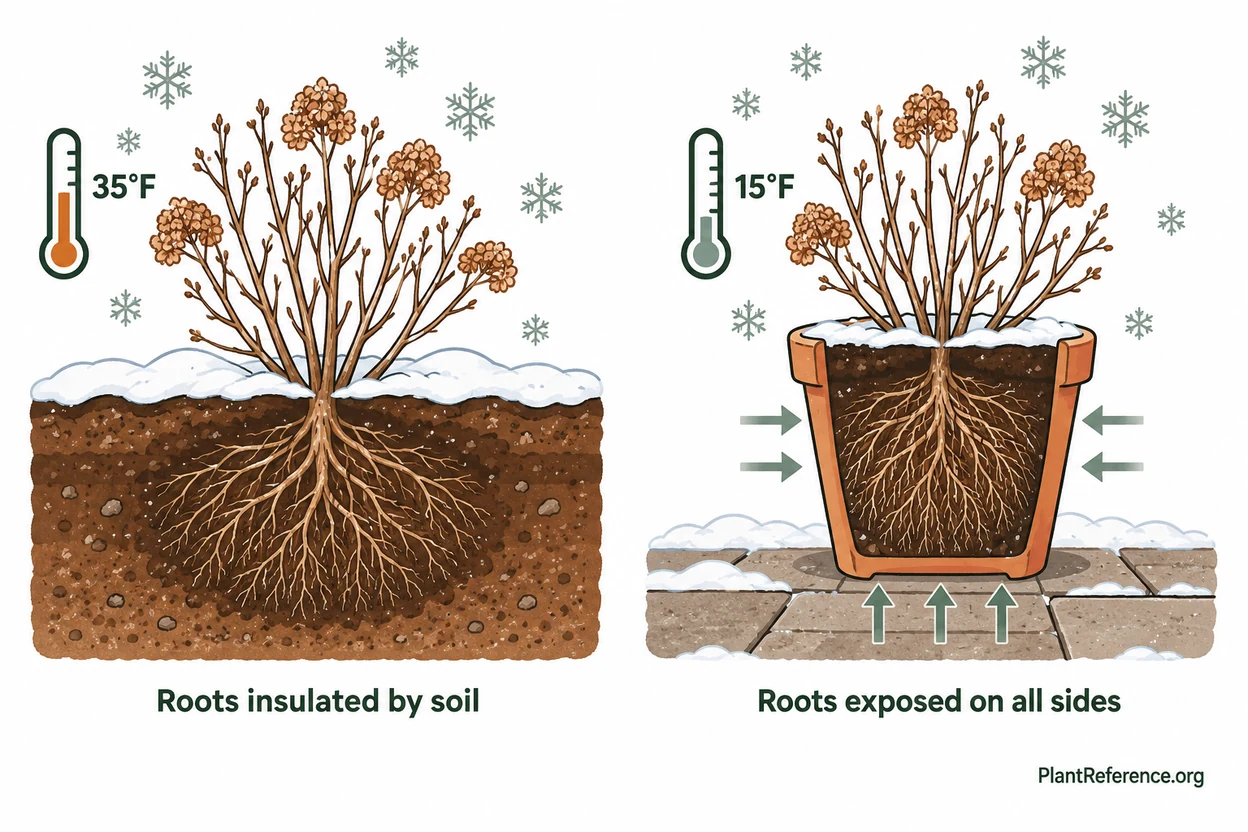
Exposed roots in winter. Soil in the ground stays warmer than the air above it. Soil in a pot freezes from every side, and roots are far less cold-hardy than stems and buds.
That last point deserves emphasis. Stem tissue on a hardy hydrangea may tolerate temperatures well below 0°F (-18°C), but the roots of most woody shrubs are killed somewhere in the range of 10-25°F (-12 to -4°C). In the ground, roots rarely experience those temperatures. In an unprotected pot, they can. This is why a hydrangea that survives winter easily in your garden bed can die in a container on the same patio. Identifying which species you own comes first, and the leaf-and-flower approach in How to Identify Any Plant: A Beginner's Guide to Leaves, Flowers, and Stems will get you there.
Best Hydrangeas for Containers
Mature size is the first filter. A full-size 🌿Hydrangea paniculata 'Limelight' reaching 6-8 feet (1.8-2.4 m) will outgrow any reasonable pot within a few seasons. Compact cultivars stay in proportion to the container and are easier to move indoors for winter. The second filter is bloom wood: new-wood bloomers flower reliably even if winter damages their stems, which makes them far more forgiving in pots.
Panicle Hydrangeas (Most Reliable)
Panicle hydrangea 🌿Hydrangea paniculata (pan-ik-yoo-LAY-tuh) is hardy to zone 3, tolerates full sun, and blooms on new wood. For containers, Hydrangea paniculata 'Bobo' is my first recommendation. It stays 2-3 feet (60-90 cm) tall and wide, and its white flower heads age to pink in late summer. Hydrangea paniculata 'Little Lime' reaches 3-5 feet (90-150 cm) and brings the lime-to-blush color progression of its larger parent to a patio-scale plant.
Smooth Hydrangeas
Smooth hydrangea Hydrangea arborescens (ar-bor-ESS-enz) is native to eastern North America, hardy to zone 3, and blooms on new wood. Hydrangea arborescens 'Invincibelle Limetta' is a true dwarf at 30-36 inches (75-90 cm), with green buds opening white and fading back to green. It handles more shade than the panicle types, which makes it a good fit for a north-facing porch alongside the plants in Best Perennials for Shade: 12 Species That Thrive.
Bigleaf and Mountain Hydrangeas
Bigleaf hydrangea 🌿Hydrangea macrophylla (mak-roh-FIL-uh) is the florist's hydrangea, and many gardeners want one in a pot precisely because a container makes flower color easy to control. Choose reblooming, compact cultivars such as Hydrangea macrophylla 'Blue Jangles' or 🌿Hydrangea macrophylla 'BloomStruck', which bloom on both old and new wood. Mountain hydrangea 🌿Hydrangea serrata (ser-AY-tuh) is naturally compact at 2-4 feet (60-120 cm) and has more cold-tolerant flower buds; Hydrangea serrata 'Tuff Stuff' is an excellent container lacecap.
Both species set next year's flower buds on this year's stems, so winter protection matters twice as much: you are protecting the roots and the buds.
Oakleaf Hydrangeas
Oakleaf hydrangea 🌿Hydrangea quercifolia (kwer-sih-FOH-lee-uh) dislikes wet feet, which makes a well-drained container a surprisingly good home. Hydrangea quercifolia 'Ruby Slippers' and 🌿Hydrangea quercifolia 'Pee Wee' both stay around 3-4 feet (90-120 cm) and add burgundy fall foliage to a patio display. For pairing ideas at the base of large pots, see Perennial Combinations That Look Good Together.
Cultivar | Mature Size | Bloom Wood | Sun Tolerance | Minimum Pot |
|---|---|---|---|---|
Hydrangea paniculata 'Bobo' | 2-3 ft (60-90 cm) | New | Full sun to part shade | 16 in (40 cm) |
Hydrangea paniculata 'Little Lime' | 3-5 ft (90-150 cm) | New | Full sun to part shade | 20 in (50 cm) |
Hydrangea arborescens 'Invincibelle Limetta' | 30-36 in (75-90 cm) | New | Part shade | 16 in (40 cm) |
Hydrangea macrophylla 'Blue Jangles' | 2-3 ft (60-90 cm) | Old + new | Morning sun | 16 in (40 cm) |
Hydrangea serrata 'Tuff Stuff' | 2-3 ft (60-90 cm) | Old + new | Part shade | 16 in (40 cm) |
Hydrangea quercifolia 'Ruby Slippers' | 3-4 ft (90-120 cm) | Old | Part shade to sun | 20 in (50 cm) |
A note on gift hydrangeas: the potted bigleaf hydrangeas sold for Easter and Mother's Day are often greenhouse-forced cultivars selected for flower size, not hardiness. They can be grown on outdoors in zones 6-9, but treat them as an experiment rather than a sure thing.
Choosing the Right Container
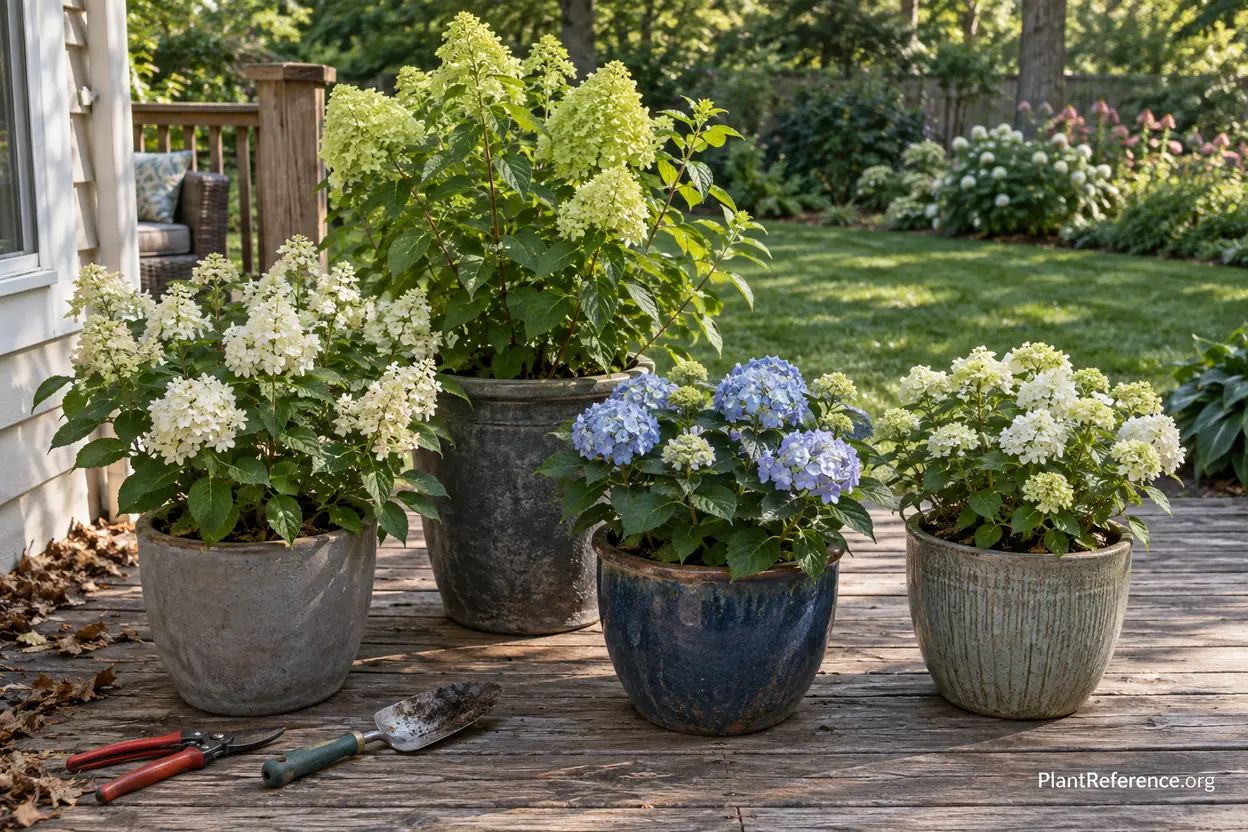
Container volume is the single biggest factor in how often you'll water and how well roots survive winter. More soil means a larger moisture reserve and more thermal mass.
Size
Start dwarf cultivars in a pot at least 16-18 inches (40-45 cm) wide and deep, which holds roughly 10-15 gallons (38-57 L) of mix. For shrubs in the 3-5 foot (90-150 cm) range, go to 20-24 inches (50-60 cm). Avoid the temptation to plant a 1-gallon nursery plant in a huge pot right away; a jump of two sizes at a time keeps the mix from staying soggy around a small root ball. The same sizing logic applies across container crops, as covered in Container Size Matters: The Ultimate Guide to Choosing the Perfect Pot for Tomatoes.
Material
Each material has tradeoffs for a plant that will sit outdoors year-round:
Fiberglass and resin: Lightweight, frost-proof, and slow to dry out. The best all-round choice for cold climates.
Glazed ceramic: Beautiful and moisture-retentive, but only frost-resistant if rated for freezing. Move or wrap in winter.
Unglazed terracotta: Breathable but dries fast and can crack when wet clay freezes. Better suited to zones 8-10.
Wood planters: Excellent insulation for roots. Line with landscape fabric to extend life.
Fabric grow bags: Superb root aeration, but dry out quickly and offer little winter insulation.
Whatever the material, the pot needs at least one large drainage hole. Hydrangeas are thirsty, but a waterlogged root zone is starved of oxygen and quickly develops root rot. Set pots on feet or a wheeled caddy so water drains freely and you can move the plant later. For exposed rooftop and balcony sites, the anchoring advice in Protecting Container Tomatoes on Windy Balconies and Exposed Patios applies just as well to top-heavy hydrangeas in full bloom.
Potting Mix and Planting
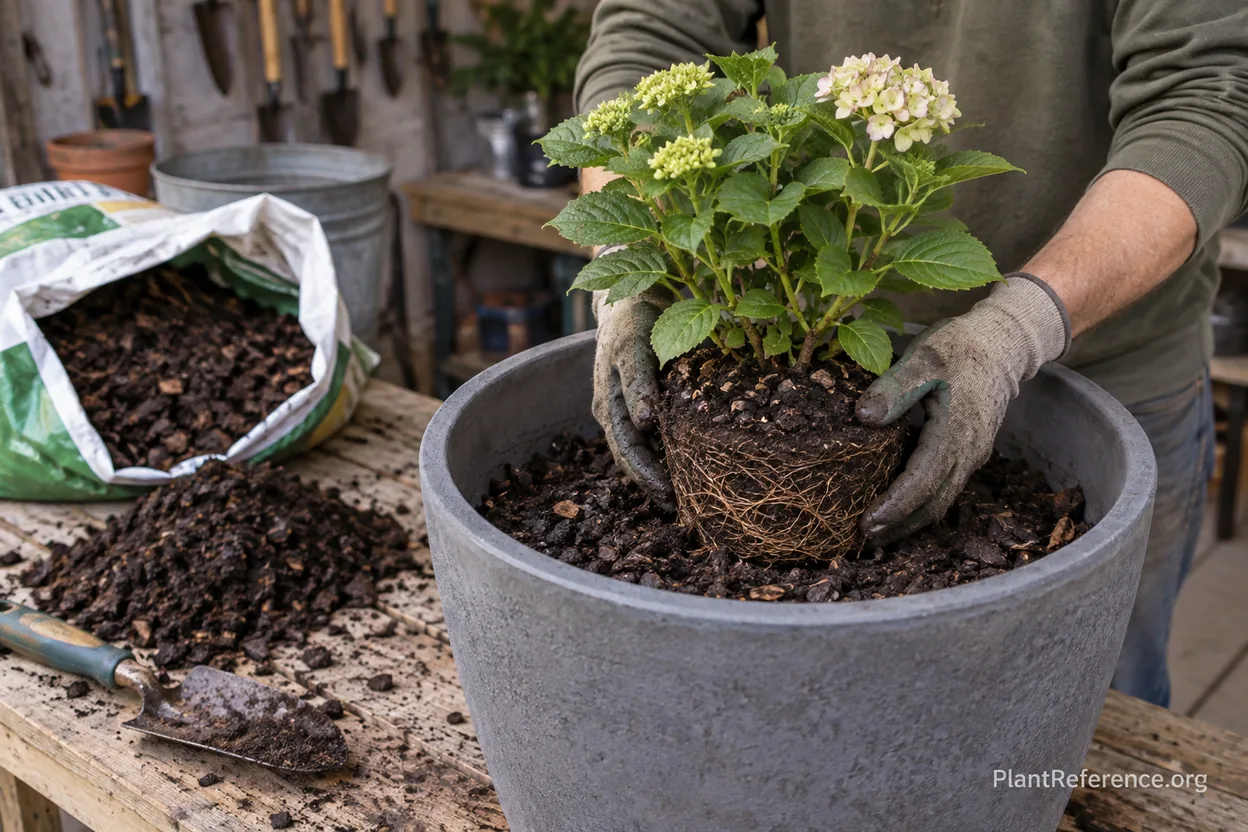
Never fill a container with garden soil. In a pot, mineral soil collapses into a dense, airless mass that drains poorly. Use a quality bark-based potting mix, and blend in 20-30 percent compost to improve moisture retention and add slow-release nutrients.
Planting Steps
Water the nursery plant thoroughly an hour before planting.
Add mix to the container so the top of the root ball will sit 1-2 inches (2.5-5 cm) below the rim, leaving room for watering.
Slide the plant out and gently tease apart any circling roots on the outside of the root ball.
Set the plant at the same depth it grew in the nursery pot; burying the crown invites rot.
Backfill, firming lightly with your fingers rather than packing hard.
Water slowly until it runs from the drainage hole, then top with 1-2 inches (2.5-5 cm) of shredded bark mulch.
Spring and early fall are ideal planting times. The plant can establish new roots before summer heat or winter cold arrives.
Watering Container Hydrangeas
Hydrangea leaves have thin cuticles and high transpiration rates, which is why these plants wilt so dramatically when dry. In a pot, that happens fast.
Check the mix daily from late spring through early fall. Push a finger 1 inch (2.5 cm) into the mix; if it feels dry, water slowly and deeply until water drains from the bottom. In peak summer heat, a 16-inch (40 cm) pot in sun may need water every day, and occasionally twice. A moisture meter takes the guesswork out, especially with larger containers where the surface dries well before the root zone.
A little midday wilting on a hot afternoon is normal. Leaves partly close to reduce water loss and usually recover by evening. If a plant is still drooping the next morning, the root zone is either too dry or too wet, and you'll need to check which. Our guide on Overwatering vs Underwatering Container Tomatoes: How to Tell the Difference walks through the same diagnostic logic.
Ways to reduce watering frequency:
Use the largest practical container.
Group pots together so they shade each other's sides.
Choose a site with morning sun and afternoon shade for bigleaf and smooth types.
Install a drip line on a timer, or use a self-watering reservoir planter.
Keep a 1-2 inch (2.5-5 cm) mulch layer on the soil surface.
Self-watering designs work very well for hydrangeas because they supply steady moisture from below. The options reviewed in 7 Best Self-Watering Planters for Tomatoes in 2026 (Tested and Reviewed) include several sizes large enough for a dwarf hydrangea.
Feeding and Flower Color in Pots
Because watering leaches nutrients, potted hydrangeas benefit from a slow-release granular fertilizer applied once in spring as new growth emerges. Supplement with a half-strength liquid feed every 3-4 weeks through mid-July if growth looks pale. Stop feeding by early August so stems can harden off before winter; late nitrogen encourages soft growth that is easily damaged by frost.
Controlling Flower Color
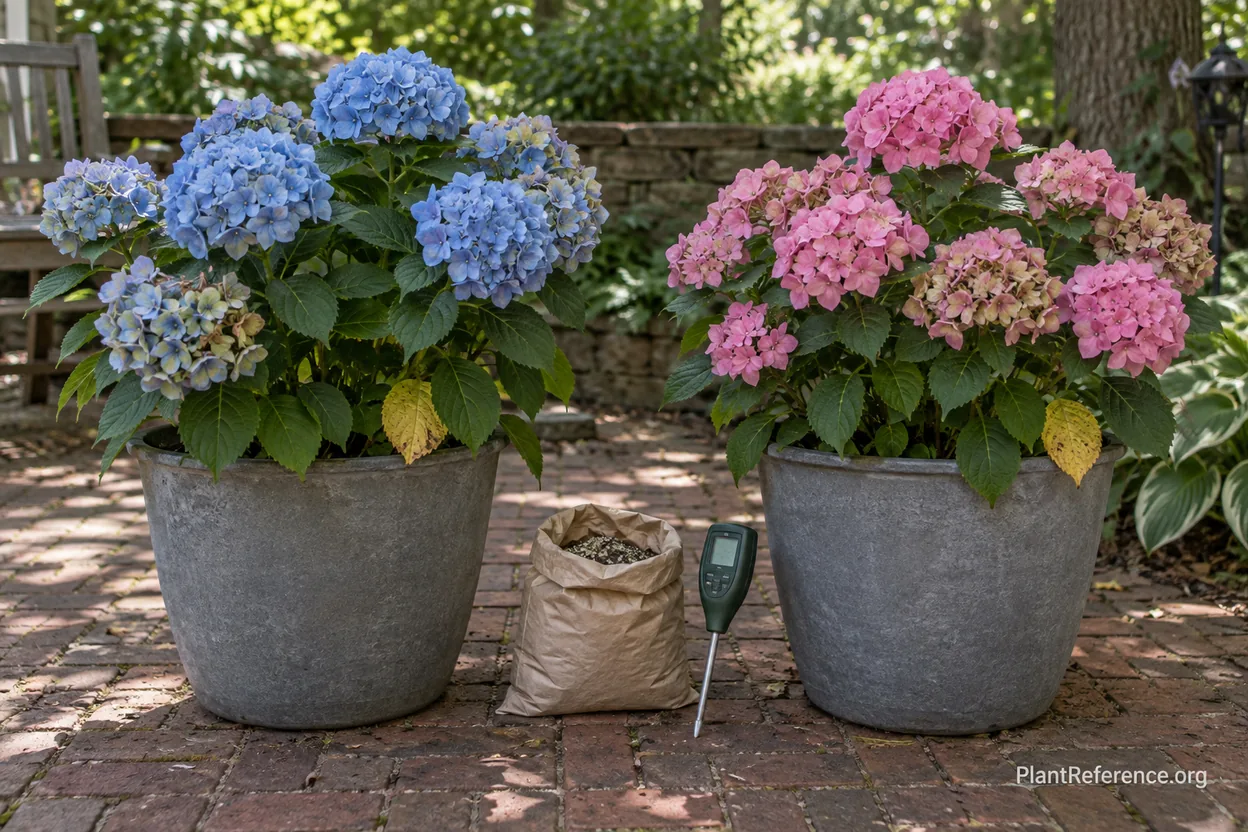
Containers give you unusual control over bigleaf and mountain hydrangea color, because you control the entire root environment. Color depends on aluminum availability, which depends on pH. In acidic mix (pH 4.5-5.5), aluminum dissolves, is taken up, and binds with the flower pigment to produce blue. In mix near neutral (pH 6.5 and above), aluminum is locked up and flowers turn pink.
For blue flowers, start with an acidic, peat- or bark-based mix and water with an aluminum sulfate solution (about 1 tablespoon per gallon, or 15 mL per 3.8 L) in spring, repeating two or three times at monthly intervals. Use a low-phosphorus fertilizer, since phosphorus binds aluminum into an insoluble form. For pink, add garden lime to the mix and use a fertilizer higher in phosphorus. Test the pH of your mix before adjusting; the testing approach in Raised Bed Soil pH Problems: Testing, Adjusting, and Maintaining Balance works for containers too.
Only bigleaf and mountain hydrangeas respond to pH. White cultivars stay white, and panicle, smooth, and oakleaf types never change color with soil chemistry.
Pruning Potted Hydrangeas
Pruning follows the same rules as in-ground plants and depends on bloom wood. Cut panicle and smooth hydrangeas back in late winter or early spring, removing roughly one-third of the height and any weak or crossing stems. They flower on the growth that follows, so even a firm cut costs you nothing.
Leave bigleaf, mountain, and oakleaf hydrangeas largely alone. Their flower buds for next summer sit at the tips of this year's stems, and any pruning after August removes them. In spring, cut out only dead stems, identified by scratching the bark: green tissue underneath means the stem is alive. Deadhead spent flowers just above the first pair of healthy leaves.
Winter Care for Hydrangeas in Pots
This is where container hydrangeas are won or lost. A useful rule of thumb: a hydrangea in a pot left fully exposed outdoors is only reliably hardy about two zones warmer than its in-ground rating. A Hydrangea paniculata 'Bobo' rated to zone 3 in the ground is a reasonable bet to overwinter exposed in a large pot in zone 5 or 6. A bigleaf hydrangea rated to zone 5 is at risk in an exposed pot anywhere colder than zone 7.
Strategies by Zone
USDA Zone | Panicle & Smooth Types | Bigleaf, Mountain & Oakleaf Types |
|---|---|---|
3-4 | Unheated garage or bury pot in ground | Unheated garage or cool basement only |
5-6 | Group, insulate, and mulch; or garage | Unheated garage or wrapped and sheltered |
7 | Leave outdoors, group against a wall | Group, wrap pot, protect buds from late frost |
8-10 | No special protection | Water through winter, shade from hot afternoons |
Overwintering Methods
Unheated garage or shed. After the plant goes dormant and drops its leaves, move it into a space that stays roughly 25-40°F (-4 to 4°C). The goal is to keep the plant dormant, not warm. Water lightly every 3-4 weeks so the mix never dries completely; dormant roots still need some moisture. Return the plant outdoors gradually once hard freezes are over.
Bury the pot. In an empty vegetable bed or open patch of ground, dig a hole and sink the entire container to its rim. The surrounding soil insulates the roots as if the plant were in the ground. Mound 6-8 inches (15-20 cm) of shredded leaves over the crown.
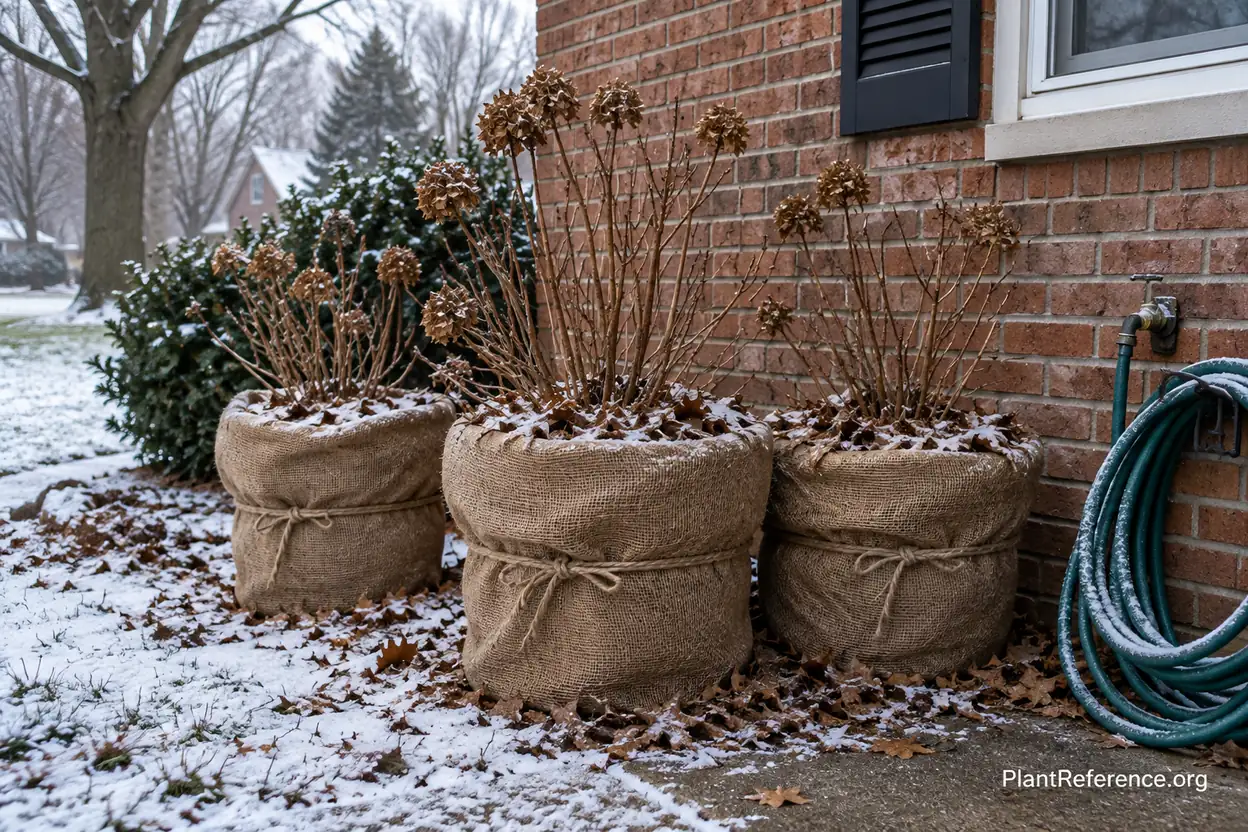
Group and insulate in place. Cluster pots tightly against a north- or east-facing house wall, out of the wind and away from winter sun that causes freeze-thaw cycles. Wrap the pots in bubble wrap or burlap stuffed with dry leaves. For bigleaf types, add a burlap cage filled with leaves around the stems to protect flower buds.
Winter protection for old-wood types continues into spring. Bigleaf hydrangea buds that have begun to swell can be killed by a single late frost, so keep a frost cloth handy and cover plants on nights below 28°F (-2°C). The general principles in How to Prepare Perennial Gardens for Winter by Species also apply to shrubs in pots.
Repotting and Long-Term Care
Even compact hydrangeas fill a container with roots within 2-3 years. Signs a plant needs attention include water running straight through the pot, roots circling the drainage hole, and smaller leaves and flowers despite regular feeding.
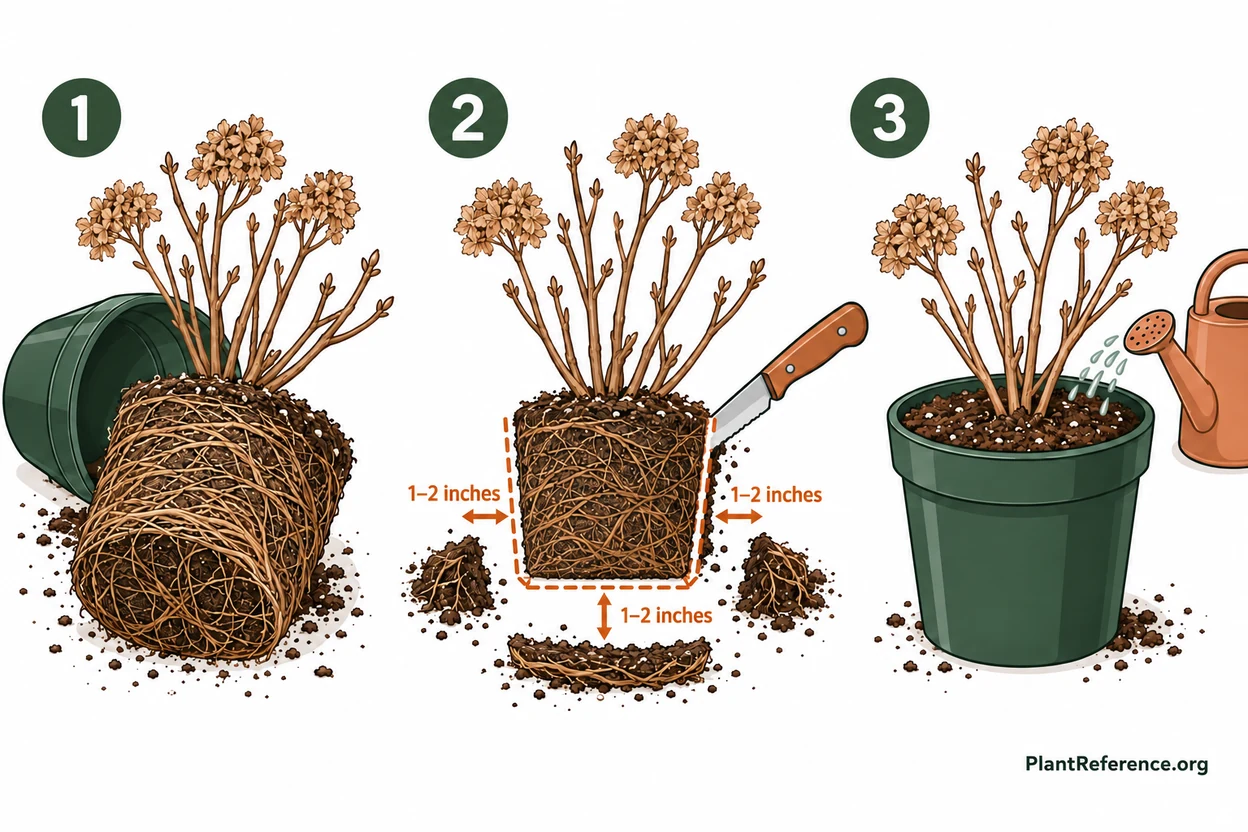
In early spring before leaf-out, you have two options. Move the plant up one pot size, 2-4 inches (5-10 cm) wider than the current container. Or, if the plant is already in the largest pot you want to manage, root-prune: slide it out, shave 1-2 inches (2.5-5 cm) off the sides and bottom of the root ball with a sharp knife, and replant in fresh mix in the same container. Root pruning keeps a mature plant vigorous in a fixed space, much like maintaining a bonsai. The warning signs described in Container Too Small? How to Save Root-Bound Tomato Plants apply to shrubs as well.
Refresh the top 2 inches (5 cm) of mix every spring in years when you don't repot. Replace the mulch layer, check that drainage holes are clear, and inspect the stems for scale insects or dieback before the growing season begins.
Frequently Asked Questions
Reading about plants and recognising them are different skills. These three build the second.
- Daily PlantIdentify the day’s mystery plant from a close-up photograph.
- Keyed OutWork a dichotomous key, lead by lead, to name a hidden specimen.
- Name That PlantName a specimen from botanical clues dealt hardest first.
Free to play, no account needed
Tagged with
Sarah earned her doctorate in plant biology and spent time working in botanical garden education before transitioning to freelance writing and consulting. Now based in Portland, Oregon, she teaches plant identification workshops at local community centers and maintains a modest collection of over 60 houseplants in her small apartment. Sarah specializes in helping beginners understand plant science without the jargon—her approach focuses on practical observation over theory. She's killed her fair share of fiddle leaf figs and finally cracked the code on keeping them alive.