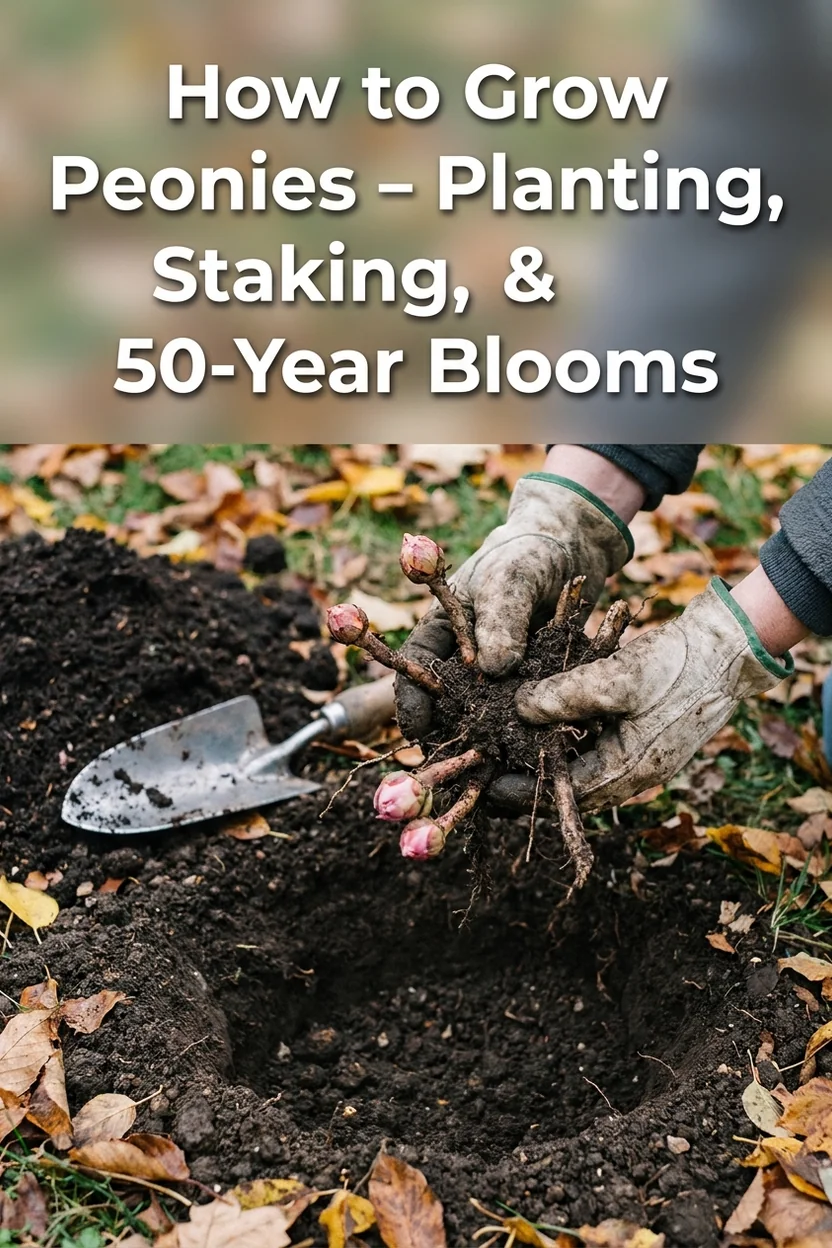
How to Grow Peonies: Planting, Staking & 50-Year Blooms
Pets & Toxicity
Recorded toxicity for plants linked in this guide. An unknown status is not a safety assessment.
Toxic to pets: garden peony, Sarah Bernhardt peony, Festiva maxima peony and 3 moreDetailsHide
Paeonia lactiflora 'Sarah Bernhardt' — Toxicity Warning
Toxic to pets and humansView Paeonia lactiflora 'Sarah Bernhardt' plant profilePaeonia lactiflora 'Festiva Maxima' — Toxicity Warning
Toxic to petsView Paeonia lactiflora 'Festiva Maxima' plant profilePaeonia 'Coral Charm' — Toxicity Warning
Mildly toxic if ingestedView Paeonia 'Coral Charm' plant profile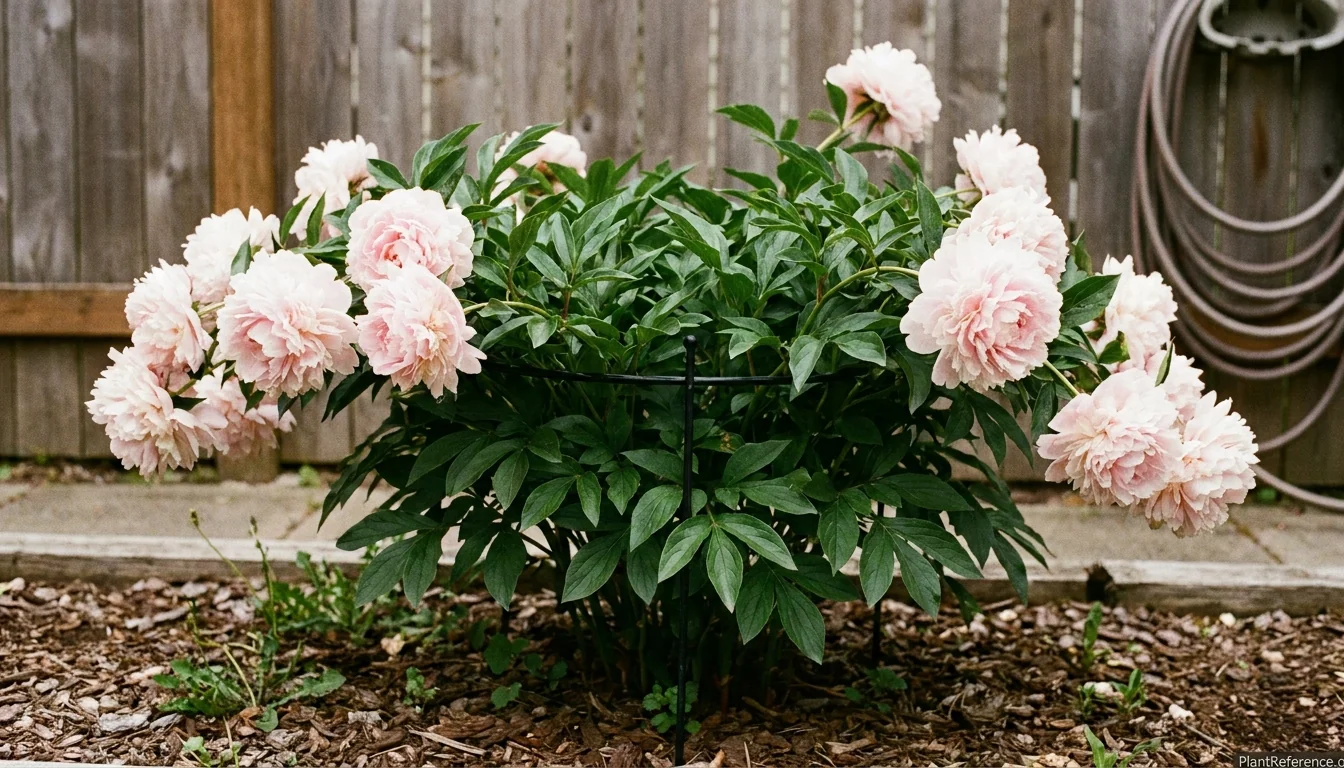
— Image © PlantReference.org 2026
Learning how to grow peonies is mostly an exercise in restraint. These are not needy plants. 🌿Paeonia lactiflora (pay-OH-nee-ah lak-tih-FLOR-ah) clumps have been documented blooming in the same spot for over a century, outlasting the houses they were planted beside. What kills them — or more often, what leaves them alive but flowerless for years — is being planted wrong once and then fussed over forever after.
Why Peonies Fail (It's Almost Always Depth)
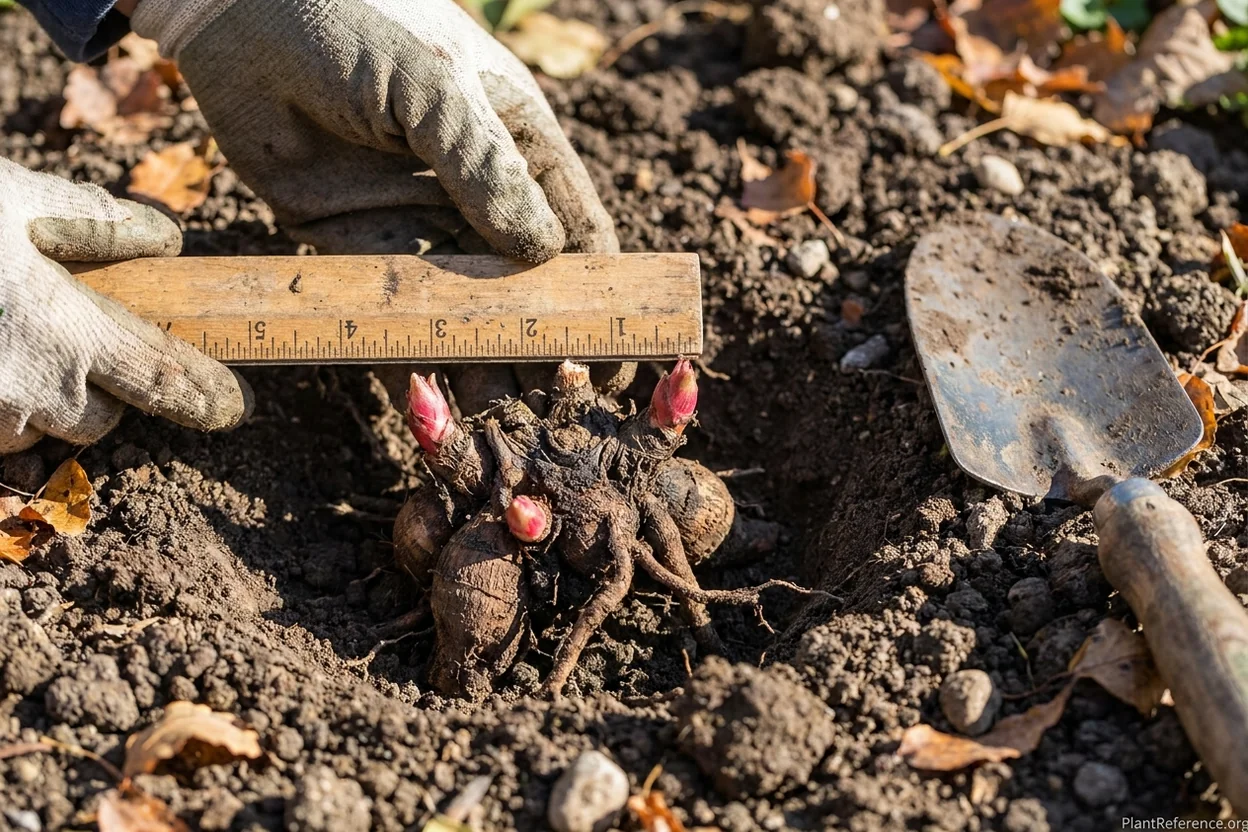
I get called out to look at non-blooming peonies more than any other perennial problem. Nine times out of ten I dig down two inches and find the eyes sitting four or five inches under the soil.
The growth buds on a peony crown — the pink or white nubs called eyes — need to sit 1.5 to 2 inches (4-5 cm) below the surface. Deeper than that and the plant reads the soil temperature as still-winter, produces plenty of foliage, and simply declines to set flower buds. It will do this indefinitely. A peony buried six inches deep can sit there green and healthy for a decade without blooming once.
The second most common cause is shade. Peonies need six hours of direct sun minimum, and in New England I push for a full day. A maple that was a sapling when the peony went in is now a problem.
Planted too deep — foliage without flowers, the single biggest cause
Too much shade from trees or shrubs that have matured since planting
Insufficient chill hours in Zone 8 and warmer, where buds never initiate
Excess nitrogen from lawn fertilizer drifting into the bed
A clump moved or divided within the last two seasons and still re-establishing
If your plants are established and refusing to flower, the diagnostic walk-through in Why Your Peonies Won't Bloom: The 5 Most Common Causes covers each cause in order of likelihood.
Choosing the Right Peony Type
There are three groups, and the choice affects staking more than anything else.
Herbaceous peonies die back to the ground each winter and re-emerge in spring. These are the classics — 🌿Paeonia lactiflora 'Sarah Bernhardt' with its heavy pale-pink doubles, 🌿Paeonia lactiflora 'Festiva Maxima' with white blooms flecked crimson, and Paeonia lactiflora 'Karl Rosenfield' in deep red. All three are gorgeous and all three flop in rain without support.
Tree peonies (🌿Paeonia suffruticosa) hold woody stems through winter and build a permanent 4-5 foot (120-150 cm) framework. They never need staking. They are slower, more expensive, and worth it if you have the patience.
Itoh or intersectional hybrids cross the two groups. 🌿Paeonia 'Bartzella' is the one most people meet first — sulphur-yellow, fragrant, with strong stems that carry the flowers upright without a ring. If you hate staking, start here.
Type | Mature Height | Staking Needed | Bloom Window | Notes |
|---|---|---|---|---|
32-36 in (80-90 cm) | Yes, always | Late spring | Heavy doubles; flops in any rain | |
30-36 in (75-90 cm) | Yes | Mid-late spring | Strongly fragrant; very long-lived | |
34-36 in (85-90 cm) | Usually not | Early-mid spring | Semi-double, sturdy stems | |
30-36 in (75-90 cm) | No | Late spring | Itoh hybrid; self-supporting | |
48-60 in (120-150 cm) | No | Mid spring | Woody framework, no dieback |
If you are building a border that carries colour past the peony window, the sequencing approach in Plan a Perennial Garden That Blooms Spring to Fall pairs well with what follows here.
How to Plant Peonies Correctly
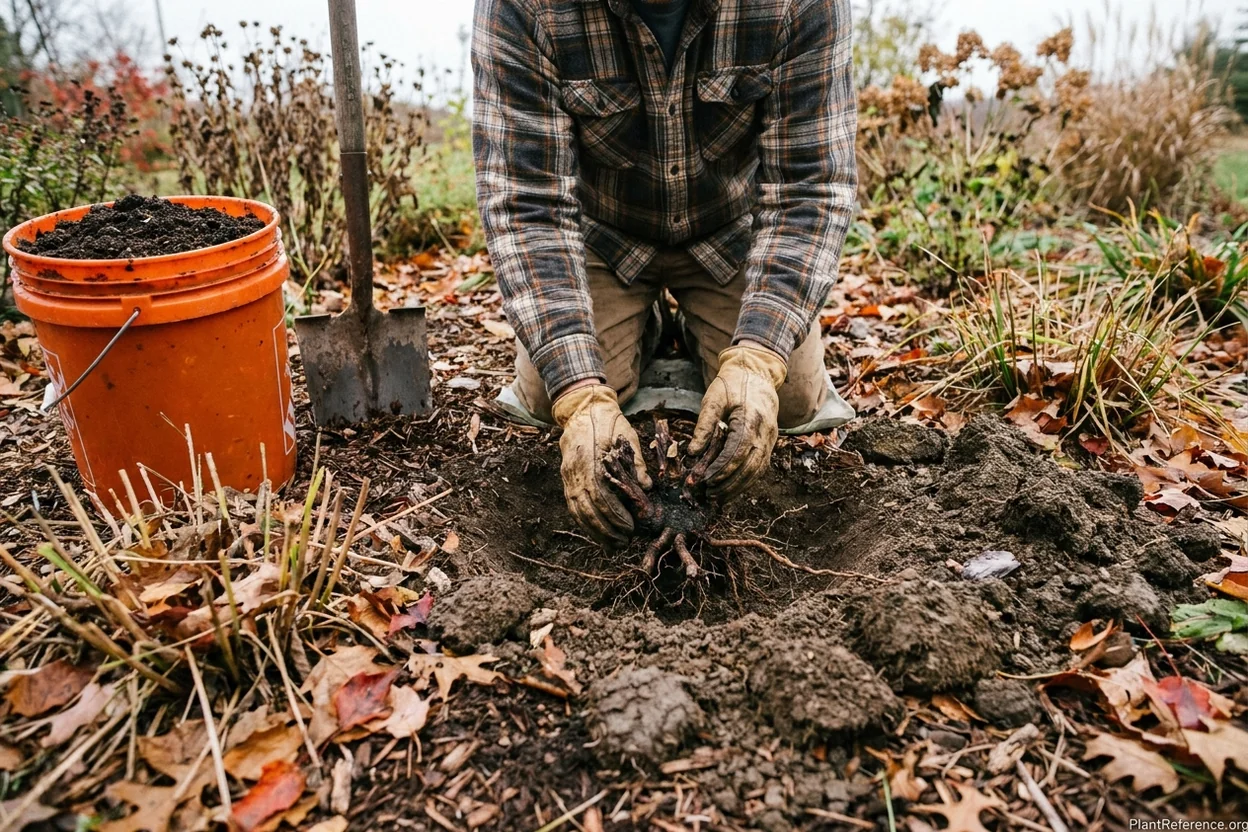
Plant bare-root divisions in fall — late September through October across most of Zones 3-8. Fall planting lets roots establish before the ground freezes and gets you a much better first spring. Potted peonies from a nursery can go in spring, but they will sulk for a season.
Dig the hole wider than deep: about 18 inches (45 cm) across and 12-15 inches (30-38 cm) deep. Work a few shovelfuls of compost into the excavated soil, then backfill enough that the crown sits at the right height when you set it in. Firm the soil, water it in, and check the depth again after it settles — soil almost always drops an inch.
Buy divisions with 3 to 5 eyes; fewer than three delays first bloom by years
Space plants 3 to 4 feet (90-120 cm) apart — they get wide and hate crowding
Target a soil pH of 6.5 to 7.0; peonies dislike strongly acidic ground
Never plant into a wet spot — the crown rots where water sits
Mark the location, because herbaceous types vanish completely by November
Drainage matters more than fertility here. If your site holds water after a storm, fix it before planting rather than after; the same principles in Poor Drainage in Raised Beds: Causes and Fixes for Waterlogged Soil apply to an in-ground border. And if you are unsure of your pH, test it — Raised Bed Soil pH Problems: Testing, Adjusting, and Maintaining Balance walks through the correction maths.
Staking: Get Ahead of the Flop
Here is the thing nobody tells you: staking a peony after it flops does not work. Once those stems bend at the base they stay bent, and tying them up afterward looks exactly like what it is — a repair.
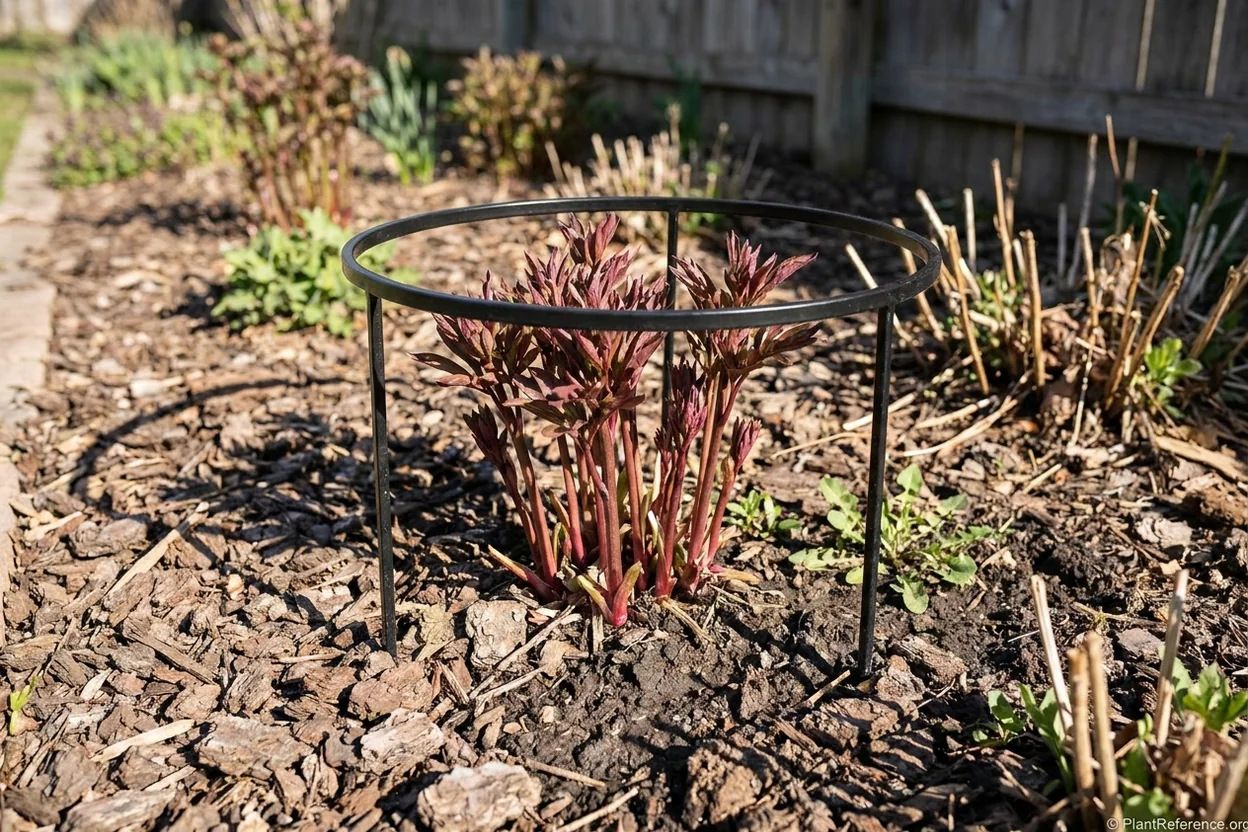
Support goes in when the shoots are 8 to 10 inches (20-25 cm) tall, usually mid-April in Zone 6b. The foliage grows up through the ring, hides the hardware completely, and the flowers open into a structure that is already holding them.
Grow-through rings are the right tool. A ring with a grid top helps carry heavy flowers, but the heaviest doubles may still need extra support. Individual bamboo stakes with soft twine work as a budget version — set three or four around the clump and run twine in a loose cat's cradle rather than cinching stems to a post.
Skip staking entirely for 🌿Paeonia 'Bartzella', 🌿Paeonia suffruticosa, and single or semi-double cultivars like 🌿Paeonia 'Coral Charm'. Their stems carry the weight.
The First Three Years
Peonies are slow starters and this trips people up. Year one you may get a single flower or none at all. Year two brings a handful. By year three the clump reads as an actual peony, and it keeps improving for another decade after that.
Do not fertilize heavily in that window trying to speed it up — you will get leaves. Do not move the plant because it looks disappointing. Do not divide it. The root system is doing the work underground where you cannot see it.
Water deeply in the first two summers, roughly an inch (2.5 cm) a week in the absence of rain, delivered in one or two long soakings rather than daily sprinkling. After year three an established clump handles ordinary summer dry spells without help.
Feeding, Watering, and What to Skip
Peonies want less than most gardeners give them. A 2-inch (5 cm) layer of compost spread around the crown each spring — not over it — is usually the entire feeding programme.
If you soil-test and find phosphorus genuinely low, a low-nitrogen fertiliser such as a 5-10-10 applied once as shoots emerge is reasonable. High-nitrogen lawn feed is the enemy. It produces tall soft stems that flop harder and flower less, the same trade-off described in Why Your Daylilies Stopped Blooming (And How to Fix It).
Compost topdressed in spring, kept off the crown itself
Water deeply and infrequently; avoid overhead sprinklers that wet foliage
Mulch 2-3 inches (5-8 cm) but pull it back from the crown in late winter
Skip nitrogen-heavy feeds entirely
Deadhead spent flowers to the first strong leaf to keep energy in the roots
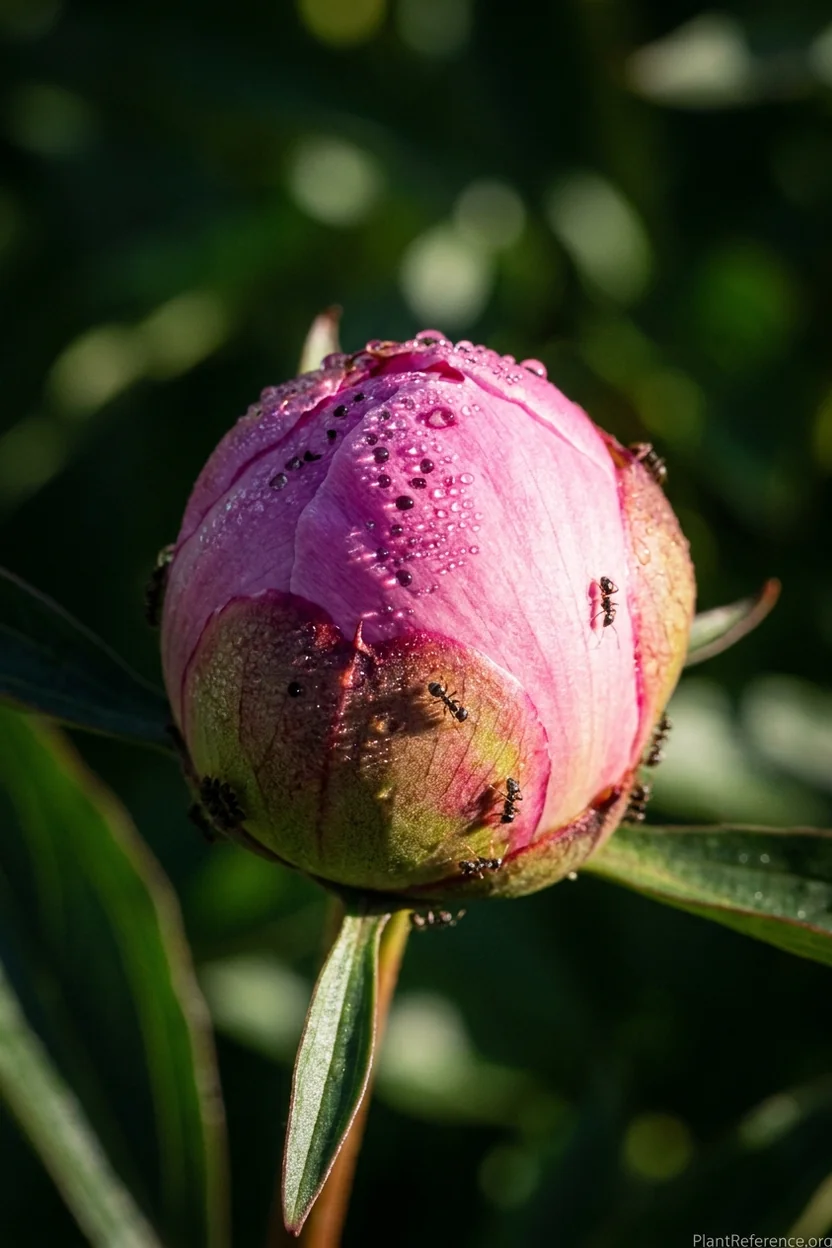
One more thing: the ants on your peony buds are harmless. They are after the nectar the buds secrete and they do not open the flowers, damage them, or need controlling. Leave them.
Fall Cleanup That Prevents Disease
Peonies are one of the perennials I cut back hard every autumn, and it is not for tidiness. Powdery mildew and botrytis spores overwinter on that foliage and reinfect the plant in spring.
Cut herbaceous peonies to 2 inches (5 cm) after the first hard frost, and remove the debris from the property rather than composting it. Tree peonies get no cutting back at all — their woody stems carry next year's buds.
This puts peonies in the minority. Most perennials in my beds stay standing over winter for seed heads and insect habitat, and When to Cut Back Perennials in Fall (And What to Leave) sorts out which is which. Peonies, bearded iris, and hostas are on the cut-it list for pest and disease reasons; the guidance for iris borer specifically is in How to Divide Irises Without Killing Them.
Moving or Dividing an Established Clump
You will probably never need to. Peonies do not require division for vigour the way daylilies and hostas do, and a clump left undisturbed will outperform one that gets split every few years.
Divide only when you want more plants, or when a mature garden has grown up around a peony and shaded it out. Do it in September or early October, never spring.
Lift the whole clump with a garden fork, hose the soil off the crown so you can see what you are cutting, and slice it into pieces carrying 3 to 5 eyes each with a clean sharp knife. Smaller pieces will survive but may take four or five years to flower. Replant immediately at the same 1.5-2 inch (4-5 cm) depth. Expect to lose the following spring's bloom regardless of how carefully you work — the general method in How to Divide Perennials: A Species-by-Species Guide applies, with peonies at the slow-recovery end of the range.
Deer largely leave peonies alone, which makes them useful in the rural edges of a property where hostas get eaten to the ground. They sit in the moderately resistant band alongside sedum and yarrow — see Deer-Resistant Perennials: A Zone-by-Zone Planting Guide for the fuller picture, and How to Grow Hostas: Varieties, Care & Pest Solutions for the plants that need actual protection.
Get the depth right, give them sun, put the ring on in April, and cut them down in November. That is the entire job. Everything else is waiting, and peonies reward waiting better than any perennial I plant.
Frequently Asked Questions
Reading about plants and recognising them are different skills. These three build the second.
- Daily PlantIdentify the day’s mystery plant from a close-up photograph.
- Keyed OutWork a dichotomous key, lead by lead, to name a hidden specimen.
- Name That PlantName a specimen from botanical clues dealt hardest first.
Free to play, no account needed
Tagged with
Kevin is a landscape contractor in the Boston area who specializes in cold-climate perennial gardens and hardscaping. He studied landscape design and worked at a prominent nursery on the North Shore before starting his own design-build firm. Kevin's gardens are built to handle New England weather—freeze-thaw cycles, nor'easters, late springs, and heavy snow loads. He's particularly interested in native perennials and shrubs that provide four-season interest without constant maintenance. Kevin writes about cold-hardy plant selection, winter garden structure, and building landscapes that look good even in February.