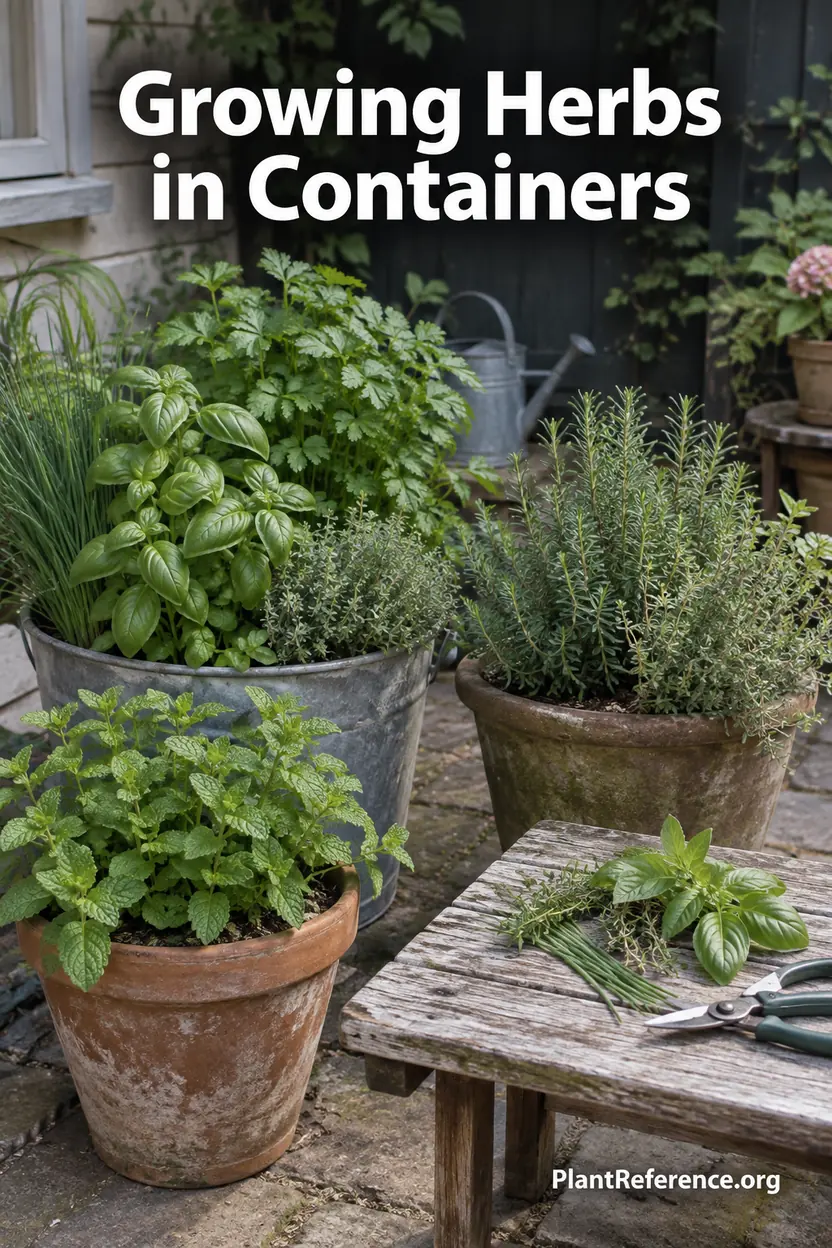
Growing Herbs in Containers: Pots, Soil & Harvest
Pets & Toxicity
Recorded toxicity for plants linked in this guide. An unknown status is not a safety assessment.
Toxic to pets: Parsley, chives (9 linked plants checked)DetailsHide
Allium schoenoprasum — Toxicity Warning
Toxic to cats and dogs if eaten; cats are especially susceptible, and raw, cooked or concentrated plant material can damage red blood cells and cause anaemia.View Allium schoenoprasum plant profile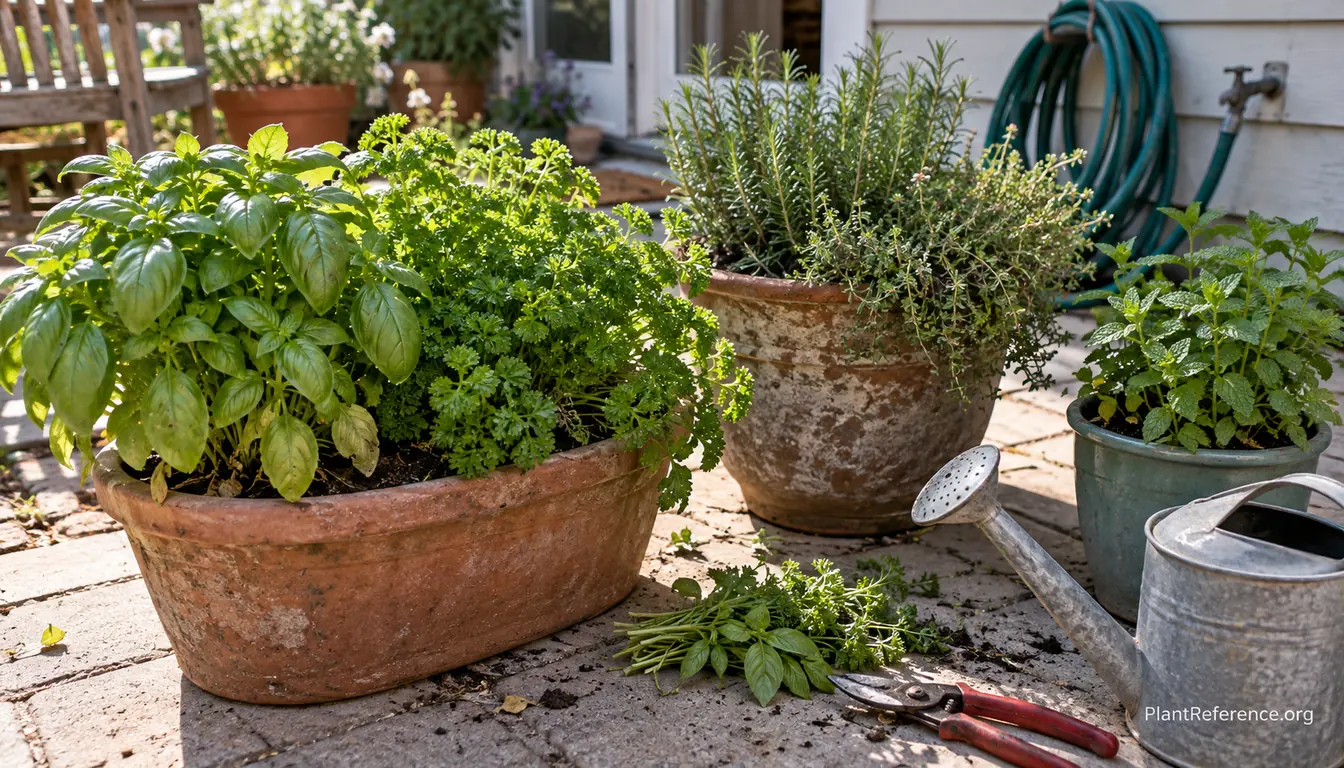
— Image © PlantReference.org 2026
Growing herbs in containers is easier when the pot arrangement follows water demand rather than a recipe. Basil and parsley like steady moisture; rosemary and thyme prefer the mix to dry further between waterings. Put those groups in separate containers, start with open drainage and enough room for mature roots, and you can harvest useful handfuls even from a narrow balcony.
Choose Herbs by Water Demand
The common kitchen-herb display looks convenient: six attractive plants pressed into one long trough. The trouble appears when you water it. Sweet basil Ocimum basilicum (oh-SEE-mum bah-SIL-ih-kum) and parsley 🌿Petroselinum crispum appreciate a more consistently moist root zone than rosemary 🌿Salvia rosmarinus and thyme 🌿Thymus vulgaris. A single watering pattern leaves one group thirsty or the other sitting too wet. I would rather use two inexpensive pots than lose half a fancy mixed planter.
Think in two working groups. The first holds soft, leafy herbs you cut often: basil, parsley, cilantro 🌿Coriandrum sativum, and chives 🌿Allium schoenoprasum. Their containers can dry slightly at the surface, but the root zone should not repeatedly go bone dry. The second group holds Mediterranean woody herbs: rosemary, thyme, oregano 🌿Origanum vulgare, and sage 🌿Salvia officinalis. These still need a thorough drink, especially when newly planted, but their mix should become noticeably drier before the next one.
Herb | Useful starting pot | Watering group | Harvest habit |
|---|---|---|---|
Basil Ocimum basilicum | 1–2 gallons (4–8 L) | Evenly moist | Pinch tips above paired leaves |
Parsley 🌿Petroselinum crispum | 1–2 gallons (4–8 L) | Evenly moist | Cut outer stems at base |
Cilantro 🌿Coriandrum sativum | 1–2 gallons (4–8 L) | Evenly moist | Cut leaves before flowering |
Chives 🌿Allium schoenoprasum | 1 gallon (4 L) or larger | Evenly moist | Cut a portion of leaves low |
Rosemary 🌿Salvia rosmarinus | 2 gallons (8 L) or larger | Drier between drinks | Trim flexible new shoots |
Thyme 🌿Thymus vulgaris | 1–2 gallons (4–8 L) | Drier between drinks | Snip young leafy tips |
Oregano 🌿Origanum vulgare | 1–2 gallons (4–8 L) | Drier between drinks | Cut stems before flowers |
Mint 🌿Mentha spicata | Its own 2-gallon (8 L) pot | Evenly moist | Cut stems to keep compact |
Mint spreads by runners and fills a shared pot aggressively. Spearmint 🌿Mentha spicata can even send stems through neighboring plants if a container is too crowded. Give it its own vessel and trim the edges. Tarragon 🌿Artemisia dracunculus also deserves its own pot: its root system and winter rest do not fit neatly into either everyday watering group. That is a practical grouping choice, not a claim that every herb in one group has identical needs.
Light changes the plan too. Most of these herbs give stronger growth with at least six hours of sun, but in intense summer heat a little afternoon shade helps soft herbs avoid wilt and early flowering. A climate-specific basil calendar matters more than a generic date. Compare When to Plant Basil in Boise: Complete Guide + Best Varieties for Zone 6a with When to Plant Basil in Seattle: Complete Guide + Best Varieties for Zone 8b to see why the same herb can need different outdoor timing.
Give Roots the Right Pot Size
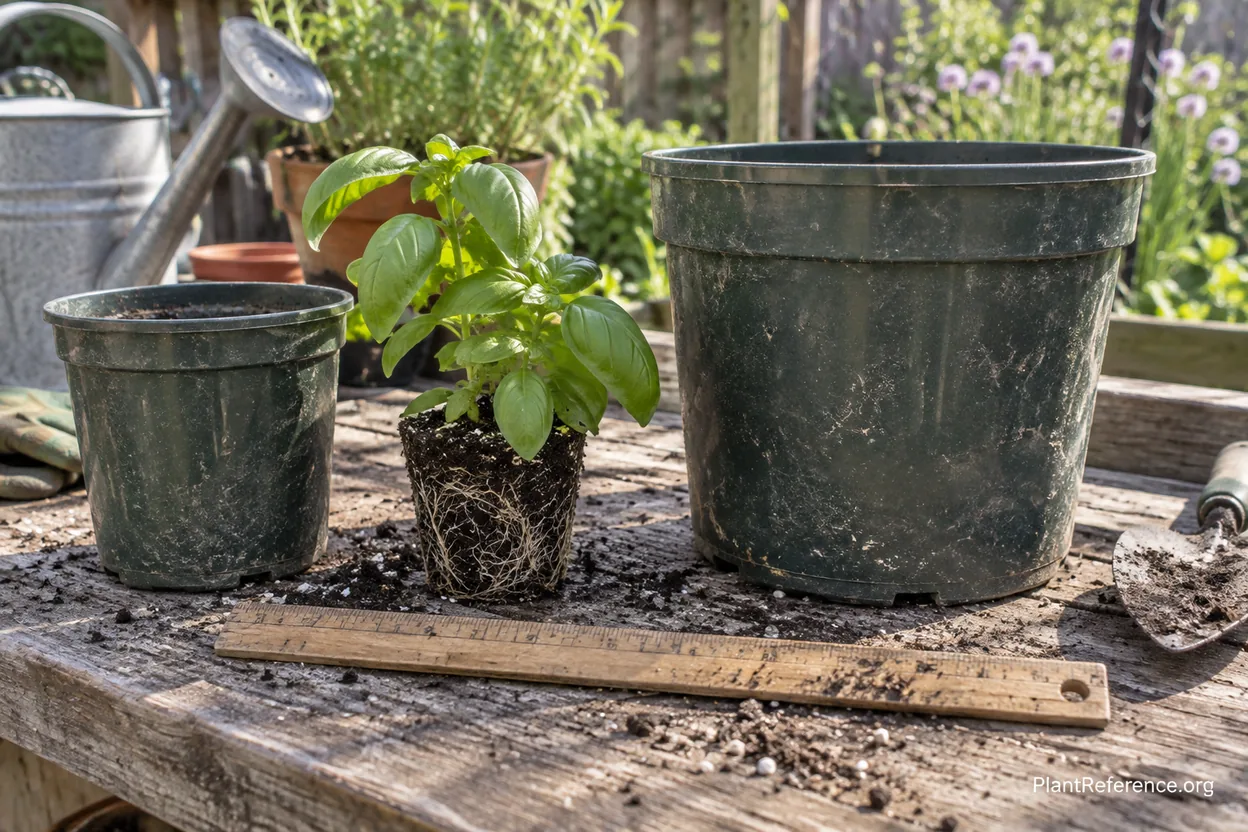
Many grocery-store herbs arrive in small nursery sleeves and look ready to live there forever. They are not. Roots soon occupy the whole sleeve, leaving almost no water reserve. For one young herb, a 1–2 gallon (4–8 L) container or a pot roughly 6–8 inches (15–20 cm) across is a useful baseline. A mature rosemary or a vigorous mint benefits from more room. A shallow broad planter can work for several soft herbs if each has space, but a deep narrow decorative pot may waste mix below their roots.
Whatever vessel you choose, it needs open drainage holes. A solid cachepot can hold an inner nursery pot, but remove the inner pot to water and drain it before putting it back. Roots need oxygen as well as moisture. Gravel under the potting mix does not improve this balance; it steals root space and can leave a saturated layer higher in the planting medium.
Terracotta is useful for growers who tend to overwater or have humid conditions because water evaporates through the wall. On a hot, windy balcony it may dry a soft-herb planting too fast. Plastic or glazed pots hold water longer and weigh less, though dark plastic can heat in strong sun. A fabric bag breathes well but may need frequent checks. The material comparison in Best Grow Bags for Tomatoes: Fabric vs Plastic Container Comparison concerns tomatoes, yet the evaporation tradeoff applies to herbs as well.
For a shared planter, allow room for the plant at full size. Two basil plants in a broad 12-inch (30 cm) pot can be more productive than four jammed into it, especially if you clip them repeatedly. If parsley and chives share, put the chives near an edge where you can cut them without crushing parsley stems. Do not place mint in that planter just because it fits today. By the time the roots tangle, separating it becomes a chore.
Fill Pots With a Mix That Drains
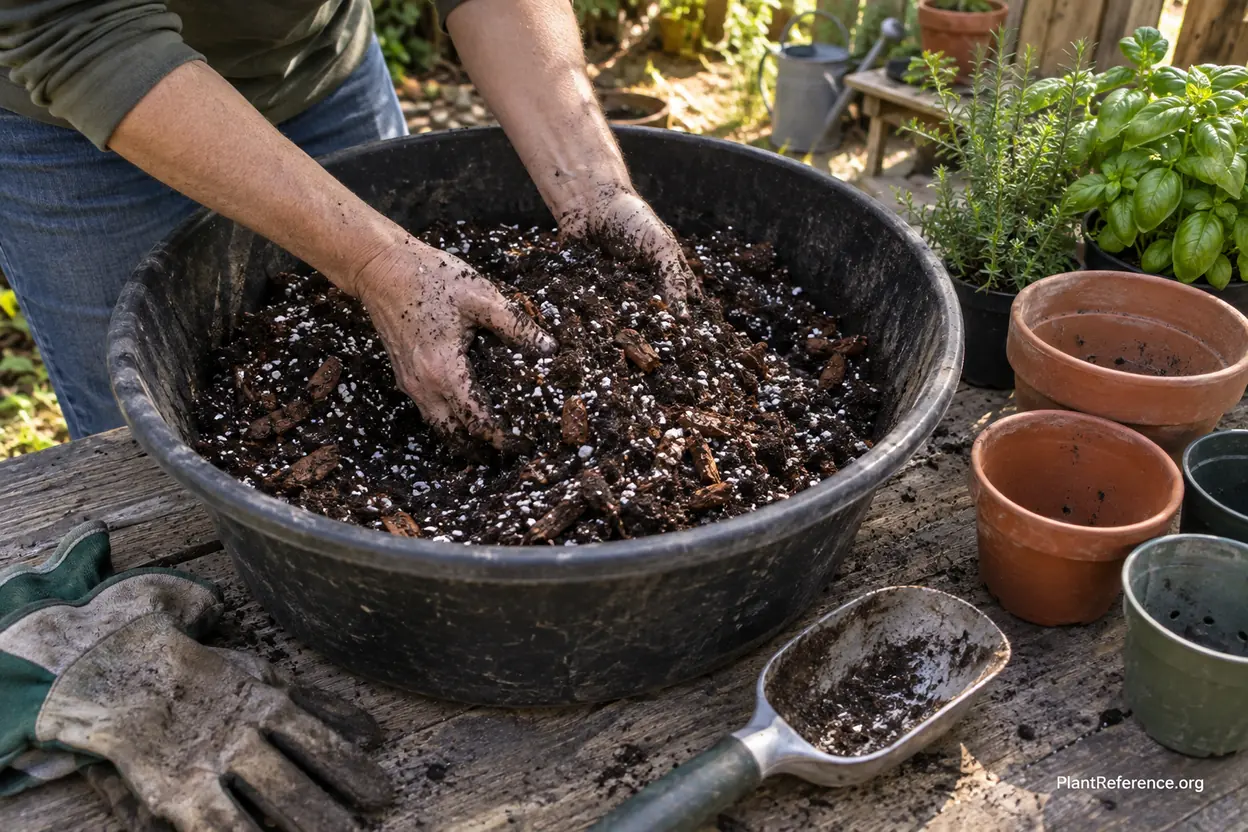
Do not fill herb pots with heavy garden soil. In a confined pot, fine mineral particles settle and reduce the air spaces roots need. A general-purpose potting mix with coir or peat for water retention and perlite or bark for structure is a better starting point. Read the bag: some mixes include fertilizer, and that matters when you set a feeding schedule. A mix sold for seed starting is often too fine and low in reserve to carry mature herbs through repeated harvest.
For soft herbs, use the standard mix as supplied unless it stays wet too long in your conditions. For rosemary and thyme, choose a coarser, free-draining blend or add a modest amount of perlite and bark. Do not turn the pot into a bowl of rocks; roots still need a medium that holds some water. Fill uniformly from bottom to top, and leave 1 inch (2.5 cm) below the rim so water can soak in rather than spilling over.
Pre-moisten dry mix before planting. Coir usually rewets readily, while peat-heavy material may repel the first pour after it becomes very dry. Add water a little at a time and stir until the medium is evenly damp but not dripping. When you water the planted pot, look for drainage from the holes and make sure the center actually gets wet. Container Tomato Soil: Creating the Perfect Growing Mix for Maximum Yields is crop-specific, but its explanation of air space and water retention helps explain why potting mix is engineered differently from yard soil.
Refresh the medium between annual plantings. Pull out old roots, loosen compacted material, and replace mix that has collapsed into fine crumbs. A perennial rosemary can stay in a pot longer, but inspect for circling roots every season and step up one or two pot sizes when necessary. Never rely on an inch of new soil on top to solve a solid root ball underneath. The warning signs in Container Too Small? How to Save Root-Bound Tomato Plants are familiar to anyone who has neglected a pot of mint.
Plant a Practical Small-Space Herb Garden
Choose seedlings with compact growth and healthy roots, or start seeds in clean trays when the season allows. Basil is a warm-season plant: move it outside only when nights are reliably mild and the risk of frost has passed. Parsley and chives tolerate cooler weather; cilantro often grows best during mild spring or autumn stretches rather than peak summer heat. Do not transplant all herbs on the same date just because the store sells them together.
Plant at the same soil depth the seedling occupied in its nursery pot unless the crop's instructions say otherwise. Tease apart tightly circling outer roots without tearing away most of the root ball. Water the container slowly after planting and give nursery-grown seedlings a few days of gradually increasing outdoor sun and wind. A sudden move from a sheltered shop bench to reflective paving can scorch leaves before roots have established.
Share a pot only when care is shared
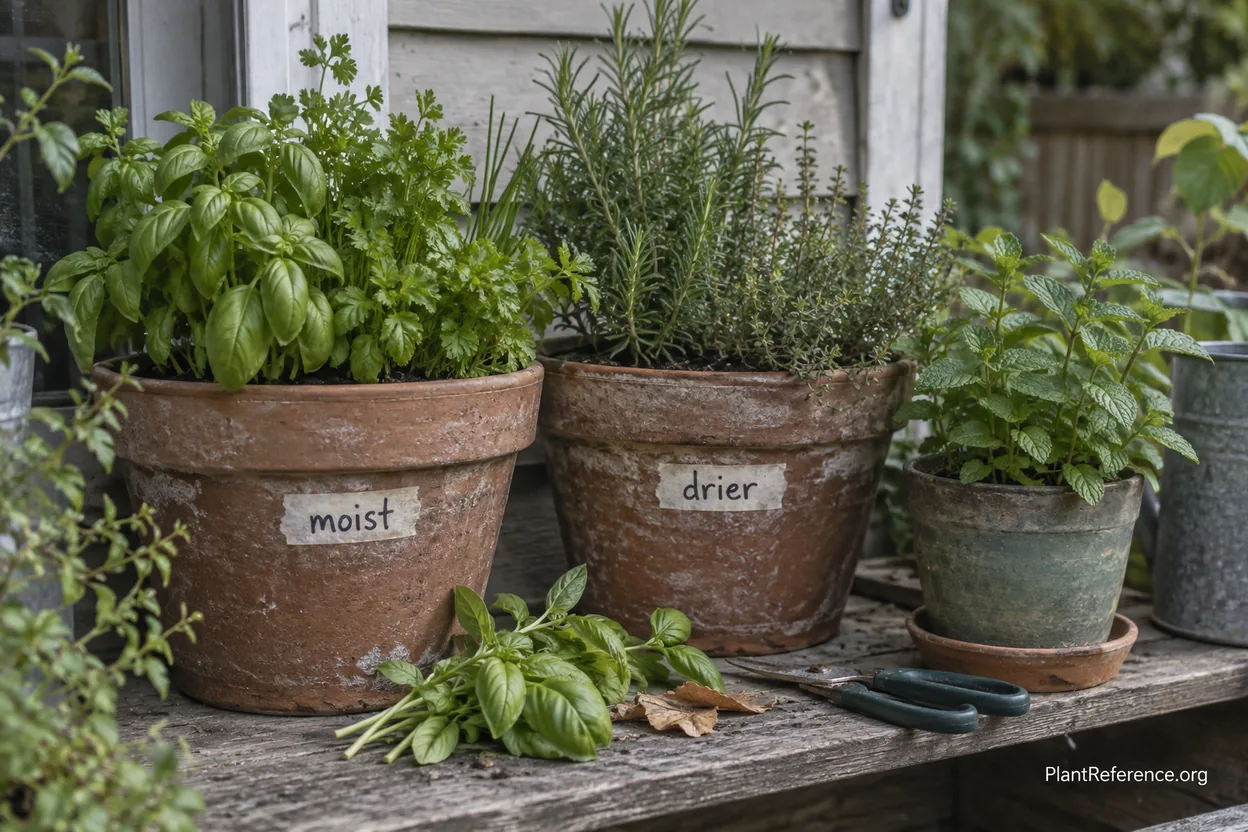
A moist-herb planter might pair basil with parsley if the vessel is broad enough and both receive adequate light. A drier planter can pair thyme and oregano, though oregano needs trimming to avoid overrunning its neighbor. Keep rosemary separate once it becomes woody and large. These are starting combinations, not permanent laws: your patio's heat and wind may mean two apparently similar herbs still dry at different rates.
Regional planting guides help with outdoor basil timing, but use the one that matches your conditions. When to Plant Basil in Chicago: Complete Guide + Best Varieties for Zone 6a and When to Plant Basil in Pittsburgh: Complete Guide + Best Varieties for Zone 6b show why a blanket spring date is unreliable. This guide stays location-free: judge outdoor planting by your local last frost, current night temperatures, and the microclimate where your pots stand.
Water and Feed Each Group
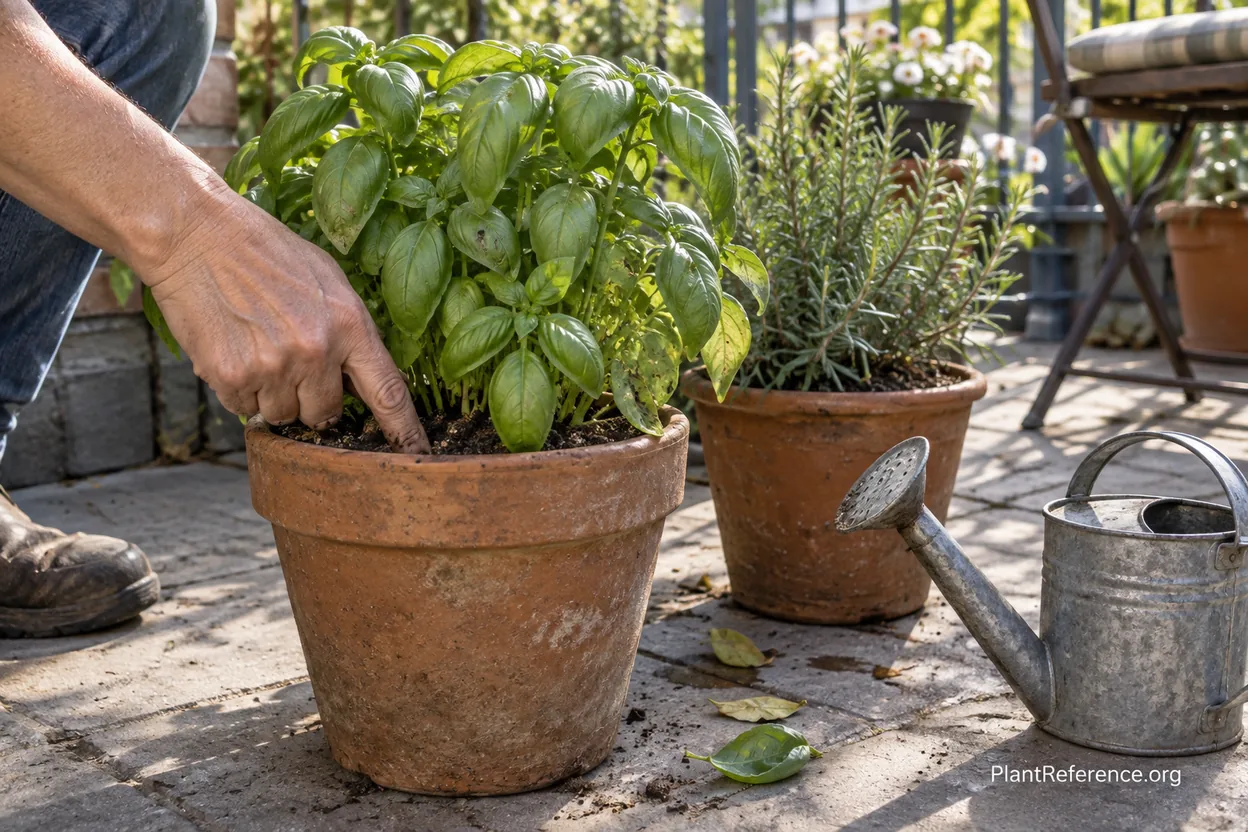
Check moisture with a finger 1–2 inches (2.5–5 cm) below the surface before you lift the watering can. For basil, parsley, cilantro, and chives, water when the upper layer begins to dry while deeper mix still feels slightly moist. For established rosemary, thyme, oregano, and sage, let more of the root zone dry before another thorough watering. Newly transplanted woody herbs need closer attention until roots reach the surrounding mix.
Water slowly across the whole surface until some exits the holes. If a pot is so dry that water runs around the root ball and straight out, soak it gradually in repeated passes; a removable inner pot can sit briefly in shallow water before draining completely. Empty saucers after runoff. Do not use a wet surface as proof the center has been watered, or a dry crust as proof the center needs more. Overwatering vs Underwatering Container Tomatoes: How to Tell the Difference uses a different crop but offers a useful method for comparing pot weight and root-zone moisture.
Feed lightly. Potting mixes often contain starter nutrients, and herbs grown mainly for leaves do not need the heavy feeding given to a fruiting tomato. Follow the fertilizer label and begin with a modest dose only when active growth slows and light, water, and root room are adequate. Too much nitrogen can make soft growth that tastes less concentrated, while accumulated salts can brown leaf tips. When a white crust appears, reduce fertilizer and flush the pot with plain water where runoff can be managed.
The dry-versus-wet diagnosis
Wilting with a light, dry pot calls for water. Wilting with a heavy pot calls for a drainage and root check, not another pour. A plant that recovers each morning but collapses against a hot wall by afternoon may be fighting root-zone heat. Move the pot or shade its sides while preserving enough leaf light. The container watering principles in Watering Container Tomatoes: The Complete Guide to Preventing Common Problems explain why steady moisture matters more than a rigid calendar.
Harvest for Regrowth and Flavor
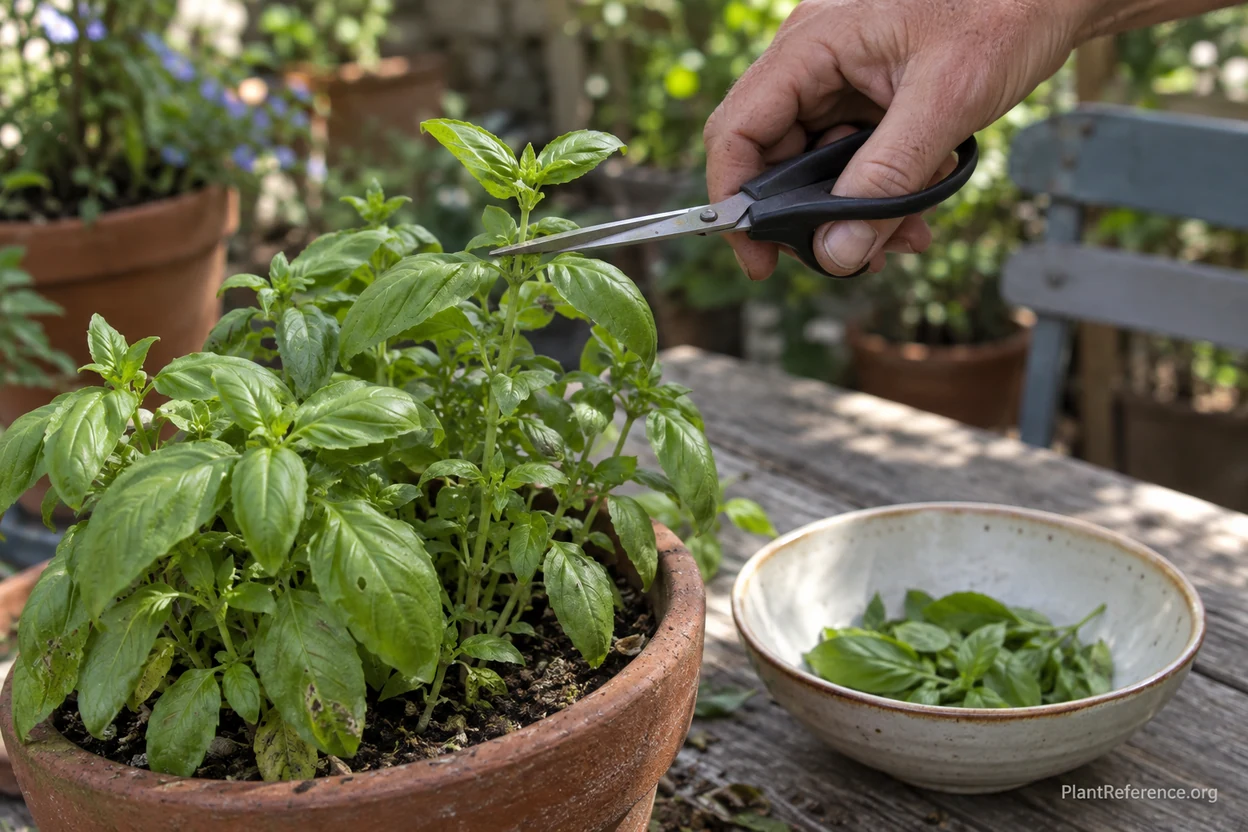
Cut herbs with clean scissors or pruners. For basil, pinch the growing tip just above a pair of leaves so side shoots form and the plant becomes bushier. Do not strip all leaves from one stem and leave a bare stick. As a practical rule, take no more than about one-third of a healthy plant at a time, then give it light, water, and time to replace what you took. A struggling seedling should establish before its first substantial harvest.
With parsley, remove older outside stalks near the base and leave the center growing point. With chives, cut a portion of the leaves low while keeping enough green growth for recovery. Cilantro can be cut young for tender leaves; once heat pushes it to flower and seed, flavor and leaf production change. That is a normal life cycle, not a watering failure. Sow a fresh small pot during cooler weather instead of trying to force one plant to stay leafy all summer.
Rosemary, thyme, oregano, and sage respond best to smaller repeated cuts of current growth. Avoid cutting deeply into old bare woody stems, which may not resprout readily. Trim oregano before or around flowering if you want tender leafy stems. Keep thyme from becoming a matted dome by taking short tips across the whole plant rather than repeatedly shaving one side. In any shared pot, cut the faster grower often enough that its neighbors still get light.
Harvest in the morning after leaves dry, then use or cool them promptly. For a short storage window, wrap clean dry sprigs loosely and refrigerate according to the herb's texture; tender basil can discolor in a cold refrigerator, so use it fresh or keep cut stems briefly in water away from harsh sun. Wash herbs just before use when possible. Dry or freeze surplus in small batches instead of waiting for one huge end-of-season cut.
Solve Common Herb Container Problems
Leggy herbs usually need more light or more frequent tip harvesting. Move the pot gradually toward better sun and trim the growing tips, leaving enough healthy leaves to recover. Yellow lower leaves can signal old age, wet roots, or poor nutrition; feel the mix and lift the pot before feeding. A sudden collapse after a hot afternoon can be water stress, but if the mix is wet and the pot is scorching, shade the pot wall first.
Flowering is another clue. Basil and cilantro often respond to long days and heat by bolting. Pinching basil flower stalks can extend leaf production for a while, but cilantro is often easier to resow in a cooler window. Do not turn a naturally seasonal plant into a months-long rescue project. Save seed if you want, or compost a spent plant and start another. The date-specific basil guides, such as When to Plant Basil in Milwaukee: Complete Guide + Best Varieties for Zone 5b, can help gardeners with a short outdoor season plan a new round.
Frequently Asked Questions
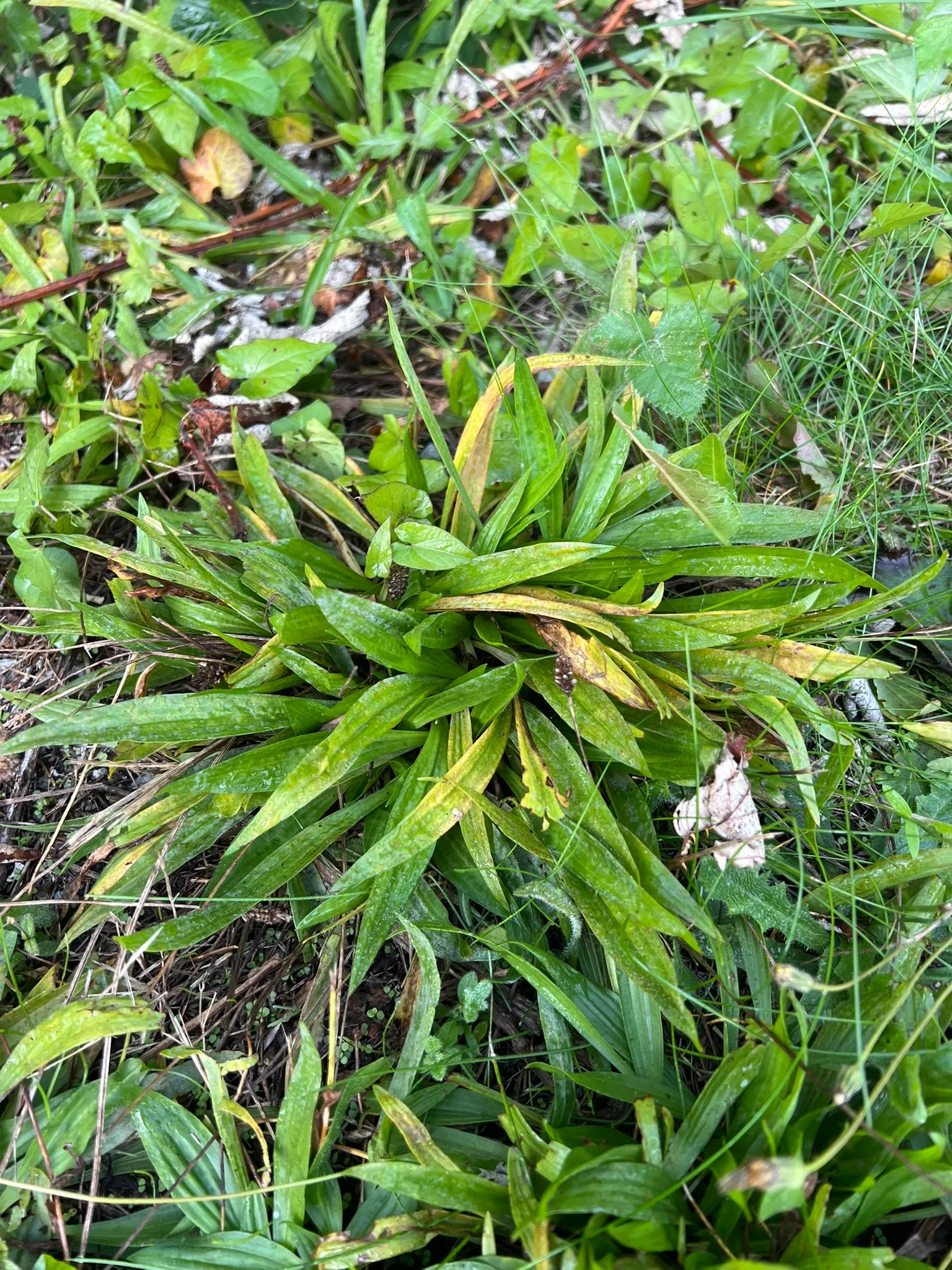
Reading about plants and recognising them are different skills. These three build the second.
- Daily PlantIdentify the day’s mystery plant from a close-up photograph.
- Keyed OutWork a dichotomous key, lead by lead, to name a hidden specimen.
- Name That PlantName a specimen from botanical clues dealt hardest first.
Free to play, no account needed
Tagged with
Carlos grew up helping his abuelos tend their backyard garden in San Antonio, Texas, but didn't get serious about growing his own food until he bought his first house in Austin. He works as an HVAC technician during the day and gardens in the early mornings and evenings. Carlos specializes in heat-tolerant vegetables and container growing—essential skills for Texas summers and his south-facing driveway that gets intense sun. He's learned through plenty of failures (multiple dead fig trees, countless bolted lettuce crops) and now helps neighbors troubleshoot their own gardens. His YouTube channel documenting his container tomato experiments has a small but dedicated following. Carlos is passionate about growing food on a budget, often sourcing free containers and building his own compost.