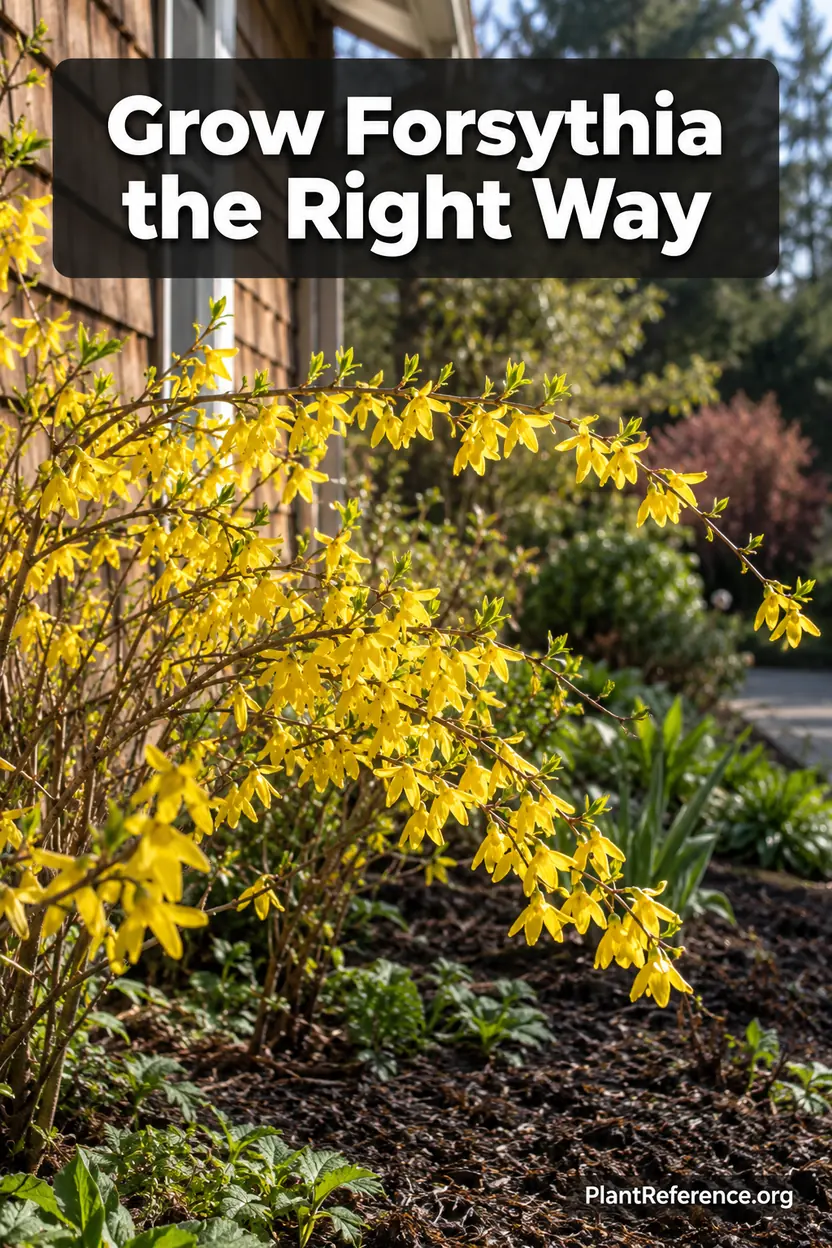
Growing Forsythia in the Pacific Northwest
Pets & Toxicity
Recorded toxicity for plants linked in this guide. An unknown status is not a safety assessment.
No linked plant is recorded as toxic (1 linked plant checked)DetailsHide
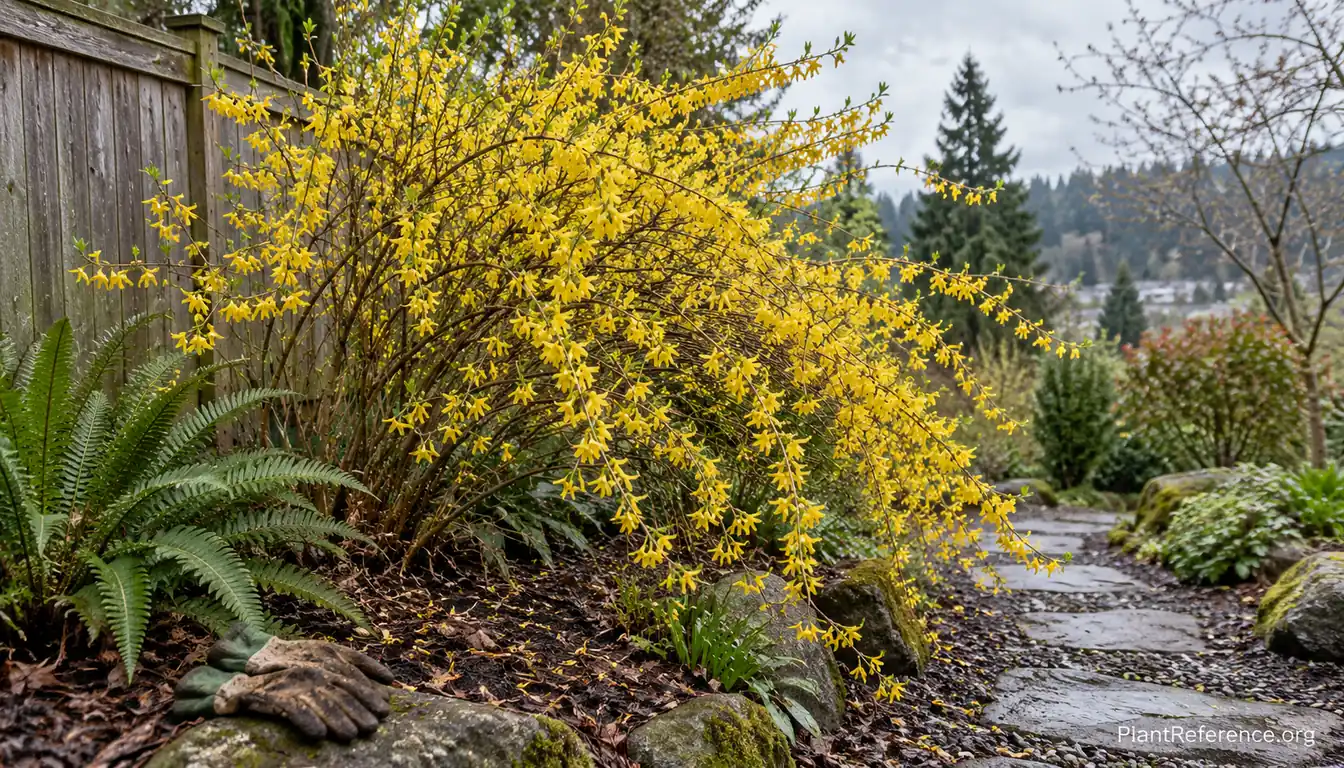
— Image © PlantReference.org 2026
Growing forsythia in the Pacific Northwest is straightforward when the site fits the shrub. The hard part is accepting its mature form. A standard forsythia is not a compact yellow ball; it is a broad fountain of canes that can occupy 8-10 feet (2.4-3 m) in both height and spread. Give it full sun, drainage through the wet season, and enough open space for the branches to arch. You will get more flowers with less work.
The pruning rule follows directly from the plant's biology. Forsythia builds its flower buds on wood formed during the previous growing season. Cut it in winter and you cut off spring color. Shear it repeatedly and flowers retreat to the outer tips while a dense, leafless interior develops. Prune just after flowering, and remove selected old canes from the base rather than trimming every branch to the same outline. For the regional climate behind that advice, see Pacific Northwest Gardening Guide: Climate, Soil & Plant Selection.
Choose a Forsythia for the Space You Have
The familiar border forsythia 🌿Forsythia × intermedia (for-SITH-ee-uh in-ter-MEE-dee-uh) grows fast and produces flower buds all along one-year-old canes when it receives enough sun. Its speed is useful in a new landscape, but it also means the plant quickly exposes bad spacing. A shrub installed three feet (90 cm) from a walkway may look sensible in its nursery pot and obstruct the path within a few seasons.
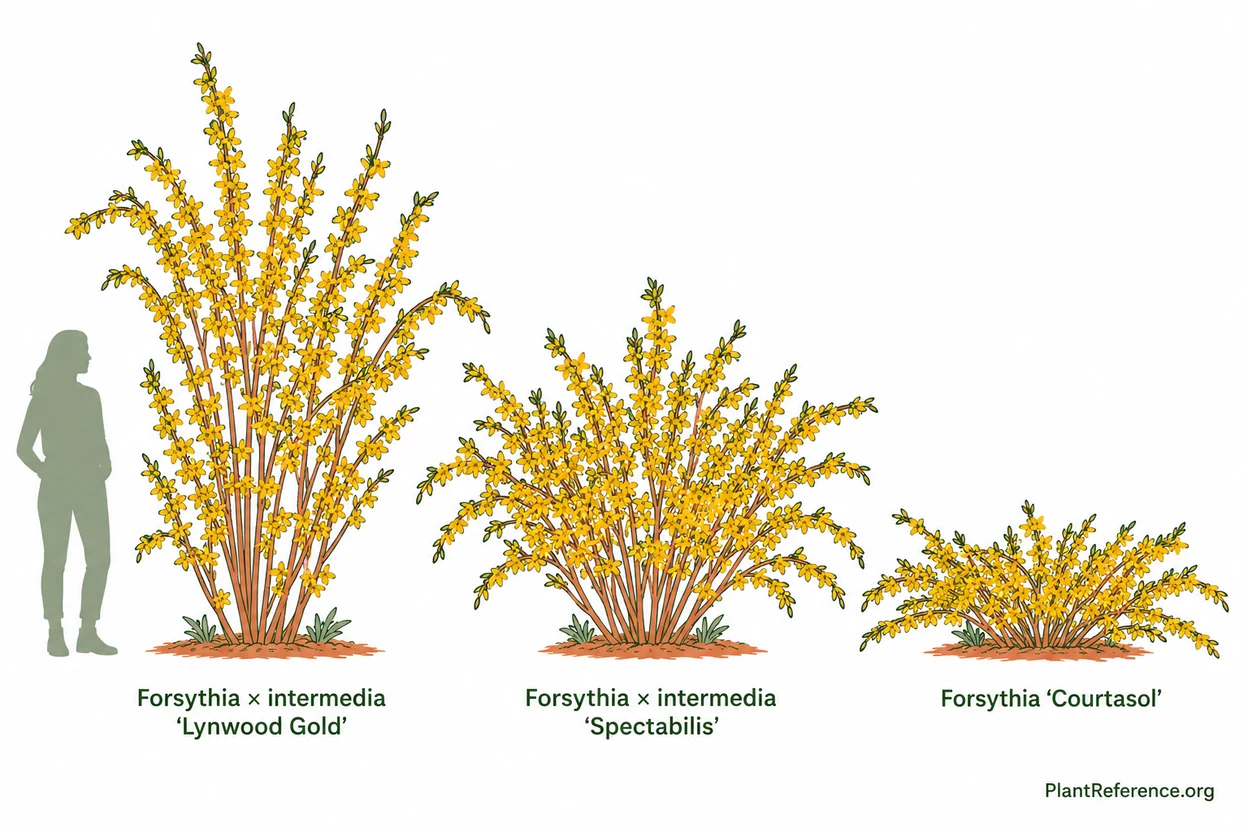
Standard cultivars such as 🌿Forsythia × intermedia 'Lynwood Gold' and Forsythia × intermedia 'Spectabilis' suit large mixed borders, loose screens, or slopes where their canes can rise and bend without hitting siding or traffic. They are poor choices beneath low windows or beside a narrow entry. A lower cultivar such as Forsythia 'Courtasol' offers a spreading habit for smaller banks and broad foreground areas, but “compact” does not mean maintenance-free. Confirm the nursery's mature dimensions because naming and stock can vary.
Forsythia | Approximate mature habit | Best use | Space-planning note |
|---|---|---|---|
8-10 feet (2.4-3 m), tall and arching | Large border, specimen, loose screen | Allow the full fountain outline and access around the base | |
Forsythia × intermedia 'Spectabilis' | 8-10 feet (2.4-3 m), vigorous and broad | Bank, property edge, informal mass | Keep well away from narrow paths and small windows |
Forsythia 'Courtasol' | About 2-3 feet (60-90 cm) tall, spreading wider | Slope, foreground, low mass | Preserve spreading stems; do not force into a tiny clipped globe |
Buy for structure as well as flowers. Choose a plant with several strong canes arising near the crown, flexible shoots, and no obvious trunk damage. Avoid a specimen that has already been sheared into a dense ball. Its internal branch congestion will not disappear after planting, and restoring a natural framework takes several seasons.
Decide whether forsythia's brief, intense spring display earns the space for the rest of the year. Its summer foliage is useful but not exceptional. Pair it with evergreens, later-flowering shrubs, and perennials rather than expecting one plant to carry the whole bed. Plan a Perennial Garden That Blooms Spring to Fall helps distribute seasonal color, while Perennial Combinations That Look Good Together offers texture and form ideas for the months after bloom.
Forsythia flowers are also a practical phenological cue—a biological sign of spring progress that can be more useful than a fixed calendar date. Record when your own shrub blooms and compare that timing with soil temperature, weed emergence, and other garden events. Do not treat the flowers as a universal command to perform a particular task; microclimates can shift bloom by days or weeks.
Plant Forsythia in Sun and Well-Drained Soil
Full sun produces the densest flower display and the strongest self-supporting canes. Aim for at least six hours of direct light, with more sun in cool coastal areas. A shrub in partial shade may remain alive, but the canopy often opens, branches lean toward light, and flower buds become sparse. Morning sun also helps dry wet stems after dew or rain.
Pacific Northwest winters test drainage more than summer heat does. Forsythia tolerates a range of ordinary soils, but roots still require oxygen. Before planting, dig a hole about 12 inches (30 cm) deep, fill it with water, let it drain, and refill it. If water remains after 24 hours, solve the drainage problem or move the planting. Fix PNW Garden Drainage: Glacial Till, Hardpan & Raised Beds explains how glacial till and construction compaction create perched water.
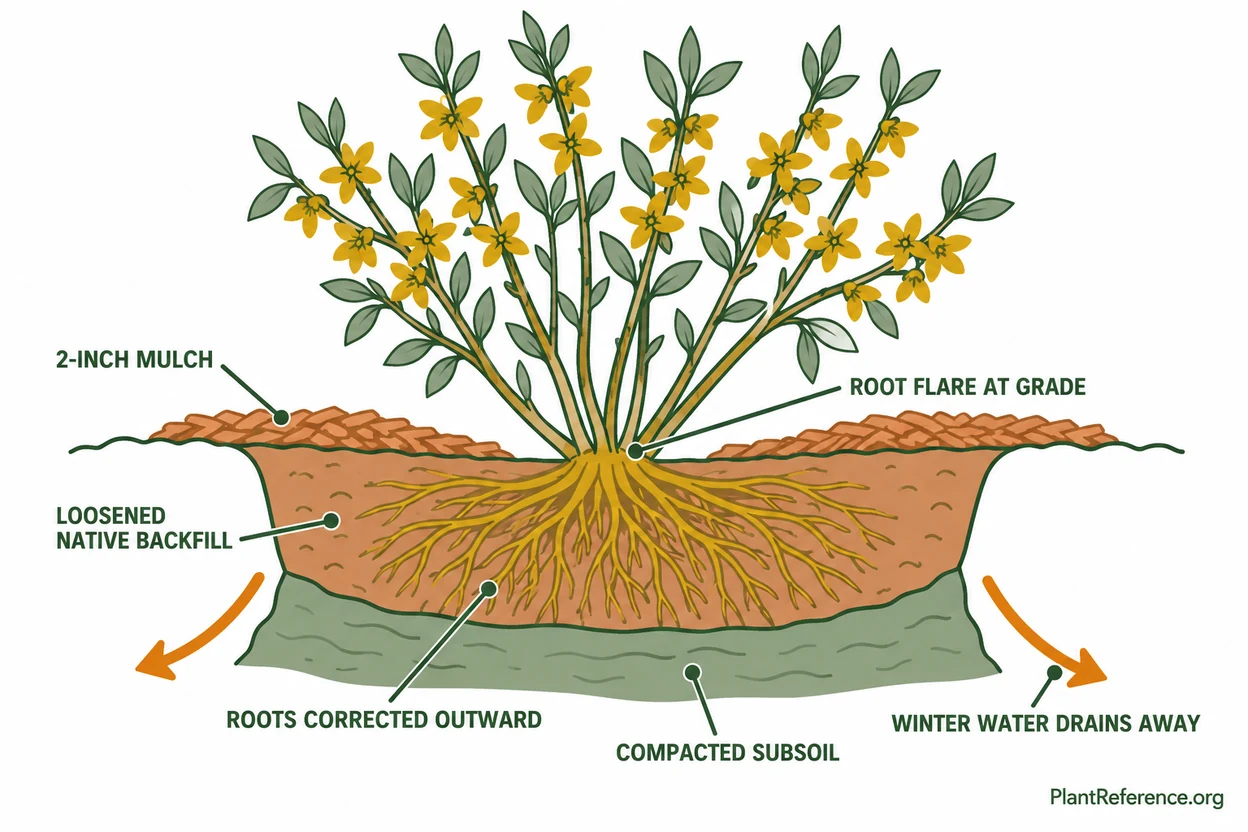
Plant in early fall after the hottest weather or in early spring while soil is workable. Dig two to three times wider than the root ball and no deeper. Expose the root flare, loosen circling roots, and set the flare at grade. On slow soil, set it 1-2 inches (2.5-5 cm) high and feather soil into a broad mound. Do not create a deep amended pocket that acts like a bathtub.
Water the container thoroughly, then slide the root ball out without pulling the canes.
Cut or tease circling woody roots so they point into surrounding soil.
Confirm the crown sits at grade or slightly high on heavy ground.
Backfill mostly with native soil and firm gently without compacting it.
Water deeply, correct any lean, and add a two-inch (5 cm) mulch ring.
Measure from the mature canopy, not the nursery pot. Keep a standard plant at least 5 feet (1.5 m) from a wall when its expected radius is similar, and leave access for pruning. Do not plant where arching stems will block a gate or conceal a sight line. That extra open soil may feel wasteful for two years; after five, it is the difference between a shrub and a maintenance problem.
Test before changing soil pH. Many regional soils are acidic, but imported fill, concrete debris, and years of amendment can alter a particular bed. Why Pacific Northwest Soil Is Acidic + How to Fix It gives context, while Raised Bed Soil pH Problems: Testing, Adjusting, and Maintaining Balance explains why measured adjustment beats guessing.
Water and Mulch Through Establishment
Water newly planted forsythia whenever the upper 2-3 inches (5-8 cm) of soil become dry during its first two summers. Apply water slowly across the original root ball and the surrounding soil. This encourages roots to cross the planting boundary. Frequent shallow sprinkling leaves the center dry, wets foliage unnecessarily, and trains roots to stay near the surface.
Once established, forsythia handles short dry periods, but prolonged summer drought can reduce shoot growth and the number of flower buds carried into spring. Give an occasional deep soak during extended rainless weather. Check below the mulch first; the surface can look dry while the root zone remains moist. If a planted basin stays wet for days, revisit drainage rather than reducing the problem to a watering schedule.
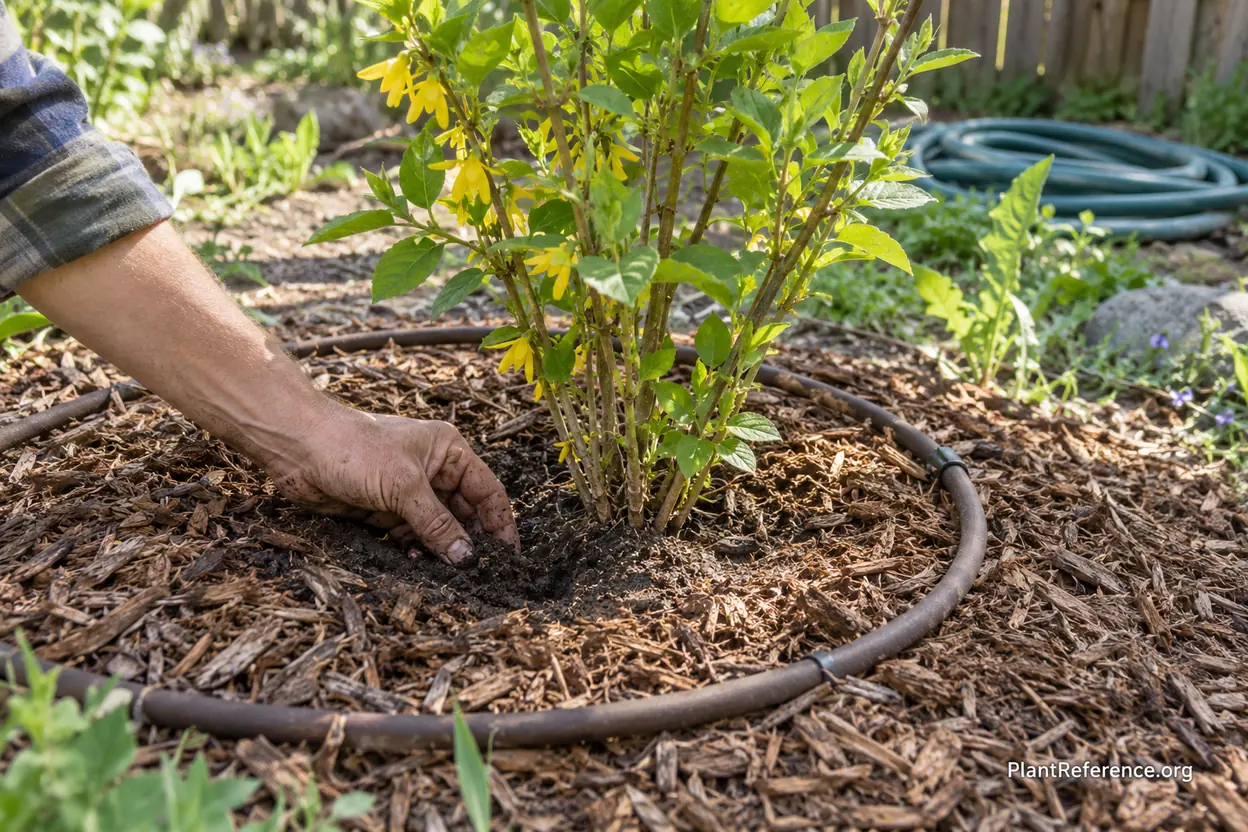
Maintain about 2 inches (5 cm) of coarse arborist chips or bark from near the crown toward the drip line. Mulch limits evaporation, suppresses grass, and reduces soil splash. Keep it 4-6 inches (10-15 cm) away from the canes so the crown remains visible and dry. Do not keep adding material until a mound forms.
Forsythia rarely needs annual fertilizer in decent garden soil. Strong leafy shoots with few flowers usually point to shade, mistimed pruning, or excess nitrogen—not hunger. If growth is genuinely weak, inspect planting depth, root-zone moisture, and light before buying fertilizer. A laboratory soil test can identify a real nutrient deficiency. Overfeeding only creates more cane growth to prune.
Remove turf around the base. Grass competes for water and invites mower or string-trimmer damage at the crown. A broad mulched bed also makes the shrub's arching outline look intentional. For low companions that reduce weeding without smothering the crown, consult Best Low-Maintenance Perennials for Beginners: 10 Picks.
Preserve the Arching Fountain Shape
Forsythia's best form comes from long canes rising from the crown, then bending outward under their own length. Each cane contributes a line to the overall fountain. When every stem is cut at the same outer surface, dormant buds just below those cuts break together. The result is a twiggy shell surrounding shaded old wood.
Give branches room to touch the ground naturally where they do not obstruct access. Some arching stems may root when they remain in contact with moist soil. Remove unwanted rooted tips before they expand the colony, or use them for propagation if appropriate. Keep the main crown clear enough to see where old canes originate.
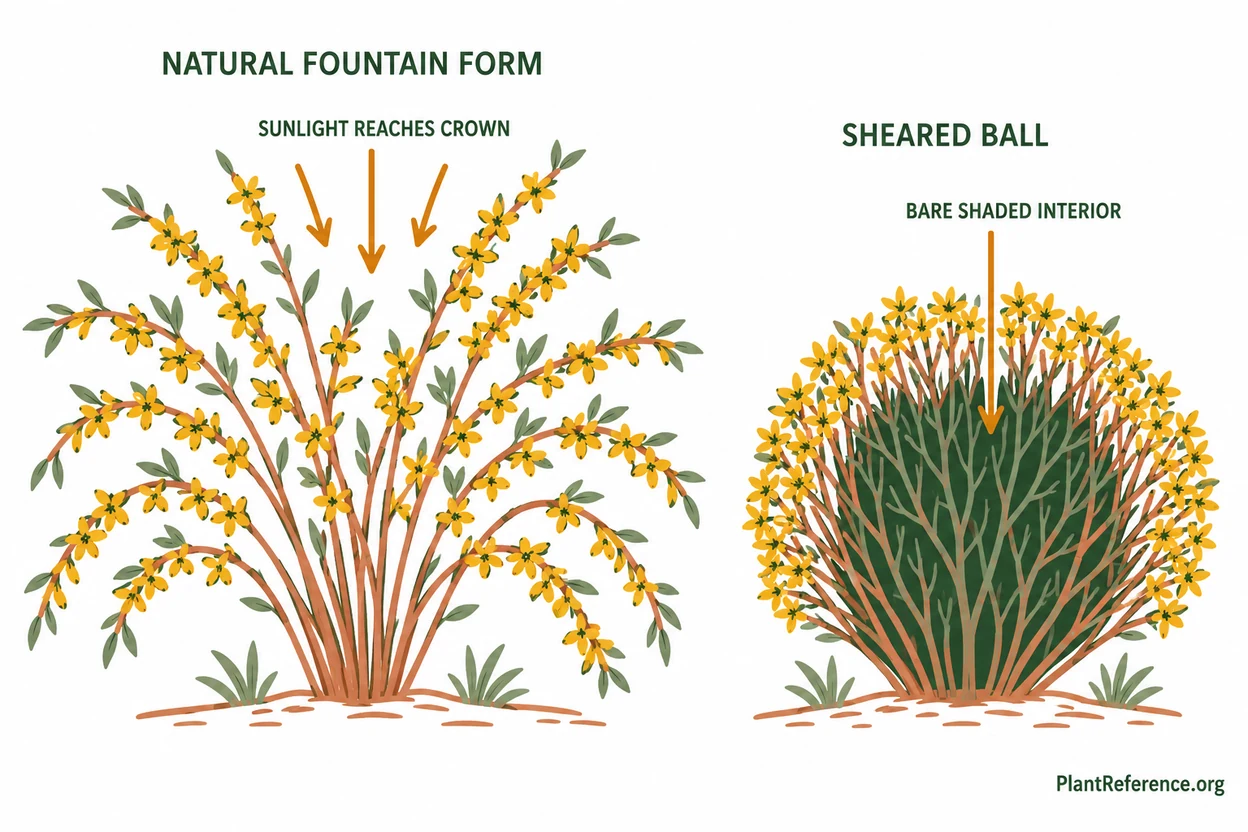
Use selective cuts when a branch reaches a path. Follow that branch inward and remove it at the crown or shorten it to a well-positioned side shoot. A cut hidden inside the canopy preserves the outline better than clipping the visible tip. If many branches occupy the same path, the site is too small; continuous trimming will not solve the mismatch.
Mass several shrubs only where the bed can accommodate their combined mature spread. Offset the plants enough that their canes interlace lightly rather than stack into a humid wall. For property edges, combine forsythia with evergreen structure so the screen does not disappear after leaf fall. Pacific Northwest Native Plants: 10 Resilient Picks can help diversify the planting instead of building a one-species strip.
Forsythia is moderately browsed where deer pressure is high. No shrub is deer-proof. Protect small plants near greenbelts until the framework rises above routine browsing, and avoid relying on a single ornamental for the entire boundary. Deer-Resistant Perennials: A Zone-by-Zone Planting Guide provides a useful framework for relative resistance.
Prune After Bloom and Renew Old Shrubs
Prune immediately after the yellow flowers fade in early spring. This timing gives new shoots the rest of the growing season to mature and set flower buds for next year. Do not wait until winter, when the bare framework seems easier to see; those stems already carry the coming display. Remove dead or broken wood whenever safety requires, but schedule routine shaping for post-bloom.
Every two to three years, remove one-quarter to one-third of the oldest canes at ground level. Old canes are usually thicker, darker, less flexible, and less floriferous than younger replacements. Cut them cleanly without leaving tall stubs. Base thinning opens the crown, admits light, and stimulates vigorous replacement canes while retaining enough mature wood to bloom the following spring.
First remove dead, broken, rubbing, and damaged wood.
Identify the oldest canes by thickness, dark bark, and weak flowering.
Cut selected old canes as close to the crown as practical.
Keep well-spaced younger canes that form the future fountain.
Step back between cuts and stop before removing more than one-third.
Use bypass pruners for small canes, loppers for stems up to the tool's rated capacity, and a pruning saw for thicker wood. Clean blades before moving to another shrub and after cutting diseased tissue. Do not twist an undersized pruner through a large cane; crushed, ragged cuts heal poorly and waste effort. The purpose-first method in Prescriptive Pruning: The PPQ Model for Structural Tree Care helps turn “make it smaller” into specific, defensible cuts.
An old, neglected shrub can be renewed gradually over three years. Remove about one-third of the oldest canes each post-bloom season. Total renovation—cutting every stem low—may produce vigorous new growth, but it sacrifices at least the next bloom and can create an unruly flush. Use that reset only when preserving the current framework no longer matters.
Sparse flowers usually come from too much shade, winter pruning, repeated shearing, or overfeeding. Yellow leaves in wet soil suggest root stress before nutrient shortage. Dead tips after an unusual freeze should be cut back to green wood once the extent of injury is clear. How to Prepare Perennial Gardens for Winter by Species offers broader seasonal planning, but forsythia itself needs sound siting more than elaborate winter protection.
The low-maintenance approach is the honest one: buy the right size, plant it where the canes can arch, and make a few decisive cuts after bloom. When the site and form agree, forsythia delivers its yellow spring signal without demanding weekly correction.
Frequently Asked Questions
Three daily games
Can you name a plant on sight?
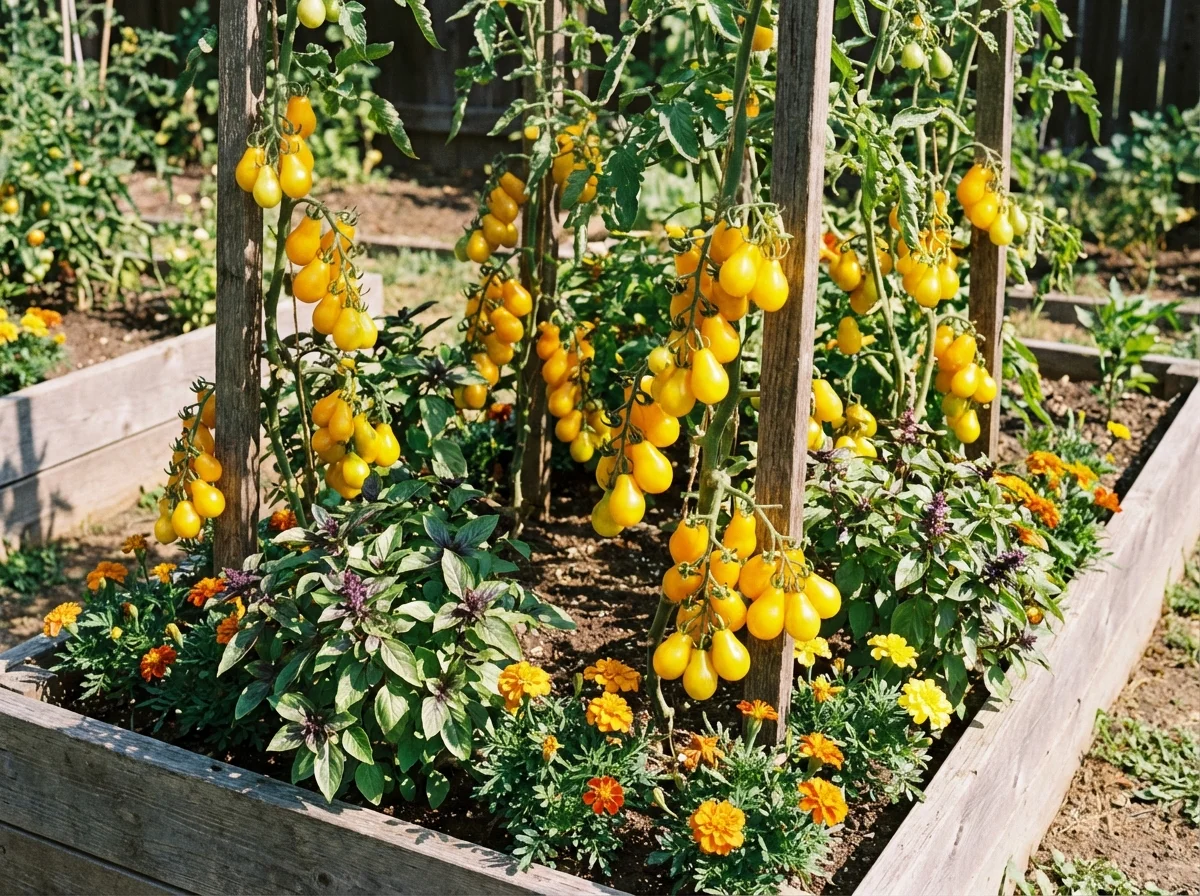
Saturday’s specimenSolanum lycopersicum 'Yellow Pear'Reading about plants and recognising them are different skills. These three build the second.
- Daily PlantIdentify the day’s mystery plant from a close-up photograph.
- Keyed OutWork a dichotomous key, lead by lead, to name a hidden specimen.
- Name That PlantName a specimen from botanical clues dealt hardest first.
Free to play, no account needed
Tagged with
Mike's been designing residential landscapes in the Seattle area, with a particular focus on Pacific Northwest natives and sustainable practices. He's a Washington State Master Gardener and worked in construction before landscaping, which gives him a practical edge when it comes to building raised beds and hardscaping projects. He runs a small side business propagating and selling unusual perennials at farmers markets on weekends. His property serves as a testing ground for low-maintenance, wildlife-friendly garden designs. Mike's philosophy: if it requires weekly maintenance, it's not sustainable.