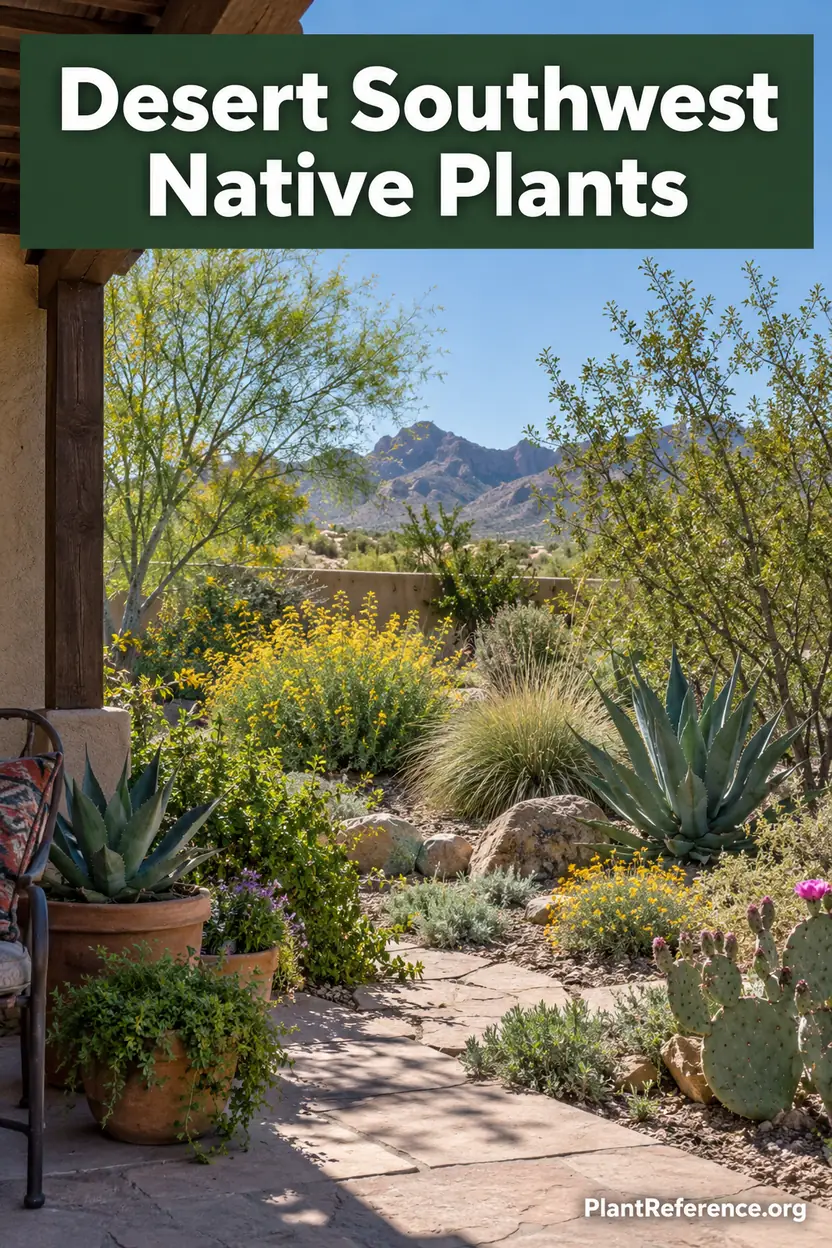
Best Native Plants for Desert Southwest Gardens
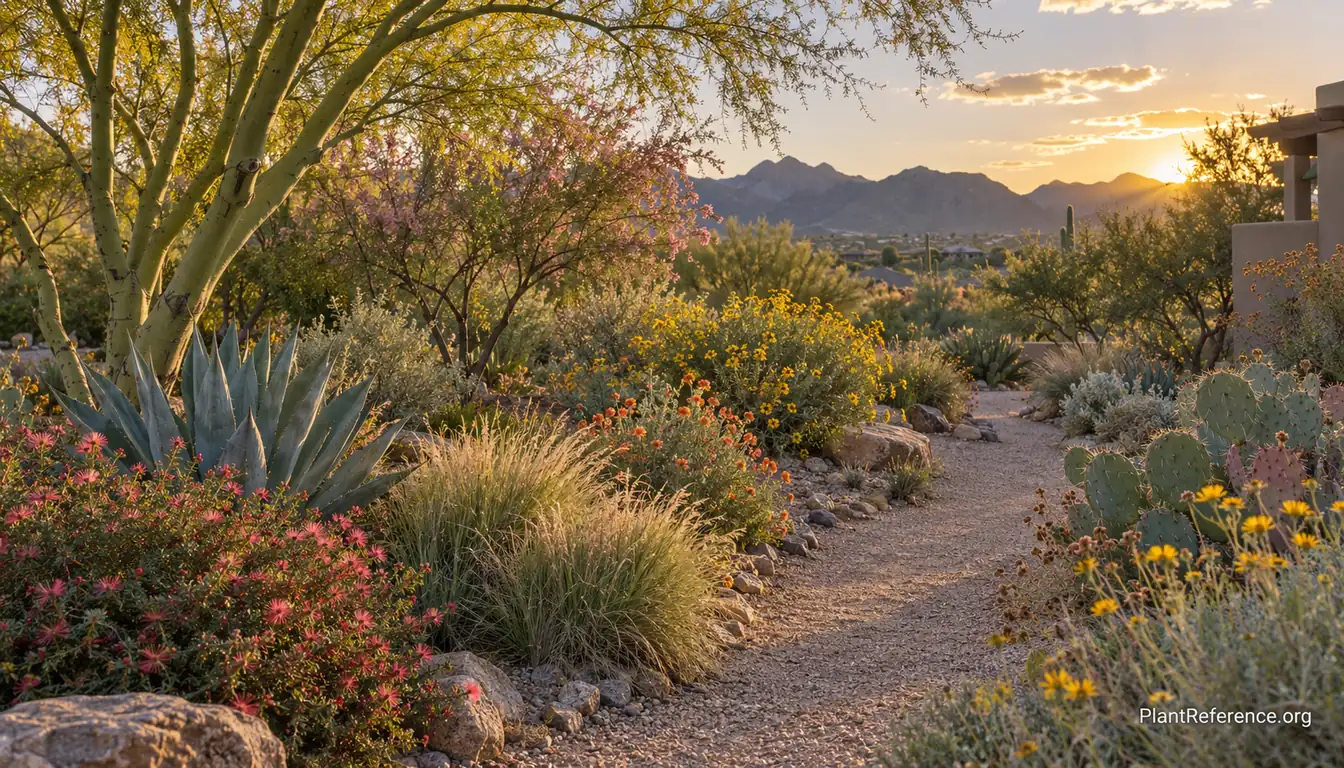
— Image © PlantReference.org 2026
Pets & Toxicity
Recorded toxicity for plants linked in this guide. An unknown status is not a safety assessment.
Toxic to pets: desert marigoldDetailsHide
Desert Southwest native plants can give a home garden shade, fragrance, hummingbirds, seed, and months of color. The trick is not covering bare ground with random drought-tolerant plants. Match each species to heat, cold, drainage, mature size, and a clearly defined water-use zone, then let open space become part of the design.
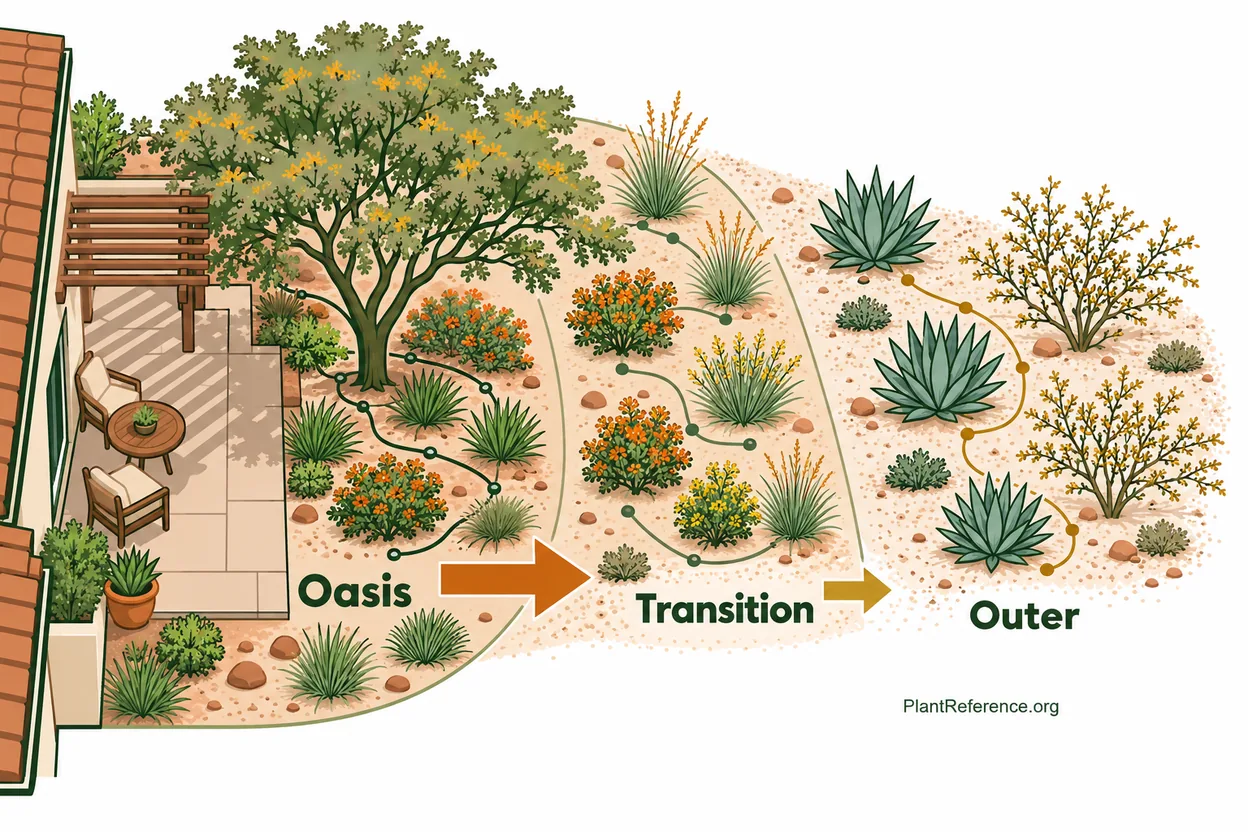
Design With Three Water-Use Zones
People think desert gardens are gravel and cactus because those are the easiest parts to recognize. Real desert plant communities have canopies, shrubs, grasses, perennial flowers, annuals, and succulents occupying different microsites. A home landscape becomes more comfortable and ecologically useful when it borrows that layering instead of scattering one specimen across a rock field.
Start with water geography. The Oasis zone sits closest to daily life: a shaded patio, entry, small herb bed, or container group where occasional supplemental water creates comfort. The Transition zone receives deep but infrequent irrigation and holds most flowering shrubs, grasses, and small trees. The Outer zone lies farthest from the house and uses locally native plants that can live on rainfall after their roots establish, with emergency water during exceptional drought.
Hydrozoning matters because "low water" is not one setting. A young desert willow needs regular establishment irrigation, while mature creosote can decline in soil kept wet on a weekly timer. Put them on the same valve and one plant will always be unhappy. Separate the zones physically, use different emitter flow rates or schedules, and keep spray irrigation off dryland shrub crowns.
Map heat as carefully as water. A west wall can radiate heat long after sunset; a north-facing courtyard may freeze harder than an open slope; reflected glare from windows can scorch foliage. Track summer sun and winter shade before buying plants. The microclimate method in Pacific Northwest Gardening Guide: Climate, Soil & Plant Selection comes from another region, but the habit of mapping exposure before planting translates directly.
Then check drainage. Dig 12 inches (30 cm) down, fill the hole with water, let it drain, and fill it again. Water that remains for many hours signals compaction, caliche, or heavy clay. Do not solve a broad drainage problem by filling one planting hole with compost; that can create a wet basin. The diagnostic clues in Poor Drainage in Raised Beds: Causes and Fixes for Waterlogged Soil help distinguish slow infiltration from simple surface dryness.
Draw the garden with mature plant widths and safe access. Keep thorny plants away from doors, mailboxes, play areas, and narrow walks. Place shade where it helps the building or patio, not where a future crown will tangle with the roof. Repeat three to five smaller plants rather than buying one of every species. Repetition gives a xeric garden calm structure even when spring flowers fade.
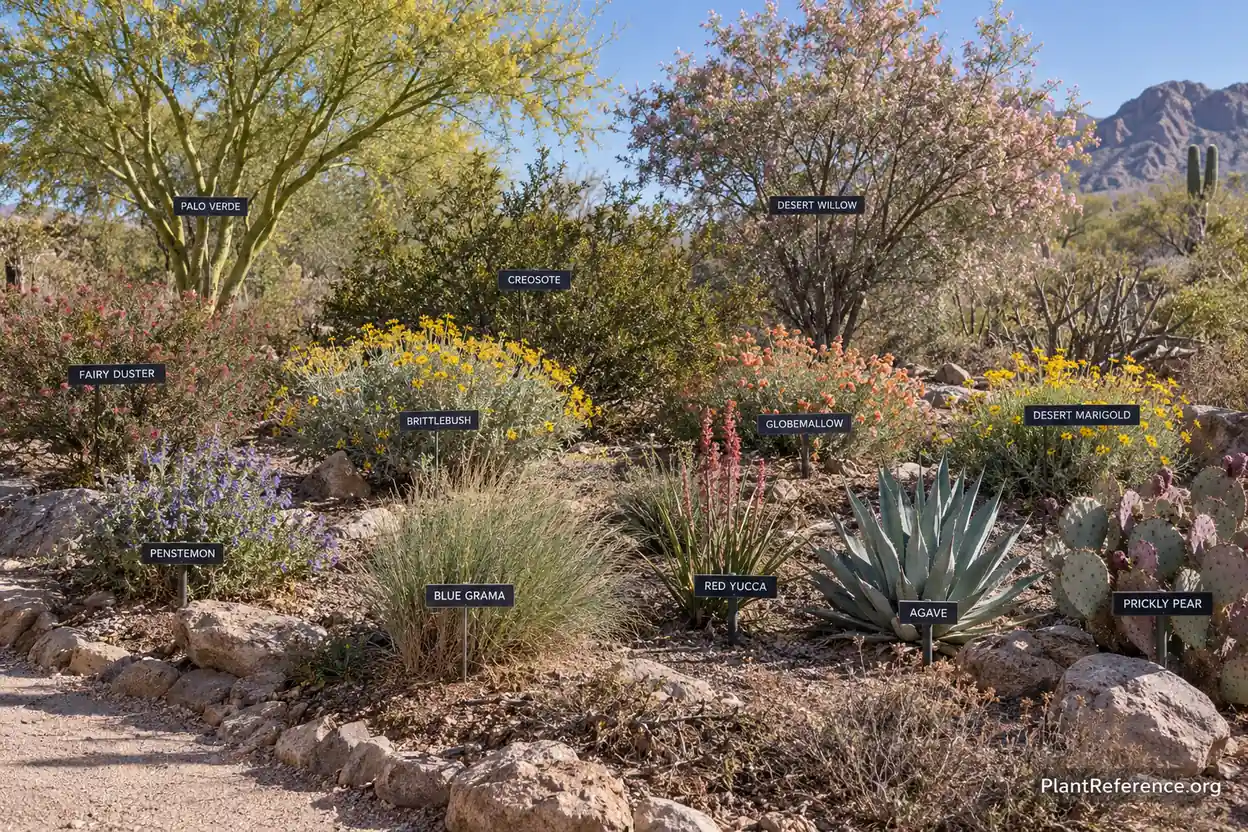
Compare 12 Desert Southwest Native Plants
This palette reaches beyond the saguaro and covers several garden layers. Native status and cold tolerance vary across the Sonoran, Mojave, and Chihuahuan deserts, so confirm a plant's regional fit with a local native nursery. Elevation matters too: a species that handles a low, hot basin may fail during repeated high-desert freezes.
No. | Native plant | Typical size | Best zone | Main garden role |
|---|---|---|---|---|
1 | Blue palo verde 🌿Parkinsonia florida | 20–30 ft (6–9 m) | Transition | Filtered shade and spring flowers |
2 | Desert willow 🌿Chilopsis linearis | 15–30 ft (4.5–9 m) | Transition | Summer bloom and small-tree shade |
3 | Creosote bush 🌿Larrea tridentata | 3–8 ft (0.9–2.4 m) | Outer | Evergreen desert framework |
4 | Fairy duster 🌿Calliandra eriophylla | 2–5 ft (0.6–1.5 m) | Transition | Hummingbird shrub and fine texture |
5 | Brittlebush 🌿Encelia farinosa | 2–4 ft (0.6–1.2 m) | Outer | Silver foliage and spring daisies |
6 | Desert globemallow 🌿Sphaeralcea ambigua | 2–4 ft (0.6–1.2 m) | Transition | Orange flowers and dry slope cover |
7 | Desert marigold 🌿Baileya multiradiata | 1–2 ft (0.3–0.6 m) | Transition | Long yellow flowering season |
8 | Parry's penstemon Penstemon parryi | 2–3 ft (0.6–0.9 m) | Transition | Pink spring spikes for hummingbirds |
9 | Blue grama 🌿Bouteloua gracilis | 1–2 ft (0.3–0.6 m) | Outer | Fine native grass matrix |
10 | Red yucca 🌿Hesperaloe parviflora | 3–5 ft (0.9–1.5 m) | Transition | Evergreen form and tall flower stalks |
11 | Parry's agave Agave parryi | 1–3 ft (0.3–0.9 m) | Outer | Sculptural rosette and winter structure |
12 | Engelmann prickly pear 🌿Opuntia engelmannii | 3–5 ft (0.9–1.5 m) | Outer | Fruit, flowers, and wildlife shelter |
Blue palo verde 🌿Parkinsonia florida (par-kin-SOH-nee-uh FLOR-ih-duh) is a Sonoran Desert structure tree with green photosynthetic bark and a cloud of yellow spring flowers. Its filtered canopy cools paving without casting the deep shade of a broad-leaved tree. Give it room for a wide crown, choose a strong nursery form, and train young branches gradually rather than raising the canopy all at once.
Desert willow 🌿Chilopsis linearis carries narrow leaves and trumpet-shaped summer flowers. It is deciduous and often multi-trunked, which makes it feel lighter than a conventional shade tree. It accepts more irrigation than creosote but still needs drying between deep soakings. Locate falling flowers and seed pods away from pools if tidy surfaces matter.
Creosote bush 🌿Larrea tridentata is the honest desert backbone: resinous evergreen leaves, yellow flowers after rain, and a powerful scent during storms. It needs full sun, open air, and very sharp drainage. Use it in the Outer zone rather than against a frequently watered lawn. Mature spacing of 5–8 feet (1.5–2.4 m) lets its natural rounded form develop without shearing.
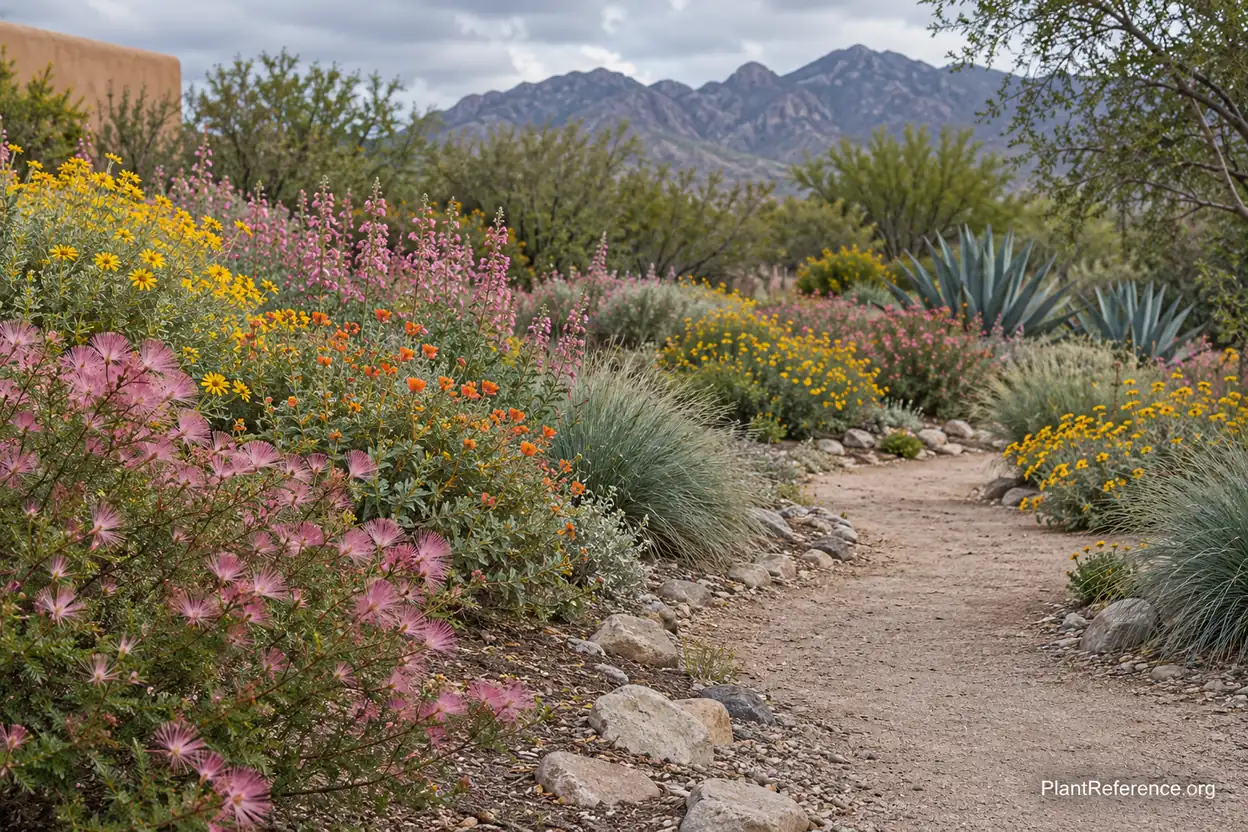
Fairy duster 🌿Calliandra eriophylla, brittlebush 🌿Encelia farinosa, desert globemallow 🌿Sphaeralcea ambigua, and desert marigold 🌿Baileya multiradiata provide the color people assume a desert garden cannot have. Fairy duster brings red-pink powder-puff flowers and fine foliage. Brittlebush contrasts silver leaves with yellow daisies. Globemallow supplies orange cups, while desert marigold carries clear yellow flowers above a gray-green base.
Parry's penstemon Penstemon parryi adds vertical pink spikes during the cool-season flowering peak. Blue grama 🌿Bouteloua gracilis supplies a quiet matrix and eyelash-like seedheads that move in wind. Red yucca 🌿Hesperaloe parviflora is not a true yucca, but its evergreen leaves and tall coral flowers are exceptionally useful in a residential transition zone.
Parry's agave Agave parryi and Engelmann prickly pear 🌿Opuntia engelmannii add sculptural mass, yet both require safe placement. Keep sharp leaf tips and glochids several feet from paths. Parry's agave often tolerates more cold than many low-desert agaves, but drainage becomes critical during winter moisture. Prickly pear flowers and fruit serve wildlife, and the pads create protected cover.
Build Shade and Structure With Native Trees
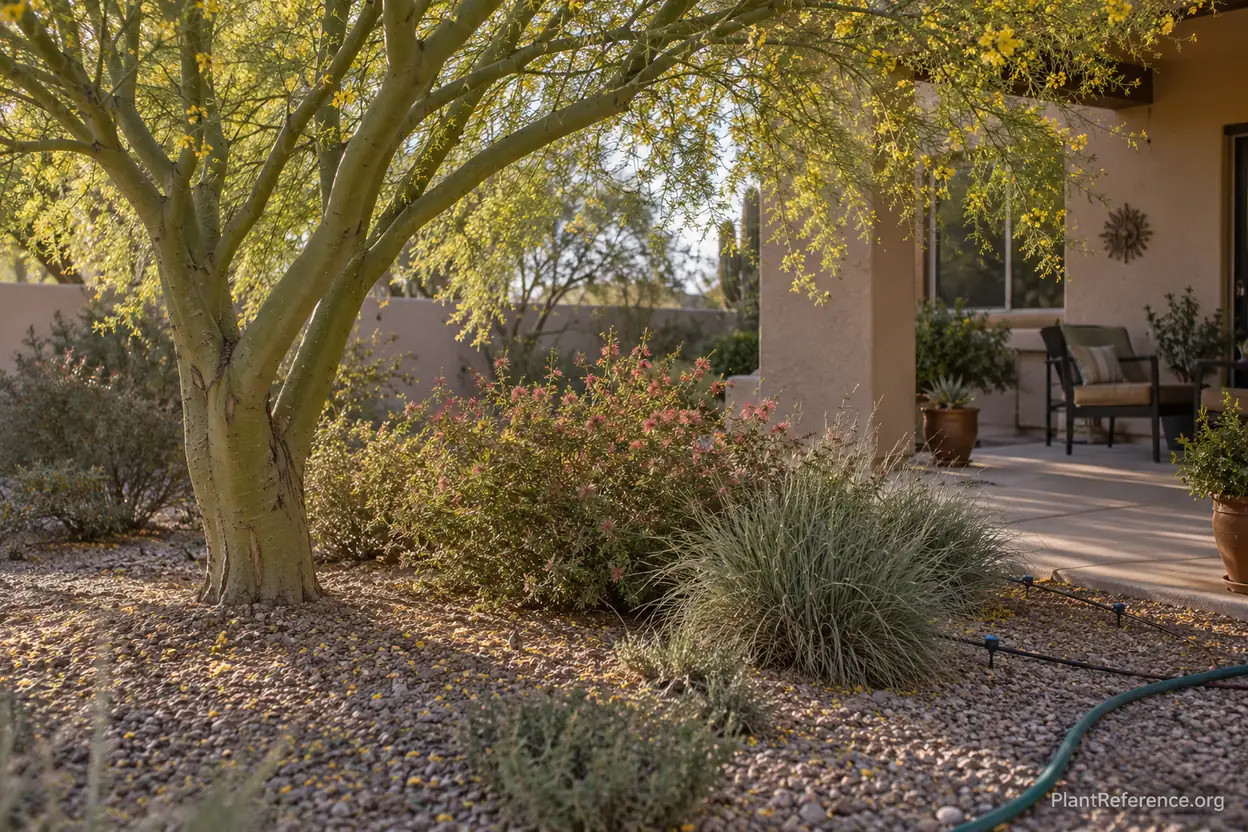
Set the trees first because they create the microclimate for everything below. One well-placed blue palo verde 🌿Parkinsonia florida can shade a west-facing sitting area and reduce reflected heat over a useful part of the afternoon. It will not produce dense, all-day shade, and that is a benefit: filtered light still supports fairy duster and seasonal flowers.
Draw the mature canopy, not the 15-gallon nursery crown. Keep trunks and major roots away from foundations, septic components, walls, and narrow paving. Look overhead for utility lines. How Much Soil Do Urban Trees Actually Need? The Root Volume Guide explains why a tiny cutout in concrete cannot support a large healthy canopy, even when the tree is drought-adapted.
Choose nursery trees with one strong leader or well-spaced scaffold branches. Avoid specimens with tight included bark, circling roots, or a trunk buried under potting mix. At planting, expose the root flare and set it at grade or slightly high where drainage is slow. A tree planted too deep may look fine for years before root or trunk problems appear.
Blue palo verde 🌿Parkinsonia florida grows fast with irrigation, but excessive water can create long, weak branches. Water deeply across an expanding root area, then let the soil dry. Structural pruning during the first several years is safer than removing heavy limbs later. Keep the natural low canopy where space allows; stripping all lower branches transfers wind force to a narrow upper crown.
Desert willow 🌿Chilopsis linearis fits smaller spaces and brings a longer summer flower season. Place it where hummingbirds can visit without the canopy blocking a walkway. It may sucker or form multiple trunks; select the structure you want while stems are young. Do not shear the outer canopy, because repeated heading produces crowded shoots and destroys the graceful form.
Understory irrigation must respect the tree. Put plants with similar water needs beneath the outer canopy, not a thirsty Oasis bed at the trunk. Move drip emitters outward as roots spread. Mulch can protect soil in the Transition zone, but keep a clear 6-inch (15 cm) collar around the trunk and avoid piling organic material against green palo verde bark.
Layer Shrubs, Grasses, Succulents, and Flowers
The middle layer does most of the visual and ecological work. Repeat fairy duster 🌿Calliandra eriophylla and desert globemallow 🌿Sphaeralcea ambigua in loose groups, then connect them with blue grama 🌿Bouteloua gracilis. A single shrub looks accidental; three or five make a readable patch that pollinators can find and people can understand.
Use foliage contrast when flowers pause. Silver brittlebush 🌿Encelia farinosa stands against the fine green stems of fairy duster 🌿Calliandra eriophylla. The upright leaves of red yucca 🌿Hesperaloe parviflora interrupt rounded shrub forms. Blue grama 🌿Bouteloua gracilis softens rock and catches light at ground level. This is the desert version of the combination logic in Plan a Perennial Garden That Blooms Spring to Fall.
Plan for seasonal rhythm instead of demanding constant bloom. Cool-season rain wakes desert marigold 🌿Baileya multiradiata, Parry's penstemon Penstemon parryi, and desert globemallow 🌿Sphaeralcea ambigua. Brittlebush 🌿Encelia farinosa peaks in spring and may shed leaves during brutal heat. Red yucca 🌿Hesperaloe parviflora carries the display toward summer, while storm-driven flowers can appear again after monsoon rain.
Plant flowering species in broad enough groups to act as resources, not isolated decorations. Bees and butterflies recognize a patch more easily than one small flower separated by gravel. Best Perennials for Pollinators: Bees & Butterflies covers the same principle in a broader perennial context. Leave some bare, undisturbed mineral soil for ground-nesting native bees and avoid blanket pesticide applications.
Use succulents as punctuation, not a defensive wall. Place Parry's agave Agave parryi where its mature rosette and offsets can expand without spearing passersby. Set Engelmann prickly pear 🌿Opuntia engelmannii behind low shrubs or within a wide Outer-zone island. Never put either beside a curb where people step out of cars.
Rock mulch is useful when it reflects local geology and leaves soil accessible, but an unbroken field of white stone raises glare and heat. Combine local gravel with living ground layers, shaded soil, and selected organic mulch beneath compatible trees. Skip plastic landscape fabric across the whole yard. Windblown dust eventually supports weeds above it, while the buried fabric makes editing and natural reseeding harder.
A desert native planting can replace part of a conventional lawn, but it changes how the space is used. Keep a small durable surface where children, dogs, or gatherings need it, then convert unused edges into layered habitat. Lawn Alternatives That Actually Work: 5 Options Beyond Grass helps match a replacement to traffic rather than treating every square foot alike.
Plant and Irrigate for Deep Desert Roots
Plant during the cool season when soil is workable and the plant has months before extreme heat. In low deserts, autumn into winter often gives roots the longest runway; colder high-desert sites may favor spring after severe freezes. Avoid installing shrubs during a heat wave. Even a native from a nearby wash cannot establish instantly from a nursery container in 105°F (41°C) weather.
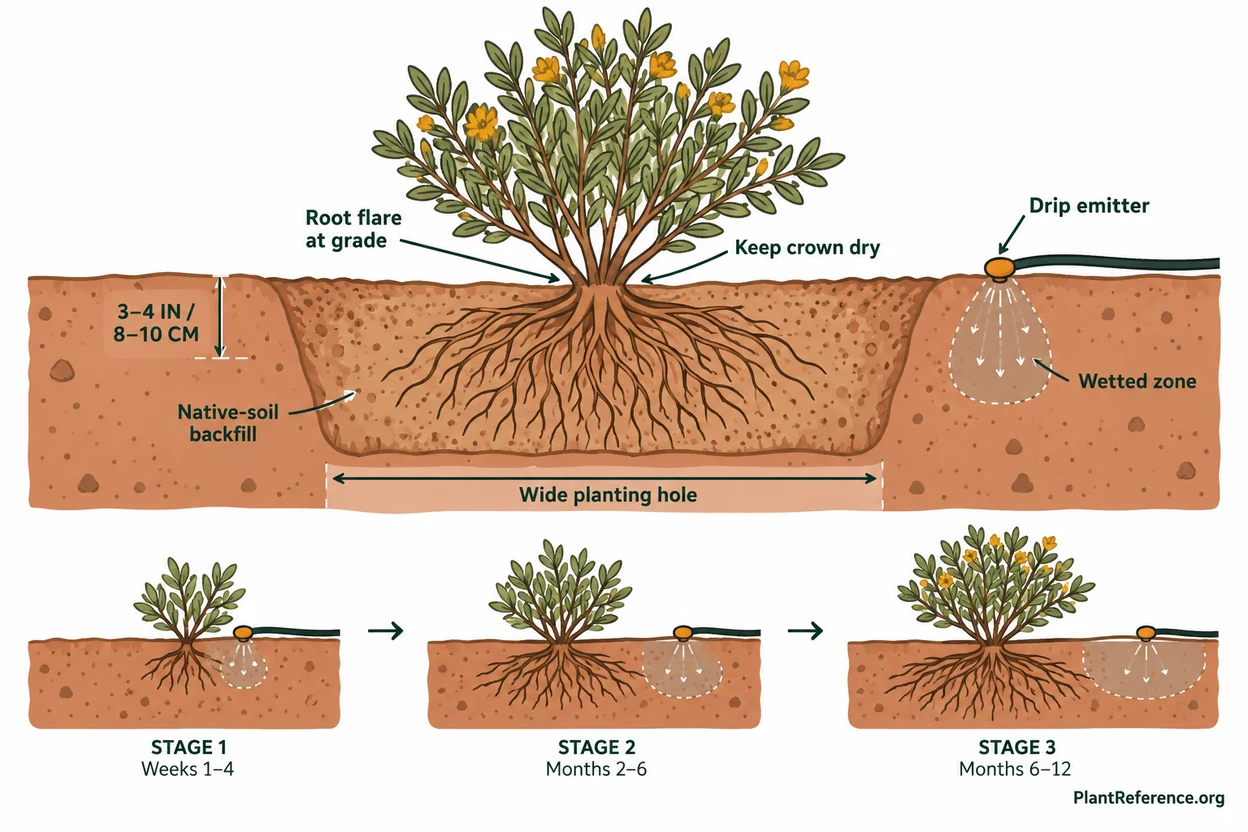
Water the container before planting. Dig a hole no deeper than the root ball and two to three times wider where compacted soil allows. Find the root flare, loosen circling roots, and set the plant at grade or 1 inch (2.5 cm) high in heavy soil. Backfill with native soil rather than a rich amendment pocket. The root system must cross into surrounding ground to survive.
Caliche needs a broader solution. If a solid layer blocks drainage, test several locations or build a low berm with mineral soil rather than drilling one narrow bathtub. Do not plant a dryland shrub above a hole that holds water. Soil settling can also bury crowns over time; the principles in Raised Bed Soil Settling and Compaction: Prevention and Solutions help explain why freshly moved soil changes level.
Create a shallow watering basin beyond the stem, not a deep moat against the crown. For the first several weeks, water when the root ball approaches dry, checking 3–4 inches (8–10 cm) below the surface. Extend intervals gradually while increasing the wetted area. The goal is a wide root system that can use natural rainfall, not a permanently damp cylinder under one emitter.
Use separate drip valves or schedules for the three zones. Oasis plants may need regular summer water. Transition plants usually need deep, widely spaced irrigation after establishment. Outer-zone creosote bush 🌿Larrea tridentata, brittlebush 🌿Encelia farinosa, and Engelmann prickly pear 🌿Opuntia engelmannii should receive little beyond rain once rooted, except during exceptional drought or recovery from disturbance.
Check actual soil moisture before running a timer. A probe can compare locations, but a trowel tells you soil texture and wetted depth. Salts may accumulate where irrigation is shallow; occasional deep watering that moves salts below active roots is better than frequent sips, provided drainage is adequate. Container growers can adapt the salt-management steps in White Crust on Potting Soil: Causes and How to Flush It to understand what evaporation leaves behind.
Fertilizer is rarely the missing ingredient. Native desert soils can be lean, and excess nitrogen produces soft growth, weak branches, and higher water demand. Correct planting depth, drainage, and irrigation first. If a soil test shows a true pH or nutrient problem, use targeted correction rather than routine feeding; Raised Bed Soil pH Problems: Testing, Adjusting, and Maintaining Balance explains how to act on measured results.
Maintain a Xeric Garden Through Heat and Monsoon
Summer changes the appearance of a desert garden. Brittlebush 🌿Encelia farinosa may thin, desert marigold 🌿Baileya multiradiata may pause, and grasses may turn tawny. That is not a design failure. Keep permanent structure through trees, creosote, red yucca, agave, and prickly pear, then let seasonal plants respond honestly to heat and rain.
Inspect irrigation monthly during the hot season. Look for clogged emitters, tubing pulled loose by animals, and a shrinking wetting pattern around growing trees. Water before sunrise when evaporation is lowest. Do not compensate for one wilted new plant by doubling water across an entire hydrozone; diagnose its root ball, exposure, and emitter first.
Monsoon rain can arrive hard and fast. Slow runoff with shallow basins, contouring, and vegetation, but keep water moving away from foundations. After storms, repair erosion while soil is visible and check that agave or cactus crowns are not buried. Fallen desert willow 🌿Chilopsis linearis branches often reveal weak attachment that should be corrected through earlier structural pruning.
Prune selectively. Remove dead, broken, crossing, or hazardous branches with clean tools. Avoid shearing fairy duster 🌿Calliandra eriophylla, creosote bush 🌿Larrea tridentata, and brittlebush 🌿Encelia farinosa into cubes; shearing creates a thin green shell and dead interior. Cut individual stems at their origin and preserve the plant's natural architecture.
Leave healthy seedheads and some leaf litter where they do not create access or fire concerns. Blue grama 🌿Bouteloua gracilis seedheads feed birds and hold winter light. At the same time, remove dead material from against structures, roofs, vents, and narrow paths. No plant is fireproof. Spacing, maintenance, and current local defensible-space guidance matter more than a marketing label.
Review the design after two full summers. If a plant needs constant rescue, move it to a wetter zone or replace it with a species already succeeding nearby. If gravel dominates, add repeated grass or shrub groups instead of more decorative stone. A good Desert Southwest garden does not fight the climate. It turns shade, storm water, seasonal rest, and deep roots into the design.
Frequently Asked Questions

Reading about plants and recognising them are different skills. These three build the second.
- Daily PlantIdentify the day’s mystery plant from a close-up photograph.
- Keyed OutWork a dichotomous key, lead by lead, to name a hidden specimen.
- Name That PlantName a specimen from botanical clues dealt hardest first.
Free to play, no account needed
Tagged with
Alejandro is a landscape designer in Phoenix who focuses on low-water, desert-adapted plantings. He grew up in Tucson surrounded by Sonoran Desert plants and got frustrated watching neighbors install water-hungry lawns in a city that gets eight inches of rain a year. After earning his landscape architecture degree, he started designing residential gardens using native and desert-adapted species. Alejandro's approach is practical—he works with the climate rather than against it, using microclimates, shade structures, and efficient irrigation to create gardens that look good without draining the aquifer. He's a regular speaker at local xeriscaping workshops.