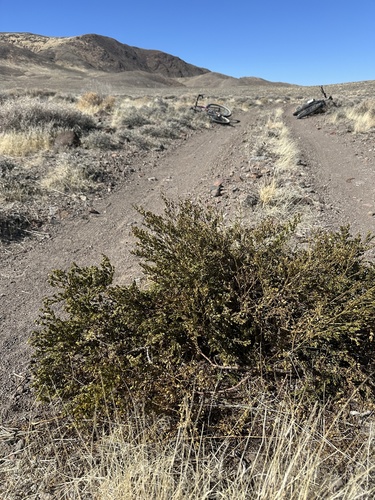
Larrea, Genus, tridentata, Species,
- Genus & species
creosote bush
Overview
Larrea tridentata is an evergreen shrub in the caltrop family, native to the deserts of southwestern North America, growing 3-10 feet (0.9-3 m) tall with many slender, flexible branches rising from the base. The small, resinous leaves are divided into two opposite leaflets joined at the base, each 0.2-0.7 inch (5-18 mm) long, olive to yellow-green and coated in a sticky resin that gives the plant a strong scent, sharpest after rain. From late winter into spring, and again after summer rains, it bears solitary yellow flowers 0.6-1 inch (1.5-2.5 cm) across with five petals that twist like a pinwheel; these are followed by small, rounded fruits densely covered in white to rusty hairs. The shrub spreads its roots widely and shallowly to capture scarce moisture, and it releases compounds that limit the growth of competing plants nearby, producing the evenly spaced stands typical of creosote flats. It tolerates extreme heat, drought, and poor, alkaline soils. Plants are very long-lived, and a clonal ring of this species in the Mojave Desert has been estimated at roughly 11,000 years old. The resinous foliage has a long record of use in traditional medicine across its range.
Native Range
Larrea tridentata is native to the hot deserts of southwestern North America, including the Mojave, Sonoran, and Chihuahuan deserts of the United States and Mexico. It grows on dry flats, slopes, and desert plains.Suggested Uses
Larrea tridentata is planted in desert and low-water landscapes in hot, arid regions for its evergreen, aromatic foliage and drought tolerance. It suits naturalistic plantings, erosion control on dry slopes, and gardens that mimic desert habitat. Its open form and wide roots make it a plant for spacious, well-drained sites.How to Identify
Appearance
Size & Dimensions
Height3' - 10'
Width/Spread3' - 8'
Bloom Information
Flowering occurs mainly from late winter into spring, with further flushes after summer monsoon rains. The yellow pinwheel flowers open across the shrub and are followed by fuzzy white to rusty fruit capsules. Bloom timing depends closely on rainfall rather than a fixed season.
Detailed Descriptions
Foliage Description
olive to yellow-greenGrowing Conditions
Sun Requirements
Requires 8-12 hours of direct sunlight daily
• Full Sun: 6+ hours of direct sunlight
• Partial Shade: 3-6 hours of direct sunlight
• Full Shade: Less than 3 hours of direct sunlight
Care & Maintenance
Care Guide
Larrea tridentata grows in full sun in dry, well-drained, sandy or gravelly desert soils and tolerates intense heat, drought, and alkaline ground. Once established it needs no supplemental water and grows slowly, drawing on a wide, shallow root system. It is sensitive to frost and to wet, poorly drained soils, which can rot the roots. In cultivation it suits low-water desert landscaping in hot, arid climates. The resinous foliage limits the growth of nearby plants, so it is usually given open space. Young plants establish slowly and take occasional deep watering in their first year.Pruning
Light pruning to shape the shrub or remove dead wood can be done in spring after the main flowering. The plant needs little pruning and keeps a naturally open, branched form. Hard cutting is rarely needed and slow to regrow in its dry habitat.Pruning Schedule
Prune: April–May
late spring
Container Growing
Suitable for container growing
Minimum container size: 5 gallons