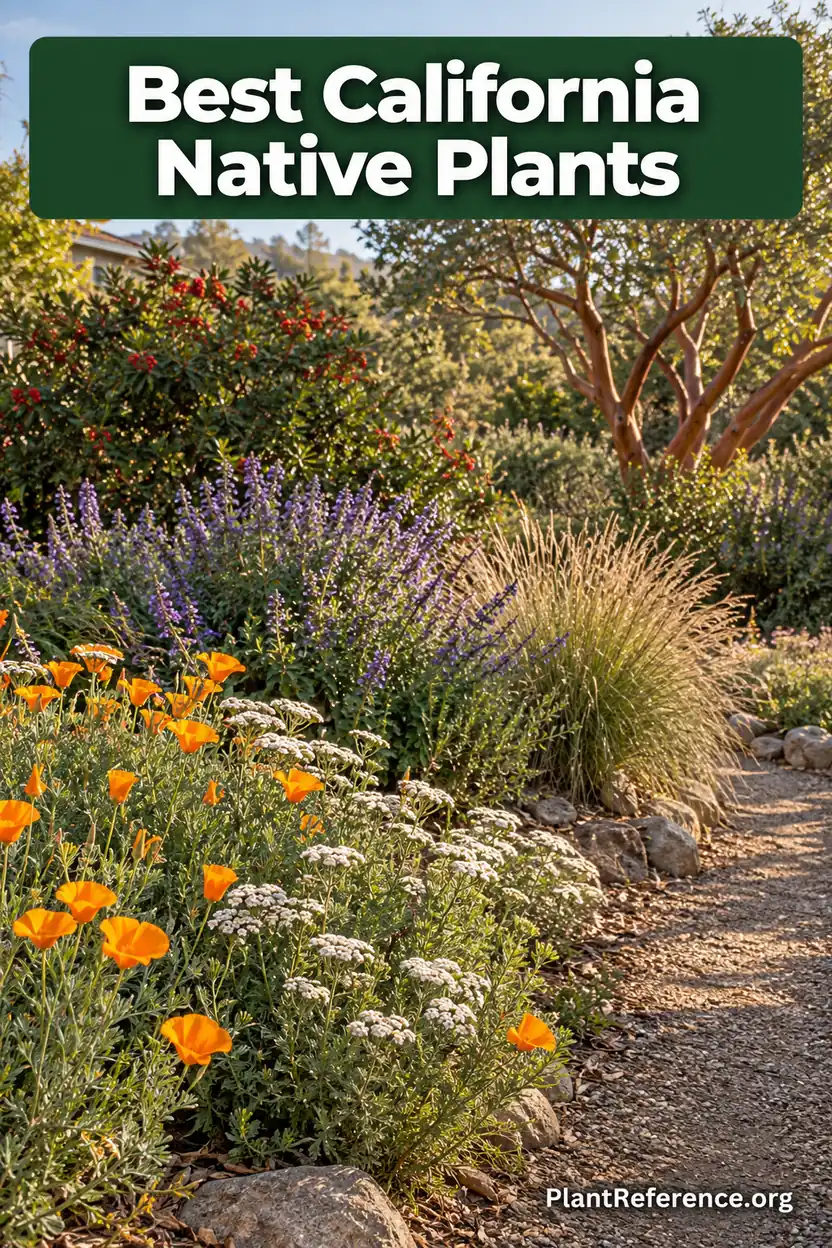
Best California Native Plants for Mediterranean Gardens
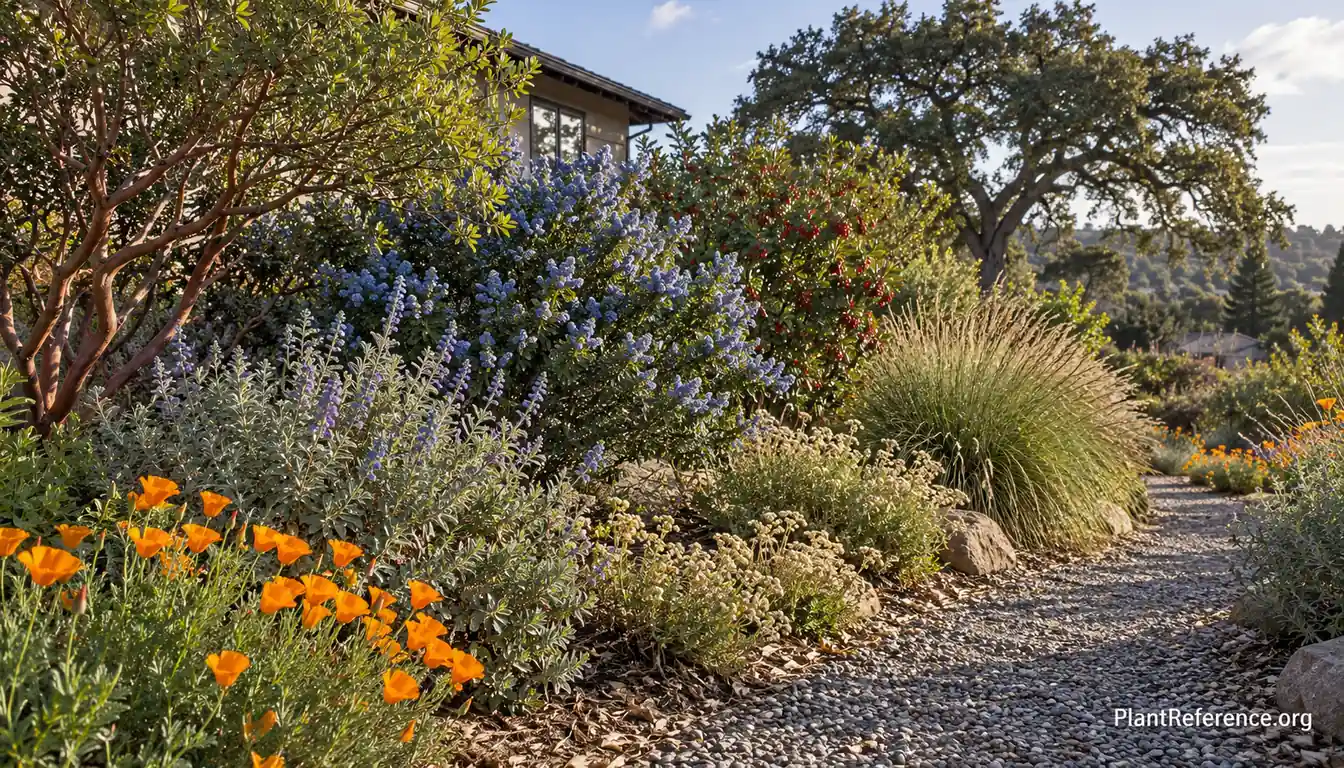
— Image © PlantReference.org 2026
Pets & Toxicity
Recorded toxicity for plants linked in this guide. An unknown status is not a safety assessment.
Toxic to pets: coast live oak, common yarrow, California poppyDetailsHide
Quercus agrifolia — Toxicity Warning
Toxic when leaves or acorns are eaten in quantity, especially by horses and grazing livestock; human ingestion toxicity is generally low.View Quercus agrifolia plant profileCalifornia native plants can make a beautiful drought-adapted garden, but "native" does not mean every plant belongs in every California yard. Coastal fog, inland heat, winter cold, soil depth, drainage, and local plant communities matter. Start with the site's conditions, then choose a compact palette that shares similar summer-water needs. That approach is calmer and more reliable than collecting attractive plants from unrelated habitats.
Design for California's Mediterranean Rainfall Pattern
Much of California has a Mediterranean climate: cool to mild rainy winters followed by warm to hot dry summers. Native plants often grow, flower, and root when moisture is available, then slow down or enter partial dormancy as soil dries. A yellowing leaf or quiet midsummer plant is not automatically failing. It may be following the seasonal pattern that lets it survive. Resist the urge to respond to every sign of summer rest with daily irrigation.
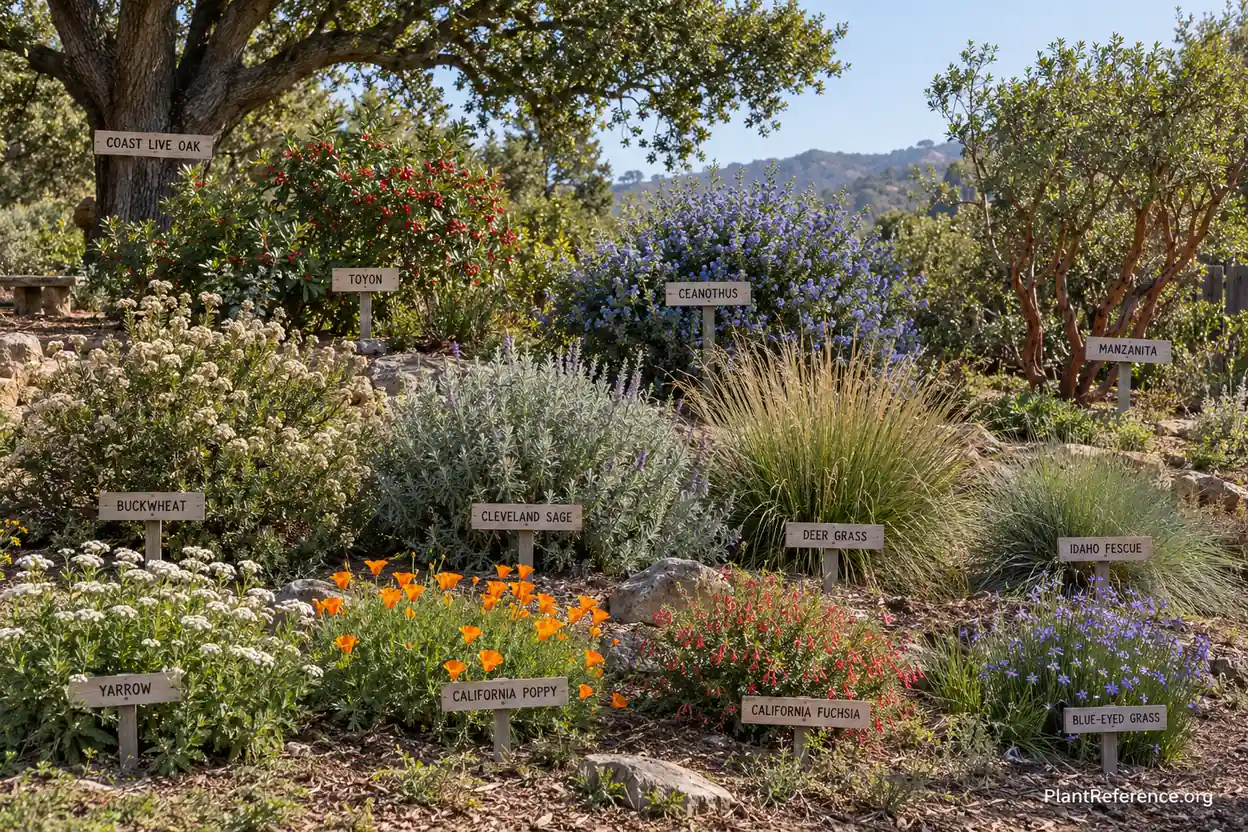
The climate label still covers very different gardens. A coastal site may have fog, mild temperatures, and sandy soil; an inland valley can experience intense heat and heavy clay; a foothill garden may freeze; a south-facing urban slope may reflect heat through the night. USDA Zones 8–10 describe minimum winter temperatures, not summer heat, drought duration, fog, or soil drainage. Use the zone as one filter, then confirm local habitat and exposure.
Begin by mapping sun, slope, drainage, and existing roots. Watch where winter rain moves and where puddles remain. Dig a hole 12 inches (30 cm) deep, fill it with water, let it drain, and fill it again to compare infiltration across the site. A plant from dry chaparral may tolerate lean soil but resent a low basin that stays wet. Poor Drainage in Raised Beds: Causes and Fixes for Waterlogged Soil focuses on constructed beds, yet its clues for compaction and perched water also help diagnose landscape soil.
Divide the garden into hydrozones. Put plants that accept occasional summer water near the house or vegetable area. Group highly drought-adapted chaparral shrubs farther from irrigation overspray. Keep lawn sprinklers away from coast live oak trunks. If one emitter must serve every plant, the design is not finished. Irrigation differences cause more trouble than a missing fertilizer schedule.
California natives also need intentional form. Repeat two or three shrubs, run a grass or ground-layer plant through several sections, and keep a clear path or low edge. This visual structure makes seasonal dormancy look purposeful. The regional logic differs from Pacific Northwest Native Plants: 10 Resilient Picks, where summer drought can matter but winter saturation and forest-edge conditions often dominate.
Compare 12 California Native Plants by Garden Role
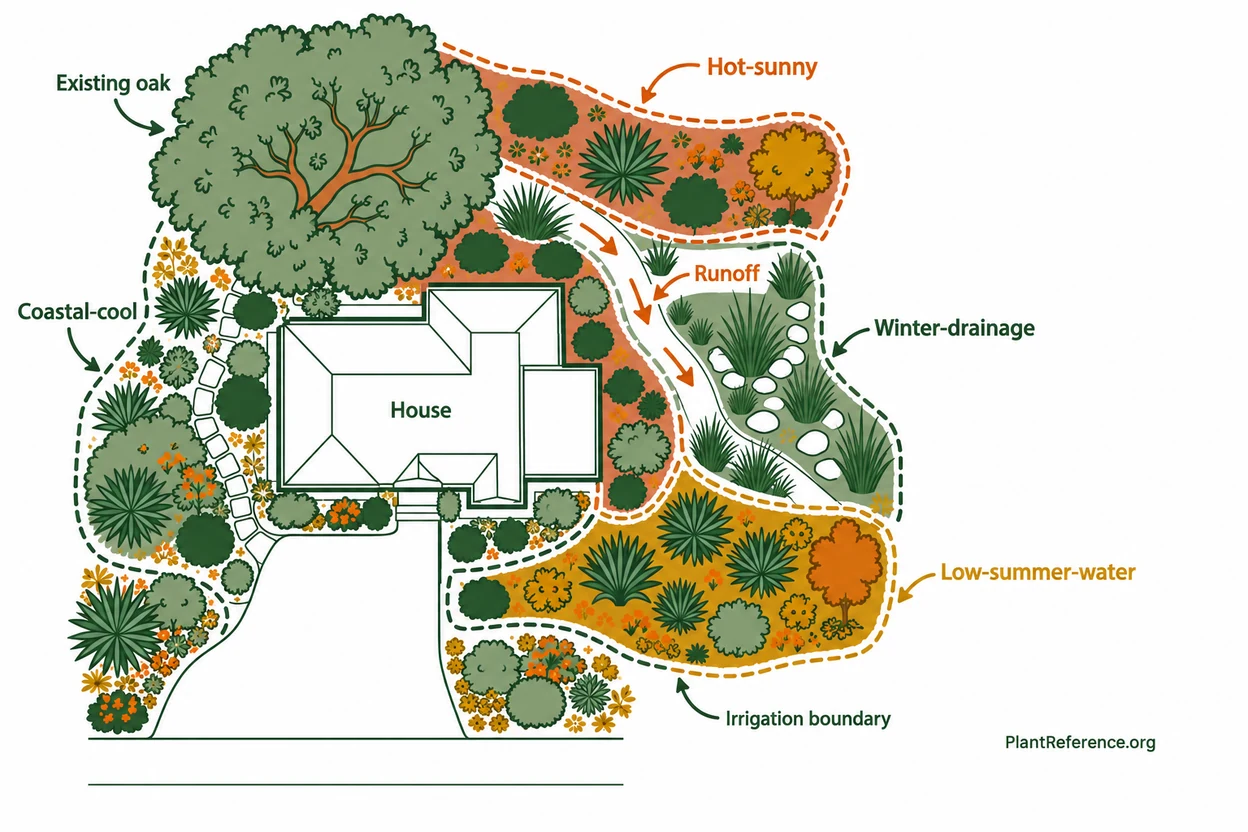
This list creates a layered starting palette rather than a statewide prescription. Confirm that each species is locally appropriate before planting near wildlands, and ask a native nursery about local provenance. Some plants span large areas; others come from narrower habitats. Mature width matters as much as height because drought-adapted shrubs often become broad, woody structures that should not be squeezed against a walkway.
No. | Native plant | Typical size | Water after establishment | Best design role |
|---|---|---|---|---|
1 | Coast live oak 🌿Quercus agrifolia | 30–70 ft (9–21 m) | Very low | Canopy and wildlife anchor |
2 | Toyon 🌿Heteromeles arbutifolia | 8–20 ft (2.4–6 m) | Low | Screen, small tree, winter fruit |
3 | Blueblossom 🌿Ceanothus thyrsiflorus | 6–20 ft (1.8–6 m) | Very low | Evergreen screen and spring bloom |
4 | Vine Hill manzanita 🌿Arctostaphylos densiflora | 3–6 ft (0.9–1.8 m) | Very low | Sculptural evergreen shrub |
5 | Dwarf coyote brush 🌿Baccharis pilularis | 1–3 ft (0.3–0.9 m) | Low | Bank cover and evergreen mass |
6 | California buckwheat 🌿Eriogonum fasciculatum | 1–4 ft (0.3–1.2 m) | Very low | Pollinator shrub and slope cover |
7 | Cleveland sage Salvia clevelandii | 3–5 ft (0.9–1.5 m) | Very low | Aromatic flower mass |
8 | Deer grass 🌿Muhlenbergia rigens | 4–5 ft (1.2–1.5 m) | Low | Upright grass structure |
9 | Idaho fescue 🌿Festuca idahoensis | 1–2 ft (0.3–0.6 m) | Low | Fine-textured grass matrix |
10 | Common yarrow 🌿Achillea millefolium | 1–3 ft (0.3–0.9 m) | Low to moderate | Spreading flower layer |
11 | California poppy 🌿Eschscholzia californica | 0.5–2 ft (15–60 cm) | Very low | Spring annual color |
12 | Fuchsia-flowered gooseberry 🌿Ribes speciosum | 4–8 ft (1.2–2.4 m) | Low | Part-shade hummingbird shrub |
Coast live oak 🌿Quercus agrifolia is a long-term canopy tree, not a quick shade accessory. Its broad crown and roots need generous space, and established trees should not receive routine summer water near the trunk. Plant one only where it can mature without severe pruning, foundation conflict, or overhead-wire interference. For the scale of soil required by large trees, see How Much Soil Do Urban Trees Actually Need? The Root Volume Guide.
Toyon 🌿Heteromeles arbutifolia is more adaptable in residential scale. It can be kept as a large shrub or trained gradually into a small multi-trunk tree. White summer flowers support insects, and red winter fruit feeds birds. Give it room rather than shearing it into a narrow box; dense exterior trimming hides dead interior growth and removes flowers. Place it where fallen fruit will not make a polished walkway frustrating.
Blueblossom 🌿Ceanothus thyrsiflorus provides evergreen mass and a striking spring display. It requires fast drainage and minimal water once established. Exact size differs among selections, so read the label carefully and format named choices correctly, such as Ceanothus thyrsiflorus 'Snow Flurry'. Manzanitas are equally variable. Vine Hill manzanita 🌿Arctostaphylos densiflora offers smooth red bark, pale urn-shaped flowers, and twisting branches, but it needs air movement and low summer moisture.
Dwarf coyote brush 🌿Baccharis pilularis and California buckwheat 🌿Eriogonum fasciculatum work closer to the ground. Coyote brush is valuable on banks and windy sites; male selections do not produce the cottony seed of female plants, though straight species plantings provide fuller ecological diversity. Buckwheat holds rounded flower clusters that age from white or pink toward rust and feed many small insects. Both look best when allowed to develop natural outlines.
Cleveland sage Salvia clevelandii delivers strong fragrance and violet-blue flower whorls. Place it in full sun with lean, quick-draining soil and enough room for air to move. Deer grass 🌿Muhlenbergia rigens creates a bold fountain of leaves and tall flower stalks. It tolerates more garden water than many chaparral shrubs, so it can occupy a transition between a lightly irrigated zone and the driest outer planting.
Idaho fescue 🌿Festuca idahoensis forms smaller blue-green clumps that can repeat through open areas, although it appreciates cooler conditions than the hottest inland desert edge. Common yarrow 🌿Achillea millefolium spreads more actively and accepts occasional summer water. Use it where that movement is helpful, not beside delicate miniature plants. Its flat flower heads support insects and connect spring annuals with later shrubs.
California poppy 🌿Eschscholzia californica fills winter-moist openings with spring color, then commonly dries or disappears as summer arrives. Scatter seed onto prepared soil before the rainy season and allow some heads to ripen. Fuchsia-flowered gooseberry 🌿Ribes speciosum belongs in part shade or the bright edge of an oak-like canopy. Its red dangling flowers attract hummingbirds, and its spiny stems make it a poor choice beside a narrow path.
Place Trees and Large Shrubs Before Smaller Plants
Start the plan at mature scale. Draw the eventual crown of coast live oak 🌿Quercus agrifolia, not the size of its nursery container. Keep it away from foundations, pavement, pools, and utilities by distances appropriate to the mature tree and local rules. If the property cannot accommodate a 30-foot (9 m) or broader crown, choose a smaller structure plant rather than planning to top an oak.
Preserve existing native oaks first. Avoid trenching, grade changes, paving, soil compaction, and frequent irrigation beneath their canopies. A mature oak's root system often extends beyond the drip line. New drought-adapted understory plants may be installed carefully outside sensitive root zones, but major excavation for irrigation is not an improvement. Consult a qualified arborist before changing drainage or hardscape around an established tree.
Place toyon 🌿Heteromeles arbutifolia where an 8–12 foot (2.4–3.7 m) shrub can screen a view or shelter smaller plants. If you want a small tree, begin structural pruning when it is young, selecting a few well-spaced trunks. Do not remove large portions at once. A natural multi-stem form handles wind and looks at home with chaparral companions.
Site blueblossom 🌿Ceanothus thyrsiflorus and vine Hill manzanita 🌿Arctostaphylos densiflora on well-drained ground where sprinklers will not soak them in hot weather. Their roots need oxygen. Amending one small hole with rich compost can create a moisture-holding pocket and discourage roots from moving into native soil. Plant into existing soil when feasible, correcting broad drainage problems rather than creating a luxury pot underground.
Use smaller plants to soften the spaces between these anchors. A repeated line of deer grass 🌿Muhlenbergia rigens can guide the eye without becoming a hedge. Buckwheat 🌿Eriogonum fasciculatum can occupy a dry slope below toyon, while yarrow 🌿Achillea millefolium belongs nearer occasional irrigation. The layering method in Plan a Perennial Garden That Blooms Spring to Fall helps organize color, but summer dormancy is part of this regional palette.
Build the Shrub, Grass, and Flower Layers
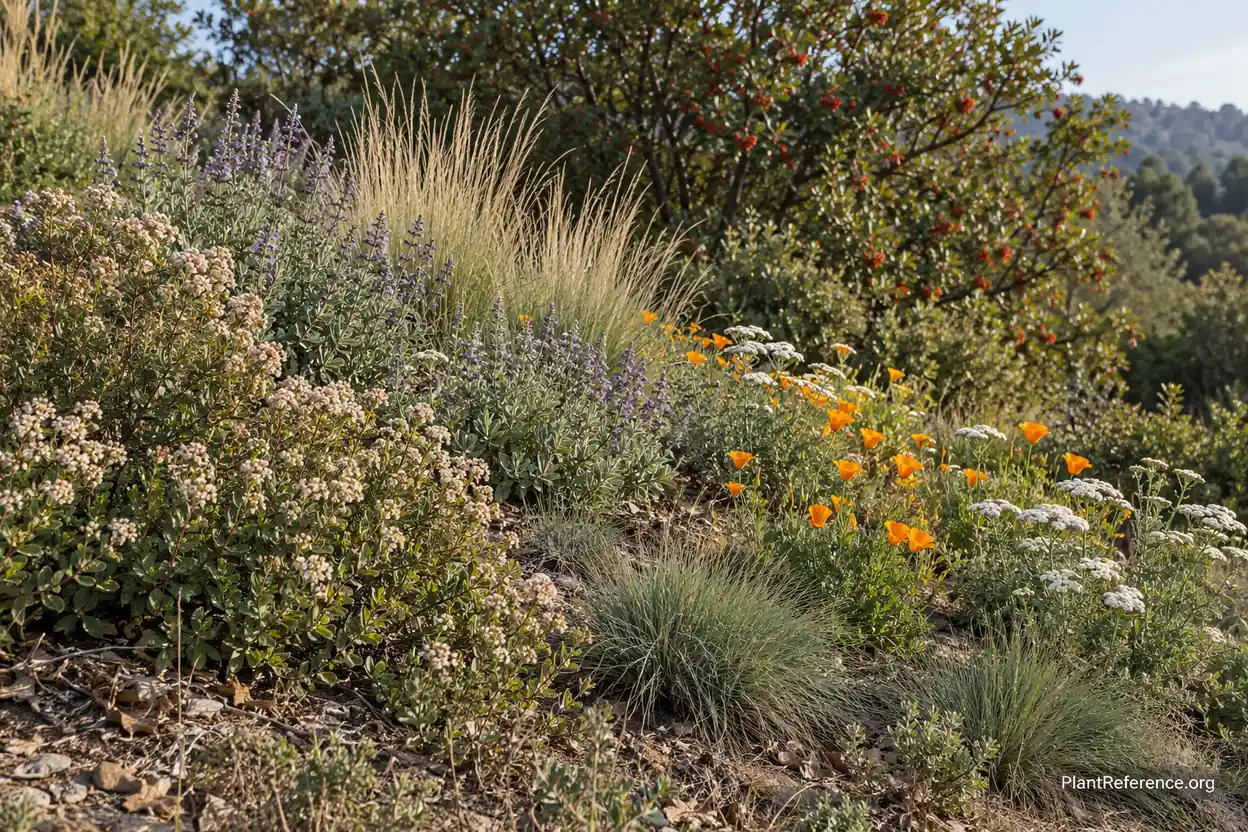
Think of the lower garden as a continuum from chaparral shrubs to open grassland, not a flat border with one of everything. Repeat three to five individuals of smaller plants and leave room around sculptural shrubs. California buckwheat 🌿Eriogonum fasciculatum, Cleveland sage Salvia clevelandii, and deer grass 🌿Muhlenbergia rigens create a durable sunny framework. Poppies and yarrow then move through the openings.
In the driest full-sun zone, combine buckwheat and sage with scattered manzanita. Their gray and deep green foliage remains visually useful after spring bloom. Use mineral gravel sparingly where it suits the site, keeping it shallow and away from trunks. Do not install impermeable plastic weed barrier under the whole bed; it blocks organic exchange, complicates reseeding, and eventually fills with weeds rooted above the fabric.
In a lightly watered transition zone, deer grass and yarrow accept occasional deep irrigation. A broad drift of common yarrow 🌿Achillea millefolium can replace a strip of lawn, but it will not behave like a clipped sports turf. Mow or cut it selectively if you want a lower surface. Lawn Alternatives That Actually Work: 5 Options Beyond Grass compares the appearance and maintenance expectations of these living replacements.
In a cooler grassland expression, repeat Idaho fescue 🌿Festuca idahoensis with seasonal California poppy 🌿Eschscholzia californica. The fescue provides fine permanent texture while poppies claim the winter-moist gaps. Let fallen leaves remain lightly between plants where fire guidance allows, but remove thick mats that smother seedlings. The planting should show some ground; Mediterranean vegetation is not always a solid carpet.
For part shade, use fuchsia-flowered gooseberry 🌿Ribes speciosum beyond the reach of passing arms and pair it with locally appropriate woodland ground plants from a native nursery. Keep irrigation modest and separate from the dry chaparral zone. The shaded side of a wall may retain moisture far longer than a sunny bank only 20 feet (6 m) away, which is why a single watering schedule fails.
Color peaks in spring, while foliage, bark, seedheads, and form carry the remaining seasons. Blue ceanothus, orange poppies, red gooseberry flowers, white yarrow, and purple sage do not need to bloom simultaneously. Let one wave hand off to the next. Dry buckwheat heads and tawny grasses can remain through summer if they are safely spaced and not collecting against structures.
Check soil pH only when plant symptoms or unusual fill soil justify it. Most native gardens do not need routine acidifiers or lime. The bigger variables are drainage, root oxygen, and water frequency. If a test reveals a real problem, use the measured approach in Raised Bed Soil pH Problems: Testing, Adjusting, and Maintaining Balance instead of applying amendments by habit.
Plant in the Cool Season and Establish Deep Roots
Autumn through winter is the main planting window in Mediterranean California, timed so rain and cool soil help roots expand before summer heat. Exact timing depends on elevation, frost, and the arrival of meaningful rain. Do not plant waterlogged clay, and do not rush a heat-stressed shrub into dry ground during an autumn hot spell. A calm, cool stretch with workable soil is more useful than a date on a calendar.
Water nursery plants thoroughly before installation. Dig a hole no deeper than the root ball and about twice as wide where soil allows. Roughen glazed sides in heavy clay. Set the root flare or crown at grade or slightly high on slow-draining ground. Backfill with the excavated soil, water slowly to settle it, and avoid stomping the root zone into a compacted bowl.
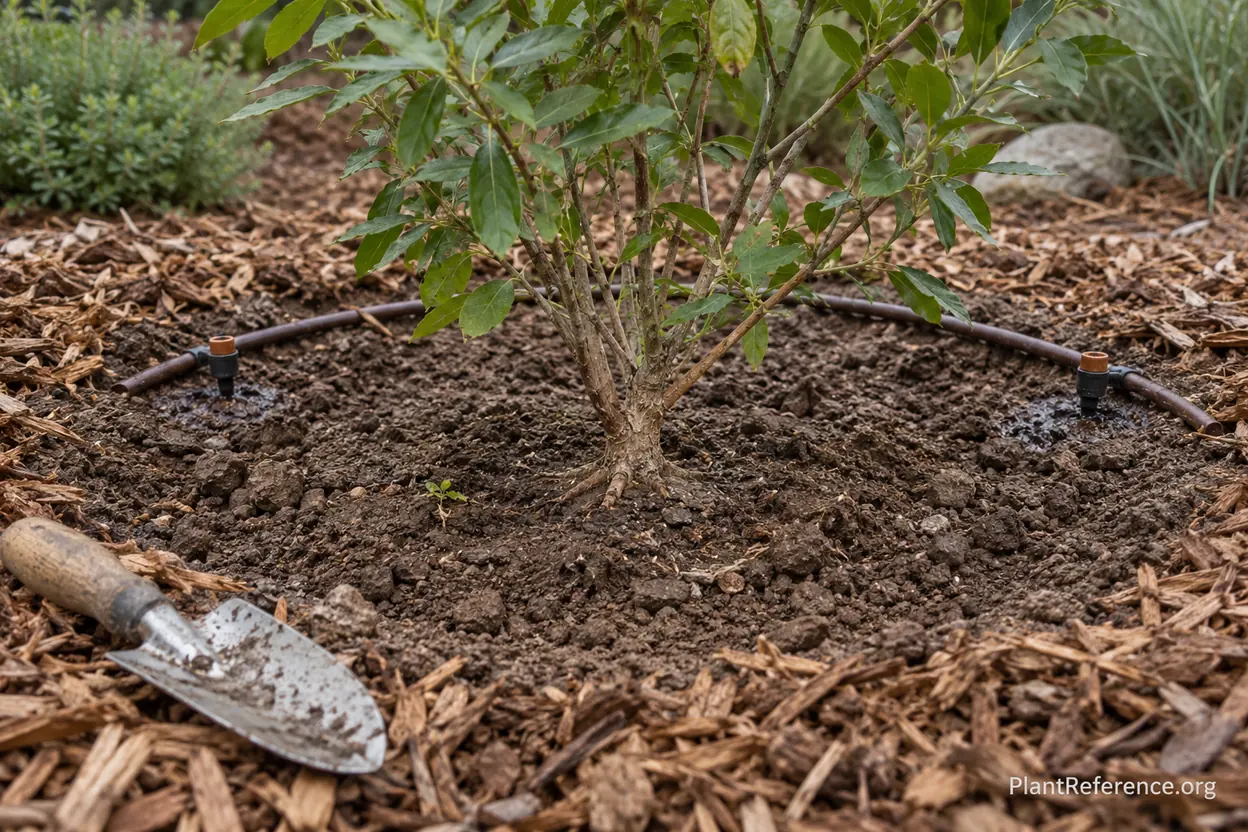
Inspect circling roots. Tease fine roots outward and make limited vertical cuts in a severely matted container root ball, taking care with brittle-rooted species. Do not bury the trunk or mound mulch against stems. Apply 2–3 inches (5–8 cm) of arborist wood chips around compatible new plants, leaving a 4–6 inch (10–15 cm) open collar. Keep dry chaparral crowns especially clear and do not cover seeded poppy areas with coarse mulch.
New natives are not drought-proof. Through the first rainy season, track actual rainfall and water deeply when the root ball begins to dry. During the first summer, many plants need periodic irrigation, but frequency depends on soil, exposure, plant type, and weather. Check moisture several inches down rather than watering because the surface looks pale. Deep, separated soakings encourage roots to move outward; frequent sips keep them near the trunk.
Extend emitters as the root system grows. A single dripper at the stem wets a tiny column and can keep the crown too moist. Use two or more low-flow emitters around a shrub or a short loop of inline drip, placed toward the expanding root zone. On slopes, run shorter cycles with pauses to prevent runoff. Container Gardening: Pots, Soil, Water & Yields addresses confined roots, but its principle of checking the root zone rather than following a blind calendar applies here too.
Expect a settling-in period. Some plants put energy into roots and add little top growth during the first year. California poppy 🌿Eschscholzia californica may provide fast color while manzanita develops slowly. Do not force woody natives with high-nitrogen fertilizer. New soft growth can demand more water and distort their natural form. A modest garden that establishes well is better than a lush first-year display dependent on permanent irrigation.
Manage Summer Water, Pruning, and Fire Awareness
"Never water natives in July" is too blunt. A plant installed the previous winter may still need summer support; yarrow and deer grass tolerate more moisture than mature ceanothus or manzanita; coastal conditions differ from inland heat. The useful rule is to separate hydrozones, water deeply only when the root zone needs it, and allow drought-adapted soil to dry between applications. Warm, continuously moist soil can favor root disease in chaparral shrubs.
Check plants early in the morning. Folded or dull leaves, premature leaf drop, and very dry soil at depth may indicate stress, but species differ. Use a trowel or moisture probe 4–6 inches (10–15 cm) from the crown, then check farther out. A wet root ball with wilting foliage can mean root damage, not thirst. Adding more water to oxygen-starved roots makes the problem worse.
Prune lightly and with a reason. Remove dead, broken, rubbing, or hazardous growth; thin to improve access; and shape young toyon gradually. Avoid shearing ceanothus, manzanita, and sage into tight geometric forms. Do not cut old woody sage stems without confirming live buds below. Work after bloom or during the species-appropriate cool season, and never remove more foliage than a stressed plant can replace.
Summer dormancy can look untidy. California poppy 🌿Eschscholzia californica dries after seed ripens, some sages shed leaves, and grasses turn straw-colored. Cut annual remains only after enough seed has fallen, and leave selected seedheads for wildlife where safe. Clean around paths, structures, and ignition zones first. A defined edge lets the interior remain seasonal without appearing abandoned.
Fire-aware landscaping is a design and maintenance practice, not a list of "fireproof" plants. Follow current local rules for defensible space, access, and vegetation separation. Remove dead material near structures, keep roofs and gutters clean, prune branches away from buildings, and avoid continuous fuels that connect low plants to shrub crowns. Irrigated succulents can still carry dry litter; native shrubs can still burn. Placement and maintenance determine risk.
Reassess each autumn. Replace plants that repeatedly need more summer water than their neighbors, widen irrigation rings for young shrubs, remove volunteer seedlings from narrow paths, and renew mulch only where it has thinned. Prepare for the first rains by checking emitters and drainage, not by fertilizing. The seasonal preparation ideas in How to Prepare Perennial Gardens for Winter by Species can be adapted, but California's cool wet season is the beginning of growth for many natives, not the end.
A successful Mediterranean garden becomes easier, not thirstier, with age. The goal is not a permanently green English border, but a landscape suited to winter rain and summer dryness.
Frequently Asked Questions
Reading about plants and recognising them are different skills. These three build the second.
- Daily PlantIdentify the day’s mystery plant from a close-up photograph.
- Keyed OutWork a dichotomous key, lead by lead, to name a hidden specimen.
- Name That PlantName a specimen from botanical clues dealt hardest first.
Free to play, no account needed
Tagged with
Emma runs a small succulent propagation business from her home in San Diego, shipping starter plants and cuttings across the country. She fell into succulents after college when she realized they were the only plants that survived her travel schedule—she was working as a travel nurse at the time. San Diego's mild, dry climate is ideal for outdoor succulent gardens, and Emma's front yard is a living catalog of over 200 varieties. She completed a certificate program in ornamental horticulture and writes about succulent care, propagation techniques, and drought-tolerant garden design. Her writing is calm and reassuring—she knows people feel bad about killing plants, and she wants them to stop worrying so much.